South Korea in 2026 is worth visiting for the food, the palaces, the coastline at Busan, and the ancient capital at Gyeongju. It is also, at current exchange rates, considerably cheaper than Japan for equivalent quality. South Korea surpassed 10 million international visitors by June 2026, arriving approximately a month earlier than the previous year — a 23% year-on-year increase in Q1 alone (Korea Tourism Organization). Most of those visitors spend the majority of their time in Seoul. Most of them should also go to Busan.
Most people who visit South Korea for the first time go because they watched something on Netflix or attended a concert. Most people who visit for the second time go because of the food. Both are legitimate reasons. The second reason is the better predictor of whether the trip delivered what it actually could have.
South Korea is not Japan adjacent. It is a separate country with a separate culture, a separate food tradition that is nothing like Japanese food, and a separate reason to visit that has nothing to do with proximity. The confusion about this appears to be persistent in Western travel writing and is worth correcting before arrival, because the visitor who arrives expecting Japan with Korean subtitles will find something considerably more interesting and considerably more its own thing.
What is South Korea actually for?
It is for several things that are not the first things usually listed: the late-night pojangmacha street stalls, the jjimjilbang (communal bathhouse) as a social institution, the palaces that put most European counterparts to scale, the fish markets at Busan, the stone pagodas and Silla dynasty tombs at Gyeongju, and the particular quality of Korean fried chicken eaten at a plastic table at midnight. K-culture — the music, the television, the beauty products — is a legitimate draw and an accurate reflection of a country that produces these things at a global level of quality. It is not the whole reason to go.
The food is the best single reason. Korean cuisine in Korea — not the internationalized versions available elsewhere — is serious, varied, and delivered at a price that makes the experience accessible at every budget level. The banchan system (the small side dishes that arrive automatically with a meal), the specific quality of a Korean barbecue where the meat is marinated and grilled tableside over charcoal, the naengmyeon (cold buckwheat noodles in a beef broth) on a summer day — these are not versions of other things. They are themselves.
Seoul or Busan — where should you spend your time?
Both. The standard allocation of six to seven Seoul nights and zero Busan nights is not the correct answer.
| City | Best for | Days needed | Food signature | Crowd level |
|---|---|---|---|---|
| Seoul | Palaces, markets, K-culture, shopping | 4–5 | Gwangjang tteokbokki, samgyeopsal, cold noodles | Very high at headline sites |
| Busan | Coast, fish markets, hillside villages | 2–3 | Dwaeji gukbap (pork rice soup), raw fish, Millak seafood | High in summer, manageable |
| Gyeongju | Silla dynasty history, pagodas, cycling | 1–2 | Local bibimbap, rice wine | Low |
| Jeju Island | Volcanic landscape, coastal walks, lava tubes | 2–3 | Black pork, abalone, Jeju citrus | Peak in summer |
Sources: Korea Tourism Organization (visitkorea.or.kr) 2026 visitor data; MICE Travel Advisor Q1 2026
Busan is a three-hour journey from Seoul by KTX high-speed rail — approximately ₩59,800 one way — and covers a different version of Korea that the capital does not provide: a port city, a fish market culture, a coastline that genuinely explains why the country has a seafood tradition of this quality. Two nights minimum. Three is better.
Gyeongju, the ancient Silla dynasty capital, sits between Seoul and Busan and is easily added as a one-night stop on the way south. The density of UNESCO-listed historic sites here — royal tombs the size of small hills, stone pagodas, the Bulguksa temple complex — is extraordinary for a city of this size and visitor volume. It receives a fraction of Busan’s international tourist numbers and delivers, for those who arrive with some preparation for what they are looking at, one of the more satisfying days available in the country.
What should you actually do in Seoul?
Seoul is one of the world’s largest cities and does not need to be explained through its most-photographed streets. The experience of understanding what the city is — a place that was almost entirely destroyed in the Korean War (1950–53) and rebuilt from near-zero into a global capital in under fifty years — reorganises how everything else reads.
The palaces and when to visit them
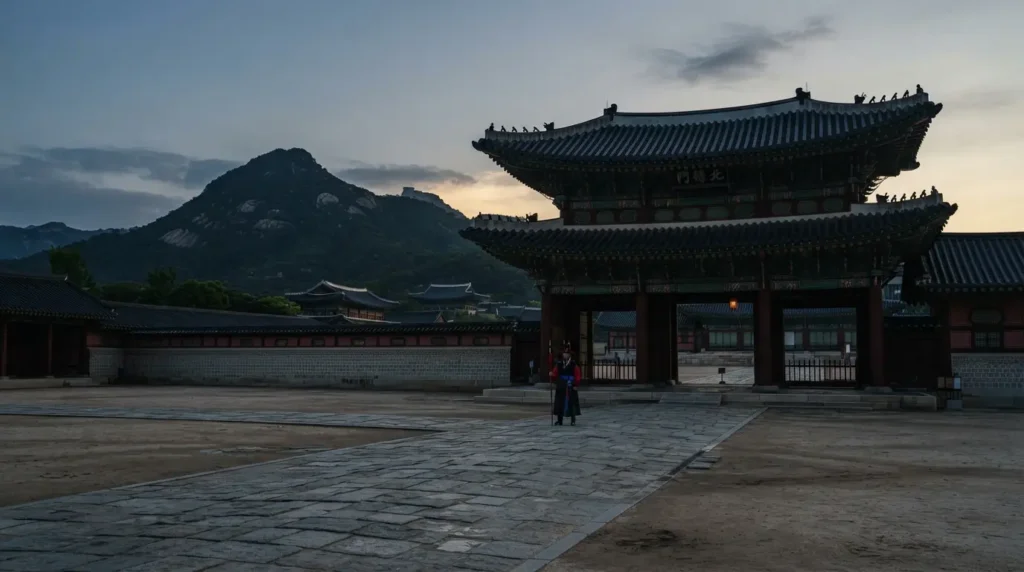
Gyeongbokgung, the largest of Seoul’s five Joseon dynasty palaces, is where most first-time visitors start. Arrive before the gates open at 9am and you will find the main courtyard largely empty. By 10am the palace is filling; by noon the Bukchon Hanok Village immediately to the east — a residential neighbourhood of preserved traditional Korean houses that has become one of Seoul’s most photographed spots — is at density levels that make walking through it a slow single-file exercise. Both Gyeongbokgung and Bukchon Hanok Village are worth the early start and substantially worse at any other time of the day during peak season.
Changdeokgung Palace, a short walk east, is arguably more beautiful than Gyeongbokgung — particularly its Secret Garden (Huwon), a forest garden of pavilions and ponds that requires a separate timed entry ticket. Book the Secret Garden access in advance through the official booking system. The Changgyeonggung and Deoksugung palaces are less visited and worth an afternoon each.
A Seoul palace and Bukchon Hanok Village walking tour starting at opening time covers the correct sequence efficiently.
The markets
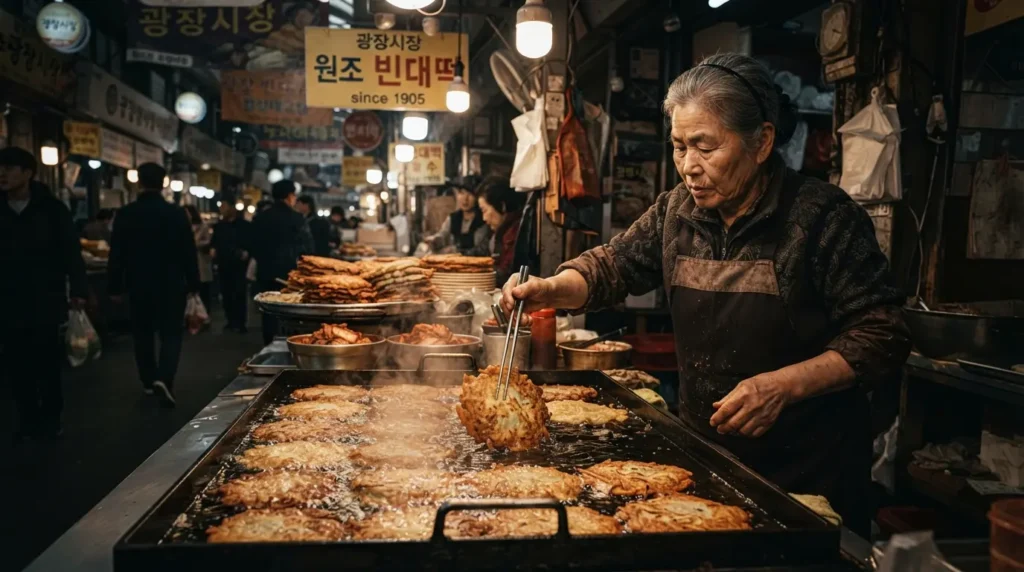
Gwangjang Market is the correct food market. It operates during daylight hours and has been producing the same specific set of cooked foods since 1905: bindaetteok (mung bean pancakes), mayak gimbap (small seaweed rice rolls), and tteokbokki (rice cakes in red pepper sauce) at vendors who have worked the same stall for decades. This is the version of Korean street food that predates the Instagram version by about eighty years. A Gwangjang Market and Korean street food tour covers the correct stalls and provides context for the food that the stalls themselves do not explain in English.
Mangwon Market in Mapo-gu is the neighbourhood equivalent — smaller, less touristed, operating for the people who live around it rather than for visitors, with an excellent range of prepared foods. Worth a morning visit before heading west to Hongdae.
Hongdae vs Gangnam — where to base yourself
Hongdae, in the university district, is the correct base for most international visitors: walkable, well-connected by metro to the palaces and Gwangjang, and operating at a human scale. Gangnam — the wealthier southern district, internationally known from the song — is more expensive, more spread out, and less useful as a walking base. It is not a reason to stay south of the river on a first visit.
Why does Busan deserve more time than most itineraries give it?
Because it is a different country from Seoul, and most travellers do not realise this before they leave.
Busan’s character comes from being a port — the largest in South Korea, one of the busiest container ports in the world — and from the culture that a working port generates. The fish is fresh in a way that is not available in the capital. The food is different: dwaeji gukbap, a pork bone broth soup eaten for breakfast in the soup restaurants of Seomyeon, is specific to Busan and not available in the same form anywhere else. The Jagalchi fish market is the country’s largest and most characteristic, a covered indoor market where the catch is sold live and then prepared on the spot in the eating area upstairs.
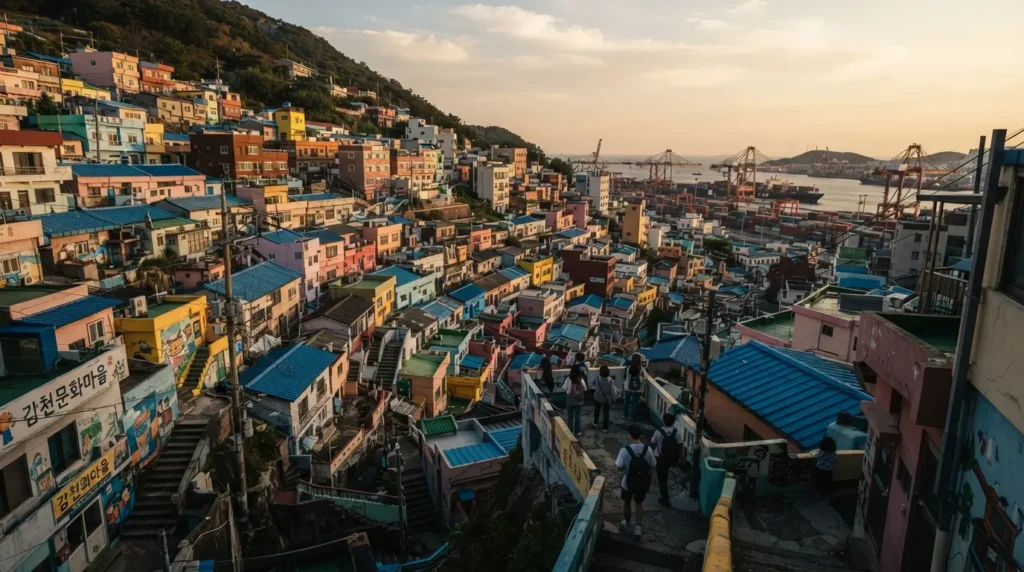
Gamcheon Culture Village, on the hillside above the port, is a former shantytown painted in vivid colours that has been converted into a neighbourhood of small galleries, cafés and lookout points. The photographs of it are accurate — it looks like a Korean version of a hillside Brazilian favela, without the context being comparable. It is genuinely worth half a day. Go in the morning and leave before noon when the walking tour groups arrive.
Haeundae beach, Busan’s main beach, is long, sandy and extremely busy in July and August. The water is swimmable and the setting, with the city behind and the mountains visible at each end of the bay, is genuinely impressive. Visit in the morning or the evening; the middle of the day in summer is not when beaches anywhere in Korea are at their best.
How does South Korea compare to Japan for cost in 2026?
Significantly cheaper, across most categories. A mid-range hotel in Seoul runs ₩100,000–180,000 per night (approximately £58–105) compared with ¥15,000–25,000 (£75–125) in Tokyo for equivalent quality. A meal at a Korean barbecue restaurant costs ₩15,000–30,000 per person (£9–18); the equivalent experience in Japan costs ¥3,000–6,000 (£15–30). Public transport — including the KTX high-speed rail between Seoul and Busan — is priced at a level that makes moving around the country affordable.
The key comparison for the Asia trip decision: South Korea and Japan share some characteristics (dense urban culture, exceptional food, excellent public transport, significant history, high safety) but are not interchangeable. Korea is louder, more direct in social interaction, cheaper, and has a food culture that is more varied and spicier. Japan is more precise, more expensive, and has a particular aesthetic discipline that Korea does not replicate. Both are worth visiting and are different enough that doing both on a longer trip — Seoul to Tokyo by flight is about two and a half hours — covers more of Asia’s range than either alone.
Our Japan 10-day itinerary covers how to build a Japan trip correctly; the Korea-Japan combination is the natural extension.
When is the best time to visit South Korea in 2026?
April to June and September to November. Both shoulder seasons deliver mild temperatures (15–24°C), manageable crowds, and the two most visually distinctive seasons in the country.
Spring (April to early June) brings cherry blossoms, which in Korea peak slightly later than Japan’s — typically in Seoul in early to mid-April and in Gyeongju around the same time. The cherry blossoms along the Yeouiseo-ro riverside road in Seoul and the Bomun Lake circuit in Gyeongju are both excellent and considerably less crowded than equivalent sights in Japan.
Autumn (September to November) delivers the red and gold foliage that Korea’s mountain landscapes are particularly suited for, along with the country’s harvest season food culture. The autumn palaces — Changdeokgung’s Secret Garden in October, Bulguksa temple at Gyeongju in early November — are the best version of those sites.
Summer (June to August) is hot and humid, with monsoon rains in July. The beaches at Busan and Jeju are at full capacity. The palaces are bearable only with early starts. South Korea in July and August requires the same early-morning strategy as Rome in July, applied consistently. You can plan your Korea itinerary on PlacesToday around your specific dates and what you want from the trip.
Frequently asked questions
Q: How many days do you need in South Korea?
A: Ten days is the correct allocation for a first trip that covers Seoul, Busan and Gyeongju without rushing any of them. Seven days is the minimum for Seoul and Busan with one day at Gyeongju en route. Anything under five days reduces to Seoul only, which is a valid trip but leaves Busan — the element most visitors say they wished they had more time for — either out or underserved.
Q: Is South Korea cheaper than Japan?
A: Yes, by a meaningful margin. Mid-range hotels run 20–30% cheaper than equivalent quality in Tokyo. Meals are 30–50% cheaper at comparable restaurants. Transport, including the high-speed KTX rail, is priced lower than the Shinkansen. The exchange rate varies, but the structural cost difference between the two countries is consistent. Both are significantly cheaper than equivalent Western European city trips.
Q: What is the best way to get between Seoul and Busan?
A: The KTX high-speed rail from Seoul Station to Busan Station takes approximately two hours and twenty minutes and costs around ₩59,800 one way (approximately £35). Book through Korail’s official website or at the station. The train is comfortable, reliable, and substantially faster than flying when airport transfer times are included.
Q: Is South Korea safe to visit?
A: Yes — South Korea consistently ranks among the safest countries in Asia for international visitors. Crime against tourists is very low. The main practical concern for visitors is the military situation on the Korean peninsula, which has been a constant background condition for decades and does not materially affect the experience of visiting Seoul, Busan or Jeju. Check current government travel advisories before departure. Standard travel precautions apply as in any destination.
Q: Is the K-culture tourism experience worth it?
A: Yes, if it is specifically what you came for. SMTOWN COEX Artium (the SM Entertainment museum in Gangnam), the BTS-associated sites around Yongsan and the Han River, and the Hallyu Star Walk in Cheongdam-dong are all functional and accessible. The more interesting observation is that most visitors who arrive primarily for K-culture leave primarily interested in the food and the palaces, which were not the original plan. Both experiences are available. The country accommodates both without conflict.
South Korea in 2026 is operating at a scale that makes its tourism credentials self-evident. The numbers — 10 million international arrivals in six months, the highest Q1 in the country’s history — reflect a destination that has moved from regional travel circuit to global bucket list. The case for going is the food, the palaces, the coast at Busan, and the value proposition versus comparable Asian destinations. The case for going soon is that the quiet version of these things still exists, in the palaces before 9am and in Gyeongju on a Tuesday in October, and it may not for much longer. Plan your South Korea trip on PlacesToday →