New Zealand is worth visiting for Milford Sound, which is the most dramatic fjord accessible by road in the world; for the Tongariro Alpine Crossing, which is the finest single-day hike in the Southern Hemisphere; for the Marlborough Sauvignon Blanc and the Central Otago Pinot Noir, which are the correct wines to drink in the correct country; and for the specific quality of the light and the scale of the landscape, which no photograph adequately communicates. October to April is the correct window for most visitors. A self-drive trip — either in a rental car with accommodation booked in advance, or in a campervan — is how the country makes most sense. Two weeks covers both islands with enough time to stop for the right reasons.
New Zealand is the last major landmass on earth to have been settled by humans. The Polynesian voyagers who became the Māori arrived approximately 700 years ago, navigating by stars across the Pacific. Europeans arrived 200 years after that. Before either, the islands had evolved in complete isolation for 80 million years — separated from the Gondwana supercontinent with no land predators, producing bird species that had no reason to fly, plants that had no reason to defend themselves, and ecological systems of extraordinary fragility and beauty that were then immediately pressured by the arrival of both human cultures. The land that remains — the fjords of Fiordland, the volcanic plateau of the central North Island, the glacial lakes of the Southern Alps — is what survived the collision of that isolation with the outside world.
This context matters because it changes what the landscape means. The kiwi bird did not evolve to be curious and ground-dwelling because of a design error. It evolved that way because nothing was going to eat it, for millions of years, until something did. The rimu and kauri forests did not evolve thorns or toxins because nothing was going to eat them, either. Understanding this — understanding that New Zealand is a place where evolution took a completely different set of decisions because the pressures were completely different — is what elevates a landscape trip into something more interesting than scenic driving.
Is New Zealand worth the flight?
Yes, and the flight is genuinely long. From the UK, a direct route to Auckland takes approximately twenty-four hours and involves at least one stop; from the US West Coast, approximately twelve hours direct to Auckland or Christchurch. The distance is real and the jet lag is significant — plan one or two days of slower activity on arrival before beginning the serious hiking or driving schedule.
What New Zealand provides in return: landscape variety within a relatively small area, a country that is fundamentally safe and functional for self-drive travel, a hiking trail network (the Great Walks) that is among the best-maintained in the world, and a food and wine culture that punches well above its population size. It is the trip most people put off indefinitely and then describe as one of their best when they eventually go.
How do you structure a New Zealand trip?
The two islands are different enough to be separate trips combined into one.
| Region | Island | Days | Best for | Key experience |
|---|---|---|---|---|
| Auckland | North | 1–2 | Arrival base, Waiheke Island wine | Waiheke Island day trip; Viaduct Harbour |
| Bay of Islands | North | 2 | History, sailing, beaches | Waitangi Treaty Grounds; Russell; sailing |
| Rotorua | North | 2 | Geothermal, Māori culture | Te Puia Pohutu Geyser; Hāngi dinner |
| Tongariro / Taupo | North | 2 | Volcanic plateau, Alpine Crossing | Tongariro Alpine Crossing (8 hrs) |
| Wellington | North | 1–2 | Capital, Te Papa, food, film | Te Papa Museum; Weta Workshop |
| Marlborough / Nelson | South | 1–2 | Wine, Sounds, coast | Sauvignon Blanc at source; Abel Tasman |
| Queenstown | South | 2–3 | Adventure, Milford Sound base | Milford Sound; Remarkables; bungee |
| Milford Sound / Fiordland | South | 1 | The fjord | Milford Sound boat cruise |
| Franz Josef / Fox | South | 1 | Glaciers | Glacier heli-hike |
Sources: Tourism New Zealand (newzealand.com); tourism industry expert consensus; Lonely Planet New Zealand 2026
Fourteen days covers both islands in a manageable sequence: fly into Auckland, drive or fly down the North Island (Bay of Islands, Rotorua, Tongariro, Wellington), fly or take the Interislander ferry to the South Island (Christchurch, Kaikōura for whale watching, Marlborough wine region, Queenstown, Milford Sound), and fly home from Queenstown or Christchurch. Two weeks is the minimum for this. Three weeks gives everything more room.
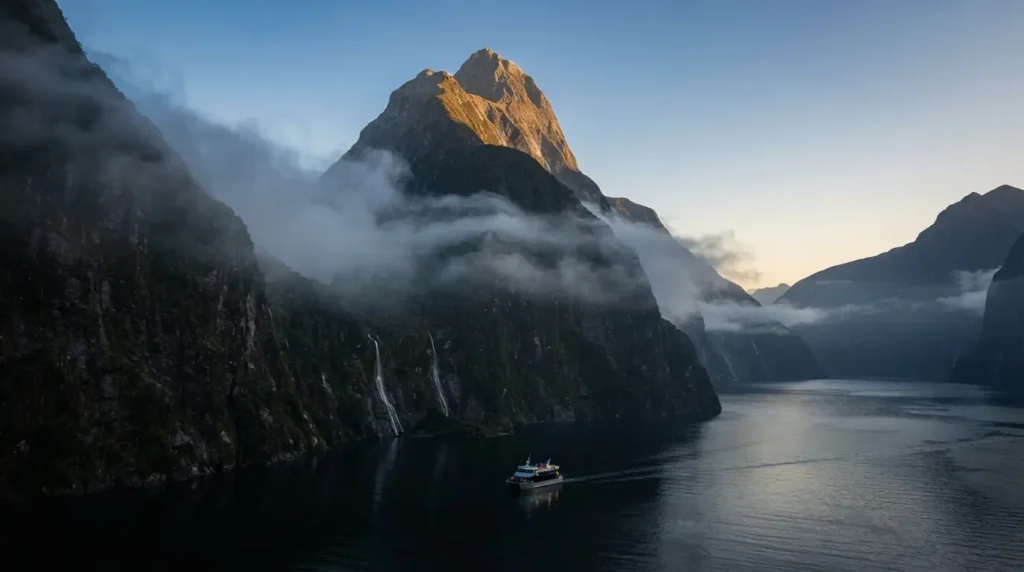
What makes Milford Sound the reason to go to the South Island?
Milford Sound is a fjord — technically a fiord — in Fiordland National Park in the southwest corner of the South Island. It is accessible by a 120-kilometre road from Te Anau through rainforest and then the Homer Tunnel, a single-lane unlit tunnel carved through the mountain. The road is not for people who find narrow mountain roads alarming in poor conditions.
The fjord itself is the most visited tourist destination in New Zealand and the reason is not complicated. Mitre Peak rises 1,692 metres directly from the water — the highest such cliff face accessible by boat in the world. The walls of the fjord are near-vertical granite, covered in hanging rainforest that falls straight to the water. Waterfalls appear everywhere when it has rained, which is frequently — Milford receives approximately 7,000 millimetres of rainfall per year, making it one of the wettest places on earth. On a clear day, the scale is extraordinary. On a rainy day, the waterfalls appear and the mist gives the cliffs additional depth. Both versions are worth seeing.
A boat cruise on Milford Sound — from one of the multiple operators at the Milford Sound wharf — runs two hours and covers the length of the fjord and back. The morning cruises depart before the road bus tours arrive and are generally less crowded. A Milford Sound scenic cruise from the Milford Sound visitor terminal is the correct way to see the fjord — on the water, not from the road above it.
Stay one night in Te Anau rather than attempting the Milford road as a day trip from Queenstown (three hours each way minimum). The dawn at Milford Sound, before the day-trippers arrive, is the version that stays.
What is the Tongariro Alpine Crossing and who should do it?
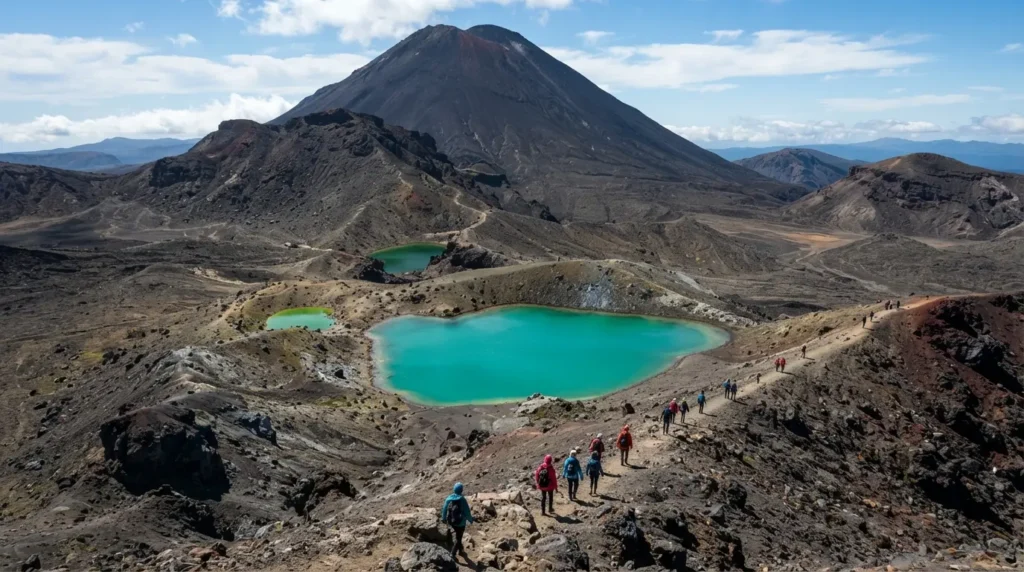
The Tongariro Alpine Crossing is a 19.4-kilometre day hike across the volcanic plateau of Tongariro National Park in the central North Island, crossing between three active volcanoes — Tongariro, Ngauruhoe and Ruapehu — and passing the Emerald Lakes, which are crater lakes of vivid turquoise and green coloured by minerals from the volcanic activity below. It is universally rated the finest day hike in New Zealand and is among the top ten single-day walks in the world by most rankings.
The walk takes 6–8 hours in good conditions. It requires reasonable fitness — the ascent to the South Crater involves a steep scree slope — and appropriate weather. The park closes the crossing when wind or visibility conditions make it unsafe, which happens frequently enough that a flexible day in the schedule is advisable. Check the Tongariro park conditions website on the morning of your planned crossing.
The Crossing is only achievable on foot — no bikes, no vehicles — and requires either a shuttle from the town of Tongariro (the only practical way to arrange transport at both ends) or a guided hike. A Tongariro Alpine Crossing guided hike from Tongariro provides the guide and the transport in a single booking, which is the practical solution for anyone without a local vehicle. The Crossing is one of New Zealand’s nine Great Walks — the network of multi-day hut-to-hut trails that require advance booking through the Department of Conservation (doc.govt.nz) — though the Crossing itself is a day walk.
What is Rotorua and why does it smell like that?
Rotorua, on the North Island’s volcanic plateau, is a geothermal city — meaning the entire landscape sits on active hydrothermal systems that produce steam vents, boiling mud pools, geysers and hot springs throughout the city itself, including in the city’s public parks and gardens. The smell is hydrogen sulphide: sulphurous, constant, inescapable and something that most visitors stop noticing within six hours.
Te Puia, on the southern edge of Rotorua, contains Pōhutu Geyser — the most active geyser in the Southern Hemisphere, erupting every 20 minutes to heights of 30 metres — within a Māori cultural centre that provides the most comprehensive introduction to Māori weaving, carving and performance traditions available in New Zealand. A Hāngi dinner — food slow-cooked in underground earth ovens using steam from the geothermal ground — is available at several Rotorua cultural centres and is worth attending specifically as a cultural experience alongside the meal.
The Wai-O-Tapu Thermal Wonderland, 27 kilometres south of Rotorua, is the most visually spectacular of the geothermal parks — the Champagne Pool (57°C water in a vivid orange-rimmed crater), the Artist’s Palette (multicoloured silica terraces), and the Lady Knox Geyser (artificially induced to erupt at 10:15am daily by the addition of soap). The artificial element of the Lady Knox geyser is worth knowing before expecting the experience to be entirely natural.
What should you drink in New Zealand?
The wine is the answer that requires specificity. New Zealand produces two wines at a level that the rest of the world’s wine industry has fully accepted: Marlborough Sauvignon Blanc and Central Otago Pinot Noir.
The Marlborough Sauvignon Blanc — from the region at the top of the South Island, where the Wairau Valley’s climate and soils produce the specific combination of tropical fruit and high acidity that defines the style — is the wine that changed how the world thinks about Sauvignon Blanc. Cloudy Bay is the brand that introduced it internationally; the Marlborough cellar doors that produce equivalent quality at lower prices are everywhere in the region and worth a morning of tastings. A Marlborough wine region cellar door tour covers three or four producers in the region with transport.
The Central Otago Pinot Noir — from the high-altitude inland basin above Queenstown, one of the world’s most southerly wine regions — is denser and darker than Burgundy Pinot at equivalent prices, and is the specific wine to drink with the local lamb that Central Otago also produces. The wineries around Cromwell and Bannockburn are accessible by car from Queenstown and are an afternoon’s circuit that most Queenstown visitors replace with a bungee jump. This is their prerogative.
What does New Zealand cost in 2026?
More than Southeast Asia, less than Australia or the UK for equivalent quality. The New Zealand dollar runs approximately 0.47 to the pound and 0.59 to the US dollar at current rates — which makes New Zealand more affordable than it was four years ago for visitors from the UK and US.
A campervan rental — the classic New Zealand self-drive method — runs NZ$120–200 per day for a basic unit, which covers accommodation and cooking facilities simultaneously and is the most cost-effective way to see the South Island specifically. Campsites run NZ$15–30 per night for the Department of Conservation (DOC) sites, which are the most beautiful and most remote. A regular rental car plus accommodation runs NZ$150–200 per day for budget travellers and NZ$250–350 mid-range.
Food costs: a cafe breakfast runs NZ$18–25; a restaurant dinner NZ$35–60 per person; a supermarket cook for yourself with New Zealand produce costs NZ$20–30 per person per day. New Zealand lamb, venison, salmon and blue cheese at a supermarket price point are among the best-value quality food available in a developed country.
Frequently asked questions
Q: How long do you need in New Zealand?
A: Two weeks covers both islands with meaningful time in the key regions — North Island (Auckland, Rotorua, Tongariro, Wellington) and South Island (Marlborough, Queenstown, Milford Sound). Three weeks removes the rushed feeling that two weeks sometimes produces and allows for weather flexibility on the Tongariro Crossing and Milford Sound, both of which are frequently closed or best seen on specific days.
Q: Is New Zealand worth the long flight?
A: Yes, for the landscape variety and the Milford Sound specifically. The flight is 24+ hours from Europe and approximately 12 hours from the US West Coast. The jet lag is significant. Build one or two slower days at arrival before the serious hiking schedule. Most people who visit New Zealand describe it as one of their best trips regardless of the journey required.
Q: When is the best time to visit New Zealand?
A: December through February is New Zealand summer — the most reliable hiking weather, the warmest temperatures (18–25°C), and the busiest tourist season. October and November (Southern Hemisphere spring) give slightly less crowded conditions with good weather. March and April (late summer to autumn) are also excellent for the South Island specifically, with the Fiordland weather at its most settled. The Tongariro Crossing is closed or restricted in winter (June–September) due to snow and ice.
Q: What is the best way to travel around New Zealand?
A: Self-drive — either a rental car with booked accommodation or a campervan for the South Island specifically. New Zealand’s road network is excellent and the distances are manageable. The campervan option combines transport and accommodation and makes the South Island’s remote DOC campsite network accessible. Domestic flights connect Auckland to Queenstown (1h45) and Wellington to Christchurch, which are worth taking when the driving alternative adds two or three days.
Q: What is the Māori culture experience worth having?
A: Te Papa Tongarewa, the national museum in Wellington — a comprehensive and beautifully designed museum of New Zealand and Māori cultural heritage, free to enter. Te Puia in Rotorua — the Pōhutu Geyser complex with Māori carving and weaving schools and a Hāngi dinner. The Waitangi Treaty Grounds in the Bay of Islands, where the founding document of New Zealand was signed in 1840 — the site and the interpretation of the Treaty’s contested legacy are among the most honest engagements with colonial history available in any country.
New Zealand is the trip that most people postpone on the grounds of distance and eventually describe as the one they should have taken sooner. The South Island is the reason and Milford Sound is the specific moment that earns the flight. The rest — the Tongariro Crossing, the Marlborough wine, the geothermal parks of Rotorua, the particular quality of the light on the Southern Alps — is the reason to stay longer than planned. Plan your New Zealand trip on PlacesToday →