Cape Verde recorded 277,000 overnight arrivals in the second quarter of 2026 alone — April to June — according to the National Institute of Statistics of Cabo Verde. The archipelago sits 570 kilometres off the coast of Senegal, ten islands spread across the mid-Atlantic, and the flight time from London is approximately five and a half hours: the same as the Canary Islands, at a fraction of the crowds. The dry season runs November to June; temperatures year-round sit between 20°C and 30°C. A mid-range traveller spending a week on Sal or Boa Vista should budget $155 per person per day covering accommodation, food, local transport and activities. UK visitors must complete EASE pre-registration at ease.gov.cv before departure — it is not a visa, but the Airport Security Tax (approximately $35) must be paid through the portal before you fly.
Cape Verde is what happens when you take the beach-holiday fundamentals — reliable warmth, consistent sun, turquoise water, white sand — and add layers that the standard package-holiday destination does not have: an active volcano you can hike, a UNESCO-listed colonial city that was once the first European city in sub-Saharan Africa, a music culture so distinct it produced Cesária Évora, and a stretch of desert where the dunes run directly into the Atlantic. The country was uninhabited when Portuguese sailors arrived in the 15th century and has been shaped since by African, European and Brazilian influences into something that is genuinely its own.
The question most first-time visitors face is which island to base on, because the ten islands are not interchangeable. They divide into two groups — the Barlavento (windward) islands in the north: Santo Antão, São Vicente, Santa Luzia, São Nicolau, Sal and Boa Vista; and the Sotavento (leeward) islands in the south: Maio, Santiago, Fogo and Brava. The resort-focused traveller goes to Sal or Boa Vista. The culture-focused traveller goes to São Vicente (Mindelo) or Santiago (Praia and Cidade Velha). The hiker and adventurer goes to Santo Antão or Fogo. The archipelago rewards a multi-island trip.
When is the best time to visit Cape Verde?
Cape Verde is one of the most reliably year-round destinations anywhere in the Atlantic. That said, the dry season (November to June) is the strongest window.
| Month | Temp (°C) | Weather | Sea | Best for |
|---|---|---|---|---|
| November | 23–27 | Dry, clear, light trade winds | 24°C | Best value start — beaches, hiking, watersports |
| December | 22–26 | Dry, clear | 23°C | Peak bookings; Christmas prices |
| January | 21–25 | Dry, coolest month | 22°C | Hiking on Fogo and Santo Antão |
| February | 22–26 | Dry, excellent visibility | 22°C | Kitesurfing season peak |
| March | 23–27 | Dry, warming | 22°C | Hiking, diving, beach |
| April | 24–28 | Transition; still mostly dry | 23°C | Best all-round month |
| May | 25–29 | Warming, some cloud building | 24°C | Beach; quieter crowds |
| June | 26–30 | Increasingly humid | 25°C | Turtle nesting starts on Boa Vista |
| July–Sept | 28–32 | Harmattan dust haze from Sahara | 26°C | Turtle watching; fewer tourists; hotter |
| October | 27–31 | Transition back to dry | 26°C | Hatchling season on Boa Vista; value |
The honest note on the July–September period: temperatures are warmest, but the Harmattan — a dry, dusty wind from the Sahara — reduces visibility and can coat everything in a fine film of Saharan dust. The sea is also at its roughest. Experienced Cape Verde visitors tend to avoid this window and return in November. Turtle watching on Boa Vista peaks August to October and draws a specific crowd of wildlife travellers who understand the trade-off.

Which Cape Verde island should you visit?
| Sal | Boa Vista | São Vicente | Fogo | Santiago | Santo Antão | |
|---|---|---|---|---|---|---|
| Best for | Beach, water sports, diving | Dunes, beaches, turtles | Music, culture, nightlife | Volcano hiking, wine | History, city break, authentic Cape Verde | Dramatic hiking, valleys |
| Vibe | Resort island, UK package holiday hub | Wilder than Sal, fewer tourists | Cape Verde’s most cosmopolitan city | Remote, raw, extraordinary | Capital energy, African market culture | Adventure, no beach life |
| Beaches | Santa Maria (excellent) | Chaves Beach (spectacular and empty) | Laginha Beach (urban bay) | None significant | Tarrafal (good, quieter) | None |
| Flying in | Direct from London (5.5h) | Direct from London (5.5h) | Connects via Sal or Santiago | Via Santiago or Sal | Direct from Lisbon; connects from Sal | No airport; ferry from São Vicente |
| Daily cost | $85–170/night mid hotel | $210–330/night resort | $18–85/night guesthouse | $50–120/night | $50–120/night | $40–90/night |
| Best months | Nov–June | Nov–June, Oct (turtles) | Nov–April (windsurfing) | Year-round | Year-round | Nov–June |
The case for each island:
Sal is the entry point for most UK package holidays: direct flights from major airports, the best water sports infrastructure in the archipelago (kitesurfing, windsurfing, diving, whale shark encounters off season), and Santa Maria town as a functional beach resort with restaurants, bars and a beach walk. The Pedra de Lume salt crater — a flooded volcanic crater that has been harvested for salt since the 15th century, where visitors float in the hyper-saline water like the Dead Sea — is the island’s most distinctive excursion. Sal is not the most beautiful or the most interesting island in Cape Verde; it is the most accessible. A Pedra de Lume salt crater tour with mud bath runs $25–40 per person from Santa Maria.
Boa Vista is where the dunes are. The Deserto de Viana — roughly 1,000 hectares of wind-sculpted white sand dunes that shift their shape with each storm — is the most visually dramatic landscape in the archipelago, and Chaves Beach is one of the best long beaches in Africa: empty, white, with the Atlantic running in across a mile of shallow sand. The island is also a key loggerhead turtle nesting ground; night turtle-watching excursions from June to October (hatchlings August–October) are among the best wildlife encounters in the Atlantic. A Deserto de Viana dunes 4×4 adventure with beach stop runs $45–65 per person.
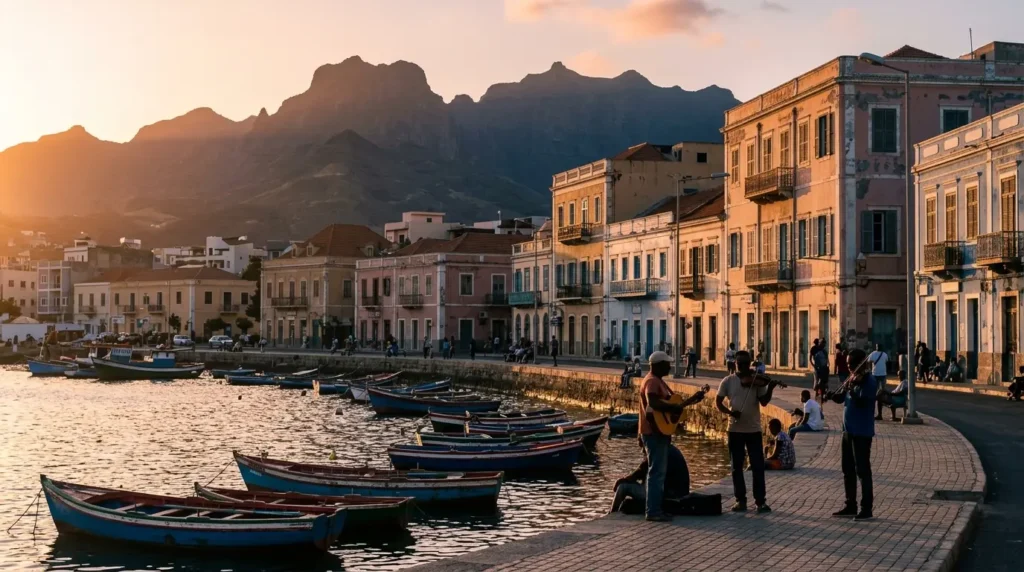
São Vicente is Mindelo — Cape Verde’s most cosmopolitan city, the island capital with a Portuguese colonial waterfront, a strong live music scene (morna, coladeira, funaná), the best restaurants in the archipelago, and the cultural gravity that produced Cesária Évora. It is not a beach destination and should not be sold as one: it is a city with character, the right base for travellers who want culture alongside the sea, and an excellent centre for connecting to Santo Antão by ferry (45 minutes) for day hikes into the dramatic ribeiras.
Fogo is the active volcano. Pico do Fogo rises to 2,829 metres and erupted most recently in 2014–2015; the lava fields from that eruption still dominate parts of the interior, having buried two villages that the inhabitants refused to permanently leave. Chã das Caldeiras — the settlement inside the caldera — is home to the island’s wine production: Fogo wine is made from vines grown in volcanic soil at altitude and is unexpectedly good. The summit hike takes five to six hours return from the caldera and requires a guide. Fogo is a one- or two-night extension rather than a primary destination but is the most singular experience in the archipelago.

Santiago — the island that gets overlooked
Santiago is Cape Verde’s largest island and the location of the capital, Praia. Most UK and German package tourists fly past it to Sal or Boa Vista and miss it entirely, which is their loss. The island has two things that nothing else in the archipelago can match: Cidade Velha, the first European colonial city built in sub-Saharan Africa (1462) and now a UNESCO World Heritage Site with the ruins of Forte Real de São Filipe and the intact Pillory Column used to punish enslaved people, which is one of the most affecting historical sites in the Atlantic; and Tarrafal, a bay on the island’s northern tip with calm water, a black-sand beach, and almost no tourists despite being one of the best all-round beaches in Cape Verde. Santiago is the island for travellers who want to understand what Cape Verde is, not just what it looks like on a sunlounger.
What does Cape Verde cost in 2026?
Daily budget (per person, USD)
| Category | Budget | Mid-range | Luxury |
|---|---|---|---|
| Accommodation | $18–40 | $85–170 | $210–330+ |
| Food | $7–15 | $20–40 | $50–80 |
| Local transport | $3–8 (aluguers) | $10–20 | $30+ (private car) |
| Activities | $15–25 | $35–65 | $80+ |
| Daily total | ~$75 | ~$155 | ~$340 |
Source: Travel with Hello Cape Verde budget guide, 2026; BudgetYourTrip Cape Verde data
Flights from the UK: Direct services from London, Manchester and other UK airports to Sal and Boa Vista operate year-round with TUI, Jet2, easyJet (seasonal) and TAP Air Portugal (via Lisbon for other islands). Return flights from London run approximately £350–600 in the November–February window; peak December and January prices are higher.
Inter-island transport: Inter-island flights with TACV Cabo Verde Airlines or BestFly CV run $60–120 one-way depending on route. The ferry between São Vicente and Santo Antão takes 45 minutes and costs approximately $10. Some inter-island routes are only served by flight.
The honest cost note: Sal and Boa Vista are the most expensive islands because of their resort infrastructure and the all-inclusive hotel dominance. São Vicente, Santiago, Fogo and Santo Antão are significantly cheaper for self-catering travellers — a guesthouse on São Vicente for $25 per night is a realistic and good option. The archipelago rewards travellers who escape the all-inclusive model: the food in Cape Verde, particularly the cachupa (a slow-cooked stew of corn, beans, sweet potato and whatever else is in the kitchen) and grilled wahoo or tuna straight off the boats in a Mindelo restaurant, is well above the resort buffet average.
Practical information for 2026
Entry and the EASE system: UK, US, EU and most Western passport holders enter Cape Verde visa-free for up to 30 days. However, all visitors must complete pre-registration through the EASE portal (ease.gov.cv) before departure and pay the Airport Security Tax (approximately 3,400 CVE, roughly $35 for stays up to 30 days). This is not a visa — it is a tourism pre-registration — but you must complete it before you board. From January 2026, nationals of 96 developing countries (including India, Egypt, Pakistan, Philippines, Nigeria and others) are now required to obtain a proper visa from a Cape Verdean embassy before travel, replacing what was previously a visa-on-arrival option. UK and US travellers are not affected by this change but still need the EASE registration. Check the FCDO Cape Verde travel advice for current entry requirements before booking.
Getting around: Aluguers — shared minibuses running fixed routes — are the island transport system and cost $3–4 per ride. They are excellent value, reliable on the main routes and an easy way to meet local people. Taxis are plentiful in resort areas; agree a price before getting in. Hiring a car gives flexibility but roads on some islands (particularly Fogo and Santo Antão) require 4×4 vehicles for the inland routes.
Currency: Cape Verdean escudo (CVE). The escudo is pegged to the euro at a fixed rate (1 EUR = 110.265 CVE). Euros are widely accepted in tourist areas. ATMs are available on Sal, Boa Vista, Santiago and São Vicente; carry cash on Fogo and Santo Antão.
Language: Portuguese and Cape Verdean Creole (Kriolu). English is spoken in tourist resorts and hotels; less so away from the main islands.
Health: No vaccinations are mandatory for entry, but hepatitis A and typhoid are recommended. There is a malaria risk on Santiago and some other islands, particularly during and after the rainy season (August–October); check the latest FCDO advice and consult a travel health clinic.
Frequently asked questions
Q: Is Cape Verde better than the Canary Islands?
A: Different, not better. The Canary Islands offer more consistent infrastructure, more island variety within a single trip, and more varied landscapes including Teide (the highest point in Spain). Cape Verde offers a more African cultural experience, less crowded beaches on the outer islands, and the unique appeal of Fogo’s active volcano and Mindelo’s music scene. Both have the same flight time from the UK. If you have done the Canaries and want something with more edge and cultural depth, Cape Verde is the natural next step. See our Canary Islands winter sun guide for a direct comparison.
Q: How many islands can you realistically visit in one trip?
A: Two or three in ten to fourteen days, if inter-island connections are planned carefully. The classic combination for a first trip: Sal or Boa Vista (four nights, beach and resort base) plus São Vicente/Mindelo (two nights, culture) plus a day trip to Santo Antão by ferry. Fogo is best added as a two-night extension from Santiago. Attempting more islands than this results in spending most of a short trip in airports.
Q: Is Cape Verde safe?
A: Cape Verde has one of the lowest crime rates in sub-Saharan Africa and is considered safe for solo travellers and families. Petty theft (bag-snatching, pickpocketing) occurs in Praia and in busy resort areas; the usual urban precautions apply. The FCDO rates Cape Verde at the same safety level as Portugal. Rip currents on exposed Atlantic beaches (particularly on Sal and Boa Vista’s outer coasts) are a genuine risk — always check local advice before swimming on ocean-facing beaches. See our Senegal and Dakar guide for West Africa context. For planning your Cape Verde trip, try the PlacesToday itinerary tool.
The window to book Cape Verde for the dry season is right now. November through March delivers the reliable warmth, clear skies and consistent trade winds that made it a winter-sun staple for northern Europeans, without the February half-term prices of the Canaries or the July crowds of anywhere else in the Atlantic. Sal and Boa Vista for the beach. Mindelo for a night of morna at a bar that looks like 1950s Lisbon. Fogo because there is an active volcano with wine and you can hike it. That is a trip.