A European family holiday in 2026 costs between €80 and €350 per day for a family of four, depending on the destination, season and accommodation type — the range is that wide. Portugal’s Algarve in May runs €130–180 per day all-in; the same family in Paris in July spends €320–450. The gap between expensive Europe and affordable Europe is not a matter of compromise — it is a matter of knowing which countries, which months and which booking windows deliver the same quality of experience at a fraction of the peak-season price. This guide covers the practical steps to build that trip.
Which European destinations offer the best value for families in 2026?
The most useful way to think about European affordability is in tiers, because “Europe is expensive” is a statement about Paris, London, Amsterdam and Copenhagen — not about Porto, Krakow, Dubrovnik in October, or the Bulgarian Black Sea coast. The southern and eastern periphery of the EU operates on prices that are structurally lower than the western core, and the gap has not closed significantly despite EU membership in many cases.
Portugal sits at the top of the first tier: it is a western European country with reliable infrastructure, good English, and warm Atlantic beaches, and it costs roughly 35–40% less than Spain and 50–60% less than France for equivalent accommodation and food. Poland and Hungary anchor the second tier: capital cities (Warsaw, Krakow, Budapest) with extraordinary history, well-developed family tourism infrastructure, and daily costs that rival Southeast Asia in some categories. Croatia occupies a middle tier — shoulder-season Dubrovnik or Split in May and September is affordable and extraordinary; July and August, it is neither. Greece follows a similar pattern: the mainland and quieter islands like Naxos or Lefkada run 40–50% cheaper than Santorini or Mykonos for equivalent quality.
The single most powerful cost-reduction lever available to a family planning a European trip in 2026 is destination selection, and it outweighs every other variable combined.
When should families travel to Europe to save money?
| Month | Pricing tier | Weather | Best destinations | Avoid |
|---|---|---|---|---|
| January–February | Low | Cold; skiing regions excellent | Budapest, Krakow, Lisbon, Malta | Beach resorts (closed) |
| March | Shoulder | Mild and brightening | Portugal, Seville, Malta | None specific |
| April | Shoulder–peak | Excellent across southern Europe | Portugal, Algarve, Greece mainland | Easter week (premium surges) |
| May | Low–shoulder | Warm, uncrowded | Everywhere — best month | Nothing |
| June | Rising | Excellent | Most of Europe | Second half if school year ends |
| July–August | Peak — 40–60% premium | Hot | Unavoidable for UK/Irish school families | Coastal Croatia, Santorini, Amalfi |
| September | Shoulder — prices fall fast | Warm, often better than Aug | Croatia, Greece, Portugal, Spain | Nothing |
| October | Shoulder | Pleasant, some rain | Lisbon, Barcelona, Budapest, Rome | Northern Europe beach |
| November–December | Low | Cool to cold | Christmas markets (Prague, Vienna, Budapest) | Mediterranean coast |
For families whose travel is not locked to school holidays, May is the single best month in Europe: the continent has come out of winter, prices are 25–40% below July, accommodation has availability at every level, and the famous sites — Colosseum, Sagrada Família, Acropolis — have manageable queues rather than the wall-to-wall crowds of summer. Families with school-age children in the UK and Ireland will typically be constrained to July–August and half-term weeks, and the strategy there shifts: choose the destinations that are least badly affected by summer crowds (inland cities, eastern Europe, the northern Atlantic coasts of Portugal and northwest Spain) rather than the ones that peak hardest.
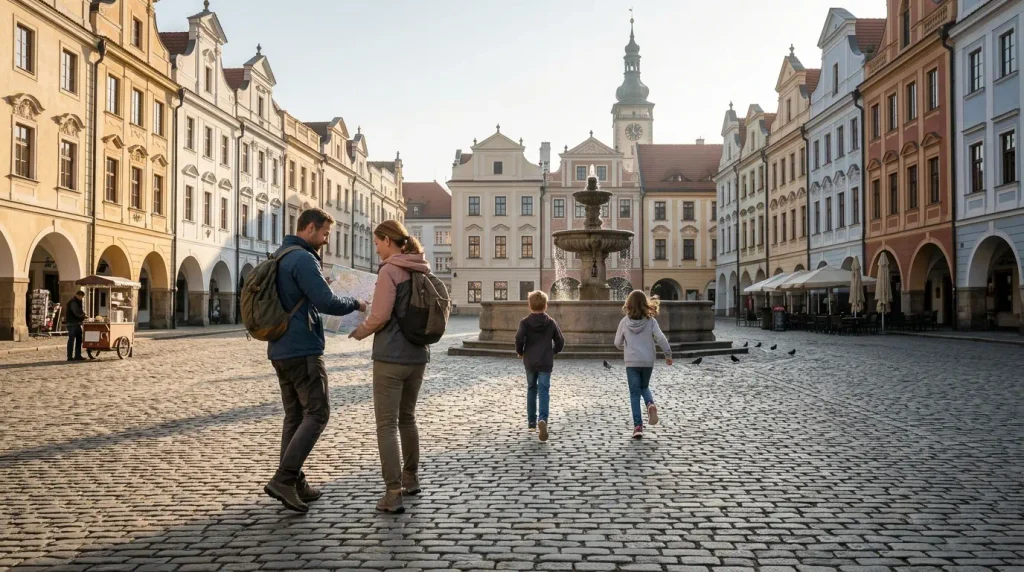
Portugal — where western European quality meets eastern European prices
Portugal is the most consistent answer to the question of affordable European family travel because it holds a near-unique combination of properties: Atlantic beaches that are genuinely world-class, a food culture that feeds children happily at half the price of its peers, easy direct flights from every major UK and Irish airport, and a national temperament that is openly welcoming to families with young children in a way that not every southern European country matches.
The Algarve — Portugal’s southern coast — is the obvious first choice, and the obvious choice is usually obvious for good reason. The beaches at Lagos (Meia Praia for families with young children who want flat, calm water; Praia Dona Ana for the dramatic sea-stack scenery), Albufeira’s Fisherman’s Beach, and the long sweep of Meia Praia near Portimão are among the best family beaches in Europe. A three-bedroom apartment in the Algarve in May — sleeping a family of four with room to spread out — runs €90–140 per night through self-catering platforms. The same apartment in August runs €200–320. The weather in May is 23–26°C with minimal rainfall and full beach days; the arithmetic of doing this in May instead of August is stark.
Lisbon with children is considerably more rewarding than most family travel guides suggest. The Oceanarium in the Parque das Nações neighbourhood is a serious aquarium — sharks, sunfish, otters — that is not a theme park attempt at one, and the ticket price (€22 adult, €14 child) is a fraction of equivalent attractions in London or Amsterdam. The Jerónimos Monastery in Belém, a short tram ride from central Lisbon, is among the most beautiful buildings in Europe: the cloisters are genuinely breathtaking, and children old enough to understand what they are looking at find it impressive rather than tedious. The city runs on affordable pastéis de nata (€1.20 each) and grilled fish meals for four at €35–50 including wine for the adults. A four-night Lisbon city break for a family of four — apartment, meals, entry to three or four attractions — runs €1,200–1,600 in shoulder season, flights not included. Book a Lisbon family highlights walking tour including the historic tram and Belém pastry stop on GetYourGuide from €28 per adult, €14 per child. <!– GYG Partner Link –>
Sintra — 45 minutes by train from Lisbon — is essential on any Portugal family itinerary. The Pena Palace, a 19th-century fairytale structure in yellow, red and purple perched above cloud level on the Serra de Sintra, has no meaningful equivalent in Europe at this price point (€14 adult, €12.50 child). The train from Lisbon’s Rossio station costs €2.35 per person each way. A day in Sintra for a family of four costs approximately €80 including train, entry fees and lunch
Central and Eastern Europe — where the budget stretches furthest
Budapest, Prague and Krakow form the affordable city-break triangle of Central Europe, and all three are underused by British families compared to their Spanish and Portuguese equivalents. The reason is partly cultural — they feel unfamiliar without the beach component — and partly practical, in that the distances from UK airports seem further than they are (Budapest is 2h20 by air from London, the same flight time as Malaga). The family that makes this calculation correctly arrives somewhere with extraordinary history, a dense programme of activities that children actually engage with, and a daily food and transport budget that is 40–60% of an equivalent western European city.
Budapest delivers perhaps the highest surprise-to-cost ratio of any European family destination: thermal baths, a medieval castle district, a river cruise that takes 90 minutes and costs €15 per adult and €8 per child, a zoo that is architecturally interesting (the buildings date from 1909 and are Budapest-beautiful), and a food hall — the Great Market Hall on the Pest bank — that is genuinely worth an afternoon and genuinely affordable. A family of four eats dinner well in Budapest’s seventh district for €35–50. Accommodation in a well-rated apartment hotel in central Pest runs €80–120 per night. A five-night Budapest family holiday for four — apartment, activities, food — runs €1,800–2,500 all-in excluding flights. Flights from London to Budapest run £60–120 per person return in shoulder season on Ryanair, Wizzair and British Airways. Book a Budapest family river cruise with audio commentary on GetYourGuide from €15 per adult, €8 per child. <!– GYG Partner Link –>
Krakow is the starting point for any family interested in 20th-century European history at the level where it is comprehensible to older children (10+). The Old Town is among the most intact medieval city centres in Europe — the Wawel Castle complex on its limestone hill above the Vistula is a morning’s work and costs PLN 75 (approximately €17) for a family ticket to the castle rooms. The salt mine at Wieliczka, 30 minutes from the city centre, is one of Central Europe’s most genuinely impressive underground experiences — a working salt mine since the 13th century, with chapels, sculptures and chandeliers carved entirely from salt, 135 metres underground — and is accessible in half a day. For families where older children are studying the Second World War, the Auschwitz-Birkenau site is 75 minutes by bus from Krakow and requires advance booking; entry is free, the educational weight is significant, and the experience is handled with appropriate gravity.
How do you find cheap flights to Europe for families?
The most effective strategies in 2026 for reducing European family flight costs are: choosing low-cost carriers and booking mid-week departures 6–10 weeks ahead of travel; flying into secondary airports (Porto rather than Lisbon, Katowice rather than Krakow, Hahn or Charleroi rather than Frankfurt or Brussels); and travelling within the shoulder windows shown in the table above rather than peak school-holiday weeks.
Specific platforms worth checking: Google Flights’ price calendar view shows the cheapest day within a ±3-day window around any given date, and the matrix view compares multiple destinations from one origin simultaneously — a useful tool if the destination is flexible. Skyscanner’s “Everywhere” search from a named departure airport returns every destination sorted by price, which is the right starting point for a family with a budget constraint and an open mind about where to go. Easyjet’s “Inspire Me” tool and Ryanair’s fare calendar work on the same principle.
For families of four buying four tickets simultaneously, the price gap between a single Tuesday versus Sunday departure on the same route can run to £200–400 return. Midweek departures (Tuesday, Wednesday) consistently underperform Thursday–Sunday on family routes. For longer European summers (12+ nights), a split-ticket approach — flying into one airport and out of another — occasionally saves more than the coordination cost adds, particularly on Portugal routes where Porto arrivals are often £80–120 cheaper per person than Lisbon arrivals on the same week.
What does an affordable European family holiday actually cost in 2026?
| Budget (shoulder) | Mid-range (shoulder) | Mid-range (peak) | |
|---|---|---|---|
| Portugal (Algarve) | €95–130/day | €160–220/day | €250–350/day |
| Lisbon (city break) | €110–150/day | €180–250/day | €270–370/day |
| Budapest | €80–110/day | €140–200/day | €200–280/day |
| Krakow | €70–100/day | €120–170/day | €170–240/day |
| Croatia (Split/Dalmatia) | €100–140/day (May/Sept) | €160–240/day | €300–450/day (Aug) |
| Greece (mainland/Naxos) | €90–130/day | €150–210/day | €220–320/day |
| Spain (inland — Seville/Granada) | €100–140/day | €170–230/day | €250–380/day (Apr/Easter) |
Costs per day for a family of four including accommodation, meals (mix of eating in and restaurants), transport and two to three paid activities. Flights not included. Source: PlacesToday.com destination research, 2026.
The total cost of a seven-night European family holiday for four in shoulder season — flights from the UK included — sits between £2,200 and £3,800 for mid-range independent travel to Portugal, Croatia or Greece, and £1,600–2,600 for Central/Eastern Europe where flights are shorter and accommodation cheaper. A comparable week in July in the same regions adds 35–55% to those totals, while a week in August in a premium beach destination (Dubrovnik, Santorini, Barcelona coast) can easily double them.
The hidden cost that most families underestimate: paid attractions. A family of four visiting three to four paid sites per day — museums, theme parks, boat tours, historic monuments — can spend €80–150 per day on entry fees alone. The mitigation is a combination of choosing one or two premium paid experiences per destination and building the rest of the programme around free-entry content: historic town centres, beaches, markets, walking routes and public viewpoints, all of which are free and often more genuinely memorable than the ticketed sites.

Frequently asked questions
Q: What is the cheapest European country for a family holiday in 2026?
A: Bulgaria, Albania and North Macedonia are the cheapest countries in Europe by daily cost, but their family tourism infrastructure is less developed than the next tier. For families wanting a familiar holiday experience at low cost, Portugal and the Czech Republic (Prague and Bohemia) offer the best value: western European standards of safety, English language use and accommodation quality at prices 30–50% below France, Germany or Spain.
Q: Is it cheaper to book a European package holiday or arrange it independently?
A: For beach destinations in peak school-holiday weeks — Algarve, Mallorca, Greek islands — a TUI, Jet2 or Easyjet Holidays package often undercuts the independently assembled equivalent, because operators buy accommodation blocks at bulk rates. For city breaks, off-peak travel and Central European destinations, independent booking (Skyscanner flights, Booking.com or Airbnb accommodation, GetYourGuide activities) almost always wins on price and flexibility. The rule: check both before committing, starting with a package comparison as the baseline.
Q: How far ahead should families book European summer holidays?
A: For July–August peak travel, 4–6 months ahead is the optimal window: it captures availability across most accommodation types and the period before airline prices surge on the 8–12 week pre-departure runway. For May, September and half-term weeks, 6–10 weeks ahead is typically sufficient and sometimes better than early booking, as accommodation fills slower and airlines discount unsold seats.
Q: Are European cities child-friendly in summer heat?
A: Cities in southern Europe (Seville, Athens, Rome) can reach 35–40°C in July and August, which significantly limits what is achievable with young children in the middle of the day. The practical approach is the Mediterranean rhythm: active sightseeing before noon, a long lunch and rest in the accommodation through 1–4pm, and late afternoon/evening activity when temperatures drop. This pattern works well with children over 5; with very young children in peak heat, beach destinations with accommodation swimming pools are more sensible than city itineraries.
Q: What is the best European beach destination for families that is not overcrowded in summer?
A: The Alentejo coast of Portugal (Comporta, Melides, the Comporta lagoons) is the answer at the quieter end — wild beaches, no large resort infrastructure, accessible from Lisbon in 90 minutes. The Vendée coast of western France, the Costa Verde of northern Spain (Cantabria, Asturias), and the northern Portuguese coast around Viana do Castelo are similarly unbuilt, Atlantic-cooled alternatives to the Mediterranean that reach 22–26°C in July while their southern equivalents bake.
The most affordable European family holiday in 2026 is not a matter of luck or early access to a deal — it is a function of choosing the right country, the right month, and the right booking approach. Portugal in May, Budapest in September, or Krakow in October all deliver the same quality of European experience — history, food, infrastructure, safety — that a family pays a 40–60% premium for in Paris in July. The planning window for spring 2027 is open; the options are better than they appear at first glance. Start planning your European family itinerary on PlacesToday →