The best European cities for families with children are not necessarily the most famous ones. Amsterdam, Prague, Lisbon and Budapest consistently outperform Paris and London on the metrics that matter for travelling with children: manageable scale, walkable historic centres, strong child-friendly museum provision, and daily costs between €100 and €200 for a family of four including accommodation, meals and activities. Rome and Barcelona make the list too, with the right planning. The cities to skip — not because they are bad, but because they are poorly suited to families with children under twelve — are Copenhagen (beautiful, prohibitively expensive for families), Venice (romantic, chaotic with a pushchair, limited family programming), and Amsterdam in peak summer (excellent city, impossible crowds in July–August).
What follows is the ranked practical guide: which cities work, which age groups they work for, what they cost, and what to do there.
What makes a European city work for a family?
The framework is straightforward once you spell it out. A good family city has a walkable historic core that children can navigate without full days in transit; at least two to three paid attractions that hold the attention of children over 6 without requiring prior specialist knowledge; a food culture that can accommodate children eating at normal hours (not 10pm Spanish dinner culture with a 5-year-old); accommodation options with kitchen or kitchenette access so not every meal is a restaurant; and a cost structure that does not require a day-by-day budget accounting exercise to stay within reach. Very few European capitals tick all five boxes. The cities in this guide tick four or five. Paris ticks two or three and charges 60% more for the privilege.
Scale also matters more than most family travel guides acknowledge. A city that is comprehensible on foot — where the main attractions sit within 20–30 minutes’ walk of each other and the historic centre is navigable without a metro map — is qualitatively different from a city where every day begins with a transit planning exercise. Lisbon, Prague, Krakow and Porto are compact in this way. Rome, Amsterdam and Budapest have larger footprints but organise well around neighbourhoods. Barcelona and Madrid are large cities that reward good planning.
Which European city is the best for families with young children?
For children under 8, Amsterdam is the answer. The canal-ring city is exceptionally well-organised for families in practical terms: it is flat (no cobblestone hills or stair-heavy metro to navigate with a pushchair or small wheels), the distances between the main family attractions are short, the Dutch transport infrastructure is the best in Europe, and the city has world-class children’s museums that are not derivative attempts at the format — NEMO Science Museum is a genuine five-floor hands-on science experience built specifically for curious children, not an afterthought installed in a heritage building. The Artis Royal Zoo, open since 1838, has a planetarium, aquarium and microbe museum integrated into its footprint. The Anne Frank House is essential for children over 10 and requires pre-booking weeks or months ahead; the Rijksmuseum has an excellent family trail through the Golden Age collection that holds younger children longer than the subject matter might suggest.
The practical catch with Amsterdam is cost and seasonality. In July and August, the city is heavily congested with tourists and accommodation prices in central neighbourhoods run €180–280 per night for a family apartment. In April–June and September–October, the city operates normally: accommodation runs €120–180 per night, the famous Keukenhof tulip gardens (April–May) are at peak colour, and the streets are busy but navigable. The May shoulder window is the single best time to take children to Amsterdam.
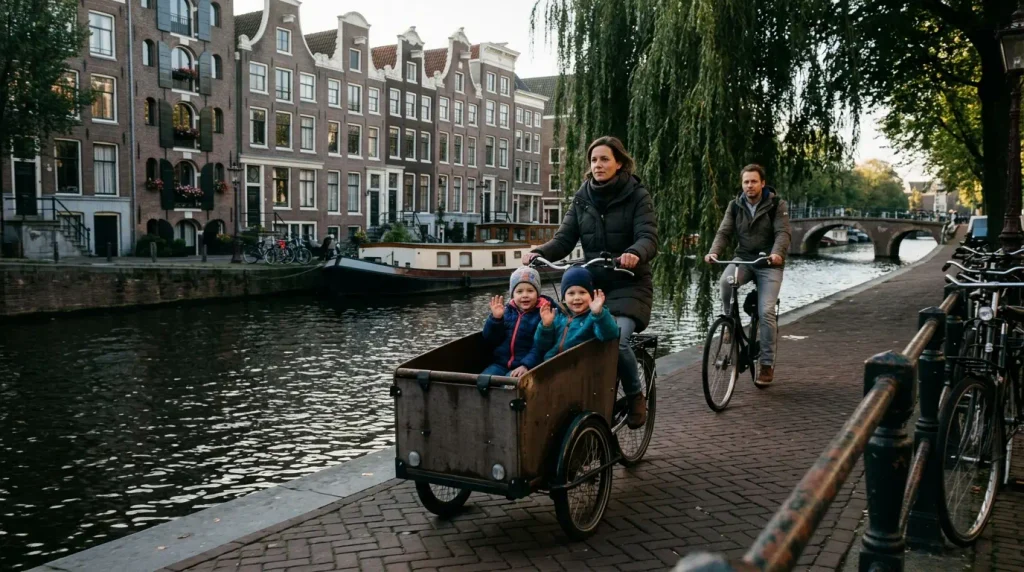
Amsterdam — canals, science museums and cargo bikes
Amsterdam earns its place at the top of the family city-break list through infrastructure rather than spectacle: it is a city engineered, over centuries, to be lived in at a human pace, and that engineering translates directly into the family travel experience. The canal ring is a UNESCO World Heritage Site, but the children do not need to know that to appreciate cycling along a canal towpath on a hired bike with their feet in the front cargo box of a Dutch bakfiets — an experience available from multiple rental operators for approximately €35 per day for a family cargo bike, and one that generates the most reliably photographed family holiday moment in Europe.
NEMO Science Museum in the Oosterdok is the city’s non-negotiable for families with children aged 6–14. Five floors of fully interactive science exhibits — chemistry, physics, biology, construction, energy — are built around the principle that children learn through doing rather than reading labels. The rooftop has a paddling fountain that operates in summer and a panoramic view over the old harbour. Entry costs €17.50 adult, €17.50 child (over 4), under 4 free. The Rijksmuseum’s Family Trail — a self-guided route through the collection designed for children 6+ — costs the standard entry fee (€22.50) and provides printed question cards that make the Dutch Masters comprehensible without prior art history. Book a family canal boat tour through Amsterdam’s UNESCO canal ring on GetYourGuide from €18 per adult, €9 per child. <!– GYG Partner Link –>
Budget for a four-night Amsterdam family break (shoulder season): €180–240 per night accommodation (family apartment), €60–90 per day food and transport, €50–80 per day activities. Total, excluding flights: €1,400–2,000.
Prague — fairy-tale architecture at budget prices
Prague belongs in every family city-break conversation and is still underused by British families relative to its actual quality. The city looks like a film set — the medieval old town, the baroque Lesser Town, the Gothic castle district and the Charles Bridge connect in a 90-minute walk that traverses what is arguably the most intact historic urban landscape in central Europe — and the price of experiencing it is roughly 40% of the equivalent in Vienna or Munich.
The Prague Castle complex on the Hradčany hill above the Vltava is the starting point for any family visit and a half-day’s worth of content in itself: St Vitus Cathedral (free to enter the nave, ticketed for the tower and full complex at CZK 500/approximately €20 for a family ticket), the Old Royal Palace, the Golden Lane (a street of tiny medieval cottages within the castle walls where Franz Kafka briefly rented a workspace), and views over the terracotta rooftops of the Lesser Town far below. For children who have been told that castles are where kings and queens used to live and want empirical evidence, Prague Castle is the most convincing version of that in Europe. Book a Prague Castle family guided tour including priority entrance on GetYourGuide from €22 per adult, €11 per child. <!– GYG Partner Link –>
The astronomical clock in the Old Town Square — the Orloj, installed in 1410 — performs an hourly spectacle that is brief (90 seconds), genuinely medieval and inexplicably compelling to children under 10. The Old Town Square itself is where a family spends the most time simply sitting on the steps, eating trdelník (a spiral pastry sold from stalls at €2–3) and watching the square do what a good medieval city square does: provide a stage for the accumulated centuries to perform on.
Food in Prague for a family of four: a restaurant meal including children’s portions runs €25–40; a grocery-run picnic on the riverbank costs €10–15. Accommodation: a well-rated family apartment in the Vinohrady or Žižkov districts (15 minutes from Old Town by tram) runs €80–120 per night. Total four-night family budget excluding flights: €900–1,400.
Lisbon — hills, trams and the best value in western Europe
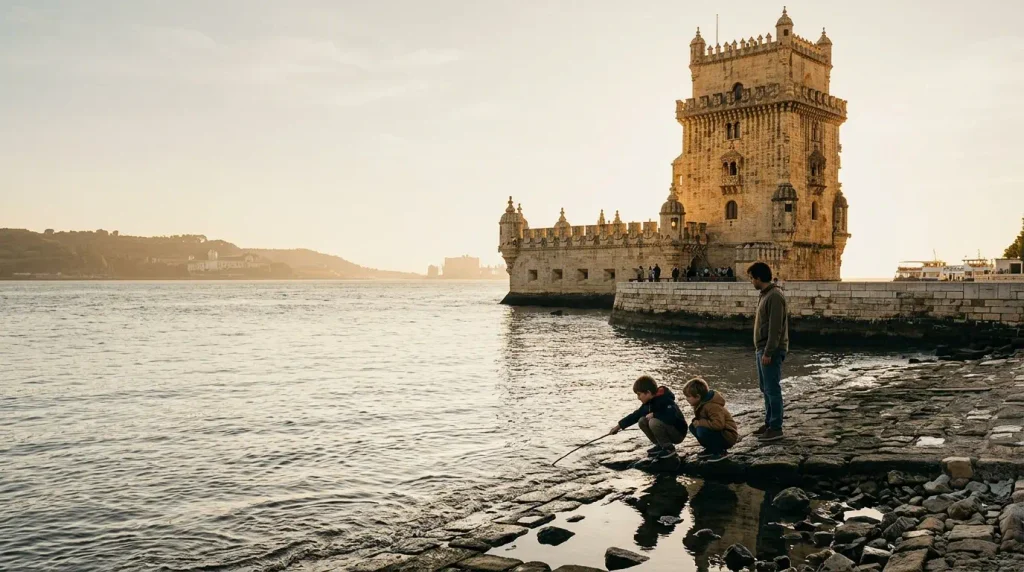
Lisbon is the European family city that most consistently exceeds expectations at check-out: visitors arrive expecting a pleasant Portuguese capital and leave having discovered that it is one of the most characterful, affordable and family-friendly cities in Europe. The historic tram routes (Tram 28 through the Alfama neighbourhood, Tram 15E to Belém) are the most charming way to cover the city’s hills, and a 24-hour family travel card covering all trams, buses and the metro costs €13.45 for adults and nothing for children under 13 — a pricing structure that immediately makes a full day of city exploration feel affordable.
Belém, the riverside district 6km west of the city centre, organises itself as a near-perfect family half-day: the Torre de Belém (€6 adult, children under 12 free) sits at the water’s edge and looks exactly like a medieval river fortress should; the Padrão dos Descobrimentos monument is a 52-metre concrete sail listing the explorers of Portugal’s Age of Discovery, climbable to the top for €6 adult, €3 child; and the Jerónimos Monastery, a 16th-century UNESCO World Heritage Site whose cloisters are the finest expression of Manueline architecture in Portugal, costs €10 adult, children under 12 free. The original Pastéis de Belém café, two minutes from the monastery, has been making the definitive pastel de nata since 1837 at €1.20 each. A half-day in Belém for a family of four including entry fees and pastries costs approximately €50.
The Oceanarium in Parque das Nações (€22 adult, €14 child) is the city’s premium family attraction: a two-storey central ocean tank visible from all four sides, housing sunfish, sharks, rays and shoals of smaller species, surrounded by four habitat exhibits representing the Atlantic, Pacific, Indian and Antarctic oceans. It requires three hours and produces no bored children. Total four-night Lisbon family budget excluding flights: €1,000–1,600.
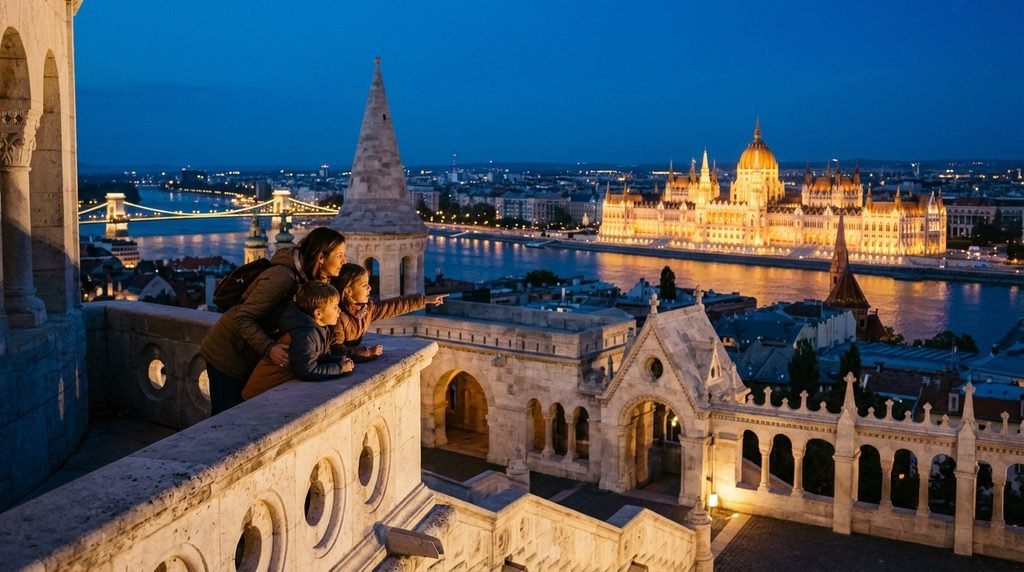
Budapest — thermal baths, caves and a castle on a hill
Budapest’s position on the thermal spring zone that runs beneath the Carpathian Basin gives it an asset no other family city in Europe has: genuinely functioning thermal baths that can be incorporated into a family city break as both a leisure day and a distinctly Hungarian experience. The Széchenyi thermal baths in City Park — 18 pools fed by natural hot springs at 36–38°C — have outdoor pools that children swim in year-round (the cold air above the warm water creates a memorable steam effect in winter months) and indoor swimming pools at more conventional temperatures. Entry for a family of four runs approximately HUF 22,000 (approximately €56) for a full day.
The Buda Castle district — across the river from the Pest side of the city, accessible by the 19th-century funicular from Clark Ádám Square — is the morning activity: the Fisherman’s Bastion (free access to the lower terraces, €1.50 each for the upper towers), the Matthias Church, and the panorama view over the Parliament building and the sweep of the Danube from the castle ramparts. The Natural History Museum in Pest is underrated: a serious collection including dinosaur fossils and a complete mammoth skeleton, well-suited to children 8+, at €10 adult and €5 child. Budapest’s Jewish Quarter in the seventh district (the “ruin bars” area) is the most atmospheric neighbourhood for family evening walking — the streets are pedestrianised in places, the street food is excellent, and the Great Synagogue on Dohány Street, Europe’s largest synagogue, is worth the €15 adult / €10 child entry for the interior.
Budget: accommodation in a central Pest family apartment runs €80–120 per night; food €40–60 per day; activities €30–50 per day. Four-night total excluding flights: €1,000–1,500.
Rome — managing the eternal city with children
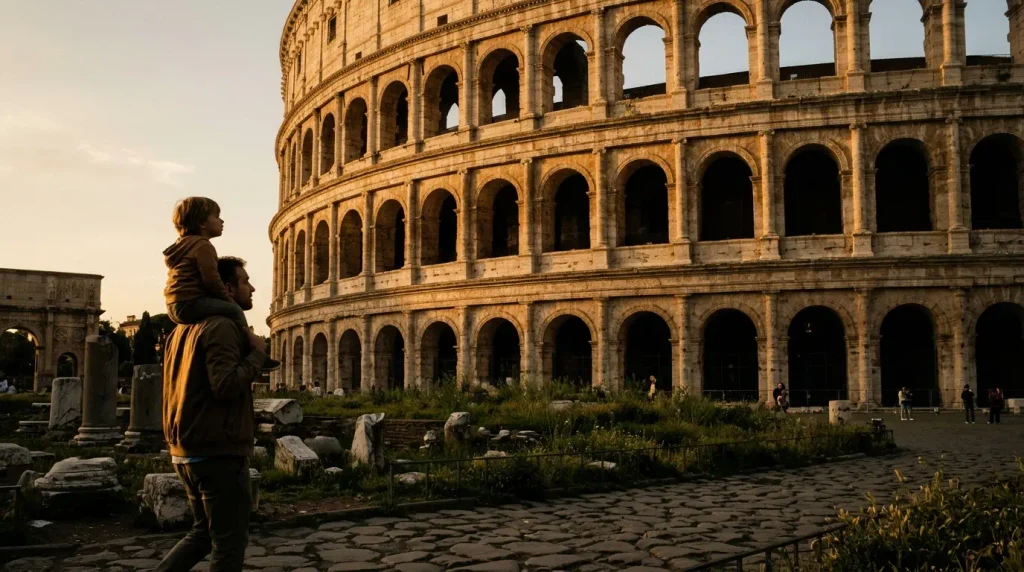
Rome with children is harder than Amsterdam with children and more rewarding than Barcelona with children, which is an honest summary of the trade-offs involved. The city is large, the historic core is cobblestoned in a way that makes pushchairs a commitment, the summer heat is serious (35–38°C in July–August), and the best attractions — the Colosseum, the Vatican, the Borghese Gallery — require advance booking that punishes the unplanned visit. None of these are reasons not to go. They are reasons to go prepared.
The Colosseum skip-the-line family tour is the single most important booking a family visiting Rome will make. Without advance booking, the queue on a peak-summer morning is 2–3 hours. With a family guided tour including priority entrance, you are inside within 20 minutes, with a guide who knows how to make the story of Roman gladiatorial combat comprehensible and engaging for children aged 8 and upward. Book a Rome Colosseum skip-the-line family tour with Palatine Hill and Roman Forum on GetYourGuide from €30 per adult, €18 per child. <!– GYG Partner Link –> The Palatine Hill and Roman Forum are included in the same ticket and add a further two hours of ancient city archaeology that rewards curious children.
The Vatican — St Peter’s Basilica (free, but climb the dome at €8 per person for the view), the Vatican Museums and Sistine Chapel (€17 adult, €8 child, book online) — is another half-day. The trick with children in the Vatican Museums is going straight to the Sistine Chapel first rather than last: the queue is longest at the Sistine Chapel, and arriving at opening time with a pre-booked ticket allows you to enter the Chapel while it is quiet before the majority of visitors work their way through the galleries.
Best months for Rome with children: April, May, September, October. July and August are possible with air-conditioned accommodation and a midday rest break, but the Colosseum at 37°C is a different experience from the Colosseum at 24°C. Budget per family of four per night in Rome (mid-range, shoulder season): €150–220 accommodation, €70–100 food, €50–80 activities.
How do these family city breaks compare?
| Amsterdam | Prague | Lisbon | Budapest | Rome | Barcelona | |
|---|---|---|---|---|---|---|
| Best age group | 5–14 | 7–15 | 5–15 | 7–15 | 9–15 | 6–15 |
| Daily cost (family of 4) | €180–280 | €110–170 | €120–200 | €110–170 | €160–260 | €170–280 |
| Pushchair-friendly | ✅ Excellent | ⚠️ Cobblestones | ⚠️ Hilly | ⚠️ Mixed | ⚠️ Cobblestones | ✅ Good |
| Peak crowd problem | High (Jul–Aug) | Moderate | Moderate | Low | Very high (summer) | Very high (summer) |
| Best month | May | May, Oct | Apr, May, Oct | Apr, Sept | Apr, May, Oct | May, Sept |
| Direct from London | Yes (50 min) | Yes (2h) | Yes (2h30) | Yes (2h20) | Yes (2h35) | Yes (2h15) |
| English spoken widely | ✅ Extensively | ✅ Well | ✅ Well | ✅ Good | ⚠️ Tourist areas | ⚠️ Tourist areas |

Frequently asked questions
Q: What is the best European city break for a family with a toddler?
A: Amsterdam, for its flatness, its compact scale, and the absence of significant heat in spring. The canal ring is entirely navigable with a pushchair, the museums at the lower end of the age range (NEMO, the Artis Zoo) are genuinely engaging for ages 2–5, and the city’s culture of cargo bikes and family cycling means small children in pushchair configurations are a normal, accommodated part of the street environment rather than an inconvenience.
Q: How many days does a family need in each city?
A: Three full days is sufficient for a first visit to Prague, Lisbon or Budapest: one day for the main historic core and castle/palace, one day for the museums and neighbourhoods, and one day for a half-day excursion (Sintra from Lisbon, Kutná Hora from Prague) plus a final evening. Amsterdam and Rome are more comfortably done in four days. Barcelona benefits from five if combining beach and culture days.
Q: Is it worth buying a city card for family visits?
A: For Amsterdam, yes — the I Amsterdam City Card (€55/24h, €75/48h adult; children pay a reduced rate) covers the NEMO museum, Rijksmuseum, Van Gogh Museum, unlimited public transport and a canal cruise, and repays its cost within one active museum day. For Prague and Budapest, city cards are worthwhile only if three or more paid attractions are planned in a single day; for most families, individual ticket purchases are more economical. For Rome, a combined Colosseum/Forum/Palatine ticket (€16 adult, €2 child) is the practical way to manage the main sites.
Q: What is the best time of year for a European family city break?
A: May and September are consistently the best months across every city in this guide. School in most UK regions is in session for most of May, making it difficult for families with primary-age children except during the half-term week at the end of May. September (particularly the second and third weeks) has most schools back in session in the UK but falls after the Italian, Spanish and Portuguese summer holiday period, meaning cities are genuinely less crowded and accommodation prices drop sharply from their August peak.
Q: How far in advance should I book a family city break to Europe?
A: For peak school-holiday weeks (October half-term, Christmas week, February half-term), book 2–3 months ahead for accommodation and as early as 4–6 months ahead for the most in-demand attractions (Vatican Museums, Anne Frank House, Borghese Gallery Rome — all require advance timed entry booking). For shoulder-season travel in May or September, 4–6 weeks ahead is typically sufficient for all but the tightest accommodation budgets.
The best family city break in Europe is the one that is matched to the right ages, the right season and the right budget — not the one most frequently photographed on other people’s accounts. Amsterdam in May with two science-curious children under 10, Prague in October with one history-interested twelve-year-old, Budapest in April for the thermal bath experience: the city break decision is an equation with variables, and each of these cities solves it differently. Start planning your European family city break on PlacesToday →