Colombia is safe to visit in 2026, genuinely exciting across three very different types of trip — city, coast and mountains — and significantly cheaper than comparable Latin American destinations. International arrivals are up 16.7% in 2026 (MICE Travel Advisor), with nearly 6 million visitors expected for the year. The World Travel & Tourism Council forecasts 5.7% growth in Colombia’s tourism GDP this year, above the global sector average of 3.2%. The country that spent a generation overcoming its reputation has now fully become something else, and the rest of the world has noticed.
Here is what actually happened to Colombia. For most of the 1980s and 1990s, the country was defined internationally by a crisis that was real, catastrophic, and entirely consuming of any other narrative. That crisis ended. The institutions rebuilt. The infrastructure improved. The cities — Medellín especially — went from being genuinely dangerous to being genuinely extraordinary, and then the travel writers arrived, and then the digital nomads, and then the flights from New York and Miami and Toronto multiplied, and now Colombia is the leading tourist destination in South America by growth rate and the third most visited country in Latin America overall (Travel and Tour World, 2026).
This is not a story about a country that used to be dangerous and is now tolerable. It is a story about a country that was always culturally extraordinary — the food, the music, the landscape diversity, the warmth — and is now also genuinely functional as a travel destination. Those two things together are what makes it worth understanding before your next trip.
Is Colombia safe to visit in 2026?
Yes, in the cities and tourist regions most international visitors go to, with the same precautions that apply in any large Latin American city. The short answer is that Medellín, Cartagena, Bogotá, the Coffee Region and Tayrona National Park are all well-established, internationally visited destinations with functioning tourism infrastructure.
The honest version: Colombia is not Switzerland. Petty theft, phone snatching and opportunistic crime in urban areas are real and consistent concerns, particularly in crowded areas, at night and in transport hubs. The advice that applies everywhere here applies in Colombia too — do not have your phone out unnecessarily on the street, use ride-hailing apps rather than flagging taxis, and book airport transfers through vetted operators or your accommodation. The Zona Rosa and El Poblado neighbourhoods in Medellín, the walled old city in Cartagena, and the Zona G and La Candelaria in Bogotá are all well-patrolled and comfortable.
Colombia had a presidential election in June 2026. Check the current FCDO Colombia travel advice before departure, as the political transition may affect regional conditions and the advisory is updated in response.
Which Colombian city should you visit first?
The answer depends on what you came for. Here is the comparison that actually matters.
| Medellín | Cartagena | Bogotá | Salento / Coffee Region | |
|---|---|---|---|---|
| Best for | Urban innovation, food, nightlife | Colonial history, Caribbean coast | Culture, museums, gastronomy | Nature, coffee, hiking |
| Climate | 22°C year-round — “City of Eternal Spring” | 28–32°C, humid Caribbean | 14–17°C, cool and occasionally rainy | 18–24°C, fresh mountain air |
| Stay | 3–4 nights minimum | 2–3 nights | 2–3 nights | 2–3 nights |
| Price level | Mid-range | Mid-range/higher in peak | Mid-range | Budget-friendly |
| Best season | Year-round (no off-season) | December–April (dry) | Year-round | Year-round |
Sources: medellingroup.com 2026; ANATO Q1 2026 data; civitatis.com
Most first-time visitors start in Medellín or Cartagena and add the Coffee Region. A two-week trip can comfortably cover all three, with Bogotá as either an arrival gateway or a final stop before flying home.
What makes Medellín worth visiting in 2026?
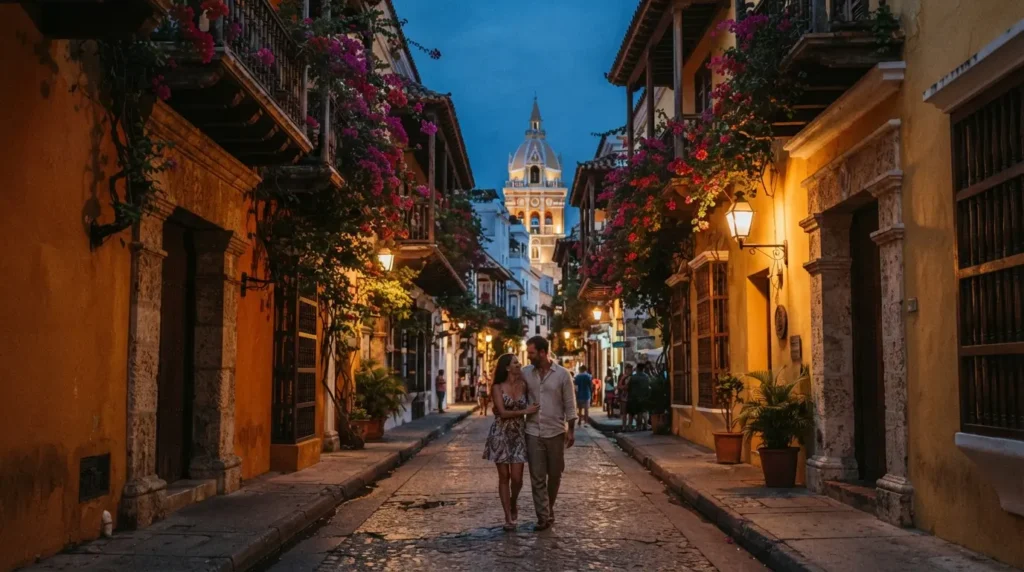
The transformation is the destination. Medellín in 2026 is a city of outdoor escalators on hillside neighbourhoods, a metro cable that connects low-income barrios to the city below, and a food scene good enough that 65% of international visitors to Colombia are between 18 and 49 years old and a meaningful share of them come specifically for this city (ANATO, Q1 2026).
The city runs at 22°C year-round. That is its baseline. There is no bad month to visit, which is unusual enough to be worth saying twice.
El Poblado — the traveller’s base
El Poblado is Medellín’s international neighbourhood — restaurants, rooftop bars, hostels and boutique hotels concentrated in a walkable grid above Parque Lleras. It is where most visitors stay and where most of the city’s internationally accessible food and nightlife is concentrated. It is also, as a result, the most gentrified and least representative corner of Medellín. Stay here and eat here, but build the rest of your time around the city beyond it.
Comuna 13 — the transformation in one neighbourhood
Comuna 13 is where the story of Medellín becomes concrete. The outdoor escalators — six connected sections, 384 metres total — were built in 2011 to connect a hillside community that previously had no public transport access to the metro below. The neighbourhood that was once one of the city’s most dangerous is now covered in murals, home to street performers and local food stalls, and visited by thousands of travellers every week. A guided walking tour of Comuna 13 is the way to understand what you are seeing rather than just photographing it.
Parque Arví — for the day out of the city
The Metrocable from the Acevedo metro station climbs to Parque Arví, a cloud forest nature reserve above the city. The cable car ride itself — the views of Medellín spreading across its valley below — takes about twenty minutes from the top metro station. The park has hiking trails, local food markets at weekends, and the particular quality of light that comes with forest at altitude. It is the part of Medellín that the Instagram algorithm has not yet fully colonised.
What does Cartagena offer that Medellín does not?
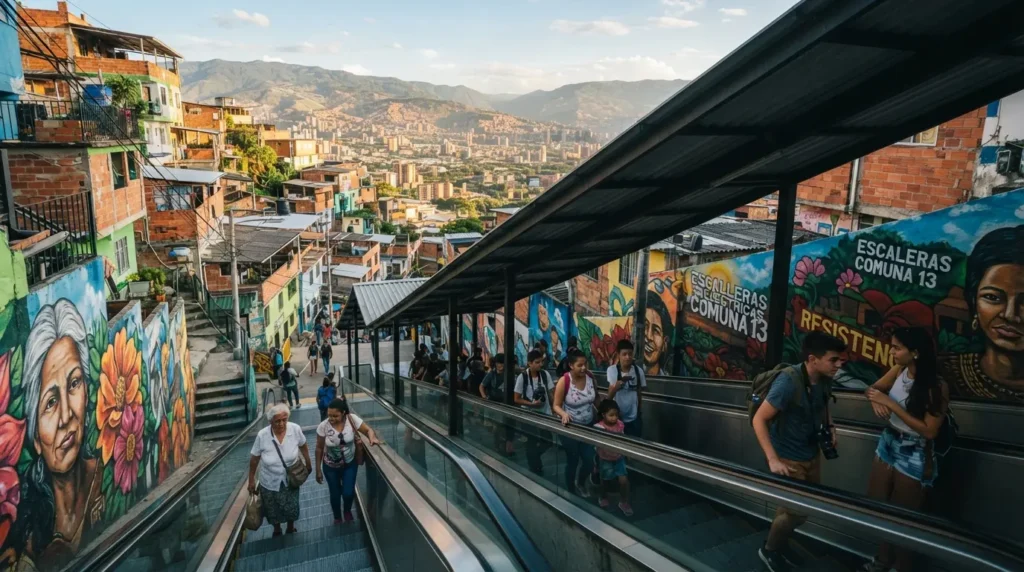
The Caribbean. The UNESCO-listed Ciudad Amurallada — the Spanish colonial walled city — is one of the most complete examples of Spanish colonial military architecture in the Americas, and walking it at dusk, when the streetlamps come on and the heat drops fractionally, is one of South America’s genuinely great evenings. The colours of the facades, the wrought-iron balconies, the sound of cumbia from somewhere in a courtyard — it all adds up to something that photographs accurately for once.
Cartagena is also, by Colombian standards, expensive. Tourist-facing restaurants in the old city charge close to European prices. The streets nearest to the cathedral fill with tour groups. The practical solution is to base yourself inside the walls for the evenings and use the beach islands nearby — Barú and the Rosario Islands — for the days. A Cartagena sunset cruise along the walled city coast is the view that the old city’s interior streets do not give you — the full scale of the fortifications from the water, at the best light of the day.
Should you visit the Coffee Region in 2026?
Yes, without much deliberation. The Eje Cafetero — the Coffee Triangle centred on Pereira, Armenia and Manizales — is Colombia’s most undervisited major attraction relative to its quality, and the Cocora Valley outside Salento is one of the most distinctive landscapes in South America.
Salento and the Cocora Valley
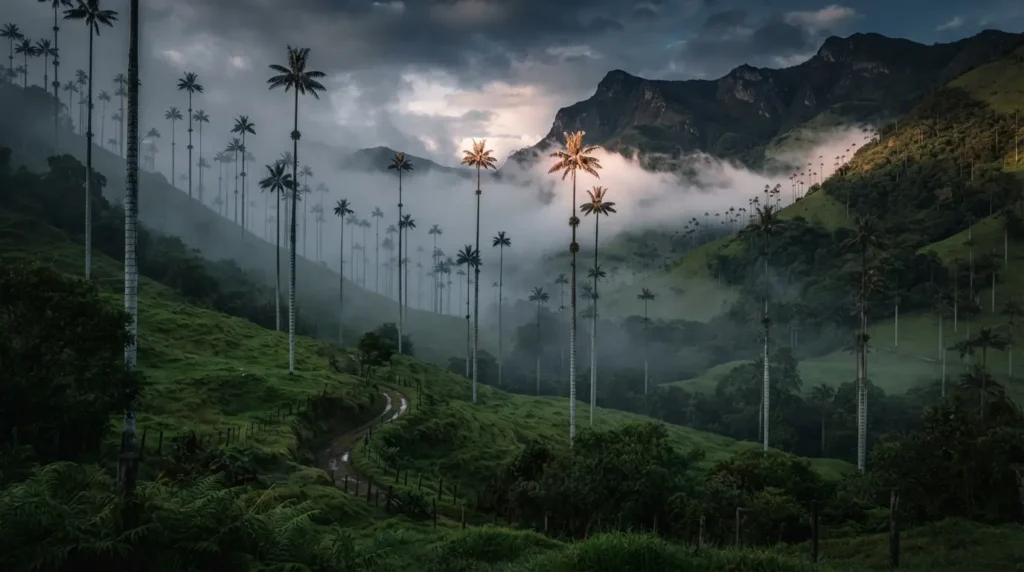
Salento is a small colonial town painted in bright colours, with a main square lined with coffee shops and restaurants serving the kind of daily meal — soup, protein, rice, beans, fruit juice — that costs a few dollars and is quietly excellent. The Cocora Valley is the reason to get up early. Wax palms — Colombia’s national tree, the tallest palm species in the world at up to 60 metres — grow across the valley floor and hillsides in a density and at a scale that looks edited. The loop trail through the valley takes three to four hours and passes through cloud forest, a hummingbird sanctuary, and the palms from multiple angles in changing light.
Coffee plantation tours
The Coffee Region’s working farms offer a full-day immersion in the process — from picking the cherry to the roasting and the first cup — in a landscape of steep green hills that has been producing some of the world’s best coffee for over a century. A coffee plantation day tour from Salento or Pereira connects the experience to the context in a way that arriving in Colombia via Bogotá and Medellín alone does not.
What does a two-week Colombia itinerary look like?
Two weeks is the right amount of time to see the main components without rushing any of them.
Start in Medellín — four nights is enough to cover El Poblado, Comuna 13, Parque Arví, and at least two good meals in the city’s internationally recognised restaurant scene. Fly or take an overnight bus to the Coffee Region and base in Salento for three nights, with the Cocora Valley on day one and a coffee farm on day two. Continue to Bogotá for two nights — the Gold Museum and La Candelaria in the morning, Zona G for dinner, Monserrate for the city view. Fly Bogotá to Cartagena for the final four nights, with the old city in the evenings, a day on the Rosario Islands, and a sunset cruise somewhere in between. The domestic flights are cheap, the food is excellent throughout, and the country is larger and more varied than any two-week summary can fully account for.
You can build a day-by-day Colombia itinerary on PlacesToday — tell us the occasion, the pace and how many days you have and we will map the route.
How much does Colombia cost in 2026?
Less than most comparable Latin American destinations. Colombia is consistently rated the most budget-friendly country in South America (traveloffpath.com), significantly cheaper per day than Buenos Aires, Rio de Janeiro or Lima for equivalent quality.
A mid-range traveller — decent hotel, restaurant meals, paid activities and internal transport — can expect to spend $80–120 per day. Budget travellers staying in good hostels and eating at local set-lunch restaurants can manage $40–60. Cartagena is the exception, where accommodation and food in the tourist centre pushes prices toward the higher end of the range. The Coffee Region and Salento are the cheapest and, by most measures, the most rewarding part of the trip.
Frequently asked questions
Q: Is Colombia safe to visit in 2026? A: Yes, in the main tourist destinations. Medellín, Cartagena, Bogotá, the Coffee Region and Tayrona National Park are all regularly visited by international tourists and have functioning safety infrastructure in tourist areas. Standard urban precautions apply: do not display valuables, use app-based transport rather than street taxis, and book airport transfers in advance. Check the FCDO or your government’s current travel advisory before departure, as the June 2026 presidential transition may affect some regional conditions.
Q: How many days do you need in Colombia? A: Two weeks is the minimum to cover Medellín, the Coffee Region, Bogotá and Cartagena without feeling rushed. Ten days is possible with a tighter focus — Medellín, Salento and Cartagena makes a coherent shorter trip. Anything under a week favours one city and one region rather than trying to cross the country.
Q: What is the best time of year to visit Colombia? A: Medellín has no off-season — 22°C year-round means any month is fine. Cartagena’s dry season (December to April) is the most comfortable for the Caribbean coast. The Coffee Region and Bogotá are pleasant year-round, with wetter months from April to May and October to November. Unlike most of the countries in this guide, Colombia does not punish visitors who book at short notice or outside the peak window.
Q: Is Medellín still dangerous in 2026? A: Not in the way the city’s history implies. El Poblado, Laureles, El Centro and the cable car network areas all function safely for international visitors who take standard precautions. The city has invested significantly in public infrastructure and community development since the 1990s, and the results are measurable. That said, Colombia is not without real urban crime — use your accommodation’s transport recommendations, keep valuables out of sight on the street, and avoid unfamiliar areas at night without local guidance.
Q: Is Colombia worth visiting before it gets too popular? A: That window is already narrowing. Colombia received nearly 6 million international visitors in 2026, growing 16.7% year-on-year, with direct flight routes from the US and Europe multiplying every season (MICE Travel Advisor). Medellín already has prices that reflect its popularity in El Poblado. The Coffee Region and the Caribbean coast north of Cartagena — Santa Marta, Tayrona National Park, the Lost City trek — are still in an earlier stage of that curve. Going now is not being first. It is being early.
Colombia’s travel story is unusual because it is true. The transformation is real, the infrastructure works, the food is genuinely excellent, and the landscape has a diversity — Caribbean coast, Andean valleys, cloud forest, coffee hills — that very few countries its size can match. The part most travellers miss is the Coffee Region. The part that surprises almost everyone is how good Medellín actually is. The part worth knowing before you go is that the country rewards the traveller who builds the trip carefully rather than parachuting into one city for a week. Ready to plan it? Build your Colombia itinerary on PlacesToday →