Costa Rica has spent thirty years building the most successful eco-tourism model in the world. In 2026, the rest of the world’s travellers have caught up with what Americans and Canadians have known since the 1990s. The country welcomed 1.6 million air arrivals in the first half of 2026 alone, up 7.8% on the same period last year, and has become Latin America’s fastest-growing tourism destination — outpacing Mexico, Brazil and Colombia (Costa Rica Tourism Institute, ICT, July 2026). The question is no longer whether to go. It is which part of it, and when.
Here is the context that makes everything else about Costa Rica make sense. In 1948, the country abolished its army. The president at the time, José Figueres Ferrer, did this in the same speech in which he handed the keys of a military barracks to the Ministry of Education. The money that would have funded a standing army went instead into schools, healthcare and the protection of natural land. Over the next seventy-five years, Costa Rica preserved 26% of its national territory as protected park land, maintained political stability that most of its Central American neighbours did not, achieved literacy rates and life expectancy that compete with wealthy European nations, and developed the most sophisticated eco-tourism infrastructure in the Americas.
That decision in 1948 is why 5% of the world’s biodiversity exists in a country that covers 0.03% of the world’s land surface. It is why the jaguars are still in Corcovado, the quetzals are still in Monteverde, and the turtles still return to Tortuguero’s Caribbean beaches each year. Costa Rica’s eco-tourism is not a marketing theme applied to a regular beach destination. It is the result of a seventy-five-year national commitment that happens to be extraordinarily good for the visitor experience.
Is Costa Rica safe to visit in 2026?
Yes — Costa Rica is consistently rated among the safest countries in Latin America and scores well above regional averages on every safety index. It has no army and a police force that prioritises tourist areas. Violent crime against tourists in the main destinations is rare. Standard urban precautions apply in San José, the capital: keep valuables out of sight, use app-based rideshare rather than street taxis, and do not walk in poorly lit areas at night. Outside the capital, in the national parks and beach towns, the safety picture is notably better.
Which part of Costa Rica should you visit in 2026?
Costa Rica is compact — roughly the size of West Virginia — but packs enough varied geography to fill a month. The practical question is which type of trip you came for.
| Region | Best for | Signature experience | Best time | Crowd level |
|---|---|---|---|---|
| Arenal / La Fortuna | Volcano, thermal pools, adventure | Volcano views, hot springs, zipline | Dec–April, Sept–Oct | High in peak season |
| Monteverde | Cloud forest, wildlife, coffee | Hanging bridges, quetzal, canopy tours | Dec–April | Moderate |
| Manuel Antonio | Beach plus wildlife | Sloths, monkeys, white sand beaches | Dec–April | High in peak |
| Guanacaste / Tamarindo | Pacific surfing, luxury resorts | Surf, sunset, Nosara wellness | Dec–April | High |
| Tortuguero | Caribbean coast, sea turtles | Canoe through canals, turtle nesting | July–Oct (turtles) | Low–moderate |
| Osa Peninsula / Corcovado | Remote, serious eco-tourism | Jaguars, tapirs, the most biodiverse park on earth | Dec–April | Low |
Sources: visitcostarica.com; ICT 2026 visitor data; Travel and Tour World 2026 Costa Rica report
Most first-time visitors combine two or three regions over ten to fourteen days. The most popular combination — Arenal plus Monteverde plus Manuel Antonio — covers the volcano experience, the cloud forest and a Pacific coast beach finish. It works well and is popular for legitimate reasons.
What makes Costa Rica’s eco-tourism different?
The honest answer is infrastructure and intent working together, which is rarer than it sounds. Most countries that claim eco-tourism credentials are offering wildlife-adjacent tourism — a boat trip to see dolphins, a national park where the animals are theoretically present. Costa Rica has built its entire national economy around actual conservation, which means the wildlife shows up because the habitat is intact, not because animals are managed for the visitor experience.
Corcovado National Park on the Osa Peninsula is the clearest example. National Geographic once called it the most biologically intense place on earth — jaguars, tapirs, scarlet macaws, poison dart frogs, all four species of sea turtle — in a park accessible only on foot or by boat, with entry managed through official guides who are required by national regulation. The requirement exists because unguided visitors damaged the ecosystem. The regulation is enforced. The jaguars are still there.
The thermal pools around Arenal are heated by genuine volcanic geothermal activity, not by boilers. The hanging bridges at Monteverde put you at canopy level in an intact cloud forest ecosystem, not in a cleared area with signage. These are meaningful distinctions and they matter to the quality of the experience.
Which Costa Rica experiences are worth the trip?
Arenal and La Fortuna — the classic combination
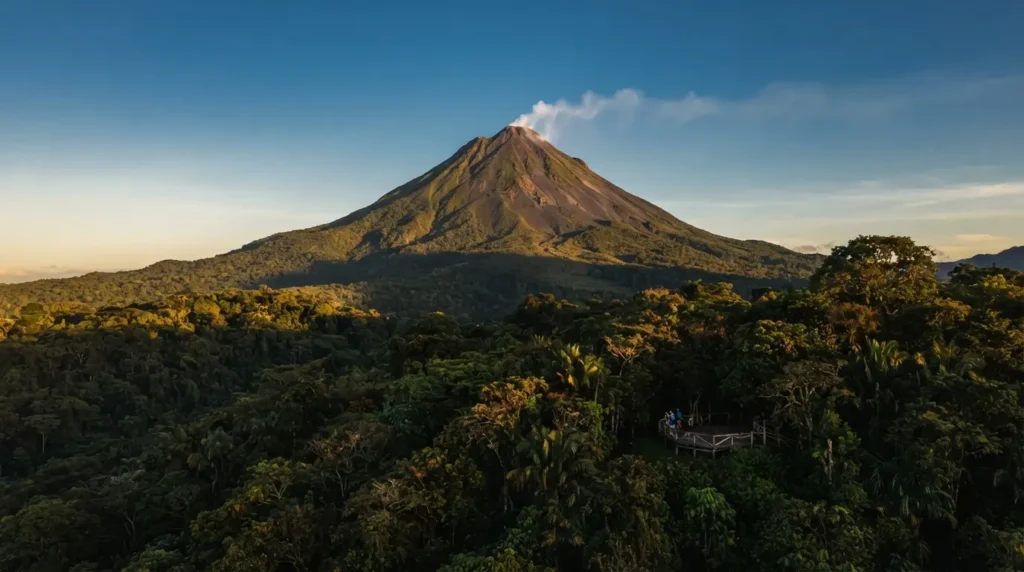
Arenal Volcano is the country’s most visited attraction and earns it. The near-perfect conical stratovolcano last had a major eruption in 2010 and remains active, emitting steam from its summit. Views of the volcano are best in the morning before cloud builds around the upper cone — a consistent pattern that means early risers see the complete profile and everyone else sees cloud. The town of La Fortuna at the volcano’s base is the functional hub, with enough restaurants, hotels and tour operators to build any version of the experience.
The thermal springs heated by Arenal’s geothermal activity — Tabacón, Baldi, EcoTermales — are the evening activity. Soaking in volcanic hot water while watching the illuminated volcano above is the specific combination that visitors consistently cite as the best night in Costa Rica. A Arenal Volcano and La Fortuna waterfall day tour covers the volcano viewpoints, the 70-metre Catarata del Toro waterfall and the thermal springs in one day with transport.
Monteverde — the cloud forest at altitude
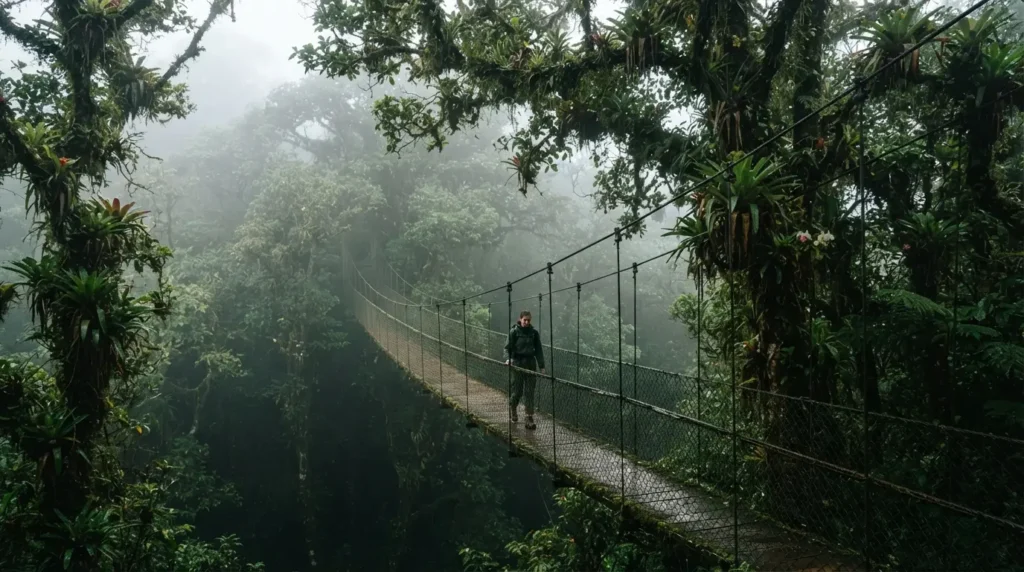
Monteverde sits at 1,440 metres above sea level, where the Caribbean trade winds meet the Tilaran mountain range and produce a cloud forest ecosystem — trees permanently shrouded in mist, bromeliads on every surface, an extraordinary concentration of bird life including the resplendent quetzal, whose iridescent green tail feathers were considered more valuable than gold by the Maya and Aztec civilisations. The quetzal is present year-round but most reliably spotted during nesting season, approximately February to April.
The hanging bridges — suspension walkways at canopy level through intact cloud forest — are the correct way to experience the ecosystem at height rather than looking up at it from the ground. A zipline across the cloud forest, for those inclined toward that kind of morning, is genuinely extraordinary. A Monteverde cloud forest hanging bridges and zipline tour covers both.
Monteverde is the coldest part of Costa Rica that most visitors reach — pack a layer.
Manuel Antonio — where the wildlife meets the beach
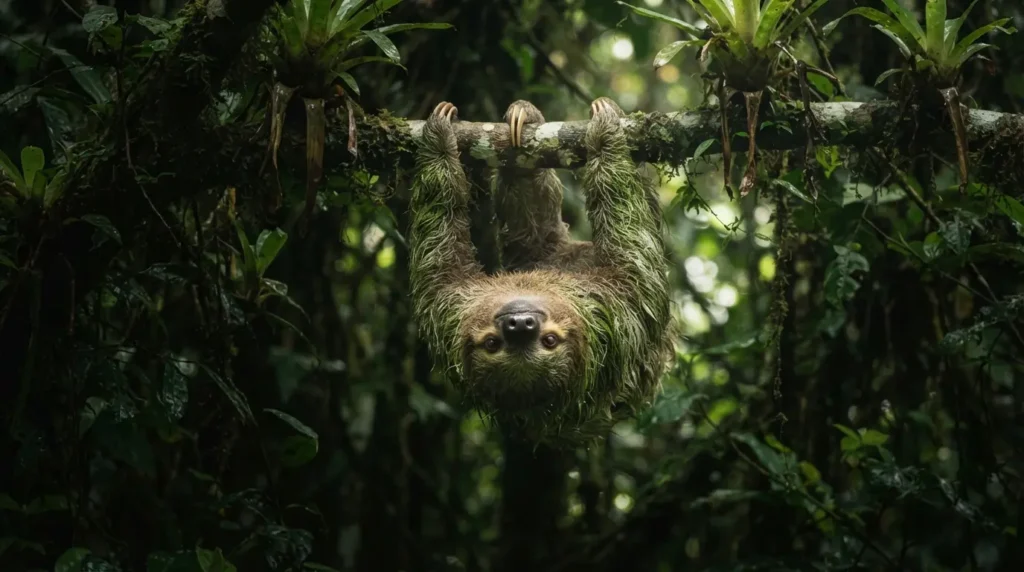
Manuel Antonio is a small national park on the Central Pacific coast that manages something genuinely unusual: three-toed sloths, white-faced and squirrel monkeys, scarlet macaws and a resident population of coatimundis all present alongside some of Costa Rica’s finest white sand beaches. The park is small enough that a guided morning visit covers the main wildlife circuits and reaches the beach by noon, where the afternoon is for swimming.
A Manuel Antonio National Park guided wildlife tour with a naturalist guide — who carries a spotting scope and genuinely knows where the animals are — is the difference between seeing a distant smudge in a tree and watching a sloth for fifteen minutes from four metres away. Take the guide. The park entry costs approximately $20 per adult; admission is timed and capped, book ahead through the official SINAC booking system.
What is the best time to visit Costa Rica in 2026?
December to April is the dry season — the clearest skies, the most comfortable conditions for hiking and beach days, and the peak season for most wildlife experiences. This is when most visitors from North America and Europe arrive and when prices are at their highest. January and February are the peak of peak.
May to November is the green season — daily rain, usually in the afternoons, transforming the landscape and reducing prices 30–50% on accommodation in most regions. The rain is predictable rather than constant: mornings are typically clear, clouds build by afternoon, rain falls for a few hours, the evening clears. Wildlife is active and lush throughout the rainy season. July and August see a brief dry spell within the rainy season (the “veranillo del buey” — the little summer of the ox) that gives manageable conditions for those months.
The Caribbean coast operates on a reversed pattern — Tortuguero and Puerto Viejo are drier in February to April and rainier in December and January. Sea turtle nesting at Tortuguero runs July to October, which is the specific reason to visit that coast in those months.
September and October in Monteverde specifically are worth noting: some cloud forest lodges and tour operators close for maintenance in September, the quietest month of the year. Check before booking.
How do you get around Costa Rica?
A rental car is the most flexible option for anything beyond a single-region stay, and the experience of driving through the rainforest and up into the cloud forest is itself part of what Costa Rica offers. Road conditions range from excellent on the main InterAmerican Highway to genuinely challenging on unpaved secondary roads — a 4WD is worth renting if you plan to visit the Osa Peninsula or more remote areas. Roads to Monteverde from Arenal involve gravel stretches that a standard sedan navigates slowly.
Shared shuttle services (Interbus, Grayline) connect the main tourist destinations — Arenal, Monteverde, Manuel Antonio, Guanacaste, San José — at reasonable prices with daily departures. This is the correct option for travellers who do not want to drive and are willing to accept the schedule constraints. Domestic flights from Juan Santamaría airport in San José reach most major destinations in 30–45 minutes and are worth considering for Osa Peninsula specifically, where the overland route takes four to five hours on unpaved road.
What does Costa Rica cost in 2026?
More than most of Latin America, less than most of Europe. Costa Rica is the most expensive country in Central America and the mid-range of its regional pricing is comparable to lower-end European destinations. A mid-range traveller — eco-lodge accommodation, restaurant meals, guided tours and transport — should budget $120–180 per person per day. Budget travellers in hostels and shared shuttles can manage $60–90. Luxury eco-lodges in Arenal and the Osa Peninsula run $300–500+ per night.
The pricing reflects infrastructure costs — building and maintaining eco-lodges in remote rainforest is expensive, conservation fees and national park entry are genuine costs, and guide requirements in protected areas add to the daily spend. The country does not try to be cheap. It tries to be worth it, and by most visitor assessments, succeeds.
You can plan your Costa Rica itinerary on PlacesToday. For how it compares to the other Americas destinations we cover, our Colombia guide and Peru guide sit at different points on the price and experience spectrum.
Frequently asked questions
Q: Is Costa Rica expensive compared to other Latin American destinations?
A: Yes — it is the most expensive country in Central America and significantly pricier than Colombia, Peru or Mexico for a comparable quality of experience. A mid-range daily budget runs $120–180 per person. The pricing reflects Costa Rica’s eco-lodge infrastructure, conservation costs and guide requirements in national parks. Most visitors conclude it is worth the premium; a few find the same wildlife experiences available at lower cost in neighbouring countries.
Q: What is the best time to visit Costa Rica?
A: December to April for the dry season: clear skies, best beach and hiking conditions, peak wildlife season. May to November for the green season: 30–50% cheaper accommodation, lush landscape, reliable afternoon rain that clears by evening. July and August have a natural dry spell within the rainy season. Sea turtle nesting at Tortuguero runs July to October — a specific reason to visit the Caribbean coast in those months.
Q: Is Costa Rica safe?
A: Yes — it is consistently one of the safest countries in Latin America. Standard urban precautions apply in San José. In national parks and beach towns, safety is not a meaningful concern for most visitors. Costa Rica has no military and has maintained political stability throughout its recent history. European visitor numbers grew 12.7% in early 2026, reflecting sustained confidence in the destination (ICT, 2026).
Q: What is the ‘pura vida’ concept in Costa Rica?
A: Literally “pure life” — and in Costa Rica, used as a greeting, a farewell, a description of something good, an expression of contentment and an entire national philosophy simultaneously. It is the correct response to asking how someone is doing, a waiter asking how your meal was, and a near miss on a mountain road. It is not ironic. The country genuinely operates at a pace and disposition that “pura vida” accurately describes.
Q: How long do you need in Costa Rica?
A: Ten to fourteen days for a trip that covers three regions — a typical combination being Arenal, Monteverde and Manuel Antonio. Seven days covers two regions adequately. Anything under five days reduces to one region and does not give you the sense of the country’s diversity that makes the flight cost worthwhile.
Costa Rica’s story is unusual because it is one of the few cases where the responsible choice and the enjoyable choice are the same trip. The country protected its forests because it made that decision decades before most other countries considered it. The forests survived. The wildlife is still there. The visitor in 2026 is the beneficiary of a very long-term bet that turned out correctly. The only remaining question is which part of it to start with. Plan your Costa Rica trip on PlacesToday →