Rome is worth visiting in any month if you understand three things: arrive at the monuments before nine in the morning, eat in Trastevere and Testaccio rather than near the Colosseum, and book the Galleria Borghese further ahead than you think you need to. Summer is the hardest season to do this city well — 60,000 to 80,000 daily visitors, midday temperatures of 32–35°C, and accommodation prices 30–40% above the shoulder season (machupicchu.org, 2026 data). It is also the only window most people have. This guide is for those people.
Most visitors to Rome eat at the restaurants nearest to the monuments they came to see. These are, almost without exception, the most expensive and least interesting restaurants in the city. They exist because visitors who have just spent three hours in a queue are hungry and do not want to walk far. This is understandable. It is also how you spend €22 on a carbonara that was made with cream.
The good restaurants are in Trastevere and Testaccio — neither of which is more than twenty minutes on foot from the Colosseum. The monuments themselves are genuinely extraordinary and deserve the inconvenience of the queue and the heat. The restaurants near them do not deserve your money. This distinction, understood before arrival, saves considerable sums and improves the trip meaningfully.
Is Rome worth visiting in summer 2026?
Yes — if you plan it correctly. The city operates year-round and its monuments do not diminish in quality because July is hot. What summer demands is a different strategy: early mornings for sightseeing, midday rest or museum visits in air conditioning, evenings for food and walking when the temperature drops to something manageable.
Summer brings the longest daylight hours — sunrise at 5:30am, sunset at 8:45pm in July — which means the best light for photography and the longest possible evenings for outdoor dining. August sees Romans leave the city for Ferragosto (15 August), which makes the residential neighbourhoods quieter while tourist zones remain busy. If you are visiting in August specifically, the week before and after the 15th is when the city breathes most clearly.
When is the best time to visit Rome in 2026?
| Season | Months | Temperature | Crowds | Price vs peak | Verdict |
|---|---|---|---|---|---|
| Spring (best) | April–May | 16–24°C | Moderate (high at Easter) | Mid–peak | Optimal: best light, best food markets, gardens in bloom |
| Summer | June–August | 28–35°C | Maximum | Peak (+30–40%) | Manageable with strategy; early mornings essential |
| Autumn (best) | Sept–Oct | 18–26°C | Falling | 10–20% below peak | Equal to spring; September still warm; October ideal |
| Winter | Nov–Feb | 8–14°C | Low | 30–40% below peak | Quiet, cheap, cold; monuments are extraordinary without queues |
Sources: machupicchu.org 2026 seasonal data; skysonar.com Rome city guide; tickets-rome.com
May is the strongest single month in Rome. The temperature sits around 22°C, the Easter crowds have cleared, the outdoor markets are full, and the gardens — Villa Borghese, the Orange Garden on the Aventine Hill, the botanical garden in Trastevere — are at their best. April is almost as good, with the caveat that Easter week brings significant crowds. September is the autumn equivalent of May. Both are considerably better than July and August, and considerably busier than November, which is the correct month for anyone who wants the monuments without the crowd.
How do you visit Rome’s monuments without the queues destroying your day?
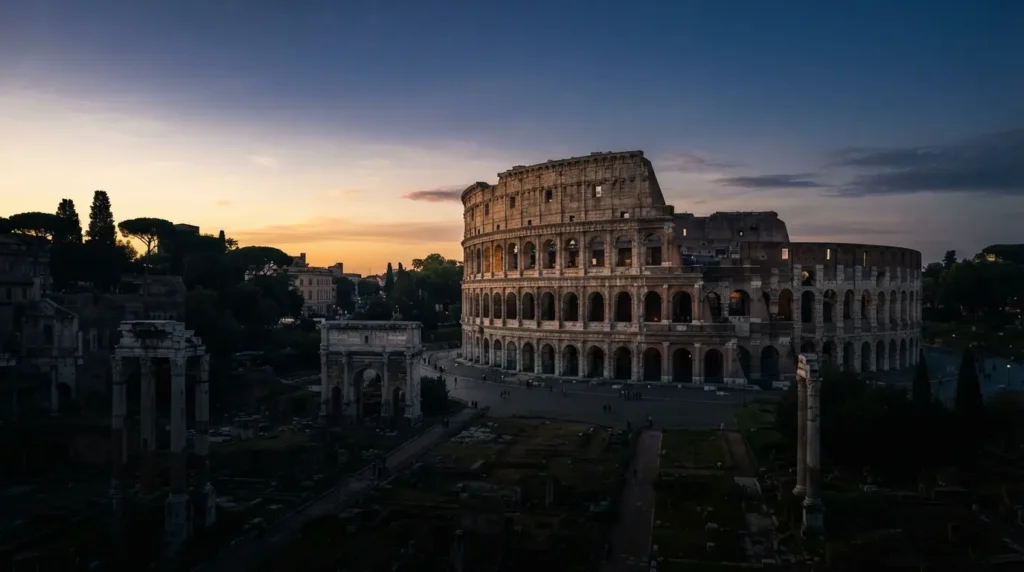
The answer is the same for all of them: before nine in the morning, with a timed entry ticket bought in advance, and on a weekday if possible. By 10:30am the Colosseum and Vatican areas have formed their characteristic queues of 2,000+ people (machupicchu.org). None of this is unavoidable with a morning start.
The Colosseum, Roman Forum and Palatine Hill
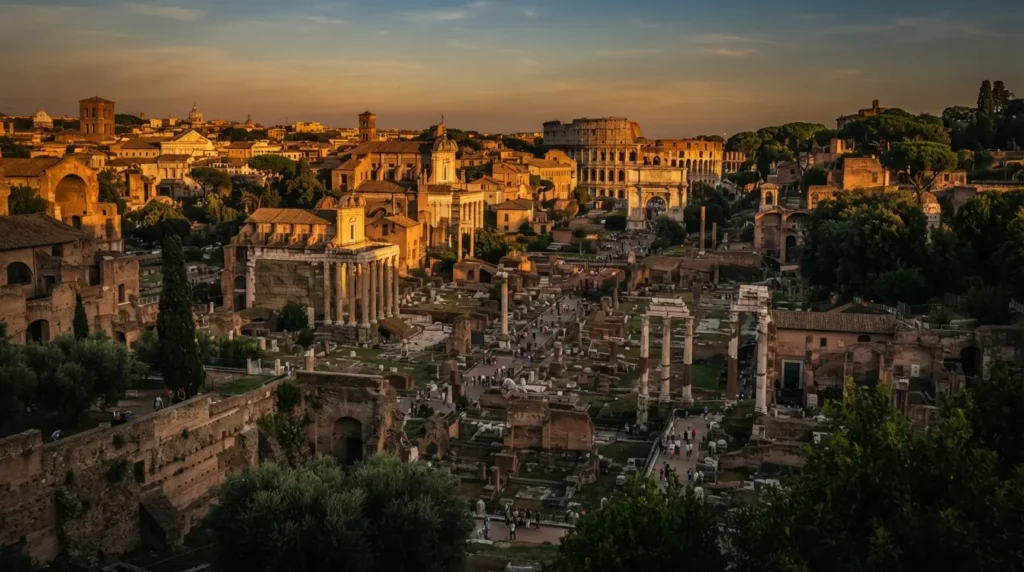
A combined ticket covers all three at €16 plus a small booking fee. Book through the official site (coopculture.it) rather than through third-party resellers, which add margins for no additional access. The Colosseum at 8am, when the gates first open, is not the same experience as the Colosseum at noon. The Forum and Palatine Hill — frequently skipped because they require more imagination to understand — are the parts of the complex that repay the most time. Standing on the Palatine Hill above the Forum, with the ruins of imperial palaces below and the Colosseum at the far end, is one of the genuinely great urban views in Europe.
A Colosseum and Roman Forum skip-the-line guided tour starts at opening time, covers all three sites with enough context to understand what the ruins were for, and finishes before the crowd arrives in force.
The Vatican — the correct approach
The Vatican Museums, the Sistine Chapel and St Peter’s Basilica require advance booking and an early start. The standard advice — arrive when the museums open at 9am — is no longer sufficient. A guided entry at 8am, which exists and is bookable, gets you into the Sistine Chapel before the crowd density makes it genuinely unpleasant. An early morning Vatican Museums guided tour with skip-the-line access is worth the premium specifically for the Sistine Chapel, which in high season by mid-morning contains hundreds of people being told not to photograph the ceiling and ignoring the instruction.
St Peter’s Basilica is separately accessed and free to enter; the queue for the basilica itself moves faster than most visitors expect. Climbing the dome (€6–8 depending on whether you take the lift) gives you the best elevated view of Rome available without a helicopter. Get there early.
Galleria Borghese — the monument nobody warns you to book
The Galleria Borghese has timed entry limited to approximately 360 visitors per two-hour slot, enforced by the gallery itself. This means it is entirely possible to stand in Bernini’s greatest work — the sculpture hall of a cardinal’s villa, containing the Apollo and Daphne, the David, the Persephone, the Aeneas — with thirty other people and adequate space and time to look at them. It is one of the great galleries of the world and operates at a scale that almost no comparable institution maintains.
Book through the official Galleria Borghese website months ahead. The gallery sells out. It does not matter that you are visiting in the low season. Most people who know about the Galleria Borghese have booked it.
Where do you actually eat in Rome?
Two neighbourhoods. Then the rest of the city as a secondary option.
Trastevere
Trastevere is where Romans have eaten on a Thursday evening for the better part of a century. The neighbourhood is across the river from the historic centre, ten minutes’ walk from Campo de’ Fiori, and characterised by ochre and terracotta walls, narrow lanes, and restaurants with paper tablecloths and wine lists that do not need to be impressive because the food does the work. The tourist presence here is real — Trastevere’s character is well-documented — but the ratio of serious local restaurants to tourist traps remains more favourable than anything near the Colosseum or the Trevi Fountain.
Eat here on a weekday evening when the neighbourhood operates at its normal pace. Order cacio e pepe — pasta with pecorino romano and black pepper — which in its correct form requires only three ingredients and cannot be made with cream. Order it at a place where the menu is not in four languages and the pasta is not described as “traditional Roman recipe.” Those are different things.
A Trastevere evening street food and wine tour moves through the neighbourhood’s best producers and food stops in two hours and covers the food geography properly before you start eating there independently.
Testaccio
Testaccio is Rome’s original food neighbourhood — the area built around the city’s former slaughterhouse, which explains both the neighbourhood’s working-class character and its food traditions. The market (Mercato di Testaccio) runs weekday mornings and has the best cooked food stalls in the city: supplì (fried rice balls with mozzarella), porchetta rolls, and artichokes cooked the Roman way — alla giudìa, deep-fried until they open like chrysanthemums, or alla romana, braised with mint and garlic. The offal tradition — tripe, oxtail, sweetbreads — that most visitors to Rome avoid is here done seriously and correctly.
Testaccio is a twenty-minute walk from the Colosseum. Most people visiting the Colosseum do not go to Testaccio. This is why most people visiting the Colosseum eat bad carbonara.
What to order and what to avoid
Carbonara (guanciale, egg yolk, pecorino romano, black pepper — no cream, no mushrooms, no peas). Cacio e pepe. Amatriciana (tomato, guanciale, pecorino). Supplì. Pizza al taglio (by-the-slice, available everywhere, legitimately excellent). Artichoke in either form. Coda alla vaccinara (oxtail stew) at a Testaccio restaurant. Gelato from a gelateria where the product is stored in covered metal containers rather than piled in a mound — the mound is invariably full of air and colouring agent. The coperto (cover charge of €2–4 per person) is standard and is not a scam.
Avoid anything described as “authentic” on a chalkboard facing the Trevi Fountain. Avoid the hop-on-hop-off bus entirely — Rome’s historic centre is small enough that walking between major sites takes twenty minutes (skysonar.com, 2026). Avoid any restaurant where someone stands outside urging you to enter.
Which Roman neighbourhood should you stay in?
Monti is the correct answer for most first-time visitors. It is the closest residential neighbourhood to the Colosseum, walkable to the Forum and within easy distance of the Trevi Fountain, and operates as a proper neighbourhood rather than a tourist facility. Restaurants in Monti are priced for Romans who live there, which is a different calculation from the restaurants visible from the Colosseum.
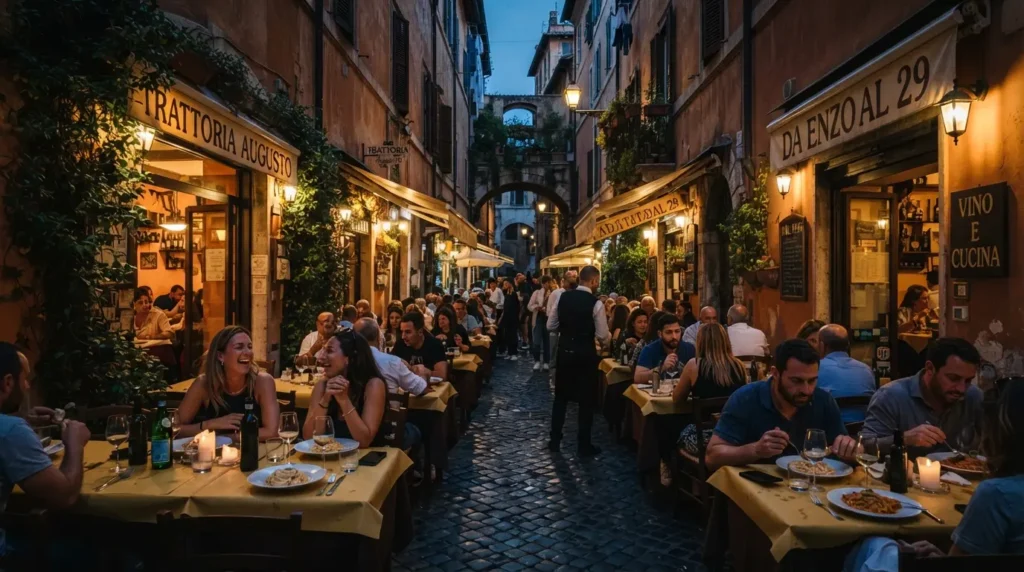
Trastevere suits visitors who want to be in one of Rome’s most atmospheric neighbourhoods and do not mind a ten-minute walk or taxi to the main monuments. Prati, directly across the river from the Vatican, is convenient for anyone spending significant time in the Vatican area and has a calmer, more local character than the immediate Piazza Navona vicinity. Termini and the immediate area around it offer budget accommodation and nothing else of particular note.
What does Rome cost in 2026?
Budget travellers in hostels and eating street food and pizza al taglio: €80–120 per day. Mid-range travellers in a decent hotel in Monti or Trastevere, eating restaurant meals twice a day: €170–255 per day. These are 30–40% higher in July and August than in November–March (machupicchu.org). The tourist tax adds €3–7 per person per night depending on the accommodation category — it is charged at check-in and does not appear in the booking price.
The Roma Pass 72-hour card costs €58.50 and covers two museum entries and unlimited metro and bus use — worth calculating against your specific itinerary before buying. Most of Rome’s most-visited monuments are in the historic centre, which is walkable without using the metro at all. The Colosseum and Vatican, the two non-negotiable paid entries, cost €16 and €17 respectively plus booking fees. Galleria Borghese is €15 plus a mandatory €2 booking fee and is worth every cent of both.
You can plan your Rome itinerary — including how to combine it with the rest of Italy — on PlacesToday. For how Sicily compares as an alternative Italian base, our Sicily summer guide covers the choice between north and south Italy in detail.
Frequently asked questions
Q: Is Rome worth visiting in summer 2026?
A: Yes, with the right strategy. Arrive at monuments before 9am, plan a rest or museum visit in air conditioning during midday, and eat in Trastevere or Testaccio rather than near the tourist sights. The city in summer has maximum daylight hours and long warm evenings that are genuinely its best feature.
Q: How far in advance should you book the Colosseum and Vatican?
A: The Colosseum: book at coopculture.it as soon as your dates are confirmed — peak summer slots sell out weeks ahead. The Vatican Museums: similarly, book the official site or a guided entry weeks ahead. Galleria Borghese: book at galleriaborghese.it months ahead. This is not an exaggeration. The gallery has strict visitor limits and sells out regardless of season.
Q: What is the best neighbourhood to stay in for a first Rome visit?
A: Monti. It is the closest walkable neighbourhood to the Colosseum, has genuine Roman character rather than tourist infrastructure, and restaurants priced for the people who live there rather than for people who just walked out of the Forum.
Q: What is the coperto charge in Rome restaurants?
A: The coperto is a cover charge of €2–4 per person, added to the bill at most traditional restaurants. It covers bread and the table service. It is a standard practice and not a scam — budget for it as part of the meal cost rather than expecting to avoid it.
Q: How much does the Vatican cost to visit in 2026?
A: Vatican Museums and Sistine Chapel: €17 plus booking fee for standard tickets. Guided early morning entry (before general opening, the best option for the Sistine Chapel) costs more but is significantly better value for the experience. St Peter’s Basilica entry is free; climbing the dome costs €6–8. Book everything in advance through the official Vatican Museums website.
Rome does not require good conditions to be extraordinary. It requires arriving before the heat and the crowds make the extraordinary things uncomfortable to experience. Go early. Eat where the Romans eat. Book the Borghese the moment you decide to go. The city will do the rest. Plan your Italy trip on PlacesToday →