The Edinburgh Festival Fringe 2026 runs from 7 to 31 August — three and a half weeks during which Scotland’s capital becomes the world’s largest performing arts festival, hosting over 3,500 shows across more than 300 venues simultaneously. In 2025 it sold 2.6 million tickets and featured performances from 68 countries. Edinburgh in August is not the city’s finest hour in terms of accommodation availability or restaurant queue length. It is, however, completely extraordinary if that is what you are after, and there is nothing else quite like it.
The Edinburgh Fringe began in 1947 when eight theatre companies arrived uninvited to perform alongside the official Edinburgh International Festival and staged their shows wherever they could find a venue. That structural principle — anyone with a performance and a space can participate — has never changed. The result is a festival of 3,500+ shows ranging from future-award-winning comedy to experimental theatre in a basement that seats eleven people, from children’s circus to spoken word in a converted whisky bond. The ratio of extraordinary to ordinary is roughly what you would expect when this many people perform this many things simultaneously over three weeks.
The city in August is genuinely unlike any other city at any other time of year. The Royal Mile becomes a continuous outdoor performance. Every pub has a flyerer outside it. Every church hall has been converted into a temporary theatre. The scale of it is disorienting on the first day and entirely natural by the third. Book your accommodation first, before anything else. This point cannot be made too emphatically.
What is the Edinburgh Festival Fringe 2026?
The Fringe is the world’s largest performing arts festival, running concurrently with the Edinburgh International Festival, the Royal Edinburgh Military Tattoo, the Edinburgh Art Festival, the Edinburgh International Book Festival and the Edinburgh International Film Festival. Together, these events make August in Edinburgh one of the most concentrated cultural experiences available anywhere.
The Fringe specifically is characterised by its open-access model: there is no selection committee, no curatorial process. Any performer who can secure a venue can take part. This produces a festival of extreme range, which is simultaneously its appeal and its challenge. Navigating 3,500 shows across 25 days requires strategy, a degree of tolerance for the unknown, and a willingness to leave a show after twenty minutes if it is not working. The Fringe has its own etiquette about this: walking out is understood, accepted and not considered rude.
The official Fringe website lists all shows with descriptions, reviews and booking. The Fringe app allows filtering by genre, venue, date and price. Both are essential tools.
When during the Fringe should you visit in 2026?
The timing within the festival’s three-and-a-half weeks materially affects the experience.
| Period | Dates | Shows | Crowds | Accommodation | Best for |
|---|---|---|---|---|---|
| Preview week | Aug 7–9 | Most running | Lighter | More available | Budget; experienced Fringe visitors |
| Early Fringe | Aug 10–16 | Full programme | Building | Tight | Good balance of access and atmosphere |
| Peak | Aug 17–24 | Full + sell-outs | Maximum | Nearly all booked | First-timers wanting full atmosphere |
| Final weekend | Aug 25–31 | Some closing | Very high | Fully booked weeks prior | Last-chance energy; more relaxed daytime |
Sources: edfringe.com 2026 programme; visitscotland.com seasonal data; findingtheuniverse.com 2026 local guide
The preview week (August 7–9) is the most useful period that most visitors ignore. Shows are cheaper — performers often discount preview tickets to build word-of-mouth — audiences are smaller, and the city is not yet at maximum density. Experienced Fringe attendees consistently recommend previews for exactly this reason: the same show that costs £18 on August 20 costs £8–12 in preview week, and the performer is often working harder for a smaller room.
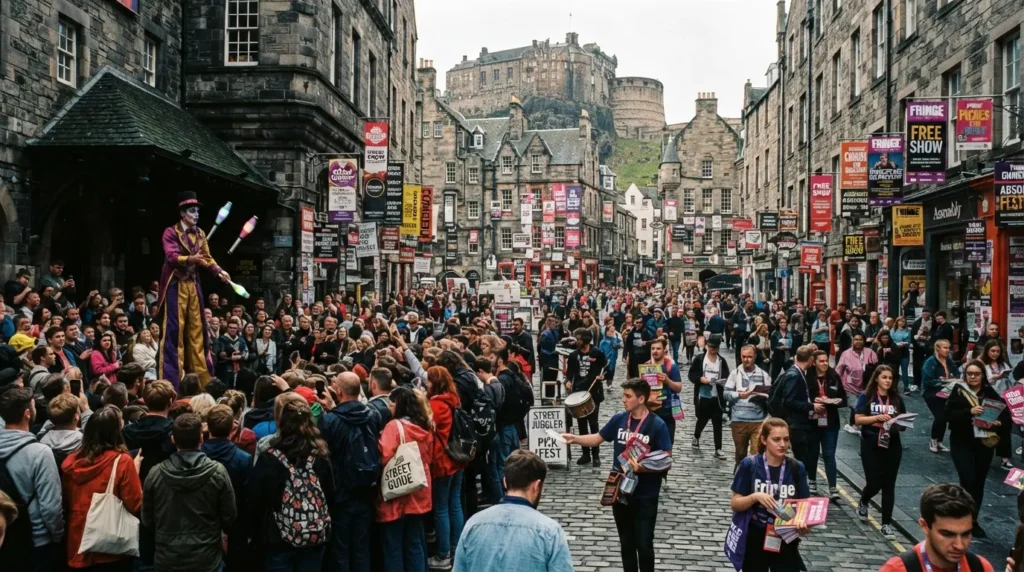
The final weekend has its own distinct atmosphere — the slightly elegiac quality of a large event winding down, performers at their most polished after weeks of refinement, and the city beginning to exhale. Book years ahead, not weeks, for accommodation during that period.
How do you book tickets for the Edinburgh Fringe?
You book through the official Fringe Box Office at edfringe.com or through individual venue box offices. Tickets open in June for the August festival. The most sought-after shows — established comedians, shows that have already received press attention — sell out within hours of going on sale. If you have specific shows in mind, set a calendar reminder for the box office opening date.
For a first visit, the more useful strategy is to arrive with a framework rather than a full schedule. Book two or three shows you specifically want to see, then fill the rest of your time with the Fringe’s most underused feature: the random show.
The show selection problem
3,500 shows is genuinely too many to browse meaningfully. The better approach: go to a venue you trust (Pleasance Dome, Summerhall, Traverse Theatre, and the newly reopened Gilded Balloon Teviot — closed since 2023 for renovation, returning to the 2026 programme — are the reliable anchors), look at what is on in the next hour, read the description, and book if it sounds interesting. The shows most Fringe veterans remember are almost never the ones they planned to see.
Free Fringe and free shows
A significant portion of the Fringe is free. Street performances on the Royal Mile operate from morning until late every day at no cost. The Free Fringe and PBH Free Fringe programmes list paid-entry shows that operate on a donations basis — these are often where the most unexpected discoveries happen. On a tight budget, a week at the Fringe is entirely possible spending nothing on tickets and experiencing fifty or sixty free performances.
Where shows actually happen
Pleasance Dome and its Courtyard have been the Fringe’s centre of gravity since 1985 — a former industrial site converted into multiple performance spaces, with outdoor courtyard bars that function as the festival’s informal social hub between shows. Summerhall, the former Edinburgh Royal (Dick) Vet School, is the venue for the more experimental and international work. The Traverse Theatre, a year-round venue, programmes the best new playwriting. A Royal Mile and Old Town walking tour covers the geography of the festival’s main corridors and is worth doing on arrival to understand where everything sits in relation to everything else.
Where should you stay for the Edinburgh Fringe?
As close to the Old Town as the budget allows, booked as far ahead as possible.
The standard advice applies here with unusual force: Edinburgh in August has approximately 3 million visitors competing for accommodation in a city of 550,000. Hotels, guesthouses and short-term rentals in central Edinburgh book out months in advance for August. Anyone reading this in July and hoping to find a good room for August should search immediately for whatever remains and accept that the options will be limited and expensive.
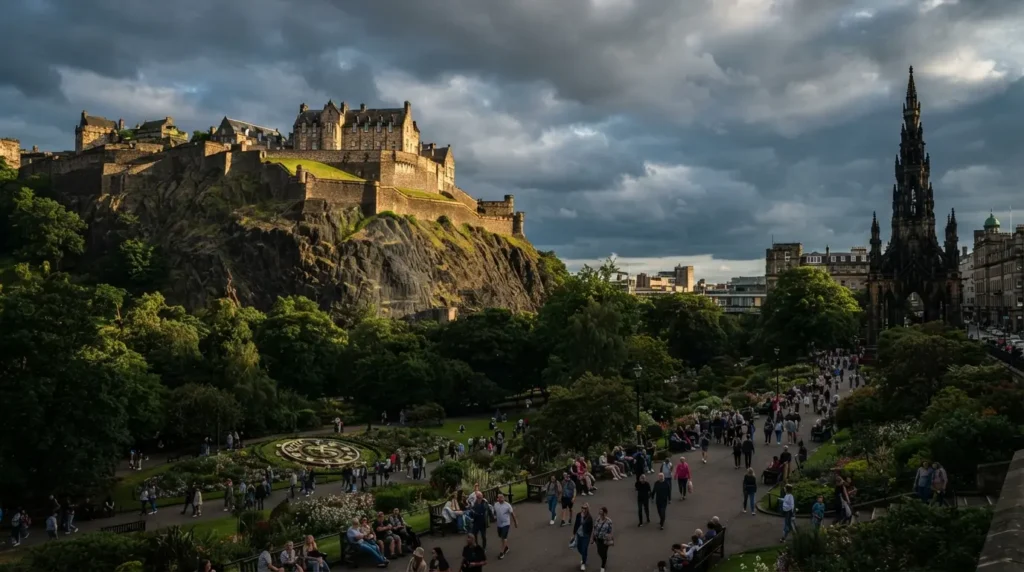
The practical alternatives: the city’s outer neighbourhoods (Leith, Portobello, Bruntsfield, Morningside) are all connected by bus and run 20–40% cheaper than the Old Town for the same standard of accommodation. New Lanark, North Berwick and even Glasgow function as bases for day visits during the festival, though the commute adds an hour to the day. Camping and glamping options in the Lothians are available and completely viable for those who plan ahead.
Budget matters here because Edinburgh in August is not cheap. A mid-range hotel room in central Edinburgh runs £200–350 per night during peak Fringe weeks. A private room in a guesthouse runs £100–180. Hostel dorms run £30–60. These are significantly above the city’s normal rates and are not negotiable by late July.
What else is happening in Edinburgh in August 2026?
The Fringe runs alongside six other major festivals, all happening simultaneously.
The Edinburgh International Festival (7–30 August) is the curated counterpart to the Fringe’s open-access model — world-class opera, classical music, theatre and dance performed at the Usher Hall, Festival Theatre and other major venues. Tickets are more expensive than the Fringe and more reliably excellent. The Royal Edinburgh Military Tattoo (7–29 August) stages nightly performances of military bands, pipe and drum corps and international performers on the Castle Esplanade — one of the most atmospheric outdoor performances available in the UK, with the castle as the backdrop. Book well ahead; it sells out annually, according to VisitScotland’s official festival listings.
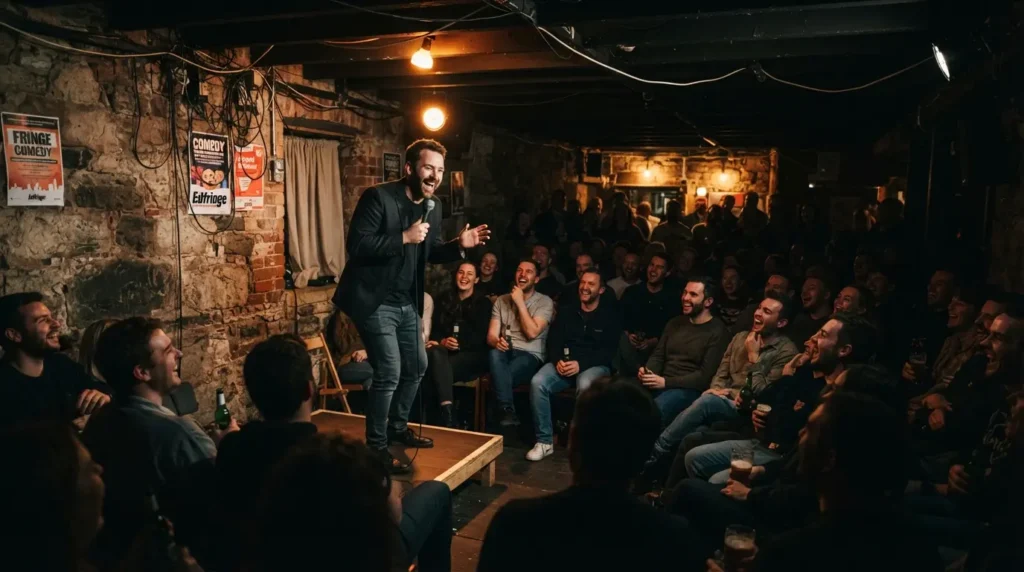
The Edinburgh Art Festival (14–30 August), the International Book Festival (15–30 August) and the International Film Festival (13–19 August) run as parallel strands, most with free or low-cost entry. The net result is that August Edinburgh is not simply a comedy festival with some theatre attached — it is the largest concentrated cultural event in the English-speaking world, and most of it is either free or affordable.
How do you get to Edinburgh for the Fringe?
The train from London is the most practical option for UK visitors and increasingly popular with European visitors. LNER operates direct services from London King’s Cross to Edinburgh Waverley in approximately 4 hours and 20 minutes. Book through LNER’s booking platform as early as possible — Fringe period trains sell out and prices increase significantly with proximity to departure. Advance fares from London start around £30–50 each way; walk-on prices during August peak are considerably higher.
Flying is faster from London (around 1 hour 20 minutes) and often cheaper when booked ahead, with Edinburgh Airport served by most UK carriers and many European airlines. The tram runs directly from Edinburgh Airport to the city centre in about 30 minutes. For European visitors arriving by plane, the Edinburgh Airport to city centre journey is quick enough that staying in the centre rather than near the airport makes consistent sense.
International visitors should note that a UK Electronic Travel Authorisation (ETA) is required for most non-UK nationals before entry, including EU citizens. Apply via the UK government website well ahead of travel.
What does the Edinburgh Fringe actually cost?
More than a normal Edinburgh trip, less than most visitors assume for the cultural content on offer.
Accommodation is the dominant cost — budget £100–350 per night depending on standard and location, with the caveats above about booking ahead. Show tickets typically run £8–20 for most Fringe shows; the Free Fringe runs on donations; street performances cost nothing. Food in Edinburgh during August is entirely normal Edinburgh pricing — meals from £8–15 at cafés, £15–30 at restaurants, higher at the more prestigious addresses. The festival itself adds no pricing premium to food outside venue bars, which are priced as bars.
A mid-range four-day Fringe trip — London to Edinburgh return by train, three nights in a mid-range guesthouse, six or seven ticketed shows, meals, and festival atmosphere — runs approximately £600–900 per person when booked ahead. This is reasonable value for the concentration and quality of cultural experience on offer and considerably less expensive than a comparable programme of ticketed arts events in London or New York.
An Edinburgh Castle guided tour is worth booking for the non-festival context — the castle is genuinely extraordinary and the Scottish Crown Jewels and Stone of Destiny are inside. It makes more sense before the Fringe exhaustion sets in than after.
For solo visitors in particular, the Fringe’s social infrastructure — the courtyard bars at Pleasance, the shared tables at Summerhall, the queues that become conversations — makes Edinburgh in August one of the more naturally sociable travel experiences available. Our solo female travel guide covers Edinburgh specifically as one of Europe’s highest-rated cities for solo travellers.
Frequently asked questions
Q: When does the Edinburgh Fringe 2026 start?
A: The Edinburgh Festival Fringe 2026 runs from 7 to 31 August, with preview performances from 3 August. The parallel Edinburgh International Festival runs 7–30 August, the Military Tattoo 7–29 August, and the Book Festival 15–30 August. The full programme is available at edfringe.com.
Q: How far in advance should you book Edinburgh Fringe accommodation?
A: As early as possible — months ahead for August. Central Edinburgh accommodation sells out during the Fringe faster than at almost any other festival in the UK. Anyone without confirmed accommodation by June for peak Fringe weeks (17–24 August) should be looking at outer neighbourhoods, nearby towns or cancellation availability. Book first, then sort the show programme.
Q: Can you do the Edinburgh Fringe on a budget?
A: Yes. The Free Fringe, PBH Free Fringe, and Royal Mile street performances provide a full programme at no ticket cost. Four days at the Fringe spending nothing on show tickets, staying in a hostel dorm (£30–60 per night), and eating at cafés (£8–15 per meal) is entirely possible and a legitimate version of the experience. The main unavoidable cost is accommodation; everything else scales with budget.
Q: Do you need tickets in advance for the Edinburgh Fringe?
A: For specific popular shows, yes — book through edfringe.com when the box office opens in June. For a flexible programme of discovery, booking ahead is useful but not essential. Many shows have same-day availability, and the walk-up queue culture is part of the Fringe experience. The Royal Mile street performances and Free Fringe events need no booking at all.
Q: What is the difference between the Edinburgh Fringe and the Edinburgh International Festival?
A: The Fringe is open-access — any performer can participate — and is the world’s largest arts festival by number of shows (3,500+). The Edinburgh International Festival is a curated programme of world-class opera, classical music and theatre, running simultaneously. Both happen in August. Most visitors experience both without particularly distinguishing between them.
Edinburgh in August is the city at its most impractical and its most alive. The accommodation situation is what it is. The queues for popular shows are what they are. The Royal Mile is, by any reasonable definition, too busy. None of this changes the fact that it is extraordinary and that the cultural density on offer for three weeks is available nowhere else on earth. Book the accommodation first. The shows will follow. Plan your UK trip on PlacesToday →