Bali in 2026 is worth visiting — but Canggu, Ubud and Seminyak are not the same places they were five years ago, and knowing which version of the island you are booking matters more than it used to. The tourist levy is $10 USD per person, payable online before arrival at lovebali.id and enforced by QR code at immigration. Hotels in the popular areas spike 40–60% in July and August (voyaige.to, 2026). Traffic at rush hour in Canggu and Ubud is genuinely bad. Sidemen, Amed and Munduk are still the Bali most visitors came looking for. This guide tells you which parts of the island are which, and what to expect from all of them.
Bali spent twenty years becoming everyone’s idea of a tropical escape. At some point the idea became the problem. The island now receives more visitors than it can comfortably process in its most famous areas, and the gap between what the photographs show and what the experience delivers — specifically in Ubud’s centre, Canggu at 5pm, and the Tegallalang rice terraces between nine in the morning and noon — is the gap most people do not know to account for when they book.
This is not a guide that tells you to skip Bali. The island is genuinely beautiful, the food is genuinely good, the Hindu temple culture is genuinely unlike anything else in Southeast Asia, and the sunrise from a volcano is the kind of morning that stays with you. It is a guide that tells you which parts of Bali are which, because they are very different from each other, and the version of Bali that matches what most people came for is often not the one they have booked.
Is Bali still worth visiting in 2026?
Yes — for the right traveller with the right expectations. Bali in 2026 rewards the visitor who goes beyond the headline areas, visits temples and rice terraces early in the morning, and builds at least one or two nights in the quieter east or north of the island into the trip.
Bali has implemented a “Quality Tourism” initiative in 2026 that includes new financial screening requirements (potentially requiring bank statements proving adequate funds), mandatory tourism levies enforced via QR code, and an integrated digital entry system (traveltourister.com, 2026). These measures are designed to attract longer-staying, higher-spending visitors and manage overtourism. In practice, the most visible change for most arrivals is the $10 tourist levy payable before landing. Everything else is manageable with advance preparation.
The honest assessment: first-time leisure travellers who want beach relaxation and resort infrastructure are often better served in that particular goal by Thailand or Vietnam, where the infrastructure has not reached the same pressure point. Travellers who want cultural depth, volcano trekking, rice terrace landscapes, genuine Hindu temple culture and Balinese food are still better served by Bali than anywhere else in Southeast Asia.
What is Bali’s tourist levy in 2026?
All international visitors pay a mandatory tourism levy of $10 USD per person, introduced in February 2024 and still in effect. Pay online before arrival at lovebali.id — the payment generates a QR code that is scanned at immigration in Denpasar airport. Paying in advance takes about five minutes. Not paying requires processing at the airport, which is slower. Most nationalities visit Indonesia visa-free for up to 30 days; check current requirements if you are unsure about your passport.
Which Bali area is right for you?
The island’s areas are genuinely different. Getting this decision right shapes the whole trip.
| Area | Best for | Vibe | Crowd level | Price level |
|---|---|---|---|---|
| Canggu | Digital nomads, surfers, café culture | Trendy, energetic, Instagram-forward | High, traffic-heavy | Mid–high |
| Seminyak | Couples, luxury beach clubs | Upscale, polished, resort-oriented | High | High |
| Ubud | Culture, wellness, rice terraces | Spiritual, hectic at its centre | Very high in centre | Mid–high |
| Uluwatu | Surfing, cliffs, Kecak fire dance | Dramatic, coastal | High at sunset | Mid–high |
| Sidemen | Quiet, rice terraces, genuinely local | Rural, peaceful, old Bali feel | Low | Budget–mid |
| Amed | Diving, snorkelling, slow travel | Very quiet, local fishing village | Low | Budget |
| Munduk | Mountains, coffee, waterfalls | Cool, misty, remote | Very low | Budget–mid |
| Sanur | Families, quiet beach, early risers | Calm, residential, local | Moderate | Mid-range |
Sources: alhijaztravelsandtours.com 2026 Bali guide; voyaige.to Bali area guide; traveltourister.com 2026 Quality Tourism data
Most first-time visitors stay in Canggu, Seminyak or Ubud because they appear most in the Bali content that preceded the trip. All three are functional bases and genuinely have things to offer. The question is whether the experience on the ground matches the expectation those areas have built.
What has actually changed about Ubud and Canggu in 2026?
More than the photographs suggest. Less than the most pessimistic accounts imply.
Ubud — still excellent, plan around the crowds
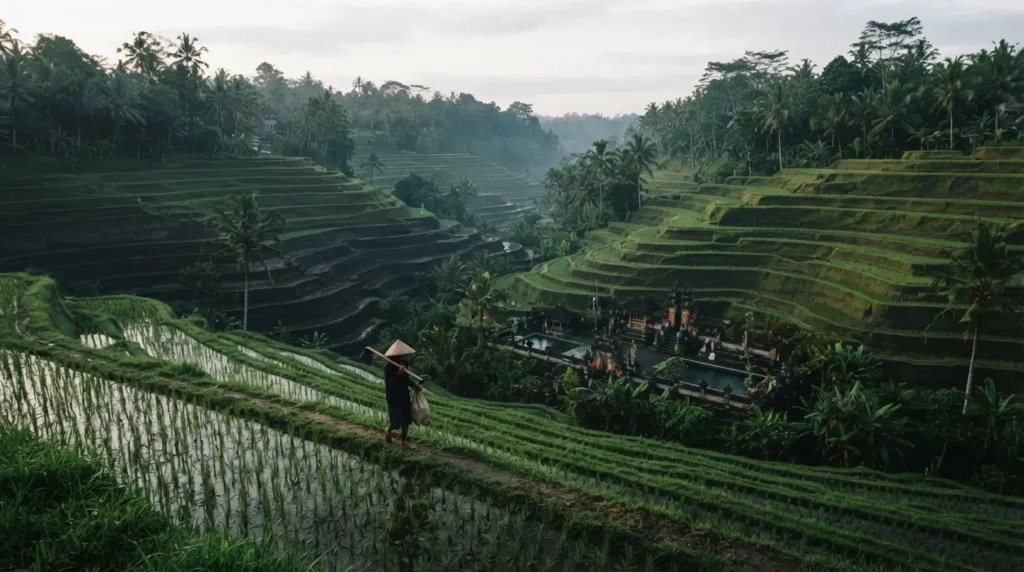
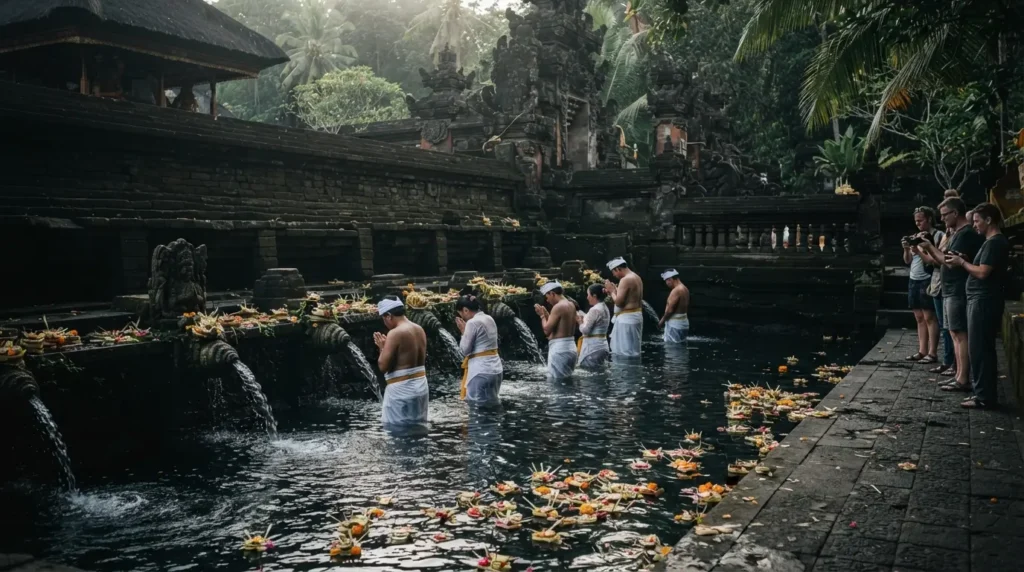
Ubud’s centre — the main market, the Monkey Forest road, the palace — has reached the kind of tourist concentration that makes midday movement there a slow shuffle. The rice terraces at Tegallalang, Ubud’s most photographed sight, are roped off at their most Instagram-friendly angles and staffed by vendors selling identical experience packages. None of this is unique to 2026; it has been true for several years. What remains true is that the Campuhan Ridge Walk at 6am is one of the genuinely lovely morning walks in Southeast Asia. Pura Tirta Empul — the water purification temple east of Ubud — at 7am before the tour coaches arrive is profound and accessible. Cooking classes at family compounds in the surrounding villages are excellent and substantially unchanged. The food in Ubud, at the right restaurants, is excellent.
A Balinese cooking class and Ubud market tour is the morning activity that most consistently delivers on Ubud’s promise — two hours at the market learning the ingredients, two hours cooking, the meal at the end. This version of Ubud still works.
Canggu — for the right traveller
Canggu is excellent if you came specifically for the café culture, the left-hand surf breaks (one of the most accessible in Bali), and the digital nomad ecosystem of co-working spaces and quality coffee. It is genuinely built for this and delivers it well. It is also, at 5pm on most days, one of the more frustrating traffic experiences available in Southeast Asia. The roads were not designed for the volume of scooters and rideshare apps now using them. If this tradeoff suits you — mornings in a great café, afternoons on the wave, evenings at a warung — Canggu works. If you came for a tropical escape from urban density, it has become urban density with better smoothie bowls.
Which parts of Bali are still genuinely peaceful?
Three areas that most visitors to Bali never reach, all worth building into a longer trip.
Sidemen — the rice terrace alternative to Ubud
Sidemen, in east Bali, is what Ubud’s surroundings look like without the tourist infrastructure. Terraced rice paddies climb the slopes of Gunung Agung, Bali’s sacred volcano and highest peak, and the valley floor has a handful of guesthouses and warungs that serve local food at local prices. Mount Agung’s profile dominates the eastern skyline on clear mornings. There are almost no shops selling the same carved wooden items that fill every Ubud street. Two nights here, combined with Ubud, covers what most people came to Bali for at a fraction of Ubud’s crowd level.
Amed — for divers and people who want the island to slow down
Amed is a string of fishing villages along the northeast coast, four hours from Seminyak by road. The coral reefs here are some of Bali’s best preserved, which makes it the correct base for snorkelling and diving. The Japanese shipwreck off the coast at Tulamben is one of the most accessible wreck dives in Asia. The village atmosphere is genuinely local — fishing boats go out at night, the catch comes in at dawn, the road through the villages is narrow and quiet. Accommodation costs a third of equivalent quality in Seminyak.
Munduk — mountains, coffee and waterfalls at altitude
Munduk sits at 950 metres in Bali’s central mountains, surrounded by clove and coffee plantations, lake views, and waterfalls. The temperature here runs 15–22°C rather than the coastal 28–32°C, which makes it the correct destination for anyone who finds Bali’s heat overwhelming. The drive up through the mountain villages is itself worth the trip. Almost no one is here compared to the south. It works as a one or two-night stop between Ubud and the north coast.
Should you also visit Lombok or the Gili Islands?
Yes, if your trip is long enough. Both are reachable from Bali by fast boat or short flight and cover a different register from anything in Bali itself.
Lombok is approximately ten years behind Bali in tourism development, which is the reason to go. The south coast’s Kuta (Lombok’s Kuta, completely different from Bali’s) has long white sand beaches, excellent surfing, and almost no commercial development beyond a handful of surf camps and guesthouses. Mount Rinjani, Indonesia’s second highest volcano, is one of the great multi-day treks in Southeast Asia. The island is large enough that getting away from the few tourist areas is easy.
The Gili Islands — three small islands off Lombok’s northwest coast — divide cleanly by travel style. Gili Trawangan is the party island: bars, clubs, backpackers, enough nightlife that sleep is an optional extra. Gili Meno is the quiet one: a handful of resorts, the underwater statue garden for snorkelling, and the closest thing to a deserted island available in the area. Gili Air sits between the two — social enough, calm enough, the best food of the three. For couples specifically, Gili Meno is the Gili island to choose. All three are motor-vehicle-free, which gives them a particular quality of quiet that Bali’s road network does not provide.

When is the best time to visit Bali in 2026?
April to June and September to October are the optimal windows — the tail and beginning of the dry season, before the July–August crowds arrive and after they leave. July and August are Bali’s peak: Australian school holidays, European summer breaks, and Indonesian domestic tourism converge, pushing hotel prices 40–60% above shoulder season in popular areas and filling the main temples and rice terraces by mid-morning (voyaige.to). If July or August is your only option, go — you will still have a good trip — but book accommodation months in advance and accept that popular sights require earlier mornings than you would otherwise choose.
The wet season (November to March) brings afternoon downpours but mornings are usually clear and prices drop substantially. Nyepi — the Balinese Day of Silence, Bali’s Hindu New Year, usually in March — closes the entire island for 24 hours including the airport. It is a genuinely remarkable cultural experience if you are in Bali for it and a logistical problem if your flight falls on it. Check the date before booking March travel.
What does Bali cost in 2026?
Mid-range travel — private villa or boutique hotel, restaurant meals, day trips — runs $80–130 per person per day (alhijaztravelsandtours.com, 2026). Budget travellers in guesthouses and local warungs can manage $30–50. Prices in Canggu and Seminyak now approach those of comparable Thai or Vietnamese destinations, without the same public transport infrastructure. In Amed, Sidemen and Munduk, costs run 30–50% lower than Seminyak for equivalent quality.
The tourist levy ($10 per person) is payable at lovebali.id before arrival. A Mount Batur sunrise trek with guide costs approximately $50–70 per person and is significantly better done through a reputable operator than independently, both for safety and for the quality of the experience. A Mount Batur sunrise trek from Ubud picks you up at 2am, reaches the summit for sunrise, and is back by mid-morning — one of the more reliable ways to earn a breakfast.
A Nusa Penida day trip with snorkelling from south Bali covers the island’s sea cliffs and the Manta Point snorkelling site — one of the most reliably beautiful day trips from Bali. Nusa Penida is reachable by fast boat from Sanur in 30–45 minutes. The cliff scenery is extraordinary and largely undeveloped; the sea snorkelling with manta rays is possible year-round.
You can plan your Bali itinerary on PlacesToday, including how to balance Ubud, the coast and the quieter east. For how Thailand compares as an alternative base, our Thailand rainy season guide covers the SE Asia decision in detail.
Frequently asked questions
Q: Is Bali worth visiting in 2026?
A: Yes, with the right approach. The island is genuinely beautiful, the Hindu culture is unlike anything else in Southeast Asia, and the food at good warungs and local restaurants is excellent. The main adjustment required in 2026 is building the itinerary around the quieter areas (Sidemen, Amed, Munduk) alongside the famous ones, and visiting popular temples and rice terraces before 9am. Travellers who do this consistently report the trip matches or exceeds their expectations.
Q: How much is the Bali tourist tax in 2026?
A: $10 USD per international visitor, payable online at lovebali.id before arrival. The payment generates a QR code checked at immigration in Denpasar. This is in addition to any visa costs. Most nationalities visit Indonesia visa-free for stays under 30 days; check current requirements for your passport.
Q: When is the best time to visit Bali?
A: April to June and September to October for the best combination of dry weather, manageable crowds and reasonable hotel prices. July and August are peak season — excellent weather, maximum crowds, highest prices. The wet season (November to March) offers substantially lower prices and green, lush landscapes with rain mainly in the afternoons.
Q: What are the quietest areas of Bali?
A: Sidemen (east Bali, rice terraces and volcano views), Amed (northeast coast, diving and fishing village), Munduk (central mountains, coffee and waterfalls) and Lovina (north coast, dolphin watching) are all considerably quieter than the south. All four have accommodation and food; none have the café scene or nightlife of the south. They work best as two to three-night additions to a trip rather than as standalone bases for a first visit.
Q: Should you combine Bali with Lombok?
A: Yes if you have ten days or more. Lombok covers a genuinely different experience — emptier beaches, a serious volcano trek, and a pace that the southern Bali areas have lost. The Gili Islands are a natural stop between the two. Fast boats run from Bali’s south coast to the Gilis in two to two-and-a-half hours; Lombok’s main port (Lembar or Bangsal) is accessible from there by local transport.
Bali in 2026 still delivers what it always promised. You just need to know which part of it you are visiting, why, and when to be there before the crowd arrives. The sunrise from Mount Batur, the rice terrace at 6am in Sidemen, the underwater statues off Gili Meno — these experiences have not deteriorated. The midday queue for Tegallalang and the Canggu rush hour have. Building a trip around the former and planning past the latter is the only skill required. Plan your Bali itinerary on PlacesToday →