Tuscany in 2026 works best with a car, a week, and no more than two nights in Florence. The places that make Tuscany worth the journey — the Chianti Classico vineyards, the Val d’Orcia’s cypress-lined roads, Montepulciano above the morning fog, Montalcino and the Brunello cellars — are not on train lines. The buses exist on schedules that appear designed for local residents catching the 7:14am on a Tuesday. Rent the car before you book anything else. September is the month to do this. April to June is the alternative.
Most people who visit Tuscany do so by train. They see Florence, take a day trip to Siena, possibly pass through San Gimignano behind a tour group at noon, and return to Florence for dinner. This is a perfectly adequate way to see the named buildings of two cities. It is not a way to see Tuscany.
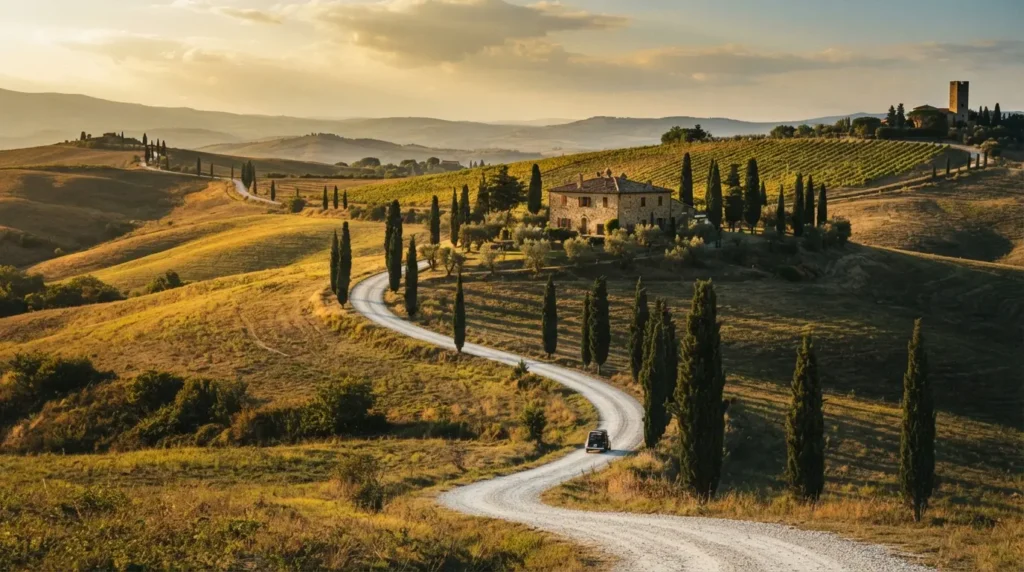
The region has nearly 58,000 hectares of vineyards. The Val d’Orcia is a UNESCO-listed cultural landscape of hills, farmhouses and cypress avenues that no train goes near. The truffle hunters in the Crete Senesi work with dogs, not departure boards. The olive oil producer outside Panzano sells direct from the farm and does not have a website. Tuscany is best understood from a car on a white gravel road in the early morning, and this is the guide for that trip.
Should you visit Tuscany in summer 2026?
Yes — but know what you are getting. Florence in July and August carries visitor density that makes certain streets and certain museums a management problem rather than a pleasure. The Uffizi gallery at 2pm on a Saturday in August has you reading the back of someone else’s phone. Arrived at 8:30am with a pre-booked slot, it is one of the great gallery experiences in the world. The difference is entirely in the planning.
The Chianti hills and Val d’Orcia in summer are, for most people, better than Florence in summer. The towns are smaller, the roads are quieter, the wine tastes the same, and the landscape — which is why people come — is at its most vivid. September specifically is when the harvest starts. The grapes come in late September; the white truffles (tartufi bianchi) from around San Miniato and Volterra start in October. These are not minor seasonal variations. They change what is on the table.
What is the Tuscany itinerary that actually works?
| Destination | Days | Best for | Key food | Drive from Florence |
|---|---|---|---|---|
| Florence | 2 | Renaissance art, Duomo, markets | Lampredotto, bistecca, crostini di fegatini | Base city |
| Siena | 1–2 | Medieval piazza, Gothic cathedral, Palio | Pici all’aglione, ricciarelli biscuits | 75 min by car |
| Chianti | 2 | Wine, olive oil, agriturismo, white roads | Brunello, Chianti Classico, bistecca | 30–60 min from Florence |
| San Gimignano | Half day | Medieval towers, before the crowds | Vernaccia di San Gimignano wine, saffron gelato | 60 min from Florence |
| Val d’Orcia | 1–2 | Landscape, Pienza, Montalcino | Brunello di Montalcino, Pienza pecorino, pici | 90–120 min from Florence |
| Lucca | Half day | Well-preserved walls, bike rides on the ramparts | Buccellato (fruit bread), tordelli pasta | 80 min from Florence |
Sources: reeltrip.com Tuscany 2026 guide; goaskalocal.com best Tuscany places 2026; visittuscany.com
A week covers Florence (two nights), Chianti as a base (two nights in an agriturismo), and the Val d’Orcia circuit with Pienza and Montalcino (two nights). A tenth night accommodates Siena on a weekday without the pace becoming a problem. This is the itinerary. Fitting everything into four or five nights means driving too much and eating too fast.
What to do in Florence without it becoming a queue management exercise
Florence has the most concentrated accumulation of Renaissance art in the world. The Uffizi alone contains Botticelli’s Birth of Venus and Primavera, works by Michelangelo, Leonardo, Caravaggio and Titian, and the entire trajectory of Italian painting from the medieval to the Baroque in one building. Michelangelo’s David is in the Galleria dell’Accademia, ten minutes’ walk away. Both require advance booking and morning arrival to be what they are capable of being.
The Duomo — the cathedral of Santa Maria del Fiore, with Brunelleschi’s dome — is free to enter and can be visited without a queue before 8am. The dome itself requires a separate ticket and a climb of 463 steps; worth doing once, best at opening time. The Piazzale Michelangelo viewpoint above the Arno is free at any time and is better at 7am or at sunset than during the hours in between.
A Florence Uffizi Gallery skip-the-line guided tour starting at opening time is worth the premium. The guide is not optional in a gallery of this size — you need someone to tell you what to look at.
What to eat in Florence
This matters more than the art, at least in terms of how well you eat for the rest of your life.
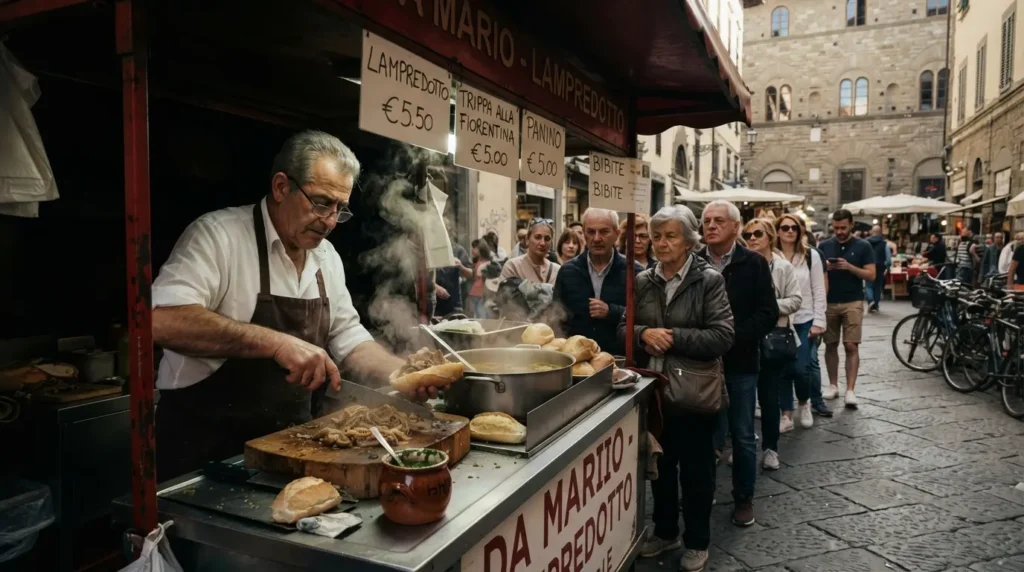
Lampredotto is the first thing. It is the fourth stomach of the cow, braised in tomato and onion broth and served in a roll with salsa verde at the street stalls (lampredottai) that operate around the San Ambrogio and Sant’Ambrogio markets and in the alleys near the Mercato Centrale. It costs approximately €5. It is the correct Florentine street food and the one most visitors do not order because the description does not help them. Order it anyway.
Bistecca alla Fiorentina is a Chianina beef T-bone of a minimum 1.5 kilograms, cooked over wood coal to rare (al sangue), seasoned only with salt, and served for the table. It is sold by weight, typically per 100 grams, and a single steak for two runs €60–80 at a serious restaurant. Do not order it medium. You will be told this by the restaurant.
Crostini di fegatini — chicken liver crostini, the standard Tuscan antipasto — and ribollita (the bread and vegetable soup that improves over two days, which is what the name means) are the two other things to order before anything more complicated appears on the menu.
Why Siena is better than Florence on most days
Because it is a functioning medieval city that never became an industrial one and has therefore retained its street plan, its towers, its Piazza del Campo, and its particular habit of making people who arrive from Florence feel that they have arrived somewhere calmer and more considered.
The Piazza del Campo — the scallop-shaped medieval square with the Palazzo Pubblico at its foot — is one of the finest public spaces in Europe. Sitting in it in the morning with a coffee, before the heat builds and the tour coaches from Florence arrive at midday, is the clearest single argument for spending a night in Siena rather than day-tripping from Florence. The Duomo’s facade is an extraordinary accumulation of Gothic marble; the inlaid marble floor inside, only fully uncovered for a brief period each autumn, is worth timing your visit around.
The Palio di Siena — the horse race run around the Piazza del Campo — takes place on July 2 and August 16, 2026. If you want to attend, you need to arrive very early in the morning, stand in the centre of the piazza for hours, and accept that the race itself lasts approximately 90 seconds. It is the most extraordinary civic ritual in Italy and the most logistically demanding day trip from Florence. Both things are true simultaneously.
Pici — a thick hand-rolled pasta, simpler and more irregular than any factory-made equivalent — is what Siena eats. Order it all’aglione (with a tomato and garlic sauce) or al ragù. It requires patience to make correctly and restaurants that make it correctly are distinguishable from those that do not.
Which Chianti towns are worth stopping in?
Chianti Classico — the specific DOCG wine zone between Florence and Siena, identifiable by the Gallo Nero (black rooster) symbol — is the correct base for a Tuscany road trip. The white gravel strade bianche between the towns are the roads that appear in every landscape photograph of Tuscany and are genuinely as good to drive as they appear.
Greve in Chianti is the main town: a market square (the Piazza Matteotti, triangular) surrounded by wine shops and the best butcher in the zone (Macelleria Falorni, which has been selling Chianina beef here since 1729). Panzano is the next village south — Dario Cecchini’s butcher shop here has been internationally famous for twenty-five years and is worth a visit specifically for the theatre of the man and the quality of the bistecca. Castellina and Radda are quieter and have the better cellar visits.
A Tuscany Chianti wine tasting tour from Florence covers two or three cellars in the Gallo Nero zone with lunch included. Book the driving version if you are staying in Chianti and the guided tour if you are day-tripping from Florence.
What is the Val d’Orcia and why is it the best part of Tuscany?
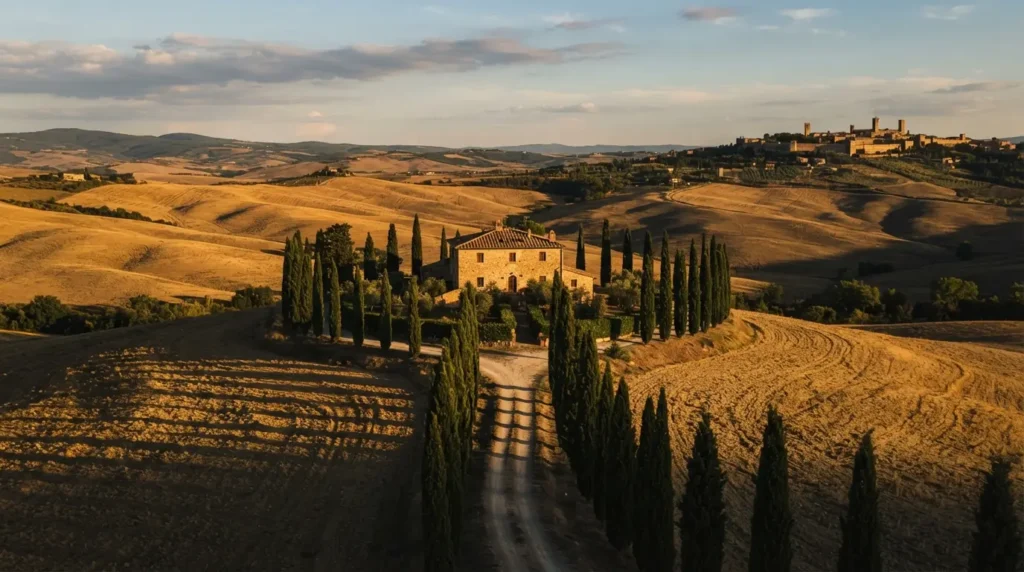
It is a UNESCO-listed cultural landscape of hills, farmhouses, thermal springs and medieval towns that has been maintained in more or less the same form since the 15th century. The cypress avenues that lead to the isolated farmhouses (poderi), the hilltop town of Pienza with its wedge-shaped cathedral and the best pecorino cheese in the region, Montalcino and the Brunello di Montalcino cellars in the hills above, and the hot springs at Bagno Vignoni (an entire square occupied by a thermal pool rather than a pavement) are the elements of the landscape.
The Brunello di Montalcino deserves specific note. It is one of Italy’s great wines — made entirely from Sangiovese Grosso grapes, required to age a minimum of five years before release, and produced in a quantity small enough that serious examples are not available outside specialist wine shops. Tasting it at a cellar in Montalcino, where the wine is poured by someone whose family has been making it for generations, is not the same as tasting it anywhere else.
Do you need a car in Tuscany?
The honest truth that most travel sites avoid stating clearly: Tuscany has almost no public transport worth using outside its cities. The Chianti hills, the Val d’Orcia, Montalcino, Montepulciano, San Gimignano — the places that justify the trip — are not on train lines. The buses that exist run on schedules that are not designed for tourists.
Rent a car. Do this before booking accommodation, before booking tours, before deciding on restaurants. Book it through a comparison site, check that the rental includes unlimited kilometres, and confirm the insurance covers driving on white gravel roads. Italian rental cars are typically manual — worth noting if you are accustomed to automatic.
The one critical ZTL note: every historic town centre in Tuscany is a Zona Traffico Limitato. Driving a rental car into a ZTL zone without permission generates an automatic fine of €80–200 sent to your home address weeks later. Most GPS navigation systems do not flag ZTL zones adequately. Research which streets are restricted in each town before you drive in — or park outside the walls and walk.
You can plan your Tuscany route around your occasion and travel style on PlacesToday. For how Tuscany fits into a longer Italy trip alongside Rome and Sicily, our Rome travel guide and Sicily guide cover the choices between them.
Frequently asked questions
Q: Is Florence worth visiting in summer 2026?
A: Yes, with morning starts and advance booking. The Uffizi and Accademia both sell timed-entry slots that should be booked weeks ahead in July and August. The galleries before 9am are substantially better than the same galleries at noon. The food, the architecture and the markets are available at any hour. Florence in summer is completely manageable if you treat the major sites as morning activities.
Q: Do you need a car to visit Tuscany?
A: For any itinerary that goes beyond Florence and Siena, yes. The Chianti hills, Val d’Orcia, Montalcino and the smaller towns are not accessible by public transport on any practical schedule. Book a rental car from Florence airport or Florence Santa Maria Novella station. Be aware of ZTL (restricted traffic zones) in historic town centres — fines apply automatically to rental cars.
Q: When is the best time to visit Tuscany in 2026?
A: September and October for the harvest season, truffle fair timing, and the best combination of warm weather, manageable crowds and wine culture at full activity. April to June is the spring alternative — wildflowers, green hills, and comfortable temperatures before the summer heat. July and August work well in the countryside; manage Florence carefully with early mornings and advance bookings.
Q: What is the Palio di Siena in 2026?
A: The Palio is a horse race run twice annually around Siena’s Piazza del Campo — July 2 and August 16, 2026. It is the most dramatic civic event in Italy: seventeen neighbourhoods (contrade) compete for a painted banner (the palio), with riders representing each quarter riding bareback at full speed around the square. To watch from the centre (the free standing area), arrive before dawn and expect to stand for eight to ten hours. The race lasts ninety seconds.
Q: What food should you not miss in Tuscany?
A: Lampredotto in Florence (braised tripe sandwich, eat at a street stall). Bistecca alla Fiorentina (Chianina T-bone, minimum 1.5kg, always rare). Pici pasta in Siena. Pienza pecorino aged in walnut leaves. Brunello di Montalcino from a cellar in Montalcino itself. The Vernaccia di San Gimignano white wine, ideally in San Gimignano before the tour buses arrive.
Tuscany is the correct trip for people who want to eat well, drive well and sleep somewhere in the hills with no noise except the vineyard outside the window. It requires a car and a week and the willingness to book a table at a trattoria without checking whether it has a viewpoint. The food is the reason. The landscape is the bonus. Go in September and both are at their best. Plan your Tuscany trip on PlacesToday →