Georgia in 2026 is worth visiting for the wine, the food, the Caucasus mountains and a city — Tbilisi — that Tripadvisor named the second most trending destination in the world in its 2026 Travellers’ Choice Awards. Georgia welcomed nearly 1 million international visitors in the first quarter of the year alone (Geostat, Georgia’s National Statistics Office, Q1 2026). Before you travel, buy the mandatory health and accident insurance: from January 1, 2026, all foreign visitors are legally required to hold minimum coverage of 30,000 GEL (approximately $11,000 USD). Buy it before departure rather than at the airport.
Georgia does not fit neatly into the categories that make travel planning feel orderly. It is not quite European and not quite Asian, not quite Middle Eastern and not quite Slavic. The country sits at the meeting point of the ancient Silk Road trade routes — where Persian, Byzantine, Ottoman, Russian and Mongol influences arrived at different centuries and left behind layers that the Georgians absorbed and then made entirely their own. The language is unlike any other on earth. The script is its own invention. The wine tradition is 8,000 years old, predating the grape cultivation of France and Italy by millennia.
This between-worlds quality is not confusion. It is what Georgia is. Sitting in a Tbilisi courtyard at dusk — the carved wooden balconies above you, the smell of sulfur from the Abanotubani bath district on the warm air, a glass of amber qvevri wine in a shallow ceramic bowl — is the experience of a country that has spent four thousand years deciding what it wants to be and has arrived at the answer with considerable confidence.
Is Georgia safe to visit in 2026?
Yes — Georgia ranks higher than France or Italy on several international safety indices, with violent crime against tourists exceptionally rare (Vitis Travel, 2026 safety guide). The police are trusted and helpful. The main practical cautions are the driving standards (chaotic by European norms; use Bolt or Yandex for taxis in Tbilisi rather than unmarked cabs) and the specific dress code requirements at Orthodox churches — shoulders and knees covered, women’s heads covered with a scarf which is typically provided at the entrance.
The political situation in the Russian-occupied regions of South Ossetia and Abkhazia means those territories are not accessible to visitors and should not be approached. All tourist destinations — Tbilisi, Kakheti, Kazbegi, Batumi — are well within the safe and accessible part of the country. Check your government’s current travel advisory before departure.
What is the mandatory travel insurance requirement in 2026?
From January 1, 2026, Georgia requires all foreign visitors to hold valid health and accident insurance with minimum coverage of 30,000 GEL (approximately $11,000 USD). The policy must cover emergency medical care, hospitalisation and accidents. It can be from a Georgian or foreign insurer and must be available in English or Georgian, digitally or in print. Most comprehensive travel insurance policies from UK and EU insurers meet or exceed this requirement — check your existing policy before purchasing separately. Travellers without adequate coverage may be required to purchase it upon arrival at additional cost (BBGeorgiaTravel, 2026).
What is the Georgia | official tourism site: georgia.travel
Georgia’s three pillars as a travel destination are specific and earn their claims:
The wine. Georgia is considered the birthplace of wine — a claim supported by archaeological evidence of winemaking from approximately 6000 BC in the Kvemo Kartli region. The qvevri method, in which wine ferments in large clay vessels buried underground, was practised here for thousands of years before Rome knew what a grape was. In 2013, the tradition was inscribed on UNESCO’s Intangible Cultural Heritage list. This wine is amber-coloured where white wine would be expected (from extended skin contact during fermentation), dry, complex and specific to this country in a way that nothing exported adequately replicates.
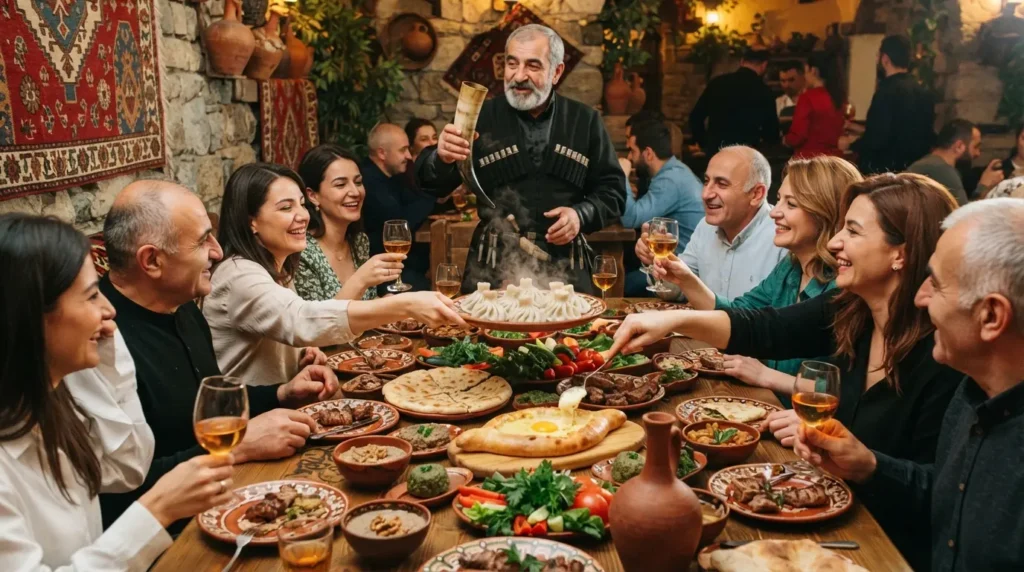
The food. Georgian cuisine is among the most distinctive in the region: khinkali (large pleated dumplings of spiced meat broth, held by the knot at the top and never cut with a knife — the broth is the point), khachapuri (a bread boat of melted cheese with an egg and butter stirred in at the table, specifically in the Adjarian version), lobiani (bean-filled flatbread), and the walnut sauces that appear throughout the cuisine in forms that have no precise equivalent elsewhere. A traditional Supra — the Georgian feast presided over by a tamada (toastmaster) who proposes elaborate toasts that guests must honour — is the most complete introduction to Georgian hospitality available.
The mountains. The Greater Caucasus range forms Georgia’s northern border and contains some of the most dramatic mountain landscapes in Europe. The Holy Trinity Church of Gergeti, positioned on a 2,170-metre peak above the town of Kazbegi with Mount Kazbek behind it at 5,047 metres, is the most photographed image in Georgian tourism — accurately so.
What is Tbilisi actually like in 2026?
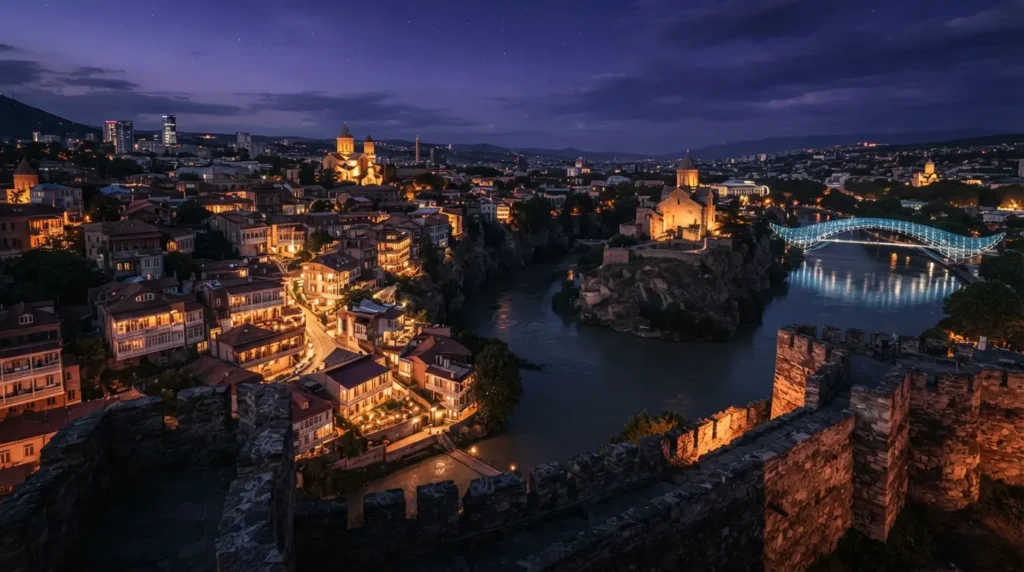
Tbilisi is compact, walkable, and structured around a river gorge that makes its geography legible on the first day. The Mtkvari River runs through the bottom of a ravine; the Old Town climbs both sides of it. Narikala fortress crowns the southern ridge. The Metekhi church projects from a cliff on the eastern bank. From the fortress walls at dusk, the city below — domes, carved wooden balconies, the blue-lit cable car, the Peace Bridge’s glass arch — holds the light in the way that old cities on rivers do.
The Old Town and Narikala fortress
Tbilisi’s Old Town (Dzveli Tbilisi) is the neighbourhood of carved wooden balconies — the distinctive ornamented latticework that wraps around the upper floors of the old buildings, providing both shade and the visual identity of the district. The lanes are narrow and unplanned, the churches appear between houses without announcement, and the neighbourhood operates as a residential area rather than a heritage attraction despite the quality of what it contains.
Narikala, the ruined fortress above the Old Town, is free to enter and best at dawn or dusk. The view from the walls encompasses the whole city — the river gorge, the old and new towns, the Soviet residential blocks on the far hills, the Kartlis Deda (Mother of Georgia) statue at the same height as the fortress. A Tbilisi Old Town walking tour covers the Old Town’s lanes and the fortress in two hours with enough context to read what you are looking at.
Abanotubani — the sulfur bath district
At the base of the ridge below Narikala, the Abanotubani district takes its name from the sulfur springs that feed its historic bathhouses. The domed structures above the baths are visible from the street; the baths themselves are underground. The water temperature runs 37–39°C and the sulfur content gives the neighbourhood its particular smell — sharp, metallic, specific — that lingers on the skin for the rest of the day. Public baths run GEL 10–15 (approximately £3) per person per hour; private rooms run GEL 30–50. The baths have been operating here since at least the 5th century, when the Kartvelian king Vakhtang Gorgasali supposedly founded the city at this spot after a pheasant fell into a hot spring and was cooked.
What is the Kakheti wine region and why does it matter?
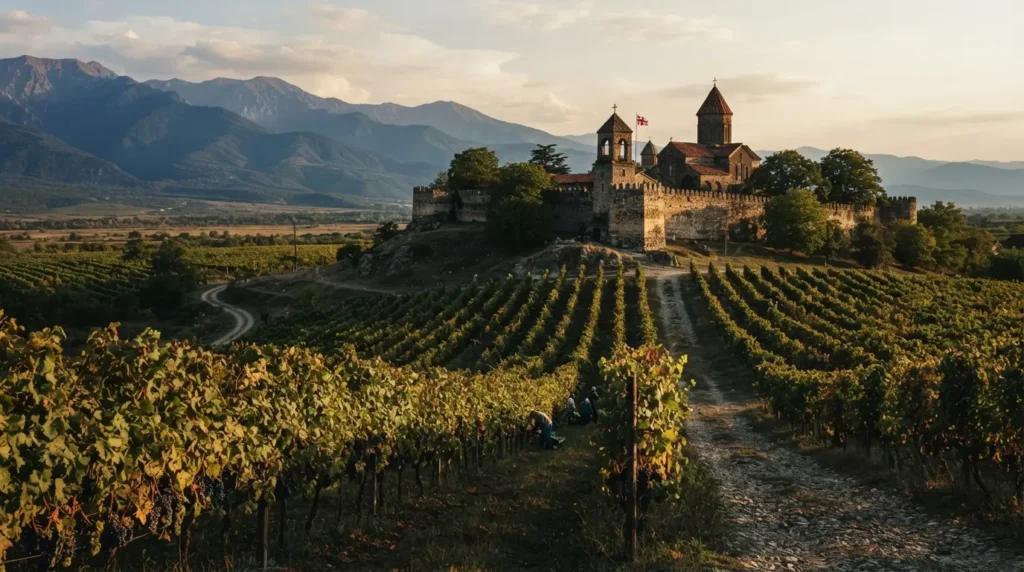
Kakheti, Georgia’s easternmost region and primary wine-producing zone, sits approximately 75 kilometres east of Tbilisi through a landscape of vine rows and ancient monasteries. The Alazani Valley, where most of the qvevri wine production is concentrated, has been under vines for thousands of years. The Bodbe Monastery and the Alaverdi Cathedral — an 11th-century church that still produces wine in its cellar using the traditional method — are the structural anchors of the region’s cultural and religious life.
A family cellar wine tasting in Kakheti is not the same experience as a wine tasting in the Douro Valley or Chianti. The cellar is usually underground, the qvevri vessels are buried in the earth, the host is usually a grandmother or a grandfather who has been making wine this way for fifty years, and the tasting is conducted in the context of a Supra that begins before the wine and ends considerably after. A Kakheti wine region day tour from Tbilisi visits two or three cellars and includes a traditional Georgian lunch with wine pairings and the opportunity to see the qvevri method explained by someone who practices it.
The harvest in Kakheti — the Rtveli — runs September through October, when the grapes are brought in by hand and the entire region smells of fermenting fruit. This is the optimal time to visit the wine country.
What is Kazbegi and is it worth the three-hour drive from Tbilisi?
The correct answer is yes, and the drive itself is part of the reason. The Georgian Military Highway north from Tbilisi climbs through the Caucasus foothills to the Jvari Pass at 2,379 metres, where the view of the mountains is the view that makes most visitors stop the car and stand outside without speaking for a while. The town of Kazbegi (also called Stepantsminda) sits in a valley below the peak of Mount Kazbek, the third-highest mountain in the Caucasus at 5,047 metres.
The Gergeti Holy Trinity Church, built in the 14th century on a 2,170-metre ridge directly above the town, is accessible by a one-and-a-half-hour hike from Kazbegi or by 4WD taxi (the road is steep and unpaved). The position of the church — on its peak with Mount Kazbek behind it and the glaciers visible above — is not the kind of landscape that photographs adequately represent. It is one of those places where the image and the experience are significantly different, and the experience is better. Stay one night in Kazbegi to see the mountain at both dawn and dusk. A Kazbegi day trip from Tbilisi covers the Military Highway, Gergeti Trinity Church and the Kazbegi National Park landscapes in one day from the capital.
What does Georgia cost in 2026?
| Budget | Mid-Range | Comfortable | |
|---|---|---|---|
| Accommodation | $20–40 (guesthouse) | $60–120 (boutique hotel) | $150–250 (upscale) |
| Meal for two | $10–15 (khinkali, salad, wine) | $25–45 | $60–100 (fine dining) |
| Wine (bottle, restaurant) | $8–15 (house wine) | $15–30 (quality local) | $30–80+ (premium) |
| Taxi across Tbilisi (Bolt) | $3–6 | $3–6 | — |
| Daily total per person | $40–70 | $90–150 | $200+ |
Sources: Vitis Travel Georgia 2026 budget guide; wander-lush.org Georgia 2026; MICE Travel Advisor June 2026
Georgia remains significantly cheaper than Western European destinations and cheaper than most of Turkey for equivalent quality. Tbilisi specifically has risen in price as visitor numbers have grown, but the value proposition — world-class food and wine, extraordinary landscapes, genuine hospitality — at these daily costs is difficult to match in Europe.
The Georgian lari (GEL) is the currency. Credit cards are accepted throughout Tbilisi and Batumi, but carry cash in the wine regions and mountain villages where card machines are not always available (Vitis Travel, 2026).
When is the best time to visit Georgia?
The honest answer separates Tbilisi from the mountains and the wine country. Tbilisi in July and August reaches 38–40°C and the city empties as locals leave for the coast or mountains — the heat and air quality in summer make this the least comfortable time for the capital. The correct Tbilisi windows are April to June and September to November, when temperatures sit at 15–25°C.
The Caucasus mountains — Kazbegi, Mestia in Svaneti, Tusheti — are accessible and at their most dramatic June through September, when the mountain passes are open and the hiking trails are clear. Kazbegi in July is cooler than Tbilisi and entirely accessible.
Kakheti’s harvest (the Rtveli) runs September through October — the single best reason to plan around that specific window. The combination of Tbilisi in September, the harvest in Kakheti, and the mountain colours beginning to change in the higher elevations makes September the optimal month for Georgia as a whole.
Frequently asked questions
Q: Do I need a visa to visit Georgia?
A: Georgia has one of the most generous visa policies in the world. Citizens of the US, UK, EU, Canada, Australia and most Western nations can enter visa-free for up to one year — an unusually long allowance that makes Georgia popular with digital nomads and extended-stay travellers. Check the Georgian e-Visa portal for current requirements if your nationality is not listed above.
Q: What is the mandatory insurance requirement for Georgia in 2026?
A: From January 1, 2026, all foreign visitors must hold health and accident insurance with minimum coverage of 30,000 GEL (approximately $11,000 USD), covering emergency medical care, hospitalisation and accidents. Most comprehensive travel insurance policies from UK and EU insurers meet this requirement. Check your policy before travel to confirm, or purchase a compliant policy specifically for the trip.
Q: Is Tbilisi a good destination in summer?
A: For July and August specifically, Tbilisi itself is hot (38–40°C) and busy with domestic and regional tourists. The Old Town and Abanotubani are still worth visiting, but the experience is more demanding. Summer is the correct time to use Tbilisi as a base for the Caucasus mountains (Kazbegi) and the Black Sea coast (Batumi), rather than spending extended time in the capital. April–June and September–October are the best Tbilisi months.
Q: What should you eat in Georgia?
A: Khinkali (spiced meat broth dumplings — hold by the knot, drink the broth, leave the knot). Khachapuri (cheese bread in multiple regional versions; the Adjarian boat-shaped version with egg and butter is the one). Lobiani (bean-filled flatbread). Pkhali (walnut-stuffed vegetable preparations). A Supra feast if you are invited to one — accept without hesitation.
Q: Is Georgian wine worth seeking out specifically? A: Yes. The amber wines made by the qvevri method — extended skin contact during fermentation in buried clay vessels — are unlike anything produced in France, Italy or Spain. They are dry, complex, distinctive and not available in this quality outside Georgia. Drink them in Kakheti, at a family cellar, from a shallow ceramic bowl, with food. This is what they were made for.
Georgia asks for a small amount of practical preparation — the insurance, the timing — and returns something that most destinations no longer offer: the feeling of being somewhere that has not finished revealing itself. Tbilisi’s Old Town before nine in the morning. A mountain church on a ridge in September. A wine cellar where the vintage is not on a label but in the memory of the person who made it. Plan your Georgia trip on PlacesToday →