The Maldives has two versions and most travel articles describe only one of them. The resort version — overwater bungalow, private island, $800–2,000 per night — is real and genuinely extraordinary if the budget covers it. The guesthouse version — local island, family-run accommodation, $50–150 per night — gives you access to the same snorkelling reefs, the same turquoise water and, in some cases, the same manta rays, for a fraction of the price. The Maldives is a Muslim country; local islands have no alcohol and require modest dress off the beach areas. Both versions are available in 2026. This guide covers both honestly.
The Maldives is 1,200 coral islands spread across the Indian Ocean, 200 of them permanently inhabited and more than 160 turned into private resort islands where only hotel guests can set foot. The system that makes this possible — the “one island, one resort” model that defined Maldivian tourism from the 1970s onwards — was partially opened in 2010 when guesthouses were permitted on inhabited local islands for the first time. That decision changed who can come to the Maldives and what they can spend doing so.
The result in 2026 is a destination with a genuine price range, from $60–98 per day on a local island guesthouse to $2,500–8,000+ per day on a private island resort (pixidia.com, 2026 Maldives budget breakdown). Both categories involve the same Indian Ocean, the same coral, the same improbable colour of the water. The experience they deliver is different in ways that matter for some travellers and not at all for others.
How does the Maldives actually work?
The geography first: Male (pronounced MAH-lay) is the capital, a small dense island that is most visitors’ entry point via the international airport at Hulhule, immediately adjacent. From Male, you reach your accommodation by speedboat (for islands within 30–60 minutes), domestic flight (for more remote atolls), or seaplane (for the remote private resort islands, $200–500 each way and often included in resort packages).
The practical structure: most visitors spend one night in Male or Hulhumale (the residential island connected to the airport by bridge) to recover from the flight, then transfer to their chosen island the next morning. Budget travellers take the public ferry or shared speedboat; resort guests take the resort’s private speedboat or a seaplane.
The cultural structure: the Maldives is 100% Muslim. On local inhabited islands, alcohol is not available, pork is not available, modest dress (covered shoulders and knees) is required when away from designated bikini beaches, and public displays of affection should be discreet. On private resort islands, different rules apply and alcohol is freely available. This distinction is real and matters for planning.
Which Maldives experience is right for you?
| Type | Cost per night | Alcohol | Beach | Includes | Best for |
|---|---|---|---|---|---|
| Local island guesthouse | $50–150 | No | Bikini beach designated | Room, often breakfast | Budget, couples wanting value, divers |
| Mid-range resort | $200–600 | Yes | Private resort beach | Half-board usually extra | Comfort without ultra-luxury |
| Luxury overwater villa | $800–2,000 | Yes | Private or house reef | Often all-inclusive | Honeymoon, special occasion |
| Ultra-luxury private island | $2,500–8,000+ | Yes | Exclusive | Everything | Bucket list, no budget concern |
| Liveaboard dive boat | $200–350 | Limited | N/A | Meals and diving | Serious divers, best value for diving |
Sources: pixidia.com 2026 Maldives guide; amaldives.com budget guide 2026; holafly.com Maldives cost 2026; travelarbitrage.net overwater bungalow guide 2026
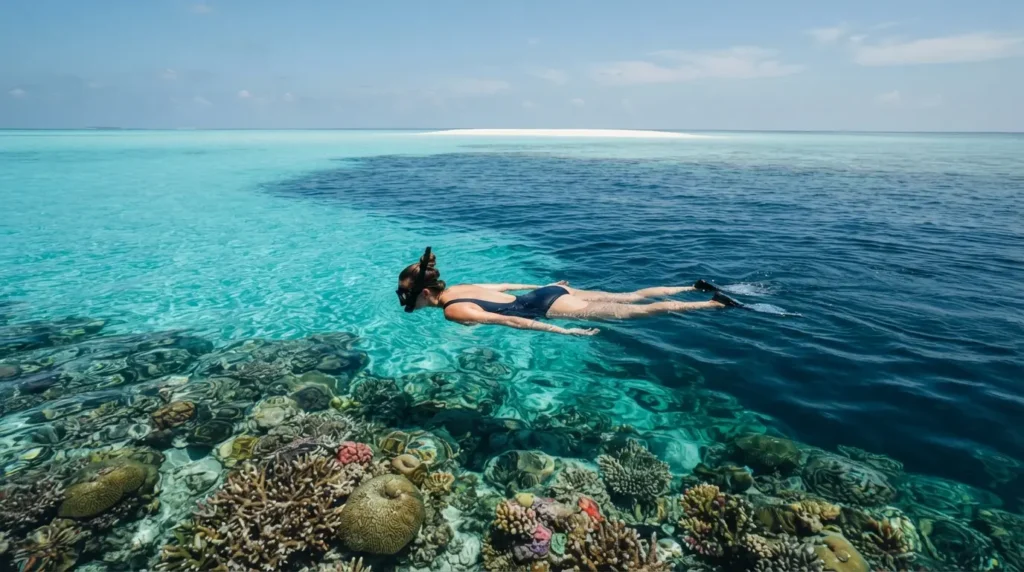
The decision that changes everything: whether you stay on a local island or a resort island. Not “which resort” — the prior question of which system you are in. Budget travellers on local islands access the same lagoons and reefs, eat freshly caught fish at local restaurants, and organise excursions through guesthouses at half to a third of resort prices. The experience is different (no swim-up bar, no air-conditioned beach butler pavilion, some bikini beach rules), but the snorkelling is the same snorkelling.
Which local islands are worth choosing in 2026?
Maafushi — the budget hub
Maafushi is 30 minutes by speedboat from Male airport ($25–30 per person, shared) or 1.5 hours by public ferry ($3–5). It is the most accessible budget island and, as a result, the most developed: dozens of guesthouses competing on price and facilities, a strip of tourist restaurants and dive shops, and a designated bikini beach. Guesthouses start at $50–60 per night for a double with air conditioning and breakfast (amaldives.com, 2026). The island itself is small and the beach is not the finest in the Maldives, but the snorkelling directly off the island is excellent and the organised excursions are the cheapest available: sandbank visits, snorkelling tours and dolphin cruises run $25–40 per person.
Thulusdhoo — for surfers
Thulusdhoo, slightly further from Male, has consistent surf breaks (Cokes, the main right-hander, is one of the most consistent waves in the Maldives) and a more relaxed atmosphere than Maafushi. Guesthouses run $80–130 per night. Non-surfers come for the snorkelling and the relative quiet compared to the budget hub of Maafushi.
Dharavandhoo and Hanifaru Bay — for the manta rays
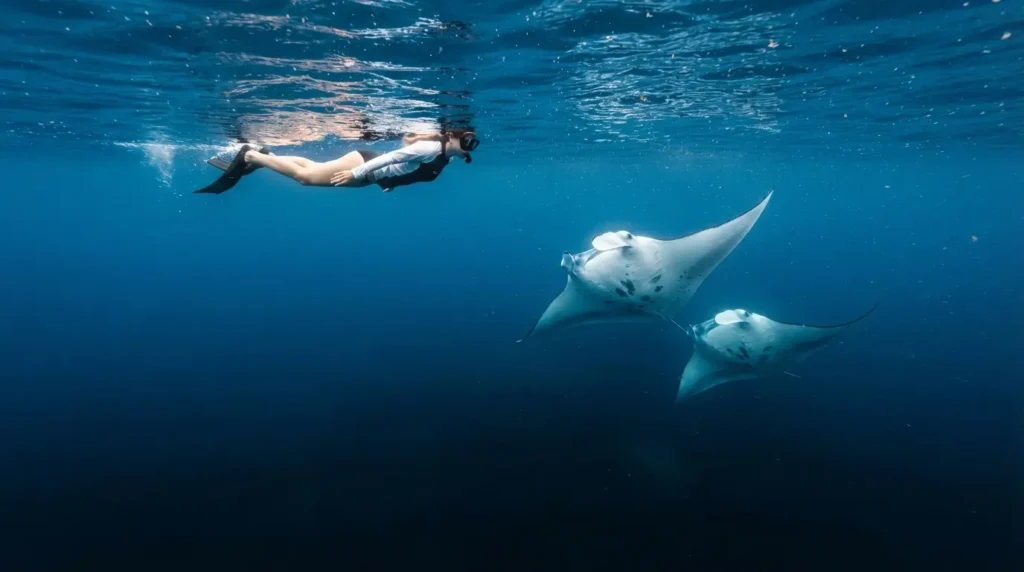
Dharavandhoo, in the Baa Atoll (reached by a 20-minute domestic flight from Male, approximately $50–70 one way), is the gateway to Hanifaru Bay — a UNESCO Biosphere Reserve and one of the world’s largest manta ray aggregation sites. During peak season (June to October, when the South Asian monsoon pushes plankton into the bay), encounter rates exceed 80% per excursion. Local dive centres organise Hanifaru excursions for $60–80 per person (pixidia.com, 2026) — the same natural phenomenon that resort guests pay $300+ to access. Guesthouses on Dharavandhoo run $40–80 per night.
This is the specific example that makes the guesthouse case most powerfully: same manta rays, one-quarter of the price, from a $60 guesthouse rather than a $2,000 resort.
Thoddoo — for quiet
Thoddoo, in the North Ari Atoll (reached by speedboat, approximately 2.5 hours from Male), is the island for watermelon and papaya farms, turtle snorkelling and a beach that is less crowded than Maafushi’s. Guesthouses start around $45 per night. It suits visitors who want the budget Maldives experience without Maafushi’s tourist-strip density.
What should you know about local island rules?
The Maldives is a Muslim country and the local islands — inhabited by Maldivian communities — operate under different rules from the private resort islands.
No alcohol on local islands. This is a legal restriction, not a preference. Resorts on private islands operate under special permits; inhabited local islands do not. If drinking wine with dinner is central to your holiday experience, a local island guesthouse is the wrong choice.
Modest dress when away from the beach. Swimwear is for the designated bikini beach (marked by flags; every guesthouse island has one). Elsewhere — the main beach, the streets, the restaurants — covered shoulders and knees are required for women, appropriate dress for men. This is not enforced aggressively but it is expected and respected by most visiting guests.
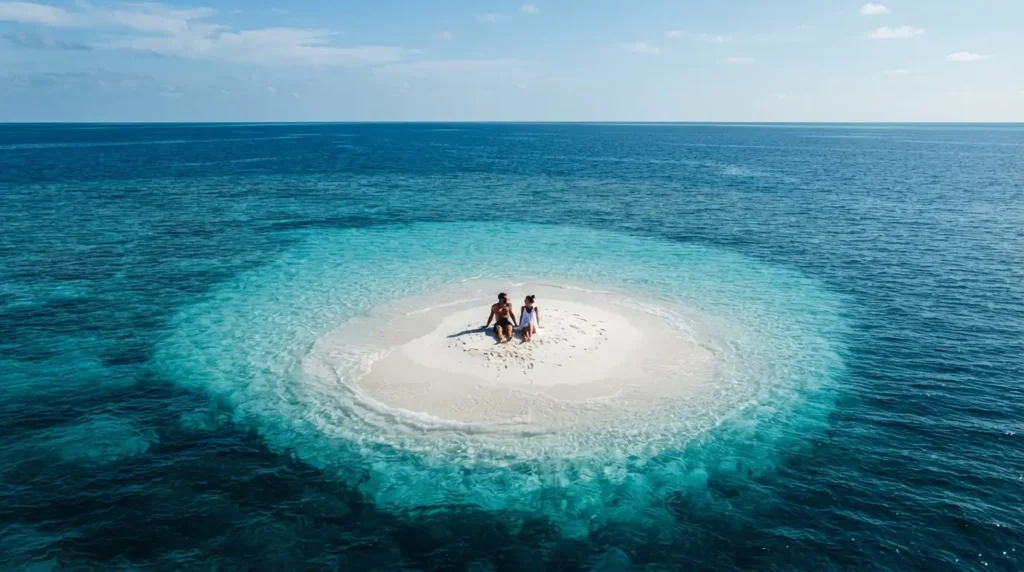
Bikini beaches are separated zones — usually a sandbar or a designated beach section away from the main community. On the better-organised islands (Maafushi, Thulusdhoo) these are well-maintained and lovely. On smaller islands, they can be basic.
These are the significant practical differences from a resort island experience. They are not dealbreakers for most travellers who are travelling specifically to snorkel, dive and experience the water — which is the primary reason the guesthouse option works well for that category of visitor.
Is the overwater bungalow worth the cost?
Yes, if the cost is manageable without strain. The overwater bungalow — a room on stilts above the lagoon, with a glass floor or a private ladder directly into the water — is genuinely one of the most extraordinary hotel experiences available anywhere. Waking up with the Indian Ocean visible through the floor panels, the lagoon accessible by climbing down a ladder without putting on shoes, the sunset from the private deck at 180° of ocean — these experiences are real and are not replicated by anything available on a local island.
The lowest end of the overwater bungalow tier ($400–600 per night in shoulder season at a three-star resort) is increasingly accessible for visitors from the UK, US and Europe who would consider it a once-in-a-decade splurge. The arithmetic for a couple on a seven-night trip at $500 per night ($7,000 for accommodation plus flights at $700–900 from London) produces a total trip cost of approximately $8,000–9,000 — comparable to a premium European river cruise or a Japan trip in business class.
If the overwater bungalow is specifically what you came for, the mid-range resort option delivers it. If the water, the reefs and the marine life are what you came for, the local island option provides most of the same at a fifth of the price.
When is the best time to visit the Maldives?
November to April — the dry season — for the clearest water, the calmest weather and the best visibility for snorkelling and diving. December through February is peak season: highest demand, highest prices. November and March–April offer comparable conditions with slightly lower accommodation rates.
May through October is the South Asian monsoon — rough weather, occasional storms and reduced visibility in some locations. However, June through October is when the Hanifaru Bay manta aggregation peaks, which inverts the logic for visitors specifically coming for manta rays or whale sharks. Guesthouse prices during the rainy season are 30–50% lower than peak, which compounds the value of the Dharavandhoo option during these months.
How do you get between Maldivian islands?
Public ferry — the cheapest option ($3–5 per journey) but slow (1.5–2.5 hours to reach islands within range of Male) and running on limited schedules.
Shared speedboat — $25–35 per person, available from the arrival area at Male airport for the near islands. Guesthouses arrange these for guests.
Domestic flight — Air Maldives and Maldivian Air Taxi connect Male to the outer atolls in 20–45 minutes. Tickets run $50–120 each way. Essential for reaching Baa Atoll (Dharavandhoo) and the southern atolls efficiently.
Seaplane — the scenic transfer used by remote luxury resorts. $200–500 each way for a 20–40 minute flight over the atolls. Usually included in luxury resort packages. Worth doing at least one way if the budget allows it — the aerial view of the atolls is extraordinary and is one of the experiences most Maldives visitors cite alongside the water itself.
What does a Maldives trip actually cost in 2026?
| Budget (local island) | Mid-range resort | Overwater villa | |
|---|---|---|---|
| Accommodation (7 nights) | $350–1,050 | $1,400–4,200 | $5,600–14,000+ |
| International flights | $450–900 (London) | $450–900 | $450–900 |
| Transfers | $50–100 | $100–300 | Often included |
| Food | $210–350 | $350–700 (or included) | Usually included |
| Activities | $200–350 | $200–500 | Often included |
| 7-night total | $1,260–2,700 | $2,500–6,600 | $6,600–15,900+ |
Sources: amaldives.com 2026; pixidia.com 2026; travelarbitrage.net 2026
The budget local island trip is genuinely achievable within $1,500–2,500 per person including flights from Europe. The mid-range resort requires $3,000–5,000. The overwater villa is $7,000–15,000+.
Our honeymoon destinations guide covers the Maldives as the default honeymoon choice and the alternatives that deliver similar experiences at lower cost. For connecting the Maldives into a wider Indian Ocean trip, our Sri Lanka guide covers the island immediately to the north. Plan your Maldives trip on PlacesToday →
Frequently asked questions
Q: Can you visit the Maldives on a budget in 2026?
A: Yes. Guesthouses on local inhabited islands — Maafushi, Thulusdhoo, Thoddoo, Dharavandhoo — cost $50–150 per night and provide access to the same reefs, the same turquoise water and, in some atolls, the same manta rays as resort guests paying $800–2,000 per night. A budget 7-day trip including flights from London runs $1,500–2,700 per person. The main differences: no alcohol on local islands, modest dress required off designated beach areas, and no private overwater bungalow experience.
Q: Is the overwater bungalow worth the money?
A: Yes, if the experience is specifically what you came for. Waking above the lagoon, stepping directly into the water from your room, the sunset from a private deck — these are not available on local islands and are genuinely extraordinary. Mid-range overwater villas start at $400–600 per night in shoulder season. If the goal is snorkelling and marine life rather than the accommodation experience, the local island option provides most of the same at a fifth of the cost.
Q: When is the best time to visit the Maldives?
A: November to April for the clearest water, calmest weather and best snorkelling visibility. December to February is peak season and most expensive. May to October is monsoon season — rougher weather, lower prices — but June to October is when Hanifaru Bay’s manta ray aggregation peaks, making it the correct time to visit the Baa Atoll specifically.
Q: Can you drink alcohol in the Maldives?
A: On private resort islands, yes — resorts have special permits. On local inhabited islands, no — the Maldives is a Muslim country and alcohol is not available on inhabited islands. This is not enforced at resorts but is strictly observed on local islands. If alcohol is important to your holiday experience, choose a resort island.
Q: How do you get from the Maldives airport to a local island guesthouse?
A: Shared speedboat from Male airport to the near islands (e.g., Maafushi, 30 minutes): $25–30 per person. Public ferry to the same islands: $3–5 per person, 1.5–2 hours. Domestic flight for more remote atolls: $50–120 each way. Guesthouses organise transfers and will advise on the correct option when you book.
The Maldives is the one destination where the gap between what the photographs show and what you can actually experience on a sensible budget is smaller than the reputation suggests. The water is that colour. The coral is that healthy. The manta rays appear on the excursion with a frequency that surprises visitors who expected them to be rarer. Whether you arrive by seaplane to a private island or by speedboat to Maafushi, the Indian Ocean beyond the beach is the same ocean. Choose the version your budget covers and the one where the rules about alcohol match what you want your evenings to look like. Plan your Maldives trip on PlacesToday →