The best European Christmas markets in 2026, matched to what you came for: Strasbourg for the most complete historical atmosphere (27 November–27 December), Nuremberg for the most traditional market in the world (27 November–24 December, closed Christmas Eve), Cologne for seven markets under a Gothic cathedral (Cathedral market 23 November–23 December), Vienna for elegance at scale (13 November–26 December), and Budapest if the budget is a meaningful constraint. All markets are free to enter. You pay only for the food, the drinks and whatever you buy. Book accommodation for Strasbourg four to five months ahead; everything else somewhat less urgently.
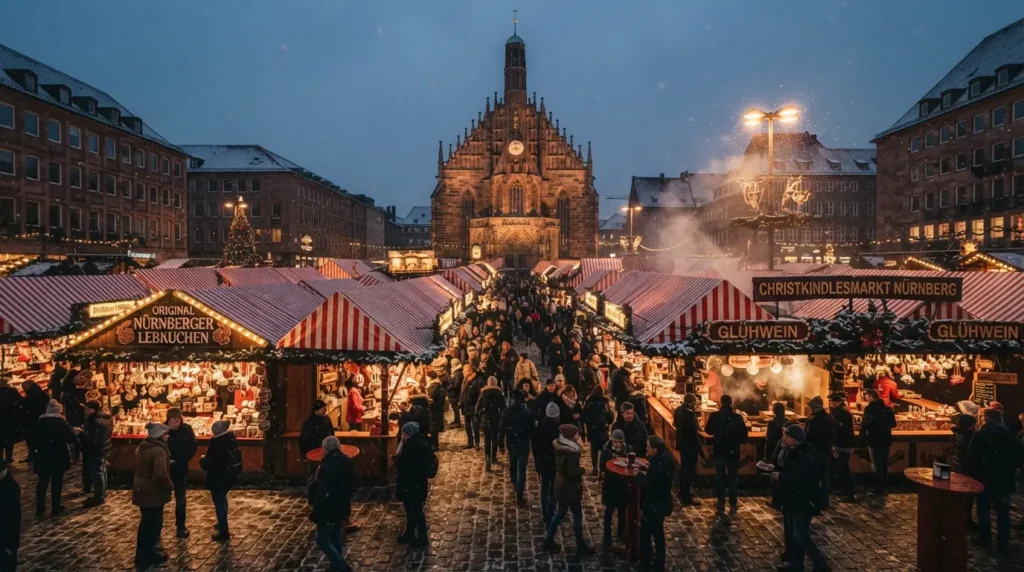
European Christmas markets run from mid-November to December 24–26 across most cities, with some extending into early January. The season is not one event; it is several hundred events in cities of different sizes with different characters and different reasons to attend. The Nuremberg Christkindlesmarkt is one of the most famous Christmas markets on earth, opened each year by a young woman dressed as the Christkind who reads a prologue from the Frauenkirche balcony. The Bruges Winter Glow light installation runs simultaneously with the canal-side market stalls until January 4. Vienna’s Rathausplatz market operates in front of the neo-Gothic city hall. These are different experiences and worth distinguishing before buying a flight to whichever one appeared first in a search result.
The honest note: most Christmas market guides do not adequately address the accommodation problem. Strasbourg at Christmas fills its hotels six to nine months before December. Vienna and Cologne three to four months. Prague and Budapest more recently. If the Christmas market trip is a November or December plan being made in October, the booking window for the most popular cities is already late. This guide names which ones still have availability and which ones do not.
When are the European Christmas markets open in 2026?
| City | Opening date | Closing date | Notes |
|---|---|---|---|
| Vienna | 13 November | 26 December | Rathausplatz largest; Schönbrunn and Spittelberg parallel |
| Edinburgh | 14 November | 3 January 2027 | St Andrew Square; East Princes Street Gardens |
| Salzburg | 19 November | 1 January 2027 | Old town setting; UNESCO backdrop |
| Bruges (Winter Glow) | 20 November | 4 January 2027 | Canal lights and market combined |
| Cologne Cathedral | 23 November | 23 December | Plus six additional markets with varying dates |
| Strasbourg | 27 November | 27 December | 11 market areas across Grande Île |
| Nuremberg | 27 November | 24 December | Closes 2pm Christmas Eve; no extension |
| Brussels | 27 November | 3 January 2027 | Winter Wonders; city-wide |
| Dresden | 25 November | 24 December | Striezelmarkt (oldest documented, since 1434) |
| Colmar | 25 November | 29 December | Best paired with Strasbourg (30 min by train) |
| Prague | Late November | 6 January 2027 | Old Town Square; Wenceslas Square secondary |
| Budapest | Late November | 1 January 2027 | Vörösmarty Square; Advent Basilica |
Sources: europeantourism.org Christmas markets 2026; europeanbestdestinations.com; tailormaderail.com 2026; luxtripper.co.uk Christmas markets 2026
The opening dates above use the confirmed 2026 figures where published and the typical pattern where confirmation is pending. Check city tourism boards directly in October and November for any adjustments.
Which Christmas market should you choose?
The question is worth answering by travel type rather than by ranking, since the ranking changes depending on what you came for.
For a first European Christmas market trip: Strasbourg, combined with Colmar (thirty minutes by regional train). Strasbourg has been running a Christmas market since 1570 and describes itself, accurately, as the Capital of Christmas. Eleven market areas spread across the UNESCO-listed Grande Île, anchored by a thirty-metre spruce on Place Kléber and the rose-sandstone cathedral. Colmar, thirty minutes south, is smaller, more immediately fairy-tale in scale, and — the considered opinion of most who have done both — where you should actually sleep.
For the most traditional, most famous: Nuremberg. The Christkindlesmarkt on Hauptmarkt Square, the red-and-white striped stalls, the Christkind opening ceremony from the Frauenkirche balcony — these are the images that defined the idea of a Christmas market for several centuries. Close on December 24 at 2pm. Plan accordingly.
For a city you are visiting anyway: Vienna (already one of Europe’s finest cities in winter, now with the Rathausplatz market as a specific addition) or Prague (the Old Town Square with the Gothic church tower and the snow-dusted Gothic backdrop). Both are covered in our Vienna guide and Prague guide.
For value: Budapest. Vörösmarty Square and the Advent Basilica market run until New Year’s Day. Budapest is the cheapest European capital for accommodation, food and drinks in this comparison set, and the markets are genuinely excellent rather than merely affordable. Beer and chimney cake (kürtőskalács) for a fraction of what Strasbourg charges.
Strasbourg and Colmar — the pair worth doing together
Strasbourg’s Christmas market dates to 1570 and now occupies eleven separate market areas across the Grande Île — the UNESCO-listed historic island city at the confluence of the Ill River and the Rhine canal. The main market on Place Kléber, anchored by its enormous decorated spruce, is the centrepiece. The cathedral square market, around the rose-red Notre-Dame de Strasbourg, is the most atmospheric of the secondary sites. The scale is the point: no other Christmas market city gives you this much to cover across this many locations.
The practical constraint: Strasbourg accommodation in late November and December books four to six months ahead (theblueberrytrails.com, 2026). Anyone reading this in October for a December trip should check availability immediately and accept that Colmar, thirty minutes south by TER regional train, may offer more options at comparable or lower rates. Colmar’s Alsatian timber-framed townhouses, canal-lined quarter and five separate market areas are arguably more immediately charming than Strasbourg at equivalent scale. The considered position from those who have done both: stay in Colmar, day-trip to Strasbourg.
Colmar 2026 dates: 25 November to 29 December. Strasbourg 2026 dates: 27 November to 27 December. A Strasbourg Christmas market guided tour covers the key market areas and the cathedral quarter with historical context.
Nuremberg — the most traditional market in the world
Nuremberg’s Christkindlesmarkt is the Christmas market that most people picture when they picture a Christmas market: red-and-white striped stalls, handcrafted ornaments, wooden toys, the specific smell of Lebkuchen (Nuremberg’s protected-designation gingerbread, different from every other version). The opening ceremony each year involves a local young woman chosen as the Christkind, who delivers a prologue in Middle High German from the Frauenkirche balcony above the Hauptmarkt, and then descends to open the market formally.
The 2026 dates are confirmed: November 27 to December 24. The market closes at 2pm on Christmas Eve and does not reopen. This is not an oversight; it is the market’s stated position on Christmas Eve, which it considers a family occasion rather than a commercial one.
The market is best visited on a weekday between opening on the 27th and the second week of December, when the weekend crowds are at their highest. The Nuremberg Lebkuchen should be bought at a stall that makes them on site rather than from the vendors selling pre-packaged versions; the difference in quality is immediately apparent.
Cologne — seven markets and one extraordinary cathedral
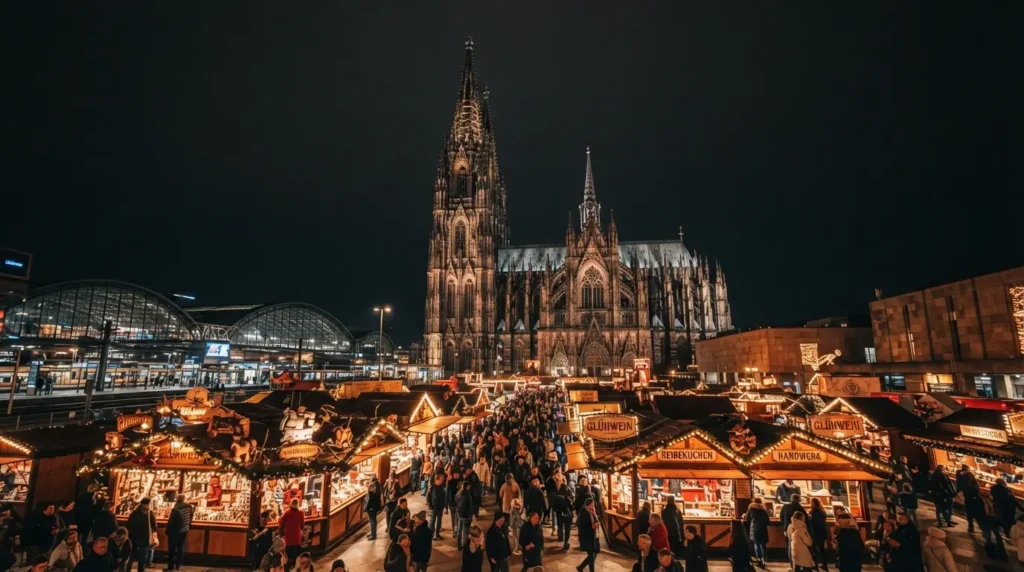
Cologne’s Christmas market claim is geographical rather than atmospheric. The Cathedral Market (Kölner Dom Weihnachtsmarkt) is held directly in front of Cologne Cathedral — a UNESCO-listed Gothic church at 157 metres, one of the tallest buildings in the world. The scale of the cathedral rising above the market stalls is something photographs communicate imperfectly and the ground-level experience communicates with considerable force.
Cologne runs six additional themed markets across the city simultaneously: the Harbour Market by the Rhine with its maritime theme, the “Angel’s Market” on the Neumarkt, the Heinzels Gnome Market in the Altstadt. The city’s Christmas market offering is the most varied of any German city (europeantourism.org, 2026). The Cathedral Market runs 23 November to 23 December; the Harbour Market typically extends to early January.
A Cologne Christmas market and cathedral guided tour covers the cathedral interior and the market circuit in two to three hours — the combination of architecture and market context that visiting either separately does not fully provide.
The underrated options
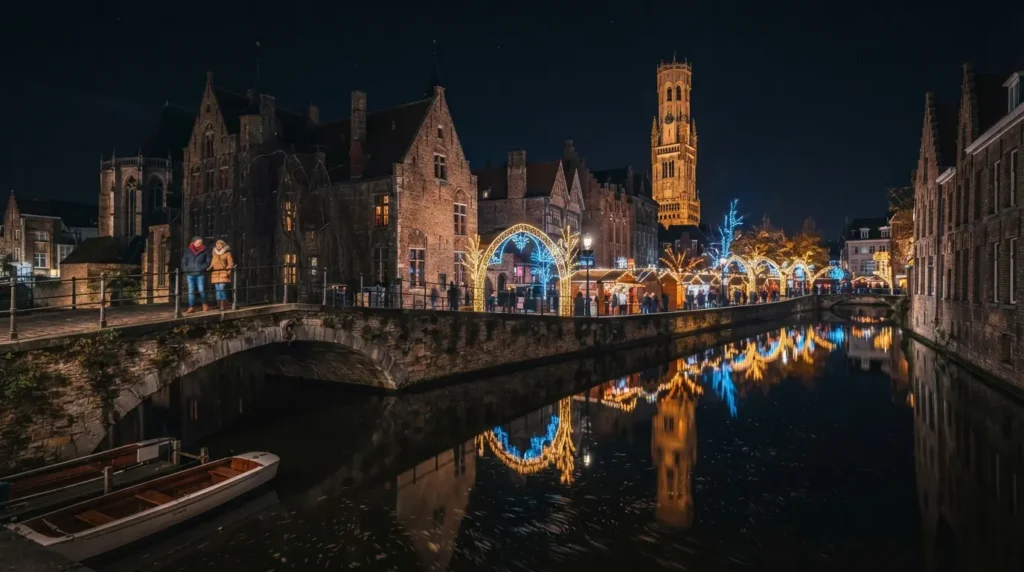
Bruges, in Belgium, runs its Winter Glow light installation and canal-side Christmas market from 20 November to 4 January 2027 — the longest season on this list and the one that most takes advantage of the city’s architecture. The medieval canal quarter, already one of the most photographed urban environments in Europe, acquires a quality in winter lighting and Christmas decoration that the summer crowds actively prevent. The market runs along the Markt and the Burg squares. Book accommodation for December weekends ahead — Bruges is accessible from London by Eurostar and is a popular UK Christmas market destination.
Budapest is the best-value Christmas market city in Europe by any reasonable comparison. Vörösmarty Square and the Advent Basilica market in front of St Stephen’s Basilica are both excellent. The chimney cake (kürtőskalács), the lángos (deep-fried flatbread with various toppings), the mulled wine at half the price of Vienna or Strasbourg — and accommodation in Budapest for December that costs a fraction of any German or French equivalent.
Edinburgh’s Christmas market (East Princes Street Gardens and St Andrew Square, 14 November to 3 January 2027) is covered alongside the city’s winter offering in our Edinburgh Fringe 2026 guide — a different season, the same city, and worth the December visit specifically for the backdrop of the castle and the illuminated Scott Monument.
Copenhagen’s Christmas is design-led rather than traditional — the Tivoli Gardens winter season being the primary destination, with the city’s characteristic precision applied to festive decoration. Our Copenhagen guide covers the city context.
What to eat and drink at European Christmas markets
The food varies by country in ways that matter.
Germany: Glühwein (mulled red wine, served in a small mug that costs extra and is returned for a deposit), Nuremberg Bratwürste (three small grilled sausages in a roll), Lebkuchen (the gingerbread specific to Nuremberg), roasted chestnuts, Stollen (the dense Christmas fruit bread specific to Dresden).
France (Alsace): Vin chaud (French mulled wine, slightly different from German Glühwein — less sweetened, different spice profile), Bredele (Alsatian Christmas biscuits), tarte flambée (thin Alsatian flatbread with crème fraîche, onion and lardons — not specifically Christmas but correct at any Alsatian market).
Belgium: Belgian waffles (eaten warm, without elaboration), hot chocolate, frites with mayonnaise. The Belgian Christmas market food is simultaneously the most internationally familiar and the most legitimately excellent.
Central Europe (Prague, Budapest): Trdelník (the cylindrical pastry, specifically Czech, rolled in cinnamon sugar — correct at a Prague market, available incorrectly everywhere else), kürtőskalács (the Hungarian equivalent), chimney cake variations. The mulled wine here is cheaper than in Germany and France; the cocoa in Prague’s Old Town Square is the correct alternative.
Practical notes that most guides skip
All markets are free to enter. You pay only for food, drink and purchases. There are no gates, no tickets, no reservations for the market itself. The food and drink are the cost.
Go on weekdays. Every popular Christmas market is significantly more crowded on weekends — particularly December Saturdays — than on Monday through Thursday. If the itinerary allows any flexibility, a Tuesday at Nuremberg or a Wednesday at Strasbourg is a materially different experience from the same market on the second Saturday of December.
Book accommodation early. Strasbourg: four to six months ahead for any December dates. Cologne and Nuremberg: two to four months. Prague, Budapest, Edinburgh: more recently, but the popular options still fill. A Christmas market trip planned in October for December should check availability immediately.
The markets close on or before December 24. Most traditional markets close by Christmas Eve. Bruges, Brussels and Edinburgh run into January; these are the exceptions rather than the rule. Plan accordingly if Christmas Eve or Christmas Day is part of the trip dates.
Plan your European Christmas market trip on PlacesToday →
Frequently asked questions
Q: Which European Christmas market is the best in 2026?
A: Depends on what you came for. Strasbourg for the most complete atmosphere (Capital of Christmas since 1570; eleven market areas; combine with Colmar thirty minutes away). Nuremberg for the most traditional (27 November–24 December 2026; closes Christmas Eve). Cologne for the most dramatic backdrop (cathedral above the market stalls). Vienna for elegance (13 November–26 December). Budapest for the best value. Prague for the most photogenic setting.
Q: How far ahead should you book accommodation for Christmas markets?
A: Strasbourg: four to six months ahead; December accommodation fills faster than almost any other Christmas market city in Europe. Cologne and Nuremberg: two to four months. Prague, Budapest and Edinburgh: earlier is better, but two months ahead typically still works. October planning for December trips should check immediately.
Q: Are European Christmas markets free to enter? A: Yes — all markets on this list are free to enter. You pay for food, drink and anything you buy. There are no tickets or gates. The Glühwein mug deposit (typically €2–4 in Germany) is returned when you return the mug.
Q: When do European Christmas markets close? A: Most traditional German markets close on or by December 24 — Nuremberg specifically at 2pm on Christmas Eve. French and Belgian markets (Strasbourg, Colmar, Bruges, Brussels) typically run to December 26–29. Edinburgh and some others extend into early January. Check individual market dates before planning travel around Christmas Eve or Christmas Day.
Q: Is Strasbourg worth the accommodation difficulty?
A: Yes — the scale and atmosphere of Strasbourg at Christmas is genuinely unmatched. If accommodation within the city is unavailable or unaffordable, base in Colmar (30 minutes by TER train) and day-trip to Strasbourg. Colmar’s own market is excellent and the Alsatian old town is arguably more immediately beautiful.
European Christmas markets are among the most consistently satisfying travel experiences on the continent — partly because the expectation (a lit-up market in a cold city with mulled wine) is so accurately met, and partly because the best examples have been doing exactly this for four hundred years without feeling they needed to improve. Go on a weekday. Book the hotel before October runs out. Order the correct local food. The rest is winter and wood smoke and entirely obvious in the best possible way. Plan your Christmas market trip on PlacesToday →