Kenya welcomed 2.79 million international visitors in the first six months of 2026 — up 88% from the same period in 2022 (Africa Travel and Tourism Association, October 2026). A mid-range Kenya safari costs $250–300 per person per day including accommodation, park fees and guiding. The Great Migration’s most dramatic Mara River crossings run from late July through September. The cheapest months to go are January, February and November, when wildlife is still excellent and the crowds are not.
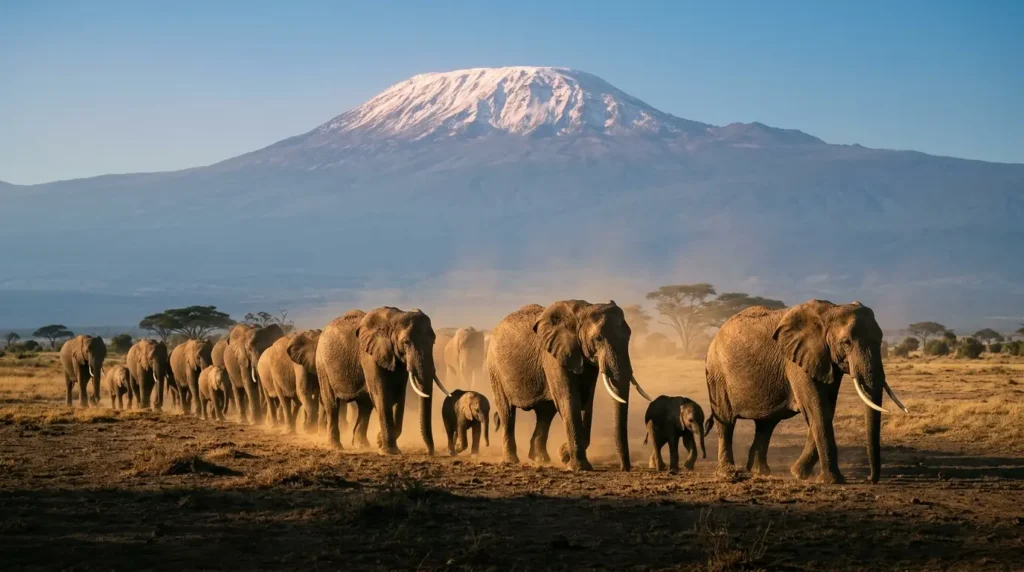
There is a version of the Kenya safari conversation that focuses entirely on the Masai Mara in August and how expensive it is. That version is accurate and incomplete. Kenya’s wildlife infrastructure is more varied than its reputation suggests. The Mara is genuinely extraordinary during the Migration. It is also one of the most expensive and crowded park experiences in Africa at that time. Amboseli with Kilimanjaro on the horizon behind a breeding herd of elephants is, in the view of many experienced safari-goers, the more powerful photograph and the better value trip. Samburu, in the north, has species that do not exist in southern Kenya and almost no one goes there. The question is not whether to go to Kenya — the answer to that is yes, resoundingly, in 2026 — but which Kenya you want.
Kenya Tourism Board signed route expansion partnerships with Emirates and Qatar Airways in September 2026, which means international access is broader than it has been. Tourism earnings reached KSh 564 billion in the first half of 2026, up 110% from 2022 — the infrastructure investment that money enables is visible in the quality of mid-range camps.
Is a Kenya safari worth it in 2026?
Yes — with the caveat that “safari” covers a range from $120/night tented camps with shared facilities to $1,500/night private conservancy lodges where you are the only vehicle at every sighting. The experience is worth it at both ends of that range, provided your budget matches your expectations. What Kenya offers that other safari destinations do not — to the same degree — is volume and variety: more game, more reliably, across more different ecosystems, within a country whose infrastructure for international visitors is well developed. The Masai Mara alone has more lion prides visible to guests on a given morning than most other parks in Africa.
Which Kenya national park should you visit?
| Masai Mara | Amboseli | Samburu | Ol Pejeta | Tsavo | |
|---|---|---|---|---|---|
| Best for | Migration, big cats | Elephants, Kilimanjaro views | Rare northern species | Rhinos, chimpanzees | Scale, red elephants |
| Peak season | July–October | Year-round | Year-round | Year-round | January–March, July–Oct |
| Cost tier | High–very high | Mid–high | Mid | Mid | Budget–mid |
| Crowds | High in Aug–Sept | Moderate | Low | Low | Low |
| Drive from Nairobi | 5–6 hours | 4 hours | 6–7 hours | 3.5 hours | 4–5 hours |
| Fly-in option? | Yes (recommended) | Yes | Yes | No | Yes |
Sources: Kenya Tourism Board; Africa Travel and Tourism Association, 2026
Masai Mara — the one everyone knows, and why that is justified
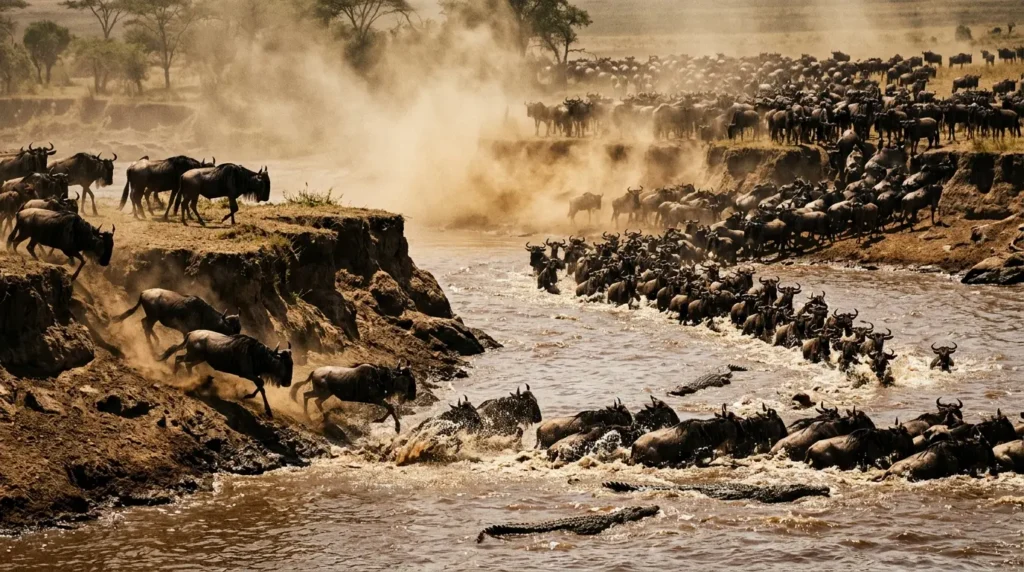
The Mara is the headline for a reason. The great plain supports the densest concentration of big cats in Africa, a year-round resident elephant population, and — from late July through October — the wildebeest Migration crossing at Mara River, which is one of the genuinely unmissable wildlife events on the planet. A million and a half wildebeest moving from the Serengeti in Tanzania to the Mara’s short-grass plains, crossing crocodile-filled rivers in groups of thousands, is not something that photography adequately prepares you for.
The honest briefing: August and September in the Mara are peak season, peak price and peak crowds. Vehicles can stack twenty deep at a crossing point. Book a private conservancy outside the national reserve boundary — Naboisho, Olare Motorogi, Ol Kinyei — and you gain exclusive access to the same ecosystem with strictly limited vehicle numbers. It costs more. It is worth it.
Outside Migration season — November through June — the Mara is still excellent for big cats and elephant, significantly cheaper, and navigable without the vehicle congestion. The resident wildlife does not leave when the wildebeest do.
Amboseli — elephants and Kilimanjaro
Amboseli National Park, four hours south of Nairobi near the Tanzanian border, is built around one of the best elephant-watching experiences in Africa. The park’s elephant families are habituated to vehicles in a way that allows close observation of genuinely natural behaviour — breeding herds, calves, matriarchs — against a backdrop that, on a clear morning, includes the full 5,895-metre face of Kilimanjaro rising from the flat plain. This is Africa’s most-photographed landscape for a reason.
The park is smaller than the Mara, which means you cover it comfortably in two to three days. It pairs well with the Mara on a combined itinerary: fly Amboseli to Mara, saving the long drive and gaining two completely different experiences.
Samburu — the northern specialist
Samburu National Reserve in northern Kenya is where experienced safari-goers go for their second or third trip, or for the photographs that do not look like everyone else’s. The reserve is home to species that exist nowhere in southern Kenya: Grevy’s zebra (larger, more narrowly striped than the common zebra), Beisa oryx, reticulated giraffe, Somali ostrich. The Samburu people, the reserve’s Maasai equivalents in the north, are more deeply present in the landscape here.
The roads are worse. The accommodation ranges from good to exceptional. The crowds are minimal year-round. It is one of the most under-visited game reserves in East Africa relative to its quality.
Ol Pejeta — rhinos and chimpanzees
Ol Pejeta Conservancy in Laikipia County is where Kenya keeps its black rhino population — the largest in East Africa — and, unusually for this region, a chimpanzee sanctuary. Home of the world’s last two northern white rhinos (Najin and Fatu, both female), Ol Pejeta carries a conservation weight that most safari destinations do not. Game drives here are mid-range priced; the conservancy is genuinely well run and not overcrowded. It pairs well with Samburu and Mount Kenya on a Laikipia circuit.
When is the best time for a Kenya safari in 2026?
| Month | Migration status | Weather | Crowd level | Price |
|---|---|---|---|---|
| January–February | Herds in Tanzania | Dry, warm | Low | Low–mid |
| March–May | Tanzania / returning | Long rains | Very low | Lowest |
| June | Entering Mara | Rains clearing | Low | Mid |
| July | First crossings begin | Dry | Building | High |
| August | Peak crossings | Dry, cool nights | High | Very high |
| September | Peak crossings | Dry | High | Very high |
| October | Herds reverse south | Short rains begin | Dropping | High |
| November | Herds in Tanzania | Short rains | Low | Low–mid |
| December | Tanzania calving season | Drying | Building | Mid–high |
The best value months are January–February and November. Wildlife is excellent — the Mara and Amboseli support permanent resident populations that do not migrate — prices are 20–40% lower than peak, and the parks are navigable without competitive vehicle positioning at sightings. The long rains (March–May) bring the lowest prices but the most difficult conditions: tracks become impassable, some camps close, and photography is harder.
The Migration crossing is genuinely extraordinary if it is the reason for the trip. Book for late July through mid-September, accept the premium pricing and the vehicle volumes, and choose a private conservancy over the national reserve to mitigate the crowds.
What does a Kenya safari cost in 2026?
Per-person daily rates (all-inclusive: accommodation, meals, game drives, park fees, guide)
| Category | Daily cost per person | What you get |
|---|---|---|
| Budget / camping | $80–150 | Public campsite, self-catering or mess tent, own vehicle |
| Mid-range tented camp | $250–350 | Comfortable en-suite tents, all meals, shared game drives |
| Luxury camp | $400–600 | Premium tented lodge, private vehicles available, excellent food |
| Fly-in luxury | $450–700 | As above plus charter flights between parks |
| Ultra-luxury / private conservancy | $600–1,200+ | Exclusive access, private guide and vehicle, high conservation fee |
Sources: Africa Travel and Tourism Association; Kenya Tourism Board operator data, 2026
Sample itinerary costs
A five-day mid-range Masai Mara trip (Nairobi–Mara–Amboseli, road transfers, two camps) runs approximately $1,100–1,400 per person all-inclusive, excluding international flights. A seven-day luxury trip with fly-in transfers runs $3,200–4,000. A ten-day premium itinerary covering Mara, Amboseli and Samburu with fly-in transfers runs $5,500–7,000 per person.
International flights from the UK to Nairobi (Jomo Kenyatta International Airport) run £550–900 return on Kenya Airways, British Airways and other carriers via the new Emirates and Qatar partnerships. Nairobi is a natural stopover on routes connecting to other East African destinations.
Do I need a visa for Kenya in 2026?
UK citizens require an Electronic Travel Authorisation (eTA) rather than a traditional visa. Apply online at etakenya.go.ke — cost $51, processing typically three working days, valid for 90 days and multiple entries. Apply at least a week before departure to allow processing time.
Yellow fever vaccination documentation is required only if you are arriving from a country on the yellow fever risk list. Check the FCDO Kenya travel advice for the current requirements, as the list changes. Routine vaccinations — typhoid, hepatitis A — are recommended by most travel health clinics for Kenya.
Should I add Nairobi to a Kenya safari itinerary?
Yes — and not just as an unavoidable transit point. Nairobi has become a genuinely interesting city with good food, a real café culture, and two wildlife experiences that are worth a morning regardless of what comes after.
The David Sheldrick Wildlife Trust Elephant Orphanage at the edge of Nairobi National Park is one of the most affecting wildlife encounters available in East Africa. Orphaned elephant calves — most rescued from poaching situations — are fed, socialised and raised for eventual release back into wild populations. Visiting hour runs for one hour in the morning. It is free to visit (donations welcome). Book in advance; it fills.
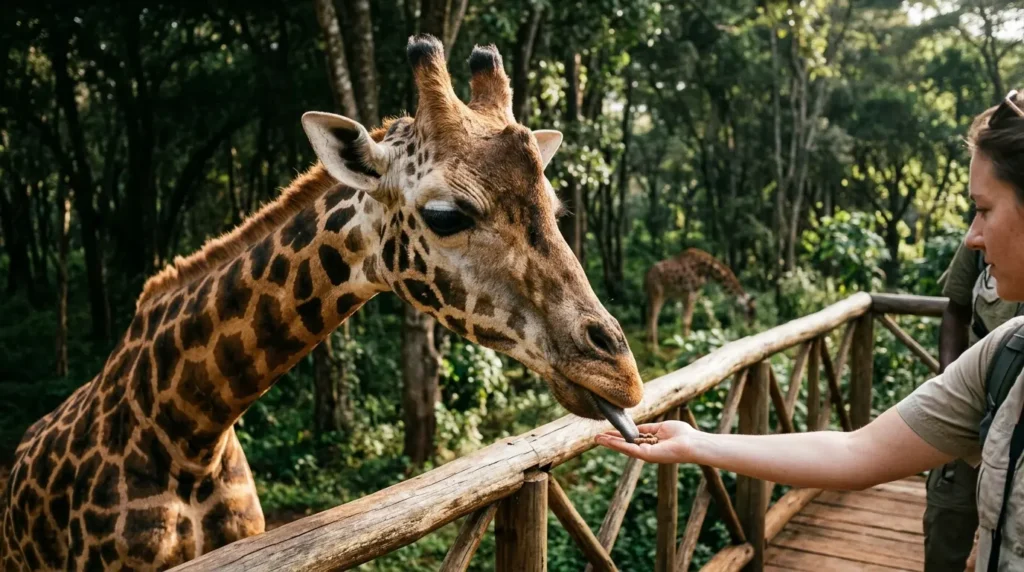
The African Fund for Endangered Wildlife Giraffe Centre lets you hand-feed Rothschild giraffes — one of the world’s most endangered giraffe subspecies — from an elevated wooden platform. Morning is when the giraffes are most active and the interaction most rewarding. Combine both in a single Nairobi morning before a four-hour road drive to Amboseli.
Nairobi’s restaurant scene, particularly in Westlands and Karen, is far stronger than the city’s reputation suggests. A proper evening there — rather than a hotel dinner — is worth building into the arrival day.
Should I add a beach extension to a Kenya safari?
Diani Beach, 90 minutes south of Mombasa on the Indian Ocean coast, is the standard beach extension for Kenya safaris. The beach itself — wide, white, backed by low coastal forest — is excellent. The water is warm year-round. The coral reef makes it viable for snorkelling and diving. Most visitors fly Nairobi–Mombasa on the domestic leg and spend three to five days before flying home from Mombasa.
The combination works well on a ten-to-fourteen day trip: seven to eight days on safari, three to four days on the coast. It is a different Kenya from the parks — slower, humid, with a Swahili coastal culture that has nothing to do with the savannah interior.
The Mombasa coast is not the Maldives and should not be approached as one. It is good beach travel with excellent seafood and an interesting old town (Fort Jesus, the Arab quarter, the dhow harbour) that rewards a half-day of exploration.
Frequently asked questions
Q: Is Kenya safe for tourists in 2026?
A: The safari parks and Nairobi’s tourist areas (Karen, Westlands, the hotel districts) are generally safe for tourists. The FCDO advises normal vigilance in Nairobi and notes that some northern border areas near Somalia and South Sudan carry higher risk — these are not on any standard safari itinerary. The FCDO Kenya travel advice has current status. Petty theft exists in Nairobi’s CBD as in any large city; the safari parks themselves present no particular personal safety risk.
Q: Do I need a guide for a Kenya safari?
A: In most Kenyan national parks, you are required to have a licensed guide. Self-drive is permitted in some parks (Nairobi National Park, parts of Tsavo) but the majority of visitors — and all visitors to the Masai Mara via a tour operator — travel with a professional guide. A good guide adds the difference between seeing animals and understanding what you are looking at. The guide quality gap between budget and mid-range operators is significant.
Q: How many days do I need for a Kenya safari?
A: A minimum of five days on the ground. Seven to ten is the range where you can cover two or three parks meaningfully. With fewer than five days, the travel time between parks erodes the game-drive time significantly. A two-week trip that includes Nairobi, two to three parks and a beach extension is the format that experienced Kenya visitors most often describe as the right length.
Q: What is the Great Migration and when exactly are the river crossings?
A: The Great Migration is the cyclical movement of approximately 1.5 million wildebeest between the Serengeti (Tanzania) and the Masai Mara (Kenya), following the seasonal grass. The Mara River crossings — where the wildebeest plunge into a crocodile-filled river in panicked groups of hundreds — begin in earnest in late July and continue through September, with the herds returning south in October. The crossing timing varies by year depending on grass and rain conditions. Experienced guides and camp managers track the herd movement and can advise on daily positioning. No one can guarantee a crossing on any given day; most visitors who spend four or more days in the Mara in August or September witness at least one.
Q: Is Kenya more expensive than Tanzania for a safari?
A: Comparable at the mid-range level; Tanzania’s Serengeti is marginally more expensive than the Masai Mara on average. Kenya has better domestic road access to multiple parks without fly-in transfers, which lowers trip cost if you have time for road travel. Tanzania’s parks are less crowded on average. A combined Kenya–Tanzania trip covering both sides of the Migration ecosystem is the format serious safari-goers choose when budget allows.
Kenya in 2026 is delivering the wildlife experience it always promised — and with tourism revenue up 110% from 2022, the camps and guides that revenue supports have continued to improve. The Masai Mara in Migration season is everything people say it is. Amboseli with Kilimanjaro on a clear morning is a different kind of extraordinary, and significantly quieter. Samburu, Ol Pejeta and the Laikipia plateau are still running below their deserved attention. Any of these, at any time of year, justifies the trip. The question is only which one matches your timing and your budget. Start planning your Kenya safari on PlacesToday →