Budapest attracted approximately 7 million foreign visitors in 2025 — up as Hungary as a whole recorded more than 20 million tourism guests, a national record (Hungarian Central Statistical Office, KSH). A mid-range day in Budapest costs €55–90 per person including a good hotel, restaurant meals and entry to a thermal bath. The city’s Christmas markets open on 13 November 2026, and the Advent Bazilika at St Stephen’s Basilica has been named Europe’s best Christmas market four times. The best months to visit are May and September; the best value months are January and February, when the thermal baths are at their most atmospheric and the entire city is running at a fraction of summer prices.
Budapest does several things that larger European capitals cannot. It has architecture — the Parliament, the Castle District, the Chain Bridge — that belongs in the top tier of anything in Europe. It has thermal baths that are genuinely ancient (Roman-era springs, Ottoman-era bathhouses, Austro-Hungarian-era palaces) and genuinely affordable (€13–35 depending on which you choose). It has a ruin bar scene in the Jewish Quarter that has been widely imitated and never quite matched anywhere else. And it costs roughly half what the equivalent experience costs in Prague, a third of what it costs in Vienna, and a quarter of what it costs in Paris.
Hungary uses the forint, which has made the city consistently good value for euro- and pound-carrying visitors for years, and which continues to make Budapest one of the cheapest EU capitals at every tier of travel. The food — goulash, lángos, the layered Dobos torte, the lamb dishes from the Hungarian plains — is underrated in the way that Central European cooking generally is: substantial, specific to place, and considerably more interesting than the tourist menus in the main squares suggest.
Is Budapest worth visiting in 2026?
Yes — straightforwardly and without significant caveats. The city has not been overwhelmed by tourism in the way that Prague’s Old Town or Krakow’s market square have been. The main sights are busy but navigable. Prices remain among the lowest of any European capital. The infrastructure — hotels, transport, restaurants — is good enough that a trip here feels comfortable rather than adventurous in the challenging sense. And the combination of architectural grandeur, thermal bath culture, a serious food scene and a nightlife that starts late and runs long makes it more versatile than almost any comparable European city break.
When is the best time to visit Budapest?
| Month | Temperature | Crowds | Price | Best for |
|---|---|---|---|---|
| January–February | 0–8°C | Very low | Lowest | Thermal baths, budget travel, quiet sightseeing |
| March–April | 5–20°C | Low–moderate | Moderate | Spring blossoms, Budapest Spring Festival (late March–April) |
| May | 17–24°C | Moderate | Moderate–high | Best overall month — outdoor pools open, long evenings |
| June | 20–28°C | High | High | Rooftop bars, river cruises, long days |
| July–August | 22–32°C | Peak | Peak | Sziget Festival (August); heat, crowds and full prices |
| September | 17–24°C | Dropping | 15–25% below July | Best value summer feel — Design Week, wine harvest |
| October | 10–20°C | Moderate | Moderate | Autumn colour, harvest day trips to Eger and Tokaj |
| November | 4–12°C | Low | Low | Christmas markets from 13 November |
| December | 0–7°C | Moderate | Moderate (peaks Christmas week) | Christmas markets, New Year’s Eve |
Sources: budapest-trip.com seasonal guide; Hungarian Central Statistical Office (KSH) 2025 tourism data
May and September are the practical sweet spots for first-time visitors who want good weather without peak-season pricing. May brings 17–24°C, the outdoor pools at Széchenyi and Palatinus Island open, and the city’s terraces fill in the evenings without the July and August density. September is when the crowds drop after Sziget (Budapest’s major music festival, held in mid-August), the wine harvest begins in the surrounding countryside, and accommodation prices fall 15–25% below the summer peak.
November and December are the specific reason many UK visitors choose Budapest for a winter break. The Christmas market season begins on 13 November and the city’s Advent atmosphere — candlelit markets, mulled wine, illuminated bridges — is genuinely special and significantly less expensive than equivalent markets in Vienna, Strasbourg or Cologne.
Budapest’s Christmas markets in 2026
Budapest has four significant Christmas markets. Two — Advent Bazilika and Vörösmarty Classic Xmas — are adjacent in the city centre and manageable in a single evening.
Advent Bazilika (St Stephen’s Basilica, 13 November 2026 – 1 January 2027) is the flagship market and has been named Europe’s best Christmas market four times. Nearly a hundred Hungarian craft exhibitors, a giant tree in the square, a nativity scene and an illuminated façade light show every afternoon from 17:30. Opening hours: Sunday–Thursday 11:00–22:00, Friday–Saturday 11:00–23:00. Entry is free; drinks and food are priced per stall, typically HUF 800–2,500 (€2–6) for mulled wine and Hungarian street food. The square in front of the Basilica fills quickly on weekend evenings; arrive before 17:00 for the light show with manageable crowds.
Vörösmarty Classic Xmas (Vörösmarty tér, 13 November – 31 December 2026) is the city’s longest-running Christmas market, on the square that anchors the pedestrianised Váci utca shopping street. Hungarian crafts, a central tree, and a free children’s train. The historic Café Gerbeaud — one of Europe’s oldest coffee houses, opened in 1858 — faces the square and is worth a visit for the Dobos torte and the hot chocolate, at prices that are steep by Budapest standards and still reasonable by Western European ones.
Advent Óbudán (Fő tér, District III, from 27 November) is the neighbourhood market — further from the centre, quieter, with an ice rink open daily and weekend concerts. The right choice for visitors who want a market that feels like it is for local people rather than for visitors.
A Budapest Christmas market guided evening tour covers Advent Bazilika, Vörösmarty and the illuminated Chain Bridge in two hours and is useful specifically for the context it provides on the market history and the Basilica architecture.
What makes Budapest worth more than a weekend?
The Parliament — book in advance
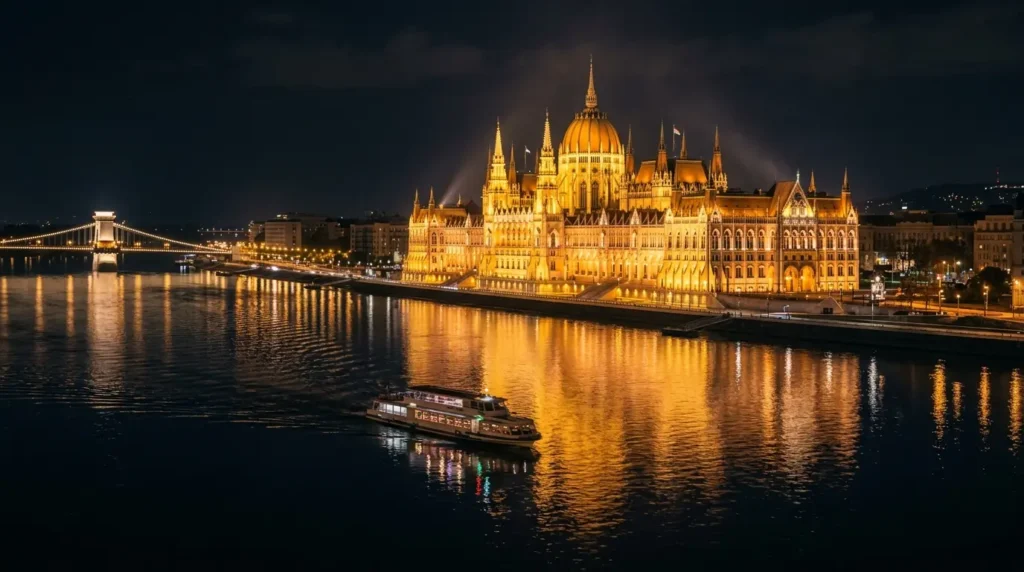
The Hungarian Parliament Building is the largest parliament building in the world by floor area and one of the three most ornate in Europe alongside the Palace of Westminster and Vienna’s Ringstrasse. The exterior — 691 rooms, 365 towers, a central dome that echoes that of Westminster — is impressive from the Danube embankment at night in the way that major European landmarks are sometimes not. The interior, on a guided tour, is the correct delivery mechanism: the main staircase, the lobby ceiling, the Hungarian crown jewels displayed in the central domed hall. Book a Budapest Parliament guided tour online in advance (€20 for non-EU citizens; EU citizens free, though they still need a booked entry time). Morning slots are the least crowded.
Castle Hill and Fisherman’s Bastion — arrive at dawn
The Castle District on the Buda bank of the Danube contains the Royal Palace (now the Hungarian National Gallery and Budapest History Museum), Matthias Church (the 13th-century coronation church with its Zsolnay ceramic tile roof), and Fisherman’s Bastion — the neo-Romanesque terrace with the best panoramic view of the Pest bank, the Parliament and the river. Fisherman’s Bastion is free before 9am and €3 after; the view is identical. Arrive at dawn, especially between October and February when fog sits on the river and the Parliament’s lights are still on, and the terrace is empty. The Castle Hill funicular runs €5 each way from the Chain Bridge to the top; the stairs are free and take six minutes.
The thermal baths — choose based on purpose
Budapest sits on 118 thermal springs, the combined legacy of Roman settlements, Ottoman conquest and Austro-Hungarian ambition. Three baths dominate visitor recommendations:
Széchenyi (City Park) is the most famous and the most photographed — an 1913 neo-baroque palace whose outdoor pools operate year-round, including through snow. It is the social bath: chess players at the outdoor pool edges, large groups, the monthly Sparty (a spa party with DJs that runs in summer). Entry from €25–35.
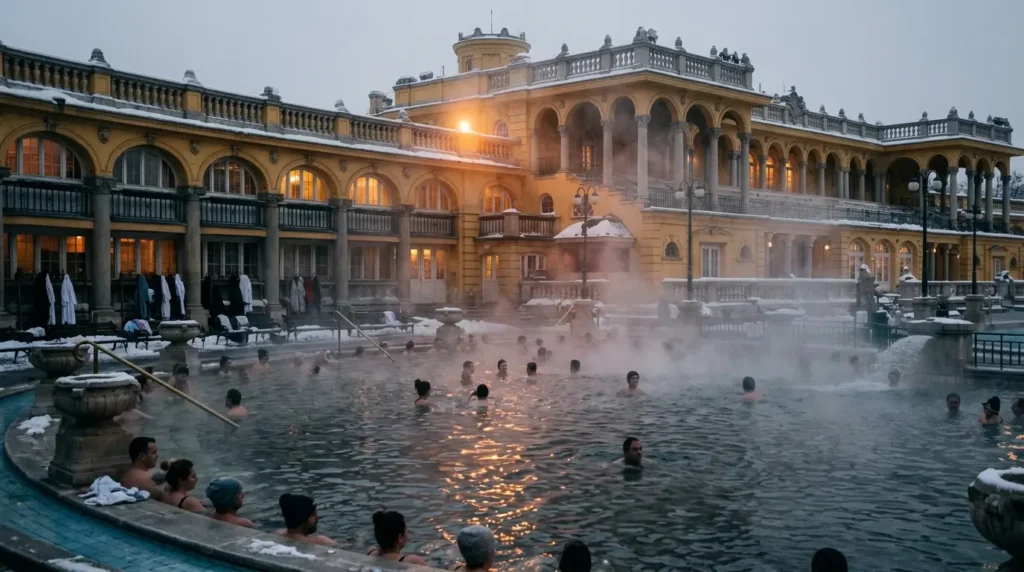
Gellért (Pest, Art Nouveau, adjacent to the Gellért Hotel) is the most beautiful interior — a vaulted hall, mosaic tiles, arched windows over the main pool. More formal than Széchenyi, quieter, and worth it if you care about the architecture. Similar pricing.
Lukács (Buda, near the Chain Bridge) is the most local. Fewer tourists, a regular clientele of Budapest residents, lower prices (€13–17.50), and a real sense of a neighbourhood bath rather than an attraction. The correct choice for visitors who want to spend three hours in hot water with Budapestians rather than with other tourists.
A Széchenyi Thermal Bath entry ticket with optional massage includes locker access. Book the massage in advance; same-day availability disappears quickly in peak months.
The ruin bars — go on a Thursday
The Jewish Quarter’s ruin bars occupy the shells of abandoned pre-war buildings and courtyards — rough concrete, second-hand furniture, mismatched lights, a density of small bars in the same space. Szimpla Kert on Kazinczy utca is the original and most famous: a multi-room complex in a derelict apartment building with a functioning vintage car in the courtyard and approximately forty different things happening simultaneously. It is busier at weekends and better on Thursdays when the resident crowd is larger relative to the tourist one. Entry is free. Beer runs €2–4.
The surrounding streets — Kazinczy, Rumbach, Dob — have enough independent bars, restaurants and coffee shops to occupy a full evening without repeating yourself.
Buda or Pest — where should you stay?
Budapest is two cities joined by eight bridges, and the Danube between them is wide enough that the choice of bank materially affects the feel of a stay.
Pest (the flat, eastern bank) is where most of the city’s restaurants, ruin bars, nightlife and hotels sit. The inner districts — District V around the Parliament, District VII (the Jewish Quarter), District VI along Andrássy Avenue — are dense, walkable and full of 19th-century boulevards. The major hotel inventory is here. The pace is urban. Most first-time visitors should stay on the Pest side.
Buda (the hilly, western bank) is quieter, more residential, and home to the Castle District, Gellért Hill and the southern wine villages that dissolve into the city limits. Staying in Buda means better sleep, longer travel times to the Pest-side bars and restaurants, and a different city from the one most people come for. The exception is a stay directly beneath Castle Hill in Víziváros (the Water Town quarter), which gives Buda proximity with easy access to the Chain Bridge crossing.
For the Christmas markets specifically: both Advent Bazilika and Vörösmarty are in central Pest and within walking distance of the District V and VI hotels. The Lukács bath and Advent Óbudán are on the Buda side and require a tram or bus. The practical solution for a four-night Christmas market trip is to stay in Pest and cross the river by foot or tram for the Buda elements.
What does Budapest cost in 2026?
Daily budget (per person, excluding accommodation)
| Category | Budget | Mid-range | Comfortable |
|---|---|---|---|
| Accommodation | Hostel €12–18 | Hotel €60–100 | Boutique €90–140 |
| Breakfast | Market/street €3–5 | Café €7–12 | Hotel or brunch €15–20 |
| Lunch | Menu special €8–12 | Restaurant €15–22 | Sit-down €25–35 |
| Dinner | Street food €8–12 | Restaurant €18–28 | Fine dining €45–80 |
| Transport (daily) | €3–6 (travelcard) | €5–8 | Bolt/taxi €10–15 |
| One bath or attraction | €13–20 | €25–35 | €35–50 |
| Drinks/evening | €6–10 | €12–20 | €25–50 |
| Daily total | €30–45 | €55–90 | €100–160 |
Note: Budapest is priced in Hungarian forint. All €-equivalent prices use approximately 400 HUF per euro (October 2026 rate). Pay in HUF at card terminals — dynamic currency conversion adds 4–7%.
Sources: budapest-trip.com daily budget guide; chasingwhereabouts.com Budapest cost breakdown, 2026
A 72-hour transport travelcard (€14) is the right choice for stays of three to five days; it covers metro, tram, bus and the suburban HÉV trains. The airport bus (100E) runs €6 each way from Terminal 2 to Deák Ferenc tér in the city centre. The Bolt ride-share app operates widely; airport to centre by Bolt costs €15–25 depending on time of day.
A note on the tourist tax: Hungary does not currently charge a per-night tourist tax in the way that Barcelona or Venice do. Accommodation is taxed through VAT, which is included in quoted prices. This is a meaningful practical advantage over comparable European city breaks.
Frequently asked questions
Q: How many days do you need in Budapest?
A: Three nights covers the Parliament, Castle Hill, one thermal bath, the ruin bars and the Christmas market or Great Market Hall. Four nights allows for a day trip to Eger (the baroque wine town in the Mátra hills, 90 minutes by train, home of Egri Bikavér red wine) or a day on the Danube Bend (Visegrád, Esztergom). Five nights or more is comfortable for visitors who want to go deeper into the Jewish Quarter history, the contemporary art scene, or the surrounding wine country. Two nights is not enough unless you have been before.
Q: Is Budapest cheaper than Prague or Krakow? A: Yes, in most categories. Accommodation is comparable at the budget end and 15–25% cheaper at the mid-range level. Meals and drinks are consistently cheaper. The thermal baths have no equivalent in Prague or Krakow. The ruin bar scene, while imitated, is more developed. Prague’s Old Town is arguably more uniformly beautiful in a concentrated area; Budapest’s scale and variety are greater. For a first European city break on a budget, Budapest and Krakow are the two strongest cases. Budapest wins on architecture, nightlife and the bath culture.
Q: Is Budapest safe for tourists?
A: Yes — Budapest has low levels of violent crime and is a standard European capital for personal safety. Petty theft (pickpocketing) is the primary risk in crowded areas: Váci utca, the Christmas markets, packed tram and metro carriages. Keep phones and wallets in front pockets and use hotel safes for passports. Unmetered taxis operating near the main tourist sites quote prices in advance that are significantly above the Bolt or official taxi rates; use the Bolt app or a licensed taxi with a running meter. The FCDO has no travel warnings for Hungary beyond standard precautions.
Q: What should you eat in Budapest?
A: Goulash (gulyás) — a paprika-heavy beef and vegetable soup rather than the thick stew served outside Hungary — is the correct starting point and should be eaten at a sit-down restaurant rather than at a tourist market stand. Lángos (deep-fried dough with sour cream and cheese, €2–3) is the correct street food. The Central Market Hall (Nagyvásárcsarnok), the large 19th-century cast-iron market at the south end of Váci utca, is the right place to buy paprika, Tokaji wine and Hungarian salami to take home, and has a decent upstairs food hall for lunch. Dobos torte — layered sponge with chocolate buttercream and a caramel top — is the dessert that belongs specifically to Budapest and is worth eating at Café Gerbeaud or at Ruszwurm (the tiny pastry shop in the Castle District, open since 1827). See our best European Christmas markets guide for how Budapest’s market compares to the other top-ranked European options.
Q: Is the Budapest Card worth buying?
A: For most visitors, the 72-hour transport travelcard (€14) is more cost-effective than the Budapest Card (72 hours, approximately €75). The Budapest Card includes unlimited transport plus free entry to a selected list of museums and baths. It is worth doing the maths for your specific itinerary: if you plan to visit Széchenyi, the Parliament, the Hungarian National Museum and the House of Terror in 72 hours, the card likely saves money. If your priorities are Fisherman’s Bastion (free before 9am), the ruin bars (free entry), the Christmas market (free entry), and one thermal bath, the travelcard is the cheaper option.
Budapest in October and November is one of Europe’s more rewarding planning decisions — the autumn colour on Castle Hill and in City Park is at its peak now, the crowds are manageable, and the Christmas market season opens on 13 November. The city is the most affordable EU capital for pound and euro-carrying visitors at any time of year, and it is delivering genuinely world-class architecture, bath culture and a ruin bar scene that has not been replicated elsewhere at any comparable price point. Book the Parliament tour in advance. Arrive at Fisherman’s Bastion at dawn. Eat lángos at the Central Market Hall. Everything else can be improvised. Start planning your Budapest trip on PlacesToday →