The Albanian Riviera is a 120-kilometre stretch of Ionian coastline running from Vlorë south to Ksamil near the Greek border. In 2026, it delivers turquoise water and cliff-backed beaches at 30–50% lower cost than Greece or Croatia. Bookings surged 53% year-on-year (lastminute.com), making it Europe’s fastest-rising beach destination right now.
There is a coast where the mountains drop straight into the sea, the water turns an improbable shade of blue, and a beach sunbed costs €5 instead of €40. That coast is Albania. And 2026 may be the last year you can arrive before everyone else does.
The Albanian Riviera has moved from obscure Balkan coastline to one of Europe’s fastest-booked destinations in under two seasons. Albania ranked fourth globally for percentage growth in international tourist arrivals (UNWTO). Chase Travel named it one of its 26 trips to take in 2026. Flight routes from Ryanair, Wizz Air and Lufthansa now connect major European hubs directly to Tirana.
If you have been rethinking the crowded hotspots — the queues for a Santorini sunset, the Amalfi Coast gridlock, the Dubrovnik cruise-ship bottleneck — the Albanian Riviera in 2026 is where to look instead. This guide tells you exactly where to go, what to pay, and what to see, before the window closes.
What makes the Albanian Riviera worth visiting in 2026?
The Albanian Riviera stretches 120 kilometres along the Ionian Sea, from Vlorë in the north through Dhërmi, Himarë and Borsh, ending at Ksamil near the Greek border. It is not a resort strip. It is a coastal route of mountain passes, hidden coves and stone fishing villages.
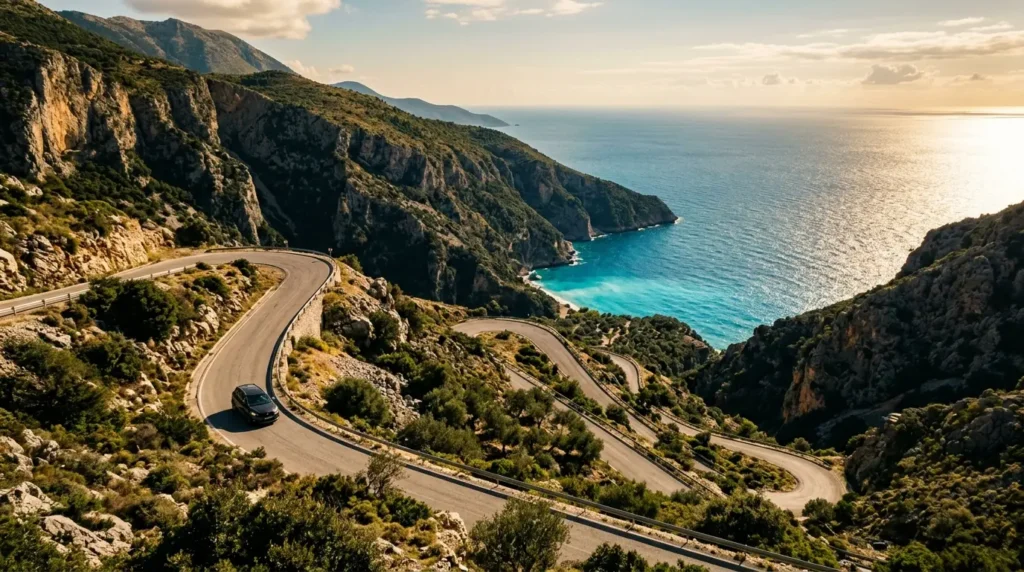
The geography sets it apart from anywhere else in the Mediterranean. The Llogara Pass drops over 1,000 metres in hairpin bends before the sea appears below, turning from green to turquoise to deep Ionian blue as the road descends. Most beaches are fine white pebble rather than sand — which is precisely why the water is so extraordinarily clear.
Why 2026 specifically is the right time
Albania recorded approximately 11.7 million foreign visitors in 2024, a 15.2% rise on the year before (INSTAT). Bookings from Western Europe accelerated sharply throughout 2025. The infrastructure has now developed enough to be comfortable — reliable hotels, good restaurants, functioning roads — but not yet enough to be crowded in the way Greece and Croatia have become.
A new international airport near Vlorë is expected to open in late 2026. Once it does, direct access to the southern Riviera will bring a significant step-change in visitor numbers. Go this summer while Tirana is still the only international entry point.
Who the Albanian Riviera suits
It suits couples, solo travellers and small groups looking for a genuine Mediterranean beach holiday without the price tag and crowds of the established hotspots. It is less suited to families expecting flat sandy beaches with shallow water — most of the Riviera is pebble, and the best beaches require a short hike or boat trip to reach.
Which Albanian Riviera beach is right for you in 2026?
The Riviera’s beaches are not interchangeable. Each town has a different character, price point and atmosphere. Here is the honest breakdown from north to south.
Dhërmi — boutique and dramatic
Dhërmi sits on a mountainside above a long stretch of white-pebble beach, reached by a road that winds through olive groves. It is one of the most visually striking settings on the coast. Hotels run €60–150 per night and beach clubs here are well-developed (machupicchu.org, 2026 data). Come for the scenery and atmosphere rather than budget value.
Himarë — the best base for most travellers
Himarë is the Riviera’s sweet spot. Accommodation runs 25–50% cheaper than Dhërmi and Ksamil for the same standard, restaurants are excellent, and three distinct beaches sit within easy walking distance (findingalexx.com, 2024 field report). The old castle quarter adds cultural texture. Most experienced Albanian Riviera travellers base themselves here.
Ksamil — the postcard beach
Ksamil is the most photographed spot on the coast — turquoise water, small beaches, and four tiny islands you can swim to. It is also the most crowded and priciest in peak season, with central beach sunbed sets running €20–40 for two loungers and an umbrella (himara.net, 2025 data). Visit in June or September and the crowd drops sharply.
Borsh — for pure escape
Borsh stretches 7 kilometres of pebble beach backed by olive groves and castle ruins. Many sections are free to access. If you want space, silence and Albanian local life rather than beach clubs, Borsh is the answer.
Gjipe — for the adventurous
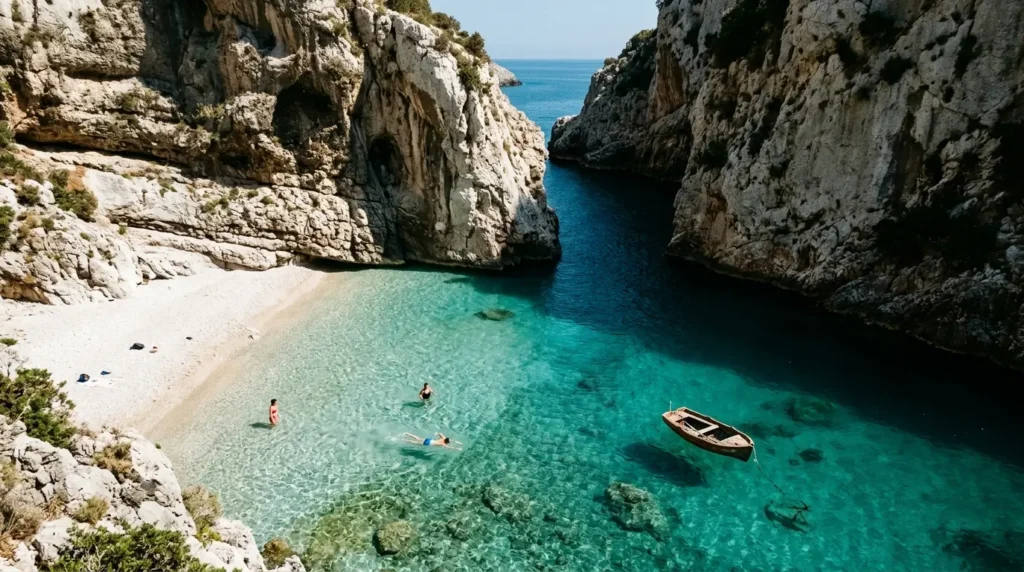
Gjipe is accessible only by a 20–30 minute hike or a small boat from Himarë. The canyon walls make it one of the most dramatic spots on the entire Riviera. There are almost no facilities — bring water, food and water shoes. The reward is a beach that still feels completely unspoilt.
How does the Albanian Riviera compare to Greece and Croatia for cost?
This is the real reason travellers are switching, and the numbers are significant. A beachfront lunch in Dhërmi costs €6–15 versus €25–45 in Santorini (terrainvestsolutions.com). Midrange hotels in Himarë run €45–120 per night, compared with €100–250 in comparable Greek island towns. Beach sunbeds in the best-value areas cost €10–15 for the day — versus €30–100 in Mykonos (himara.net, 2025 data).
A full day on the beach, including sunbeds, meals and a boat trip, comfortably comes in under €60 per person in Himarë. That same day in Greece or Croatia costs roughly twice that figure.
Where the price gap is narrowing
Ksamil and Saranda are the exceptions. Peak-season prices in those two towns have climbed 12–20% every year and now approach mid-range Greek island levels (himara.net). The genuine value play is Himarë, Borsh and the smaller coves between them.
Practical daily budget breakdown
Budget travellers sharing a guesthouse room and eating at local tavernas can manage €40–60 per person per day. Mid-range travellers in a decent hotel with beach days and evening dinners out should expect €100–140. Luxury is available — the Green Coast Hotel (MGallery) near Palasë is Albania’s only Blue Flag property — but remains 40–60% cheaper than equivalent Greek island luxury (terrainvestsolutions.com).
When is the best time to visit the Albanian Riviera in 2026?
September is the optimal month. Sea temperatures hold at 25°C, air cools to 26–28°C, summer crowds drop sharply, and hotel prices fall 30–50% from the July–August peak (terrainvestsolutions.com). June is a close second — warm, swimmable, and manageable before the high-season rush arrives.
July and August bring the Riviera to full capacity. Last-minute accommodation rates in Ksamil and Dhërmi can become extreme because demand still outpaces supply along most of the coast (findingalexx.com). If peak summer is your only window, book accommodation as early as possible.
May and October are cooler and very quiet, but many beach clubs, boat tours and smaller restaurants close outside the main season.
How do you get to the Albanian Riviera?
Flying in
Tirana International Airport is the main gateway, now served directly by Ryanair, Wizz Air and Lufthansa from London, Berlin, Vienna, Milan and other European hubs. From Tirana, the drive south to Himarë takes 3–4 hours on the SH8 coastal road, which is itself one of the most scenic drives in the Balkans.
Coming from Greece
The ferry from Corfu to Saranda runs year-round and takes under 45 minutes. This is the fastest entry into the southern Riviera and a natural route for travellers combining both countries. From Saranda, Ksamil is 14 kilometres south.
Getting around the Riviera
Renting a car gives the most freedom, particularly for reaching the hidden coves off the main road. Furgons — shared minibuses — connect towns for €4–8 per leg and run throughout the summer. The coastal SH8 road is well-surfaced. A practical note: ATM fees run €5–8 per withdrawal along the Riviera (findingalexx.com), so carry enough euros from Tirana or Corfu to minimise cash runs.
What else can you do beyond the beaches?
The Albanian Riviera rewards travellers who look beyond the coastline. The cultural and natural depth here is genuinely surprising.
Butrint National Park — UNESCO World Heritage Site
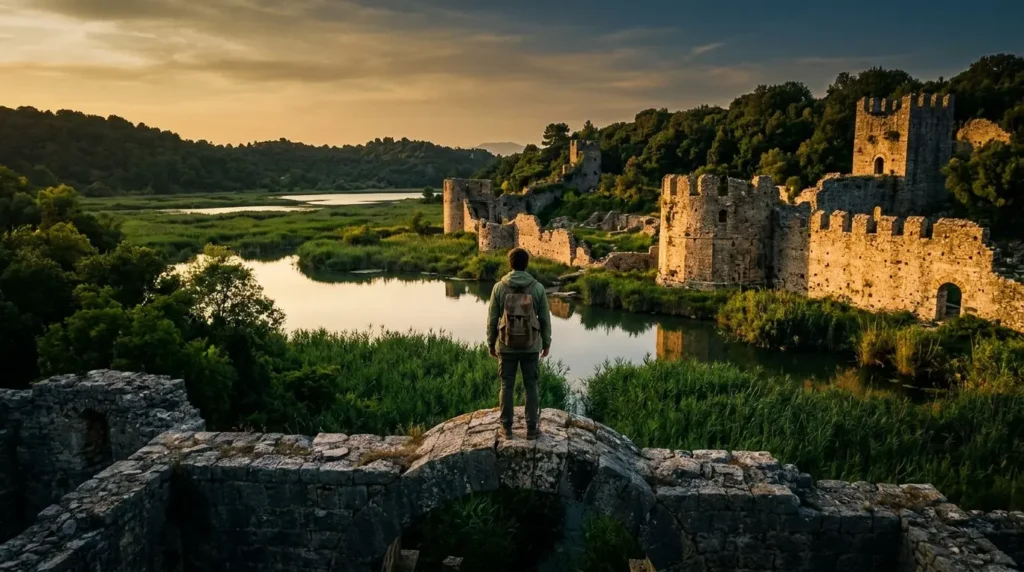
Near Ksamil, Butrint is one of the most layered archaeological sites in the Mediterranean — Greek, Roman, Byzantine and Venetian ruins occupying a peninsula surrounded by a lagoon. Entry costs a few euros. It is consistently rated one of the most impressive UNESCO sites in the Balkans, and it receives a fraction of the visitors of comparable sites in Greece or Italy.
Boat tours to Grama Bay and Karaburun Peninsula
The Karaburun Peninsula north of Vlorë is accessible only by boat. Grama Bay contains over 1,500 rock carvings spanning Ancient Greece through World War Two. Rare Mediterranean monk seals inhabit the marine park. Boat tours from Himarë and Vlorë can be booked directly with local operators or through GetYourGuide.
The Blue Eye — Syri i Kaltër
About an hour from Saranda by car, the Blue Eye is a natural spring where ice-cold water boils up from an unknown depth through a karst pool of vivid turquoise. The colour is extraordinary — nothing else quite like it in the region. Day tours run from Saranda and Ksamil.
Porto Palermo Castle
A 19th-century fortress built almost entirely surrounded by water, Porto Palermo Castle sits on a small peninsula between Himarë and Borsh. The setting is genuinely theatrical — stone ramparts over the Ionian Sea, almost no other visitors. Open until late during summer.
Frequently asked questions
Q: Is the Albanian Riviera safe to visit in 2026? A: Yes. Violent crime against tourists is rare and Albanians are known for their hospitality. Solo female travellers should note that Sarandë and Ksamil can involve persistent attention in the evening; Himarë, Dhërmi and smaller towns along the Riviera are consistently rated more comfortable (findingalexx.com). The rest of the Riviera is widely reported as very safe.
Q: Do I need a visa to visit Albania in 2026? A: Citizens of the EU, UK, US, Canada, Switzerland and Australia can enter Albania visa-free for up to 90 days. Saudi Arabian visitors benefit from a seasonal visa-free exemption running from 15 April to 31 December 2026. Holders of valid multi-entry Schengen or US visas can also enter without a separate Albanian visa.
Q: Is the Albanian Riviera better than Greece for a beach holiday? A: For value, space and discovery, the Albanian Riviera wins clearly in 2026. For infrastructure, variety and island-hopping, Greece is more developed. Many travellers now combine both — the Corfu to Saranda ferry takes under 45 minutes, making it easy to do a week in each.
Q: What currency is accepted on the Albanian Riviera? A: The official currency is the Albanian lek (ALL), but euros are widely accepted across the Riviera at a fixed rate. Card payment is increasingly available in Dhërmi and Ksamil, but cash remains essential for beach sunbeds and smaller restaurants. Carry enough euros from Tirana or Corfu — ATM fees along the Riviera run €5–8 per withdrawal (findingalexx.com).
Q: Which Albanian Riviera town is best for couples in 2026? A: Dhërmi for dramatic scenery and boutique hotels, Gjipe for total seclusion, and Himarë for a romantic balance of beach, good food and local character. Avoid the party atmosphere of Jale Beach and central Ksamil if you want quiet evenings. September gives the best conditions — warm sea, cooler nights, very few crowds.
Q: Is the Albanian Riviera a good alternative to Santorini? A: For budget, space and raw natural beauty, yes — the Ionian water is just as vivid and the scenery just as dramatic. For the classic whitewashed-village aesthetic, no. The Albanian Riviera is not trying to be Santorini. It is something different and, in 2026, significantly less crowded and less expensive. You can read more about the shift away from Europe’s famous hotspots in our guide to where to go instead of crowded Europe this summer.
Plan your Albanian Riviera trip
The Albanian Riviera in 2026 is the Mediterranean beach holiday that rewards the traveller who moves one step off the obvious path. Ionian water, cliff-backed coves, UNESCO ruins, mountain scenery, and costs that make Greece and Croatia look overpriced — all in a country that is changing fast but has not yet tipped into mass tourism.
Go this summer. Base yourself in Himarë. Take the boat to Gjipe. Eat grilled fish with local wine at sunset over the water. This version of the Mediterranean is getting harder to find. For now, it still exists.
Ready to plan your Albanian Riviera trip around your occasion and budget? Build your itinerary on PlacesToday →