Amsterdam in 2026 is worth visiting for the Rijksmuseum, which contains Rembrandt’s Night Watch and Vermeer’s complete surviving output in a building you could spend two days in; for the Anne Frank House, which requires booking months in advance and is one of the most significant historical sites in Europe; for the canal ring, which is UNESCO-listed and genuinely as beautiful as the photographs suggest; and for the Jordaan neighbourhood, which is the version of the city that the tourist circuit reaches last and that the residents like most. Book the Anne Frank House the day the tickets go on sale. Everything else follows from there.
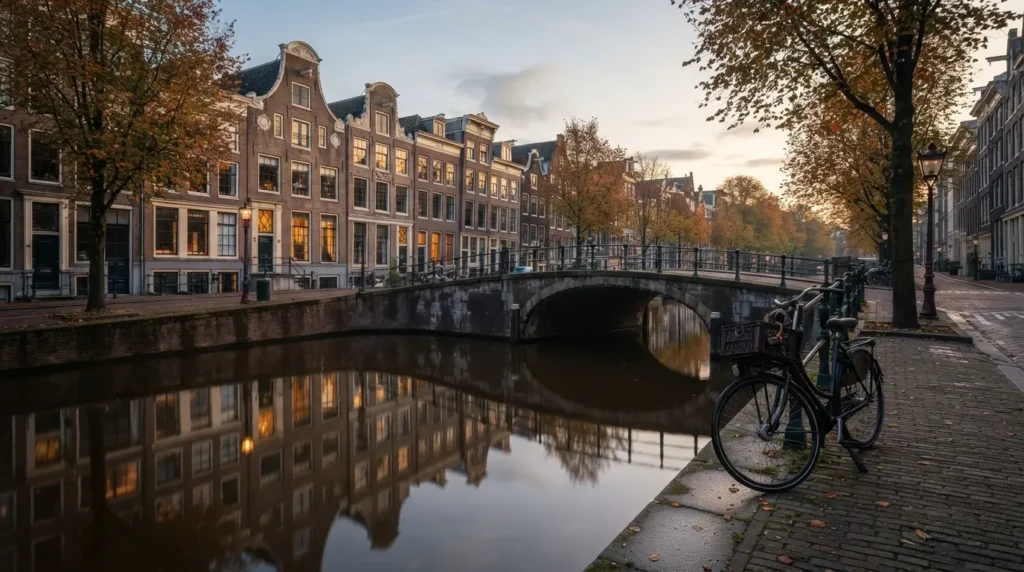
The canal light in the morning — before the tourist boats start their circuits, when the elms along the Herengracht are reflected in the brown water and someone is cycling past with bread from the bakery two streets over — is the light that the Dutch Golden Age painters were working from. Rembrandt lived three minutes from where the Anne Frank House now stands. Vermeer painted in Delft but the light is the same light: northern, diffuse, quality of illumination that makes surfaces glow without casting hard shadows. This is the thing that no photograph adequately communicates about Amsterdam — not the beauty of the gabled houses, which photographs do communicate accurately, but the particular quality of the light falling on them and the water below at seven in the morning.
Amsterdam is one of the most visited cities in Europe and has been managing its visitor numbers actively for several years — fewer party tourism licenses, higher tourist taxes (€3 per person per night plus 7% of the room rate, one of the highest in Europe), and a campaign specifically asking certain types of visitor to reconsider. The result is a city that has not lost its character to its own popularity and that rewards the visitor who approaches it as something more than an Instagram location or a stag weekend destination.
Which Amsterdam neighbourhood should you explore first?
The canals divide the city into concentric rings and the neighbourhoods between them have distinct characters.
| Neighbourhood | Character | Best for |
|---|---|---|
| Jordaan | Former working-class, now galleries and local restaurants | Independent shops, brown cafés, best local dining |
| De Pijp | Multicultural, market-centred, diverse food | Albert Cuyp Market, restaurants from every tradition |
| Canal Ring (Grachtengordel) | UNESCO-listed, tourist-facing but genuinely beautiful | The canals, the gabled houses, the museums |
| Oud-West | Residential, younger, café culture | Vondelpark, neighbourhood restaurants, fewer tourists |
| Amsterdam Noord | Post-industrial, creative, ferry away | Ndsm Wharf, Eye Film Museum, street art, space |
| De Wallen (Red Light District) | Tourist-facing, managed by the city | Worth a morning walk to understand the city; eat elsewhere |
Sources: amsterdam.info 2026; iamsterdam.com city guide; worldtravelling.net Amsterdam guide 2026
The Jordaan — west of the main canal ring, a neighbourhood of independent galleries, brown cafés (bruine kroegen, wood-panelled bars that have operated as neighbourhood social institutions for centuries), and the Saturday and Monday Noordermarkt — is the Amsterdam that residents recommend. Base yourself here or in Oud-West if the budget allows; the canal ring is a twenty-minute walk in either direction.
What should you book in advance in Amsterdam — and how far ahead?
More than in most European cities. Amsterdam’s most significant sites have genuine capacity constraints.
The Anne Frank House (Prinsengracht 263) is the single most important advance booking in Europe. Tickets go on sale on the official website (annefrank.org) two months ahead to the day, at 9am Amsterdam time. They sell out completely within hours. There is no walk-in entry, no queue, no last-minute option. Miss the two-months-ahead booking window and you will not see the Anne Frank House on this trip. This is not an exaggeration and it is not specific to peak season. Set a calendar reminder for two months before your travel date and be on the website at 9am Amsterdam time. Entry costs €16. The hour inside the house, following the movement of Anne Frank and seven others through the secret annex they occupied for two years, is as affecting as its reputation suggests.
The Rijksmuseum (Museumplein) sells timed entry tickets at €22.50. Advance booking is required in peak season (June–August) and strongly recommended at all other times. The Van Gogh Museum, adjacent on the Museumplein, requires even more advance booking — it sells out two to three weeks ahead in summer. Entry is €22. Both museums are covered by the Museumkaart (Netherlands museum card), which at €69.95 covers unlimited entry to 400+ Dutch museums for a year — worth buying if you visit three or more museums on the Museumkaart list in a single trip.
A Amsterdam canal ring and Jordaan neighbourhood walking tour covers the UNESCO canal ring, the Jordaan’s history and the key landmarks in two to three hours — the correct orientation before the independent museum days.
What makes the Rijksmuseum worth a full morning?
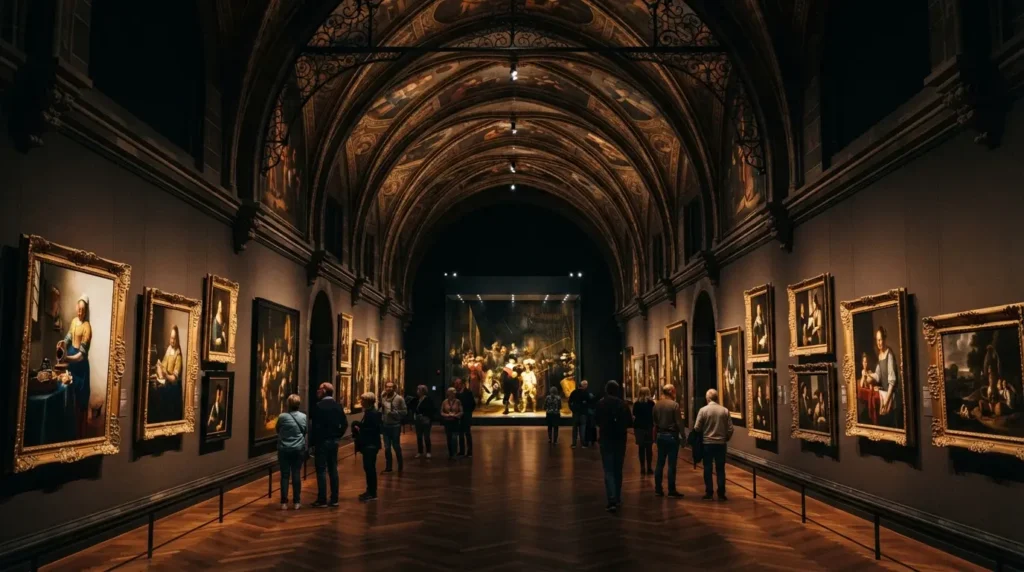
The Rijksmuseum — the national museum of the Netherlands, housed in a building on the Museumplein that is itself a significant piece of Dutch Gothic revival architecture — contains the most concentrated collection of Dutch Golden Age painting in the world. Rembrandt van Rijn, Johannes Vermeer, Frans Hals, Jan Steen, Jacob van Ruisdael — the full range of 17th-century Dutch masters, at the peak of the period when the Netherlands was the wealthiest nation in the world and its painters were recording what wealth looked like in domestic life.
The Night Watch — Rembrandt’s 1642 group portrait of a militia company, 3.63 metres by 4.37 metres — is the painting most visitors come specifically to see, and it is larger and more dynamically painted than the photographs suggest. It occupies its own room. Stand in front of it for ten minutes rather than photographing it and moving on. The Gallery of Honour corridor leading to the Night Watch contains the museum’s other Rembrandt portraits, the Vermeer paintings (Woman Reading a Letter, The Milkmaid, The Love Letter), and the Hals portraits. All are extraordinary. Attempt to understand the whole museum in one visit and you will see none of it properly.
Allow a minimum of three hours. The museum café on the ground floor is worth the stop at eleven when the first visit energy is spent and the second gallery requires fuelling.
What should you do beyond the museums?
Vondelpark and the Albert Cuyp Market
Vondelpark, the main city park west of the Museumplein, is free and functions as the city’s outdoor living room — cycling families, dog walkers, office workers eating lunch, people reading on the grass. In summer the outdoor café and theatre stage operate; the rest of the year it is simply the park. It is worth an afternoon specifically because it is the version of Amsterdam that is not performing itself.
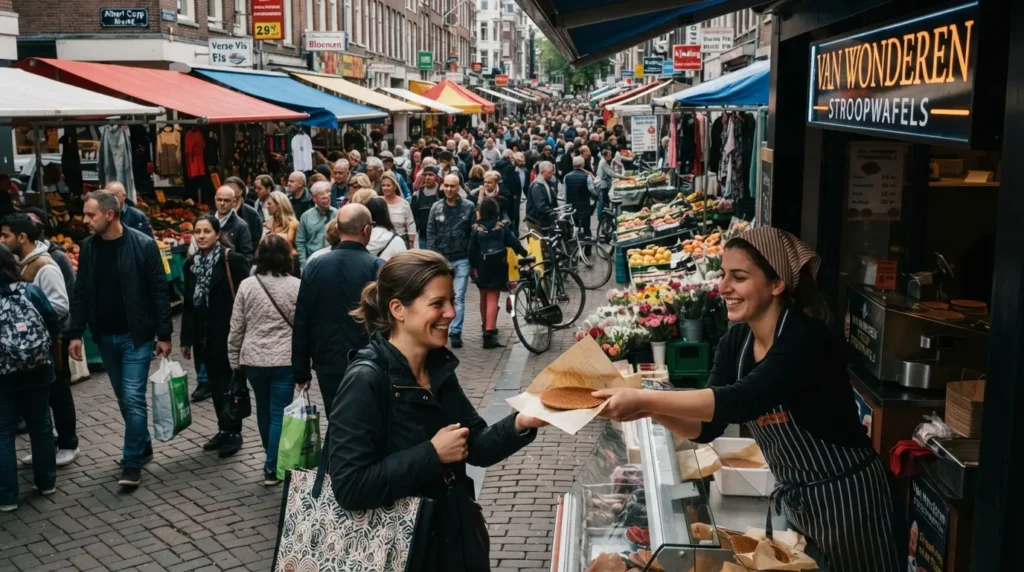
The Albert Cuyp Market in De Pijp — the longest outdoor market in the Netherlands, running for a kilometre along the Albert Cuypstraat six days a week — is free to walk and provides the most affordable food circuit in central Amsterdam. The stroopwafels (caramel waffle sandwiches, eaten warm off the waffle iron), the herring stands (raw herring with onion and pickle, eaten standing — this is the correct way to eat it), and the diverse prepared food from the Surinamese, Turkish and South Asian stalls that reflect De Pijp’s demographic character are all priced for the residents rather than the tourists.
The brown cafés and the beer
Amsterdam’s bruine kroegen — the brown cafés named for the wood panelling and centuries of tobacco smoke that stain the walls dark — are the neighbourhood social institution that the tourist circuit does not manufacture. A Heineken from the tap in a Jordaan brown café costs €4–5 and arrives in a small glass with a pronounced head, served at a specific temperature by someone who would be mildly offended by the suggestion that they serve it incorrectly. The Heineken Experience on Stadhouderskade is not this. The Heineken Experience is a €25 branded tourist attraction in the old brewery. Both exist. The brown café is the reason Amsterdam has a beer culture.
A day trip to Delft or Haarlem
Delft, twenty minutes by train from Amsterdam (€6 each way), is where Vermeer painted and where the Delft blue pottery tradition was developed. The Old Church (Oude Kerk), the New Church (Nieuwe Kerk) and the market square are compact and walkable. The Royal Delft factory is the only remaining maker of traditional Delft pottery and offers guided tours of its production. Haarlem, fifteen minutes from Amsterdam, is a smaller version of the canal-house city with half the tourist density and the Frans Hals Museum — one of the finest collections of Dutch portraiture in the country, in the house where Hals lived.
Should you hire a bicycle in Amsterdam?
Yes, for any stay of two days or more. Amsterdam’s cycling infrastructure is comparable to Copenhagen’s in quality and more historically embedded — the city has had more bicycles than residents for decades. The lanes are separated, the etiquette is consistent (cyclists have right of way; pedestrians in cycle lanes are genuinely endangered), and the experience of cycling the canal ring, through the Jordaan, to the Vondelpark and back, covers the city in a way that walking does not and tourist boats do not approximate.
Hire from a shop rather than a tourist hire stand near the main train stations — the prices are similar but the bikes are better maintained and the queue is shorter. A day’s hire runs approximately €10–15. The rule that matters most: do not walk in the cycle lane. Amsterdam’s cyclists are polite about most things and completely unforgiving about this one.
What does Amsterdam cost in 2026?
More than you expect and slightly less than the worst estimates. The tourist tax — €3 per person per night plus 7% of the room rate — is the highest per-person tourist tax in Europe and adds meaningfully to accommodation costs. A mid-range hotel room runs €120–180 per night before the tax; budget options start around €80–100.
A museum entry runs €16–22.50 per institution. The Museumkaart (€69.95) covers unlimited entry to 400+ Dutch museums for a year — it breaks even at three or four museum entries and is the correct purchase for any visitor spending more than three days. Restaurant meals in the tourist circuit (Leidseplein and Rembrandtplein) run €18–35 per person; comparable meals in the Jordaan and De Pijp run €12–25. The Albert Cuyp Market brings the food cost further down.
You can plan your Amsterdam itinerary on PlacesToday. For how Amsterdam connects to the rest of the European city break network — our Copenhagen guide and Prague guide cover the nearby alternatives.
Frequently asked questions
Q: How do you book the Anne Frank House?
A: Through annefrank.org only — there is no other legitimate booking source. Tickets go on sale exactly two months before the visit date, at 9am Amsterdam time. They sell out within hours. There is no walk-in or same-day entry. Set a calendar reminder for two months before your visit date, be on the website at 8:55am Amsterdam time, and book the first available slot. Entry costs €16. Missing this window means not visiting the Anne Frank House on this trip.
Q: Is the Rijksmuseum worth a full visit?
A: Yes — and a full morning rather than ninety minutes. The Night Watch, the Vermeer room and the Gallery of Honour sequence require time that rushing destroys. Advance booking is required in summer and strongly recommended otherwise. The Museumkaart (€69.95) covers entry to both the Rijksmuseum and the Van Gogh Museum and breaks even at three museum visits — buy it if your Amsterdam trip includes more than two paid museum entries.
Q: What is the tourist tax in Amsterdam in 2026? A: €3 per person per night plus 7% of the room rate — one of the highest tourist taxes in Europe. It is charged at accommodation check-in and does not appear in the booking price. Budget for it from the start; a family of four for five nights adds €60 plus 7% of the total room cost.
Q: Should you hire a bicycle in Amsterdam?
A: Yes, for any stay of two or more days. The cycling infrastructure is excellent and cycling is how Amsterdam residents move. Hire from a shop rather than a tourist stand; the bikes are better and the prices are similar (€10–15 per day). The primary rule: do not walk in the cycle lane. Amsterdam’s otherwise hospitable cycling culture has no tolerance for pedestrians in the designated lanes.
Q: When is the best time to visit Amsterdam?
A: September and October — the summer crowds have thinned, the canal-side elm trees are beginning to colour, hotel prices ease from their July and August peak, and the museums are accessible without the summer booking pressure. April is the other strong option: King’s Day (April 27) turns the city into an outdoor celebration in orange, and the tulip fields around Haarlem and Keukenhof are in full bloom. December for the light festival (Amsterdam Light Festival, late November to January), when the canal bridges and waterways are lit by large-scale light art installations.
Amsterdam is the Dutch Golden Age made into a city — a 17th-century merchant republic that built its wealth into the canal ring that still defines the geography and the museums that still define the reason to visit. Go early in the morning for the light that the painters used. Book the Anne Frank House before you book the flights. Hire the bicycle on day one. The rest — the Jordaan, the Rijksmuseum’s Night Watch, the stroopwafel at the Albert Cuyp Market — follows naturally. Plan your Amsterdam trip on PlacesToday →