Marrakech is worth visiting in 2026 — but it rewards the traveller who slows down rather than the one who rushes through the souks before lunch. The medina is UNESCO-listed, genuinely ancient, and genuinely overwhelming if you arrive without knowing what to expect. The best time to visit is March to May or September to November, when temperatures sit between 20 and 28°C and the city operates at full intensity without the summer heat that regularly pushes above 38°C. Budget travellers can manage on 300–400 MAD per day (approximately £25–35). A riad with a plunge pool and rooftop breakfast costs 500–900 MAD per night and is the correct way to experience the city if the budget allows.
Marrakech smells different at six in the morning. Bread from the communal wood-fired ovens, cold stone still holding the night, something faintly floral from the jasmine that climbs the riad walls. The call to prayer has already moved through the streets once. The souks are locked. The cats who have been everywhere all night are finding corners.
This hour — the one before the medina wakes — is the hour that most visitors to Marrakech never find because they arrived exhausted and slept through it. It is also the hour that explains why people who visit once tend to come back. The city has a particular quality at its quietest, before the vendors and the scooters and the crowd restore it to its daytime intensity, that is hard to describe and harder to forget.
This guide is about how to find that version of the city alongside the obvious one.
Is Marrakech worth visiting in 2026?
Yes — with specific expectations. Marrakech is not a gentle introduction to Morocco. The medina is dense, loud, and genuinely disorienting on the first day. Scooters move through lanes barely wide enough for two people walking. Vendors are persistent. The gap between tourist prices and local prices is wide and requires active navigation. None of this stops being true in 2026.
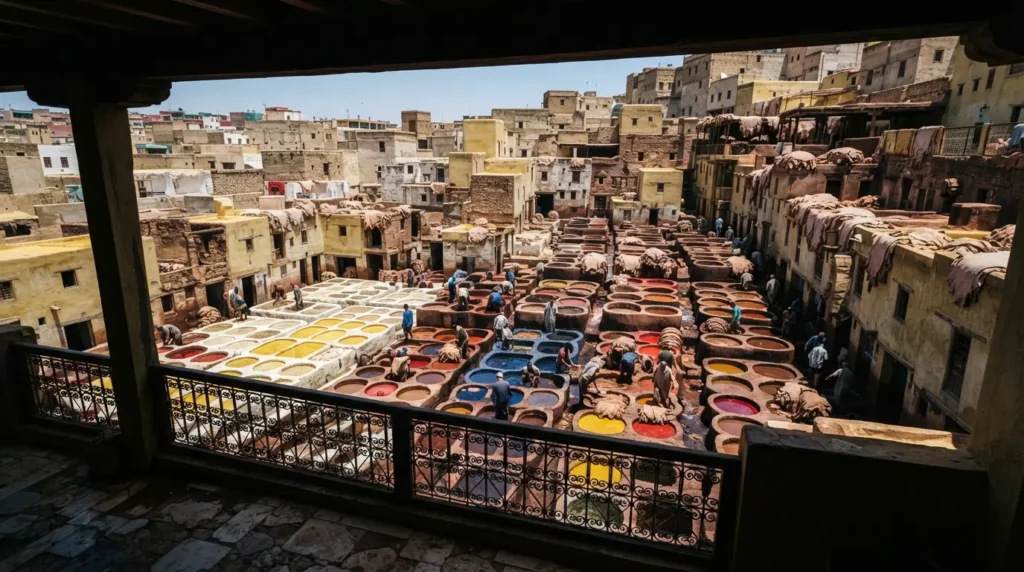
What is also true: the medina’s historic integrity is extraordinary. The tanneries in the Chouara quarter — circular stone vats of colour that have operated the same way since the 11th century — are one of the more arresting sights in North Africa. The Bahia Palace, built by a 19th-century vizier who collected wives and left them a palace of painted cedar ceilings, is genuinely beautiful. The Jardin Majorelle, restored by Yves Saint Laurent, is a vivid blue-and-yellow garden that earns the entrance fee in the first five minutes. And the food, eaten away from the main square, is the food that a hundred dirhams buys you in a city that knows how to feed itself.
Marrakech is worth it. It is also worth preparing for.
When is the best time to visit Marrakech in 2026?
| Season | Months | Temperature | Crowds | Price vs peak | Notes |
|---|---|---|---|---|---|
| Spring (best) | March–May | 20–28°C | Moderate–high | Peak | Best overall: warm, vibrant, roses in the Ourika Valley |
| Summer | June–August | 35–42°C+ | Low | 30–50% below peak | Very hot; early mornings and evenings only |
| Autumn (best) | Sept–Nov | 20–30°C | Moderate | Peak/near-peak | September ideal: hot but manageable; October excellent |
| Winter | Dec–Feb | 12–20°C | Low | 20–40% below peak | Cool evenings; quieter medina; pack warm layers |
Sources: worldtravelplanning.com 2026 seasonal data; moroccantraveltrips.com; moratra.com
March to May and September to October are when Marrakech is at its most complete — comfortable enough for extended medina walks, light enough to sit on a rooftop in the evening without a coat, and alive with the particular energy of a city that exists fully rather than at reduced capacity. July and August reduce the experience to early mornings and evenings, which is workable but limiting. December and January have the most pleasant medina atmosphere — fewer tourists, cool air, low prices — with the trade-off of cold nights that some riads are not equipped to manage comfortably.
What is Marrakech’s medina actually like?
It is genuinely not like other cities. The medina’s street plan was not designed for navigation — it was designed for defence, for community organisation, for the preservation of quarter identities that have existed for centuries. You will get lost. This is not a failure of navigation. It is the correct response to a city that was not built to be traversed efficiently.
The medina of Marrakech is UNESCO World Heritage listed. Walking it is the experience that justifies the journey. The souks divide by trade in a system that has not fundamentally changed since the medieval period: the metalworkers, the leatherworkers, the dyers, the carpenters, the spice merchants each in their own quarter, with their own smell and their own light. A guided mdina walking tour in the morning, before the heat builds and the crowds thicken, maps the logic of the quarters and saves you from spending an afternoon genuinely unable to find your way back.
The souks — how to approach them
Haggling in the souks is not optional. It is the commercial culture of the medina, and arriving with a European expectation of fixed prices creates friction on both sides of the transaction. The sticker price is an opening position, not a final offer. Counter at roughly a third of the asking price and expect to settle somewhere in the middle after an exchange that can involve mint tea, elaborately described family circumstances, and a theatrical walk-away. A lamp marked at 800 MAD sells for 350–450. A leather bag at 1,500 MAD sells for 700–900 (moratra.com, 2026 souk data).
The crucial part that most guides do not state clearly enough: the process is supposed to be enjoyable, not adversarial. Smile. Speak a little French if you have it. Accept the tea if it is offered — there is no obligation to buy. If you walk away and the seller calls you back with a lower price, that is the correct outcome. If they do not, the price was honest.
The monuments that earn their entrance fees
The Bahia Palace (70 MAD entrance): a 19th-century vizier built this for his four wives and the women of his household. The painted cedar ceilings and mosaic tiling are extraordinary. Go in the morning before the tour groups arrive. The Jardin Majorelle (70 MAD entrance, or 200 MAD combined with the YSL Museum): the blue-and-yellow garden restored by Yves Saint Laurent is small, dense with plants from three continents, and visually intense enough that the photography does not exaggerate. The Saadian Tombs: free and genuinely ancient, the burial place of the Saadian dynasty kings, largely forgotten behind a wall until 1917.
What nobody tells you about scooters
Scooters and motorbikes move through the medina’s lanes, including the narrowest ones, without slowing for pedestrians. The sound of an engine behind you is the signal to step to one side immediately. This catches most first-time visitors off guard on the first day and becomes instinctive by the second (thetruthtraveller.com, 2026). Walk to one side of any lane, listen for engines, and do not stand in the centre of an alley looking at a map.
Where do you actually eat in Marrakech?
Five minutes’ walk from Djemaa el-Fnaa, the price of a meal halves. This is true throughout the medina and is the most useful piece of practical information about eating in Marrakech.
The food that matters
Tajine is the foundation — meat or vegetables slow-cooked in a conical clay pot until everything has absorbed everything else. The version in a small medina restaurant, served in the same pot it was cooked in on a clay brazier, is the correct form. The b’stilla — a pastilla of pigeon or chicken with almonds, eggs and sugar wrapped in warqa pastry and dusted with cinnamon — sounds improbable and tastes like the result of a cuisine that has been thinking seriously about flavour for several centuries. Harira soup, thick with tomato, lentils and chickpeas, costs a few dirhams at a stall near the square and is what the city eats for breakfast during Ramadan and for breakfast on ordinary days. Moroccan mint tea — gunpowder green tea steeped with fresh spearmint and poured from height — arrives at every meal and most negotiations.
A Marrakech cooking class — typically a morning at a market to choose ingredients followed by three hours cooking and eating — is one of the better half-days available in the city. It teaches you what the food is actually made of, which changes how you eat for the rest of the trip.
Where not to eat
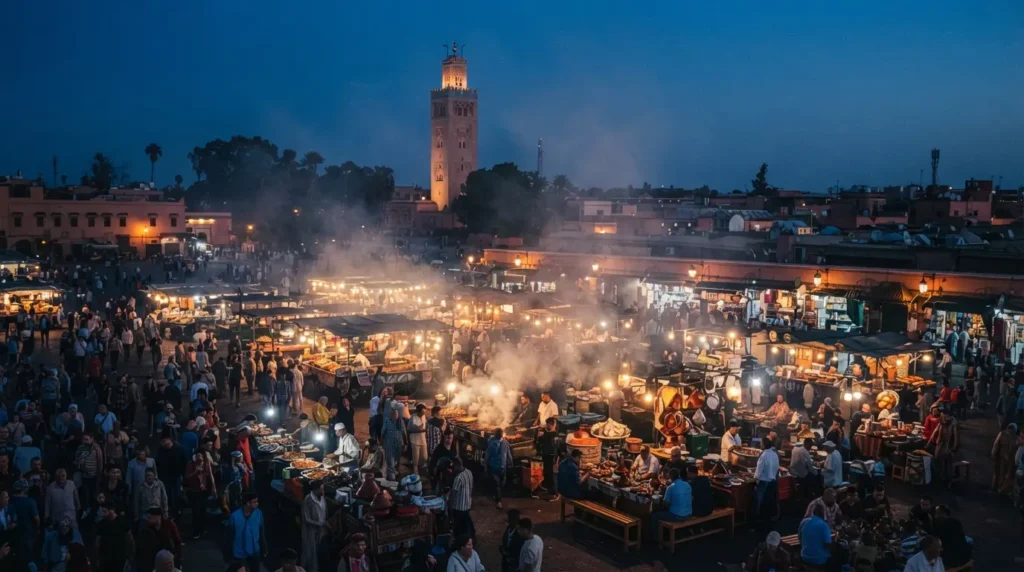
The rows of food stalls at the north end of Djemaa el-Fnaa in the evening are a tourist experience and a useful one — the atmosphere at dusk, with the smoke and the lights and the food sellers calling out to passing crowds, is part of what Marrakech offers. The food is fine, the prices are tourist prices, and the approach involves some pressure. Eat here once for the spectacle. Eat everywhere else for the food.
What does Marrakech cost in 2026?
The city is remarkably affordable if you eat locally and walk rather than taking taxis for short distances. Budget travellers in hostel dorms and eating at street-level restaurants can manage 300–400 MAD per day — approximately £25–35 (moratra.com, 2026). A private room in a small dar runs 250–450 MAD including breakfast. A riad with a plunge pool and rooftop terrace — the correct Marrakech accommodation experience — runs 500–900 MAD per night.
The exchange rate in 2026 runs approximately 10 MAD to 1 USD and 11 MAD to 1 EUR (worldtravelplanning.com). ATMs dispense dirhams at reasonable rates; the city remains largely cash-based in the medina and souks, so carry enough for a day or two before finding a machine. Book your riad directly by email or WhatsApp after finding it on a platform — owners almost always offer 5–15% below the listed rate to avoid the commission (moratra.com).
Morocco does not produce much alcohol and it is not universally available. Some mid-range and upscale restaurants have wine licences; a bottle of Moroccan red runs $18–35 at those venues. Street food stalls and medina restaurants do not serve alcohol. This is worth knowing before planning the evening.
What are the best day trips from Marrakech?
Two stand above the others for different reasons.
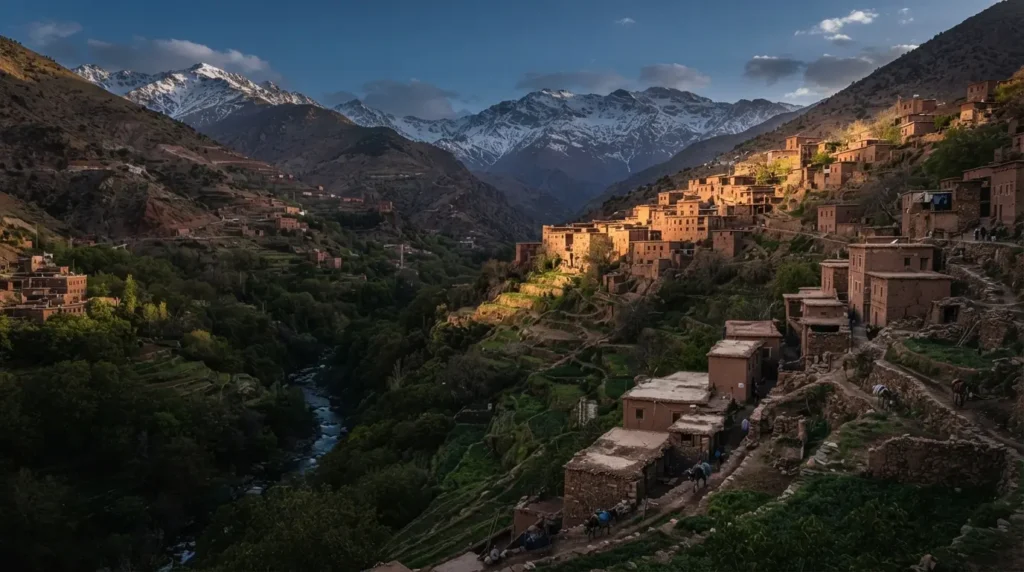
The High Atlas Mountains — specifically the Ourika Valley and Imlil — are ninety minutes from the city and a different world. The road climbs through Berber villages and terraced fields, past market towns and walnut orchards, to a landscape of snowcapped peaks in winter and wildflowers in spring. A High Atlas and Imlil day trip from Marrakech makes the geography of southern Morocco legible in a way that staying in the city alone does not. The mountains explain where the water comes from, why the valleys are green, and what the people of the medina are connected to beyond the city’s walls.
Essaouira, three hours west on the Atlantic coast, is the counterpoint to Marrakech’s intensity — a walled medina at sea level, sea wind and blue boats and grilled fish and a pace that the inland city never quite reaches. Our Morocco Atlantic coast guide covers Essaouira, the Alentejo coast and the broader coastal logic in detail. If you have a week in Morocco, the combination of Marrakech and Essaouira covers the country’s two most distinct registers.
Frequently asked questions
Q: Is Marrakech safe to visit in 2026?
A: Yes, by international standards. The UK FCDO and US State Department both classify Morocco at their lower travel advisory tiers, noting that most visitors have trouble-free trips. The most common issues are petty: pickpocketing in crowded areas, scams from unsolicited guides in the souks, and inflated prices for tourists who do not haggle. A licensed guide carries a metal badge and can be arranged through your riad. Polite firmness — a steady “non merci” and the willingness to keep walking — resolves the majority of these encounters (moratra.com, 2026).
Q: What is the best time to visit Marrakech in 2026?
A: March to May or September to October. Spring brings the roses of the Ourika Valley and comfortable medina temperatures. October is when the city is most atmospheric — warm enough to be outdoors late in the evening, cool enough to walk the souks for hours. Summer is very hot and best approached with an early-morning-and-evening strategy. Winter is quiet, cheap and cold after dark.
Q: How much does Marrakech cost per day in 2026?
A: Budget travellers in dorms and eating street food: 300–400 MAD per day (approximately £25–35). Mid-range travellers in a private riad room with meals in medina restaurants: 700–1,200 MAD. A riad with a plunge pool and rooftop runs 500–900 MAD per night. The exchange rate in 2026 runs approximately 10 MAD to 1 USD and 11 MAD to 1 EUR. Book riads directly by email for 5–15% off the platform rate (moratra.com).
Q: How many days do you need in Marrakech?
A: Three nights is the minimum to do the medina justice — one day to orient yourself, one to go deep into the souks and monuments, one for a day trip or the hammam and a slower afternoon. Five nights is better and allows Essaouira or the High Atlas without rushing either. A week combining Marrakech and the Atlantic coast covers Morocco’s two most distinct experiences without overstaying either.
Q: What should you not miss in Marrakech?
A: Djemaa el-Fnaa at dusk — the transition from afternoon to evening, when the food stalls light up and the square fills. The Chouara tannery from the terrace above. The Jardin Majorelle in the morning before the tour groups arrive. One meal of b’stilla at a restaurant five minutes from the square. One morning in the souks without a plan. The hammam — a traditional Moroccan bathhouse — at any reputable riad-adjacent establishment, booked through your accommodation rather than from a stranger on the street.
Marrakech does not give itself up quickly. The first day is disorienting. The second is where the city’s logic begins to become legible. The third is when you start to understand what you are actually looking at — the trade routes, the dynasties, the layers of stone and tile that accumulate into the particular texture of a medina that has been continuously inhabited since 1062. Go slowly. Eat away from the square. Get up early. Plan your Morocco trip on PlacesToday →