Morocco in summer is not too hot to visit — it is too hot to visit in the wrong places. Marrakech regularly reaches 38–42°C in July and August, but the Atlantic coast stays a different country entirely. Essaouira holds at 22–25°C through constant sea wind, Tangier and Agadir sit comfortably in the high twenties, and the High Atlas mountain villages drop ten degrees below the inland cities. Build your summer trip around the coast and the mountains, and Morocco in July is one of the best versions of itself.
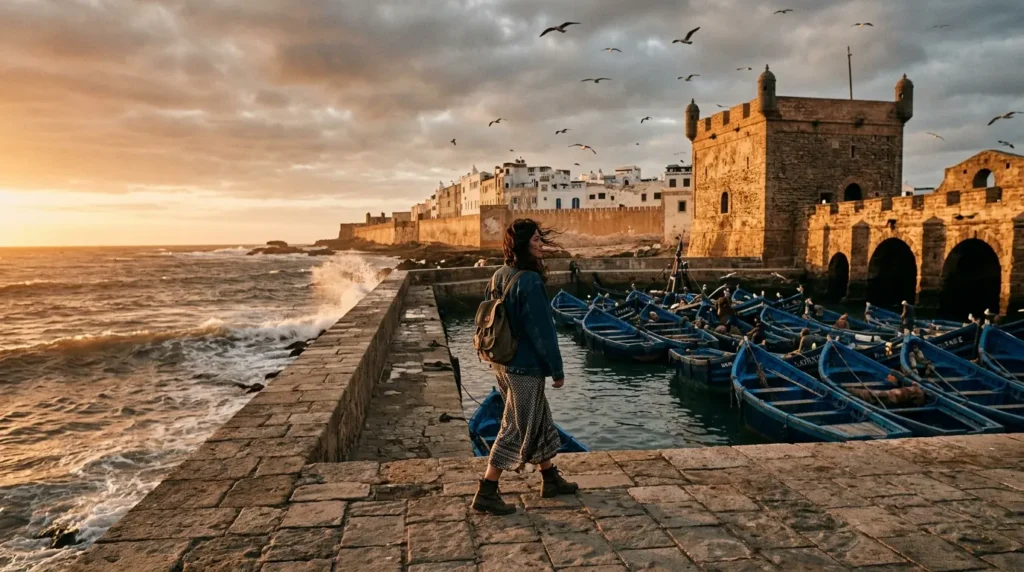
There is a particular hour in Essaouira, somewhere around six in the evening, when the wind that has been pushing against you all day finally settles, the fishing boats start coming back into the harbour, and the light turns the ramparts a colour somewhere between rust and gold. Nobody warns you about this hour before you arrive. You just find it, and then you understand why people who visit Essaouira once tend to come back.
Morocco’s tourism numbers this year tell their own story. The country welcomed 7.7 million international visitors in the first five months of 2026, a 7% rise on the same period last year, with May alone up 13% year-on-year (Morocco’s Ministry of Tourism, Handicrafts and the Social and Solidarity Economy). The country has overtaken several long-established tourism giants in growth rate this year (Travel and Tour World, 2026). But almost none of that coverage tells you what to do with a Moroccan summer beyond admiring the statistics.
This is the practical version. Where to go when Marrakech is at its most intense, which coast actually delivers, and how to build a trip that matches the season rather than fights it.
Is Morocco too hot to visit in summer 2026?
Inland, yes, in the sense that you will need to plan around it. On the Atlantic coast and in the mountains, no — temperatures stay genuinely comfortable through July and August. The mistake most first-time visitors make is trying to do the classic Marrakech-to-Sahara route in peak summer, when that route was designed for spring and autumn.
July is officially Morocco’s hottest month, with Marrakech regularly climbing to 38–39°C and occasional spikes above 42°C. The Sahara is more extreme still, often exceeding 45°C, and some desert camps close in July and August because the conditions are no longer comfortable for most travellers. The heat is dry rather than humid, which makes it more bearable than the number suggests, but it still reshapes how a day should be structured.
What changes when you plan around the season
Plan your day like the city already has, rather than fighting it. Mornings before ten and evenings after six are when Marrakech’s medina is genuinely lovely — golden light, manageable crowds, the souks waking up slowly. The hours in between are for a riad courtyard, a hammam, or simply resting somewhere with a fountain and shade, the way the city itself has always done.
Where is the coolest place to visit in Morocco in summer?
Essaouira is the standout answer. Constant Atlantic trade winds hold the city at 22–25°C through the height of summer, making it noticeably cooler than anywhere else popular in the country.
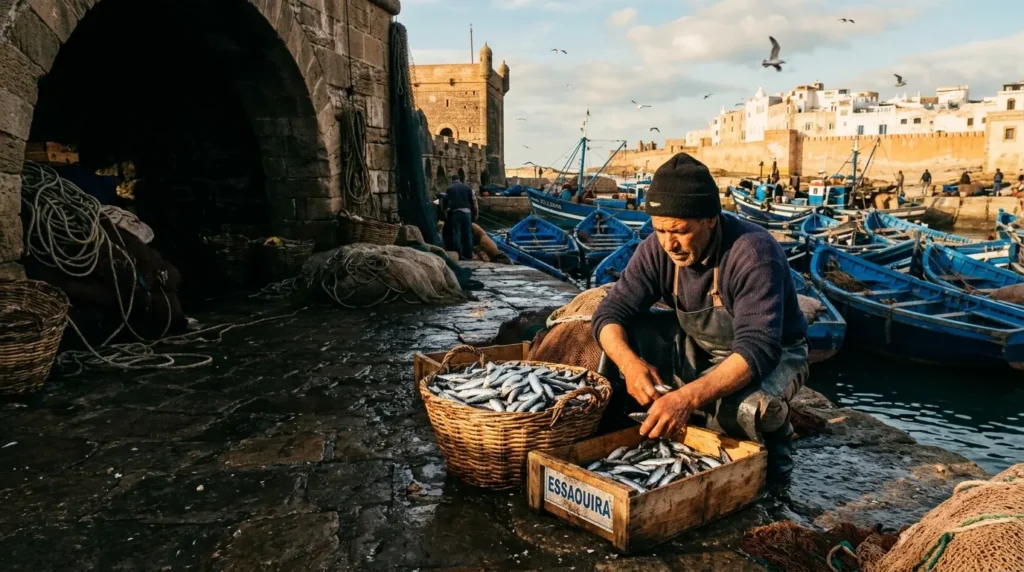
The wind that keeps Essaouira cool is the same wind that has shaped its character for centuries — fishermen reading it before they leave the harbour, the kite-surfers at Sidi Kaouki just south of town who plan entire trips around it, the blue and white medina built low and close against it. Essaouira’s medina is UNESCO World Heritage listed, and walking it in the early evening, once the wind has dropped and the light has turned, is one of the genuinely great hours available anywhere on this coast.
The rest of the coastal coolest list
Agadir runs slightly warmer than Essaouira at 26–29°C but offers Morocco’s longest stretch of sandy beach and a more developed resort infrastructure for travellers who want comfort alongside the coast. Tangier and Asilah in the north sit at 25–29°C, with the added character of a city that has always existed between worlds — Mediterranean on one side, Atlantic on the other, Europe visible across the strait on a clear day. Taghazout, just north of Agadir, has become the country’s surf town of choice, drawing a younger, looser crowd than the older resort towns nearby.
The mountain alternative
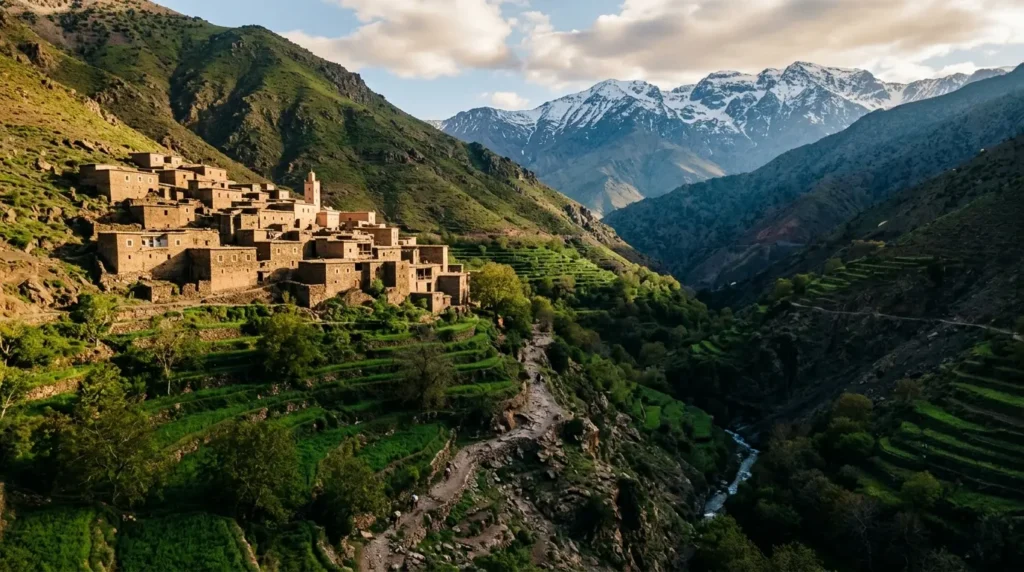
The High Atlas, only ninety minutes from Marrakech, drops the temperature by ten degrees or more. Imlil, the gateway village to Mount Toubkal — North Africa’s highest peak — sits at 1,800 metres, where summer evenings are genuinely cool enough for a light jacket. A guided trek through the Imlil valley and Berber villages is one of the more memorable ways to spend a day away from the city heat, and the wildflowers along the Azzaden Valley trail are at their fullest in early summer.
How do you plan a Morocco summer itinerary that actually works?
Build the trip around two or three regions rather than trying to cover the whole country, and let the coast or the mountains carry the middle of your trip while Marrakech gets a short, well-timed visit at either end.
The most common planning mistake is trying to follow a spring itinerary — Marrakech, Fes, the Sahara — without adjusting for the season. That route was built for cooler months. In summer, it asks too much of both the traveller and the day.
A coastal route that works
Marrakech (two days, early mornings and late evenings only) into Essaouira (three days, the wind, the medina, the seafood) and on south to Agadir and Taghazout for beach days and surfing before flying home. This route suits families, couples and anyone who wants fewer heavy sightseeing days and more time simply existing somewhere beautiful.
A northern route that works
Tangier into Asilah, with its whitewashed streets and mural-covered walls, then inland to Chefchaouen for the blue medina and Rif mountain air, before finishing in Rabat or Casablanca. The Al Boraq high-speed train connects Tangier, Rabat and Casablanca directly, which makes this route considerably easier than the long desert drives further south.
What to leave for another season
The Sahara is not the place for a summer visit. Daytime temperatures regularly exceed 45°C, and several desert camps close for July and August because the conditions no longer allow for a comfortable night under the stars. Save Merzouga and the dunes for September through November, or March through May, when the desert is genuinely magical rather than simply endured.
What should you pack for Morocco in summer?
Light, loose natural fabrics — linen and cotton rather than synthetic activewear — along with serious sun protection and a layer for cooler coastal and mountain evenings. Modesty matters more than temperature when choosing what to wear in medinas and rural areas.
Covering shoulders and knees is not only culturally respectful but practically cooler than it sounds, since loose, breathable fabric over skin protects against direct sun better than exposed skin does. A wide-brimmed hat you will genuinely wear, high-SPF sunscreen, and a refillable water bottle — aiming for two to three litres a day inland — round out the essentials. Essaouira’s evening wind and the High Atlas nights can both catch travellers off guard who packed only for heat, so a light jacket earns its space in the bag.
When should you book accommodation for Morocco in summer 2026?
Inland riads in Marrakech and Fes often drop their rates 30–40% in July and August, since this is genuinely their quiet season. Coastal towns run the opposite way — Moroccan families holiday there in summer, so Essaouira, Agadir and the northern beaches should be booked several weeks ahead for the best choice and price.
This seasonal price split is one of the more useful things to know before booking. A trip that splits time between a discounted Marrakech riad and a well-booked-ahead Essaouira guesthouse often costs less overall than the same trip in April or October, when both regions sit at full summer pricing.
Frequently asked questions
Q: What is the coolest city in Morocco during summer? A: Essaouira, consistently. Atlantic trade winds hold the city at 22–25°C through July and August, noticeably cooler than Agadir, Tangier or any inland city. The wind is also what makes Essaouira one of the world’s most reliable kite-surfing destinations.
Q: Is it safe to visit the Sahara Desert in Morocco in summer? A: It is possible but not recommended for most travellers. Daytime temperatures regularly exceed 45°C in Merzouga and the surrounding desert region, and several desert camps close during July and August because conditions no longer allow for a comfortable visit. Spring and autumn are far better windows for a Sahara trip.
Q: How many days do you need for a Morocco coastal summer trip? A: Seven to ten days allows a comfortable route — two days in Marrakech at either end, three to four days in Essaouira, and the remainder split between Agadir, Taghazout or a northern extension to Tangier and Asilah. Shorter trips work well focused entirely on Essaouira and the surrounding coast.
Q: Is Morocco cheaper to visit in summer? A: Inland accommodation is significantly cheaper in July and August, with Marrakech and Fes riads often discounting 30–40%. Coastal accommodation moves in the opposite direction, since Moroccan families holiday there in summer, so Essaouira and Agadir should be booked well ahead rather than expected to be a bargain.
Q: What is the best Morocco summer destination for surfing? A: Taghazout, just north of Agadir, is Morocco’s established surf town, with consistent Atlantic swell and a laid-back community built around the water sports. Sidi Kaouki, near Essaouira, is the stronger choice for kite-surfing specifically, given the area’s exceptionally reliable wind.
Q: Should first-time visitors go to Morocco in summer? A: Yes, with the right plan. A first-time Morocco trip in summer works best built around the coast and mountains rather than the classic Marrakech-to-Sahara route, which suits spring or autumn far better. See our full Morocco travel guide for building a first-time itinerary that matches the season.
Plan your Morocco summer trip
Morocco in summer rewards travellers who follow the wind rather than fight the heat. The coast holds the country’s calmest version of itself — fresh seafood, Atlantic light, a pace that asks nothing of you — while the mountains offer the same relief at altitude instead of sea level. Marrakech is still worth its place in the trip; it simply asks to be visited at the edges of the day rather than the middle.
Ready to build your Morocco summer itinerary around the coast, the mountains, or both? Plan your trip on PlacesToday →