India’s Golden Triangle — Delhi, Agra and Jaipur — covers approximately 750 kilometres of North India and puts three of the country’s most significant UNESCO World Heritage cities within a single week’s reach of each other. Six to seven days is enough to do it properly. October to March is the correct window — North India in July and August is monsoon season, which is manageable but not what most first-time visitors came for. The Taj Mahal is genuinely one of the most beautiful things ever built. At 6am it is also peaceful. The e-Visa is processed online in three to five days. This guide tells you the rest.
India requires calibration before arrival. Not because it is dangerous or particularly complicated, but because the scale of sensory information — the noise, the colour, the traffic, the heat, the smell of food and exhaust and jasmine and drainage all at once — is genuinely more than most visitors from quieter places have experienced before. The first hour in Delhi is bewildering. The first evening, once you have eaten something and found your bearings, is different. By the third day, the bewilderment has rearranged itself into fascination, which is the correct state for a first India trip.
India’s tourism sector is seeing a 10–15% rise in foreign arrivals compared to the previous year, with North America and Europe representing its fastest-growing source markets (Indian Association of Tour Operators, 2026). The Golden Triangle remains the country’s most popular inbound circuit because it compresses an extraordinary density of history, architecture, food culture and pure spectacle into a route that a first-time visitor can navigate without difficulty. It also happens to contain the Taj Mahal, which justifies the flight on its own.
Is India safe to visit in 2026?
Yes, in the tourist areas of the Golden Triangle and most of the country’s major destinations. Delhi, Agra and Jaipur are well-established, heavily visited cities with functioning tourist infrastructure. Solo female travellers should be aware that harassment — ranging from persistent attention to occasional inappropriate behaviour — is more common in India than in Southeast Asia, and is addressed with polite firmness rather than engagement. Most women travelling in India report that this concern, while real, does not substantially diminish the trip. Solo female travellers are advised to use app-based rideshare rather than unmarked taxis, dress modestly (covered shoulders and knees) at religious sites, and check current government travel advice before departure.
Apply for an Indian e-Tourist Visa at indianvisaonline.gov.in before travel — most Western nationalities are eligible and the process takes three to five business days. Book in advance rather than on arrival.
What is the Golden Triangle and how long do you need?
| City | Days | Key sites | Best for | Transport from |
|---|---|---|---|---|
| Delhi | 2–3 | Red Fort, Qutub Minar, Humayun’s Tomb, Old Delhi | Mughal and colonial history, street food | International arrival; train to Agra |
| Agra | 1–2 | Taj Mahal, Agra Fort, Fatehpur Sikri | The Taj at sunrise; Mughal architecture | Gatimaan Express from Delhi (1h30) |
| Jaipur | 2 | Amber Fort, City Palace, Hawa Mahal, bazaars | Rajput palaces, craft markets, food | Shatabdi from Delhi (4h30) or car from Agra |
Sources: incredibleindia.org; chardhamyatratrip.wordpress.com 2026 Golden Triangle guide; Indian Association of Tour Operators 2026
Six days is the minimum to do this correctly: two in Delhi, one in Agra, and two in Jaipur, with a final day’s buffer for travel and the inevitable delays that India introduces into any schedule. Seven days is the comfortable version. Do not try to compress it to four — what you lose is the unhurried time in each city that makes the difference between ticking boxes and actually understanding where you are.
Most itineraries run Delhi → Agra → Jaipur → Delhi or in reverse. Car hire with driver is the most flexible option for the Agra-Jaipur leg, taking approximately four hours and allowing stops at Fatehpur Sikri (a ghost Mughal capital, abandoned within decades of being built) en route. Trains work well for Delhi-Agra and Delhi-Jaipur separately.
What is Delhi actually like for a first-time visitor?
Enormous, layered and entirely absorbing once you stop trying to process it all at once. Delhi is not one city — it is the superimposition of several cities built on each other across two thousand years, and the experience of moving between Old Delhi’s Mughal lanes and the colonial geometry of New Delhi’s Lutyens boulevards and the glass towers of Gurgaon is the experience of moving between different centuries in the same afternoon.
Old Delhi — the original version
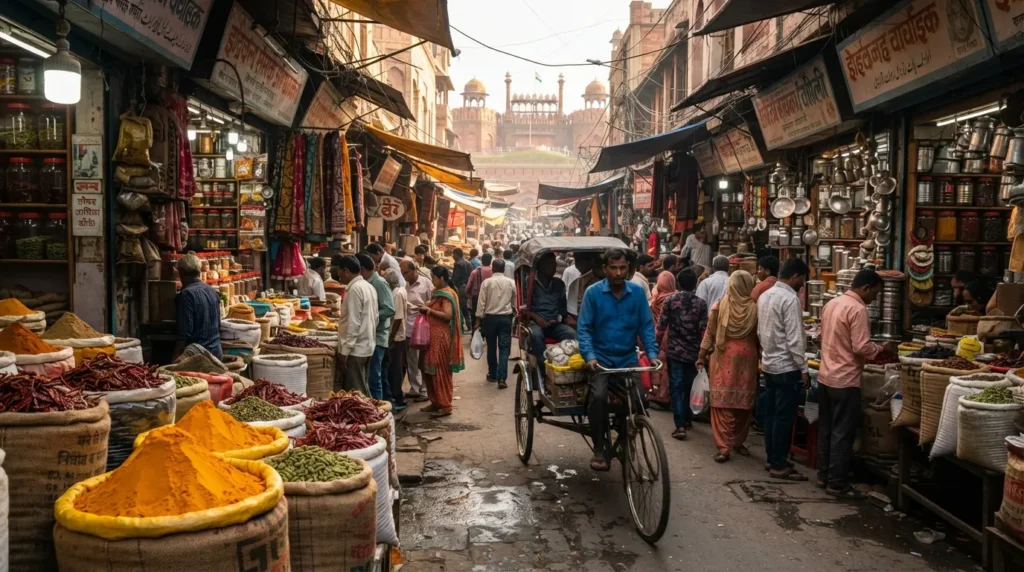
Old Delhi, the walled city built by the Mughal emperor Shah Jahan in the 17th century, is where Delhi reveals its most concentrated self. Chandni Chowk — the main market street, once the most glamorous shopping district in Asia — is now a dense corridor of spice wholesalers, silver jewellers, sweet shops and textile merchants, most of them operating from premises that have been in the same family for generations. The Red Fort at one end (UNESCO-listed, Shah Jahan’s imperial palace) and the Jama Masjid (India’s largest mosque, 25,000 worshippers at Friday prayers) are the two structural anchors.
Navigating Old Delhi on foot is the correct approach and cannot be done efficiently. Get lost. Follow the smell of something frying. A Delhi Old Town street food and spice market tour through Chandni Chowk covers the key food stalls and gives you the geography before you return independently.
New Delhi — the monuments with breathing room
Humayun’s Tomb — the first great Mughal garden tomb, built in 1572 and the direct architectural predecessor of the Taj Mahal — is one of Delhi’s most visited UNESCO sites and considerably more manageable than the Taj itself in terms of crowds and atmosphere. The Qutub Minar, a 73-metre minaret from 1193 AD, is the oldest example of Mughal-era architecture in India. Lodhi Garden, a landscaped park containing 15th-century tombs surrounded by mature trees, is one of the best places in Delhi to spend an evening without noise or pressure.
Where to eat in Delhi
Delhi has a street food culture that is, by any reasonable assessment, one of the great street food cities in Asia. Parathe Wali Gali in Old Delhi — an alley devoted entirely to stuffed flatbreads — is the starting point. The butter chicken (murgh makhani) at the restaurants that claim to have invented it in the 1950s (Moti Mahal, Daryaganj) is worth the specific pilgrimage. Use bottled water throughout, including for brushing teeth, as a straightforward precaution.
How do you visit the Taj Mahal without the crowds making it difficult?
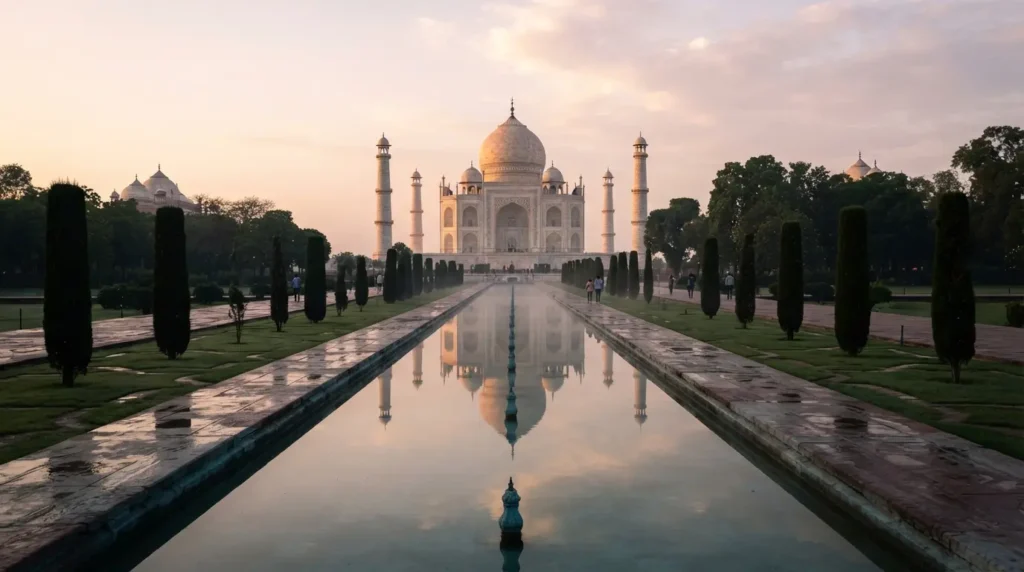
Arrive at opening time — 6am — or as close to it as possible. The Taj Mahal by 10am carries crowds that make the experience of standing in front of it a management problem rather than a contemplative one. The 6am version is something else: the marble changing colour as the light shifts from pale pink to gold to white, the mist on the Yamuna River behind the structure, and a fraction of the visitors who will fill the garden by mid-morning.
The Taj Mahal closes on Fridays. It is open sunrise to sunset six days a week. Book tickets in advance through the Archaeological Survey of India’s official system — foreign visitor entry costs approximately INR 1,100 (around £10) including the Agra Fort access package. The ticket includes shoe covers and a bottle of water; no food is permitted inside the complex.
Agra itself has more to offer than most visitors allocate time for. Agra Fort — a red sandstone Mughal fortress where Shah Jahan was imprisoned by his own son for the last eight years of his life, with a view of the Taj Mahal from his confinement quarters — is worth two hours. Fatehpur Sikri, 40 kilometres from Agra, is an abandoned Mughal capital city in extraordinary condition, built and then deserted within decades. A Taj Mahal sunrise guided tour from Agra covers the correct timing and includes the historical context that makes the architecture legible.
What makes Jaipur worth two nights?
The Amber Fort at dawn, the City Palace still in active royal use, and the best food on the Golden Triangle route.
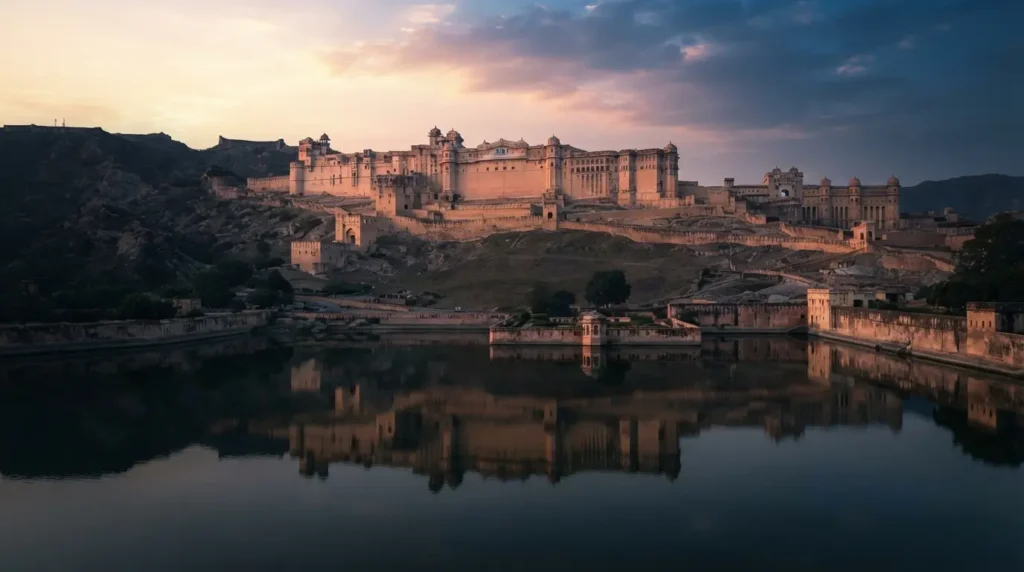
Amber Fort — a Rajput fortified palace on a hilltop above a lake, 11 kilometres from Jaipur — is approached by elephant in the traditional version and by foot or jeep in the more responsible contemporary alternative. The fort’s interiors, including the Sheesh Mahal (hall of mirrors, every surface covered in small mirrors that reflect candlelight), are the most ornate of any Rajput palace. Go in the morning and stay for an hour more than you think you need.
The City Palace at the centre of Jaipur remains partly in residence by the royal family, with the open sections housing a museum of Rajasthani textiles and weapons. The Hawa Mahal — the five-storey screen facade from which royal women could watch street processions without being seen — is exactly as photogenic as it appears. The bazaars around Johari Bazaar and Tripolia Bazar sell the block-printed textiles, silver jewellery and semi-precious stones that Jaipur has produced for centuries.
A Jaipur Amber Fort and City Palace cultural tour covers both major sites with a guide for the historical context that the monuments alone do not provide.
How do you get around the Golden Triangle in 2026?
The two options are private car with driver or trains. Both work. The car gives flexibility; the trains are faster between Delhi and Agra specifically.
The Gatimaan Express from Delhi Hazrat Nizamuddin to Agra Cantonment runs in one hour and thirty minutes, is India’s fastest train, and costs approximately INR 750–1,500 (£7–14) in chair car class. The Shatabdi Express from Delhi to Jaipur runs in four hours and thirty minutes. Both require advance booking through IRCTC (irctc.co.in) — the booking system requires registration and can be navigated with patience.
A private car with driver for the full Agra-Jaipur leg costs approximately £40–80 per day depending on the vehicle type, allows stops at Fatehpur Sikri en route, and removes the luggage logistics of train travel. For four or more days, a car hire with driver across the full circuit is the most comfortable option.
Uber operates in Delhi and Jaipur. In Agra, auto-rickshaws and e-rickshaws are the standard local transport; agree on a price before getting in if using an unmarked vehicle rather than Uber.
When is the best time to visit India’s Golden Triangle?
October to March, with November to February being the ideal window. Temperatures in Delhi, Agra and Jaipur during these months run 12–28°C — cool enough for comfortable sightseeing, warm enough for evenings outdoors. October sees post-monsoon freshness; March brings rising heat toward 35°C+ by the month’s end.
July and August are North India’s monsoon months. It is possible to visit — the rain is often brief and dramatic rather than all-day, the tourist sites are less crowded, and hotel prices drop substantially. The Taj Mahal in monsoon rain is an extraordinary sight. It is not, however, the comfortable, photogenic experience that October-March provides, and first-time visitors are generally better served by coming in the correct season.
April to June is pre-monsoon heat — Delhi regularly exceeds 40°C in May and June, which limits outdoor sightseeing to early mornings and evenings. Viable, but demanding. The correct advice: if you can choose your window, choose October to March.
What does India cost in 2026?
Significantly less than most comparable long-haul destinations. A budget traveller in guesthouses and eating at local restaurants can manage £20–35 per day excluding international flights. A mid-range traveller — comfortable hotel, restaurant meals, guided tours and transport — should budget £60–100. Luxury is available at prices that Western travellers find genuinely surprising: five-star heritage hotels in Jaipur (former maharajas’ palaces converted to hotels) run £120–300 per night, which is a fraction of equivalent quality in European luxury destinations.
Taj Mahal entry: approximately £10 per foreign adult. Red Fort: approximately £6. Amber Fort: approximately £5. These are the main paid entry costs. Local food is extraordinarily inexpensive — a thali (set meal with multiple dishes) at a local restaurant costs £1–3. The cost variable that matters most for planning is accommodation, which ranges from £8 guesthouses to £300 heritage hotels.
International flights to Delhi from the UK run approximately £450–900 return. The Indian e-Visa adds approximately £25 per person.
Frequently asked questions
Q: How many days do you need for the India Golden Triangle?
A: Six to seven days covers Delhi (two to three days), Agra (one to two days) and Jaipur (two days) comfortably without rushing any of them. Five days is the minimum if time is genuinely constrained. Anything under five days means one city gets inadequate time, and in India the time you give each place significantly affects what you find there.
Q: What is the best time to visit the Golden Triangle?
A: November to February. Temperatures sit at 12–25°C, skies are clear, and the major sites are at their most photogenic and comfortable. October and March are strong runners-up. Avoid May and June (extreme heat, 40°C+) and July to August (monsoon season) for a first visit.
Q: How do you book Taj Mahal tickets?
A: Through the Archaeological Survey of India’s official ticketing platform. Foreign visitor entry costs approximately INR 1,100 (£10), which includes access to Agra Fort. Book in advance online — the site has a booking system that accepts international cards. Arrive at 6am, when the gates first open, for the best experience. The Taj is closed on Fridays.
Q: Is India suitable for first-time visitors?
A: Yes, and the Golden Triangle specifically is India’s most visitor-friendly circuit — well-connected by train and road, with established tourist infrastructure in all three cities. The first day in Delhi can be overwhelming; the calibration required is to lower the expectation of efficiency and raise the expectation of extraordinary things happening unexpectedly. Both adjustments are correct.
Q: What should you eat in India’s Golden Triangle?
A: In Delhi: parathe (stuffed flatbreads) in Chandni Chowk, chaat street food from the Old Delhi vendors, butter chicken at one of the original restaurants that claim the dish. In Agra: Mughlai cuisine — biryani, korma, shahi paneer — at restaurants near the Taj Mahal’s south gate. In Jaipur: dal baati churma (lentils with baked wheat balls and sweet churma), laal maas (Rajasthani mutton curry), and the kachoris (fried pastry with spiced filling) from the Rawat Mishthan Bhandar bakery that has been selling them since 1961.
India does not ease you in. It puts everything on the table at once and leaves you to sort through it, which is both the challenge and the reason the trip stays with you. The Taj Mahal at 6am is the reason most people go. The morning in Chandni Chowk and the evening in Jaipur’s bazaars are the reasons most people say they want to come back. Book the e-Visa, book the Taj Mahal tickets, arrive in October. Plan your India itinerary on PlacesToday →