The Norwegian fjords worth visiting in 2026 are Nærøyfjord and Geirangerfjord (both UNESCO World Heritage sites, both accessible without a cruise ship), Hardangerfjord for slower travel and better value, and Lysefjord above Stavanger for the Preikestolen hike. From 2026, Norway mandates zero-emission electric and hybrid boats in its most protected fjords — which means the experience is quieter than it has been in decades and the environmental justification for the trip is stronger than it was last year. Bergen is the correct base. The fjords are free to enter. The cost is getting there, which this guide addresses specifically.
The fjords look like the photographs. This turns out to be an unusual thing for a famous landscape to do.
Most natural landmarks that have been photographed as extensively as Norway’s fjords arrive with some degree of gap between expectation and experience — the crowd, the angle, the scale that does not come through in two dimensions. The fjords mostly do not have this problem. The walls of Nærøyfjord rise 1,700 metres above a strip of water so narrow that the sky is a strip above you. Geirangerfjord turns a corner and reveals the Seven Sisters waterfall in a single moment of geography. These things are what they are photographed as being. The practical job — how to get there, when to go, what it costs — is what this guide is for.
Norway welcomed record numbers of visitors to its national parks and fjord regions in 2025 (Statistics Norway), and the 2026 zero-emission mandate has made the fjord cruise experience quieter and cleaner. The infrastructure has kept pace.
Which Norwegian fjords should you visit in 2026?
| Fjord | UNESCO | Best for | Access | Crowd level |
|---|---|---|---|---|
| Nærøyfjord | Yes | Most dramatic narrow fjord, electric cruise | Ferry from Flåm or Gudvangen | High in summer, managed |
| Geirangerfjord | Yes | Seven Sisters waterfall, mountain views | Ferry from Hellesylt or Geiranger village | High but restricted from 2026 |
| Sognefjord | — | Norway’s longest fjord, many arms, slower travel | Bergen or Flåm base | Moderate |
| Hardangerfjord | — | Fruit farms, cideries, Trolltunga, good value | Bergen base, 2h drive | Lower |
| Lysefjord | — | Preikestolen hike, accessible cliff | Stavanger base, ferry + hike | High at Preikestolen |
| Hjørundfjord | — | Undiscovered, Hurtigruten detour, quiet | Ferry from Ålesund | Very low |
Sources: norgetravel.com 2026 fjord guide; visitnorway.com; cruisebound.com 2026 fjords analysis
All of Norway’s fjords are free to enter. The costs are transport — the ferries, the train, the boat across the water — which are reasonable by Norwegian standards and bookable well in advance. The most important booking in the fjord region is the Flåmsbana (Flåm Railway) — the 20-kilometre mountain railway that drops from the plateau at Myrdal to the fjord at Flåm, consistently described as one of the most scenic railway journeys in the world. Tickets run 450–550 NOK (approximately £34–42) one way and sell out months ahead in summer. Book at visitflam.com or through Vy trains as soon as dates are confirmed.
What changed about visiting the Norwegian fjords in 2026?
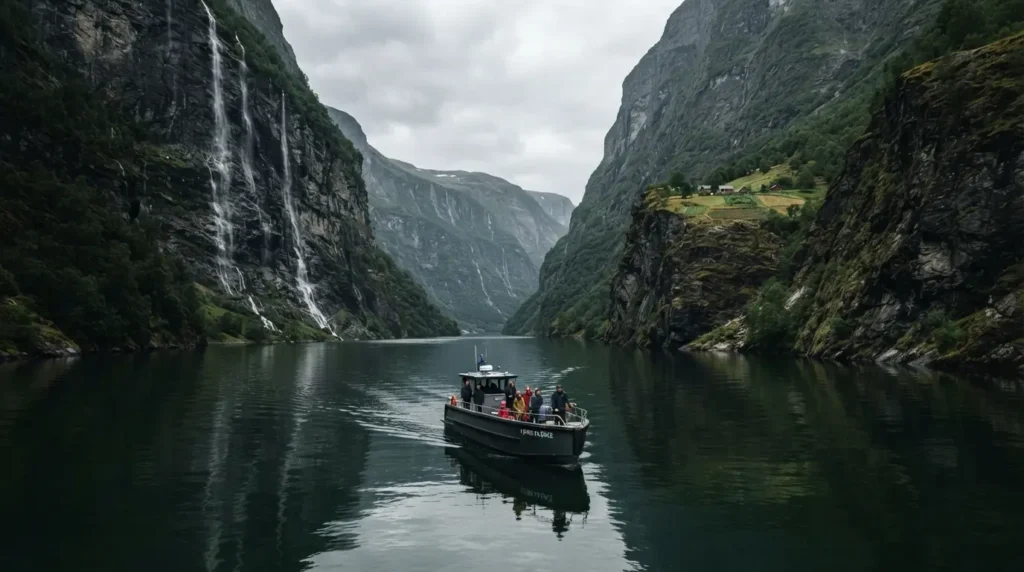
From January 2026, Norway legally mandates zero-emission vessels in its UNESCO-listed fjords, including Geirangerfjord and Nærøyfjord. Diesel-engine boats no longer meet the standard. The practical effect for visitors is that the fjord cruise is now conducted in electric or battery-hybrid silence — no engine noise, no exhaust fumes, no vibration through the hull. Norled’s electric ferries hold this standard with the largest battery packs currently at sea, capable of four hours of silent sailing through the fjords. Fjord Tours (the operator behind Norway in a Nutshell since 1982) has moved to electric ferries across its Nærøyfjord cruise leg.
Geirangerfjord carries an additional restriction in 2026: environmental rules limit vessel size entering the fjord, meaning the large cruise ships that once dominated the waterway no longer meet entry standards. Smaller hybrid and electric operators do. The experience in Geirangerfjord has measurably improved as a result.
This is not marketing from the tourism board. The silence on the water makes the experience different from what it was three years ago and considerably better. It is worth knowing before you book.
How do you visit the Norwegian fjords without a cruise ship?
More easily than most visitors assume, and considerably more flexibly. The cruise ship approach — boarding in Southampton or Hamburg for a seven-night itinerary — is one way in. The independent approach is another and gives you more control over time, pace and cost.
Norway in a Nutshell
Norway in a Nutshell is a packaged day or overnight route combining the Bergen Railway (Oslo to Myrdal or Voss), the Flåmsbana mountain railway (Myrdal down to Flåm), an electric fjord cruise across Nærøyfjord (Flåm to Gudvangen), and a bus or train back to Bergen or Oslo. It has been the most popular way to see the fjords independently since 1982 and is currently fully electric on the fjord segment. A Norway in a Nutshell day tour from Bergen covers the full circuit in one day and includes all transport.
The honest note: Norway in a Nutshell is excellent and is also extremely well-known, which means the Flåmsbana in July carries the tourist volume you would expect. It remains the most efficient single day available in the fjord region.
Bergen as a base
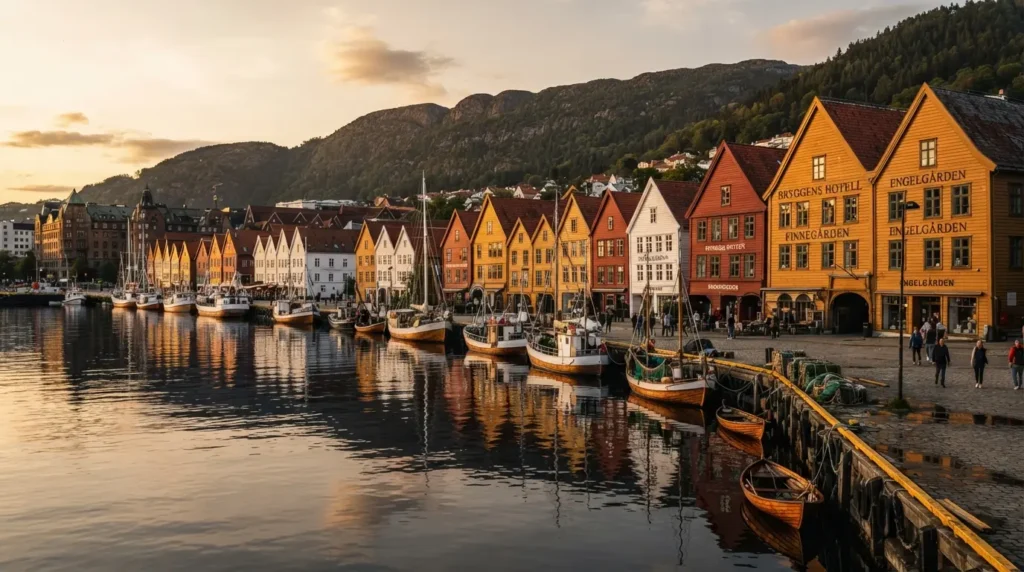
Bergen is the correct base for an independent fjord trip. The city’s UNESCO-listed Bryggen wharf — the colourful merchant houses of the medieval Hanseatic trading post — is worth a morning on its own. Bergen sits at the start of Sognefjord and within three hours of both Geirangerfjord (via road or ferry) and Nærøyfjord. Accommodation here is significantly cheaper than in Oslo. A three-night Bergen base covers Nærøyfjord by ferry, a day on the Flåmsbana, and a drive or ferry toward Hardangerfjord without feeling rushed.
A Bergen UNESCO fjord cruise including Flåm and Stegastein viewpoint runs eleven hours from Bergen and covers the full Nærøyfjord experience with the Stegastein viewpoint platform — a cantilevered structure 30 metres above the Aurlandsfjord — included.
Which fjord hike should you do in 2026?
Three main options, at significantly different levels of commitment.
Preikestolen (Pulpit Rock) — the accessible one
Preikestolen is a 604-metre flat-topped cliff above Lysefjord, accessed by a four-hour return hike (approximately 8 kilometres) from the Preikestolen Mountain Lodge. The view from the top — a sheer vertical drop to the fjord below, the water visible between your feet if you go to the edge, which is not compulsory — is the most widely photographed natural viewpoint in Norway. The hike is well-maintained, does not require technical equipment, and is suitable for reasonably fit walkers with good footwear. Go on a weekday and start before eight in the morning in July and August; the path fills significantly by mid-morning.
The base is accessible from Stavanger by ferry across Lysefjord (30 minutes) plus a bus. A Preikestolen guided hike from Stavanger includes the ferry, transport and a guide for the trail.
Trolltunga — the serious one
Trolltunga (Troll’s Tongue) is a horizontal blade of rock extending 700 metres above Hardangerfjord, accessed by an 11-hour return hike covering 27 kilometres with 800 metres of elevation gain. It is considerably more demanding than Preikestolen and should not be attempted without proper hiking boots, sufficient food and water, and a weather forecast check. Guided hikes are available and recommended for first-time visitors. The photograph — the rock jutting horizontally over the fjord — is genuinely extraordinary and is genuinely difficult to get to. Both things are true simultaneously.
Kjeragbolten — the one with the boulder
Kjeragbolten is a rock wedged in a crevice above Lysefjord, 984 metres above the water. Visitors stand on the boulder for photographs. The access hike is strenuous (9–10 hours return) and involves some scrambling. The view of Lysefjord from the surrounding plateau is one of the most complete available in southern Norway. Less famous than Preikestolen, significantly less crowded, and equally impressive.
Is a fjord cruise worth doing in 2026?
Yes — specifically the day cruise or electric ferry crossing rather than the large-ship cruise itinerary if you want the actual fjord experience rather than a fjord-adjacent one. The seven-night large-ship cruise departing from Southampton or Hamburg is a comfortable way to see the fjords from a distance; the electric ferry from Flåm across Nærøyfjord puts you inside them, with the walls close enough to appreciate their scale.
The Nærøyfjord crossing from Flåm to Gudvangen costs approximately 500–700 NOK per person (£38–53) and takes two hours at its standard pace (norgetravel.com). The electric boats run silently. The combination of the Flåmsbana descent and the Nærøyfjord crossing is, by the consensus of most visitors who have done it, one of the better days available anywhere in northern Europe.
For those specifically interested in the cruise route, the Hurtigruten (Bergen to Kirkenes, 12 days, 34 Norwegian ports) is something genuinely different from a standard cruise: a working coastal ferry that happens to also carry tourists, covering the fjord and coastline of western Norway and the Arctic. Visitnorway.com covers the full range of fjord cruise and ferry operators.
When is the best time to visit the Norwegian fjords?
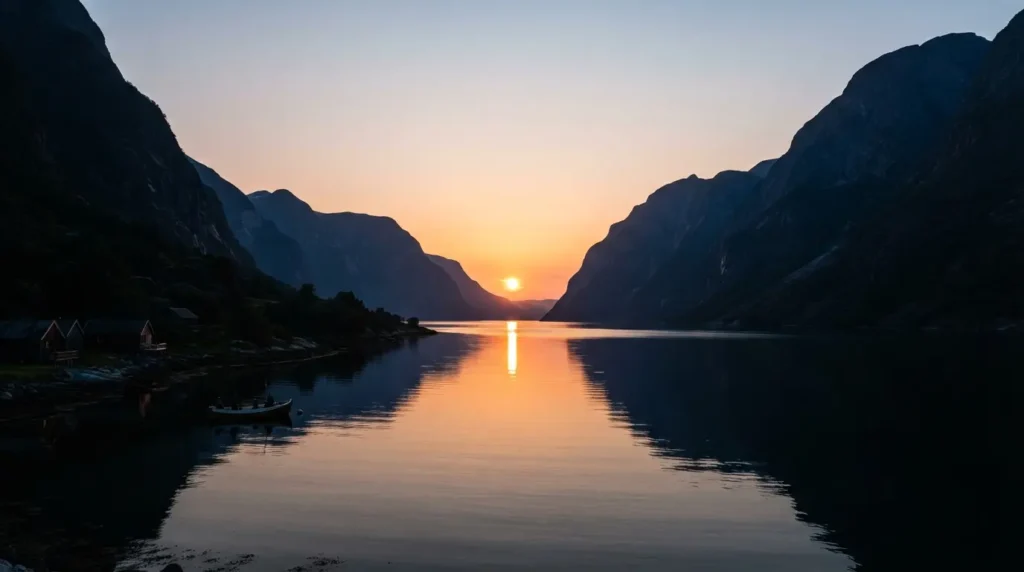
May and June for the best combination of waterfall volume, manageable crowds and lower prices. The snowmelt feeds the fjord waterfalls most intensely through May, when the cliff faces are running with water that will have reduced by August. June adds the midnight sun — in Bergen, the sun sets at approximately 11pm in late June and rises again before 4am, which reorganises the day in ways that are either delightful or disorienting depending on your sleep priorities. Pack a sleep mask regardless of what your hotel claims to offer.
July and August are peak season. The Flåmsbana, Preikestolen trail and Nærøyfjord crossing all carry their highest visitor volumes. The experience remains excellent. The early morning advantage — the same one that applies at Petra, the Colosseum and Fushimi Inari — applies here: book the first Flåmsbana departure of the day and arrive at Preikestolen before 8am.
September is underrated. The foliage turns across the fjord walls, the summer crowds have cleared, the midnight sun has ended and normal sleeping hours resume, and accommodation prices drop 20–30% from their July peak.
For solo female travellers specifically, Norway ranks among the safest countries in the world for independent travel — consistently in the global top five on safety indices and specifically noted for solo women (our solo female travel guide covers the full European ranking).
What does Norway cost in 2026?
More than most of Europe, less than people often assume for what it is. Norway is an expensive country — a coffee costs approximately 50–65 NOK (£3.80–5), a mid-range restaurant meal runs 200–350 NOK per person (£15–26), a hotel room in Bergen starts around 1,000 NOK (£75) for a budget property and 2,000+ NOK (£150+) for mid-range. The fjord activities themselves — the Flåmsbana (450–550 NOK), the Nærøyfjord ferry (500–700 NOK) — are reasonable against the experience they provide.
The practical offset: Norway does not charge entry to its fjords, its national parks, its viewpoints or most of its hiking trails. The Preikestolen hike has no ticket, no booking system, no time slot. You turn up and walk. The Stegastein viewpoint is free. The fjord views from the ferry crossing are included in the ferry ticket. Much of what makes Norway extraordinary costs nothing beyond transport.
A mid-range four-day Bergen-based fjord trip — flights, hotel, the Norway in a Nutshell circuit, Preikestolen, meals — runs approximately £600–900 per person from the UK. Plan your Norway itinerary on PlacesToday →
Frequently asked questions
Q: Which Norwegian fjord should you visit first?
A: Nærøyfjord, via the Flåm Railway and electric ferry crossing. It is the most accessible for first-time visitors, UNESCO-listed, and the combination with the Flåmsbana makes it the best single day available in the region. Geirangerfjord is the more dramatic landscape; Nærøyfjord is the more practical starting point.
Q: How do you get to the Norwegian fjords without a cruise?
A: Fly to Bergen, which has direct connections from most UK and European airports. The Norway in a Nutshell route (Flåmsbana railway plus electric Nærøyfjord ferry, bookable at vy.no or visitflam.com) is the standard independent circuit. Alternatively, hire a car from Bergen for three to four days and cover Nærøyfjord, Sognefjord and Hardangerfjord at your own pace. A car gives significantly more flexibility than public transport for the smaller viewpoints and farm stops.
Q: What is the zero-emission fjord cruise mandate in 2026?
A: From January 2026, Norwegian law requires zero-emission (electric or hybrid) vessels in the UNESCO-protected fjords, including Geirangerfjord and Nærøyfjord. Large diesel cruise ships no longer meet the standard. The practical effect is that fjord cruises are now conducted in electric silence — no engine noise, no exhaust — and only smaller, cleaner operators can enter the most protected waterways. Norled and Fjord Tours are the main compliant operators on the Nærøyfjord route.
Q: Is Preikestolen hard to hike?
A: Moderately. The four-hour return hike (8 kilometres, 334 metres of elevation gain) is well-maintained and does not require technical equipment. Good walking shoes are essential — trainers are insufficient on the uneven rock. Go on a weekday and start before 8am in July and August; the path becomes significantly busier by mid-morning. The view from the summit — a 604-metre vertical drop to Lysefjord — is exactly what it is photographed as being.
Q: When is the best time to visit the Norwegian fjords?
A: May and June for waterfall volume and midnight sun with manageable crowds. September for foliage, empty trails and lower prices. July and August are peak season — excellent, crowded, and the best window for guaranteed good weather if summer is your only option. The Flåmsbana should be booked well ahead for any summer travel; tickets sell out months in advance.
The Norwegian fjords are one of the places where the effort required to reach them and the experience of being there reach an unusually fair equilibrium. They are not easy to get to. They are exactly as extraordinary as the photographs suggest, which is the correct return on the investment. May and June are the best months. September is the best value. The Flåmsbana needs to be booked before anything else. The fjords themselves are free. Plan your Norway trip on PlacesToday →