The Philippines received 4.42 million international visitors in the first eight months of 2026, up year-on-year, with the United States the top source market at 20.98% of arrivals and South Korea second (Department of Tourism / DICT, 2026). The dry season — November to April — is when the country is most consistently accessible; January and February are the best overall months. A mid-range traveller spending time across multiple islands should budget $60–90 per person per day excluding international flights. El Nido is the better choice for travellers who prioritise dramatic scenery and boat tours; Boracay is the better choice for those who want a world-class beach they can walk to from their room. Both are worth visiting if the itinerary allows.
The Philippines is 7,641 islands, which is both the most compelling thing about it and the reason first-time visitors occasionally arrive confused. The framework that makes it navigable: the main gateway is Manila, but Manila is not a destination in the way that Bangkok or Singapore are — it is a transit hub that functions best as a single overnight rather than a multi-day base. The destinations are the islands, and the islands divide into four types by what they offer. Palawan (El Nido and Coron) for the scenery and the caves. Boracay for the beach itself. The Visayas (Cebu, Bohol, Siargao) for surfing, diving, and a more local travel infrastructure. And the highland cordillera (Banaue, the Ifugao rice terraces, Sagada) for a version of the country that has nothing to do with the sea.
The country overtook Indonesia as the number-one Southeast Asia destination for American travellers in the first quarter of 2026, a shift that reflects both the ease of English (the Philippines has two official languages, Filipino and English, and English is the medium of instruction from primary school) and the growing international profile of El Nido as a bucket-list destination.
Is the Philippines worth visiting in 2026?
Yes — and for most visitors the question is not whether but when and where. The scenery in Palawan is among the best in Southeast Asia: the limestone karst topography of the Bacuit Archipelago around El Nido, the turquoise lagoons and cave entrances, the underwater visibility in Coron’s dive sites. The surfing on Siargao at Cloud 9 is world-class and the island has remained reasonably affordable despite growing international profile. The whale shark encounters off Oslob in Cebu are ethically complicated and still one of the most singular wildlife experiences in the region.
The honest briefing: the islands are spread across a large country, inter-island transport takes planning, and the typhoon season (June–October) limits window of visit for several key destinations. Plan for the dry season, build in enough days between islands to allow for ferry and flight connections, and do not treat Manila as more than a gateway.
When is the best time to visit the Philippines?
| Month | Weather | Typhoon risk | Crowds | Best for |
|---|---|---|---|---|
| November | Transitional, rapidly clearing | Low by mid-month | Low–moderate | Best value start to dry season |
| December | Cool, dry, sunny | Low | High (Christmas) | Holiday atmosphere; peak rates |
| January | Cool, dry — best overall weather | Low | Moderate | Best overall month |
| February | Cool, dry, excellent light | Low | Low–moderate | Best weather, lower prices than Jan |
| March | Excellent, final reliable dry month | Low | Moderate | Tubbataha reef opens mid-March |
| April | Hot (33–36°C), mostly dry | Low | High (Holy Week) | Avoid Holy Week; late April good value |
| May | Hottest month, humidity building | Low | Low | Mountain regions; first rains late May |
| June–October | Wet season; storms between clear spells | Peak in September–October | Low (and cheaper) | Siargao surfing (Sept–Nov); budget travel |
Sources: geographyworlds.com Philippines seasonal guide; Philippine Department of Tourism, 2026
Regional variations matter more in the Philippines than almost anywhere else in Southeast Asia. Palawan (El Nido, Coron) has its dry season running November–April and experiences fewer direct typhoon hits than the eastern islands. Boracay follows the same November–April window and closes for environmental maintenance for a period in each year — check the current schedule before booking, as the closure timing shifts. Siargao’s surfing season is September–November, which coincides with elevated typhoon risk; most travellers who are not specifically there for surf visit between January and March.
Which Philippines island should you visit?
| El Nido | Boracay | Siargao | Cebu | Coron | |
|---|---|---|---|---|---|
| Best for | Scenery, island hopping, lagoons | Beach, resort, watersports | Surfing, nightlife, nomads | Diving, canyoneering, whale sharks | Wreck diving, lakes, budget Palawan |
| Vibe | Nature-first, town shuts at midnight | Resort island, active evenings | Laid-back surf town | Urban hub and adventure base | Remote, quieter than El Nido |
| Dry season | Nov–April | Nov–April | Jan–March (avoid surf season) | Year-round | Nov–May |
| Access | Direct flight, or Puerto Princesa + minivan | Caticlan airport + 10-min boat | Direct flights from Manila, Cebu | International flights direct | Puerto Princesa or Manila + ferry |
| Daily cost | $50–90 (mid-range) | $55–100 (higher peak pricing) | $35–65 | $40–70 | $40–70 |
| Best for families | Older children, active | Yes — best for small children | Older teens and adults | Older children | No (limited family infrastructure) |
El Nido — the scenery that justifies the journey
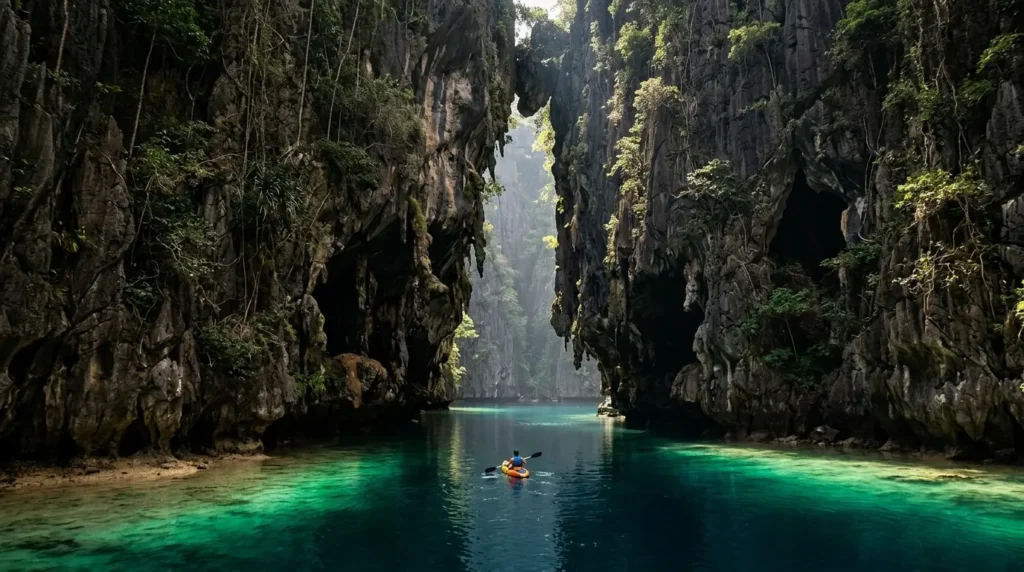
El Nido is the most visited part of Palawan and the most photographed destination in the Philippines: the limestone karst formations of the Bacuit Archipelago, the Big and Small lagoons accessible by kayak through low cave entrances, the secret beaches visible only from the water. The landscape is genuinely extraordinary — a karst environment more dramatic than Ha Long Bay in several respects, entirely surrounding a small town that functions as the logistical base for the boat tours.
The tour structure is the entry point: Tour A (the lagoons), Tour B (the beaches and snorkelling), Tour C (caves and hidden beach), Tour D (the northern islands). Most visitors do Tour A first because the lagoons are the photographs that brought them here. An El Nido island hopping Tour A runs $22–35 per person including a boat, a guide, lunch and snorkelling equipment; book through your accommodation the night before, as tours fill quickly in December and January.
The honest logistics note: getting to El Nido requires a direct flight from Manila (operated primarily by Air Swift, which charges a premium for the convenience) or the cheaper option of a flight to Puerto Princesa and a five-to-six-hour minivan transfer. Budget for the transfer time and adjust your expectations about El Nido town accordingly — it is a small tourism town with good food and limited nightlife, which is exactly the right environment for the kind of trip it enables.
Coron, also in Palawan, is the dive destination alternative: the Japanese warships sunk in World War II lie at depths of 10–40 metres in water with visibility up to 30 metres. It is quieter than El Nido, cheaper, and significantly better for underwater photography. A combined El Nido–Coron trip connected by the island ferry through the Calamian Islands (a three-to-four-day route) is the format that experienced Southeast Asia travellers consistently describe as the best Philippine itinerary.
Boracay — the beach that started it all
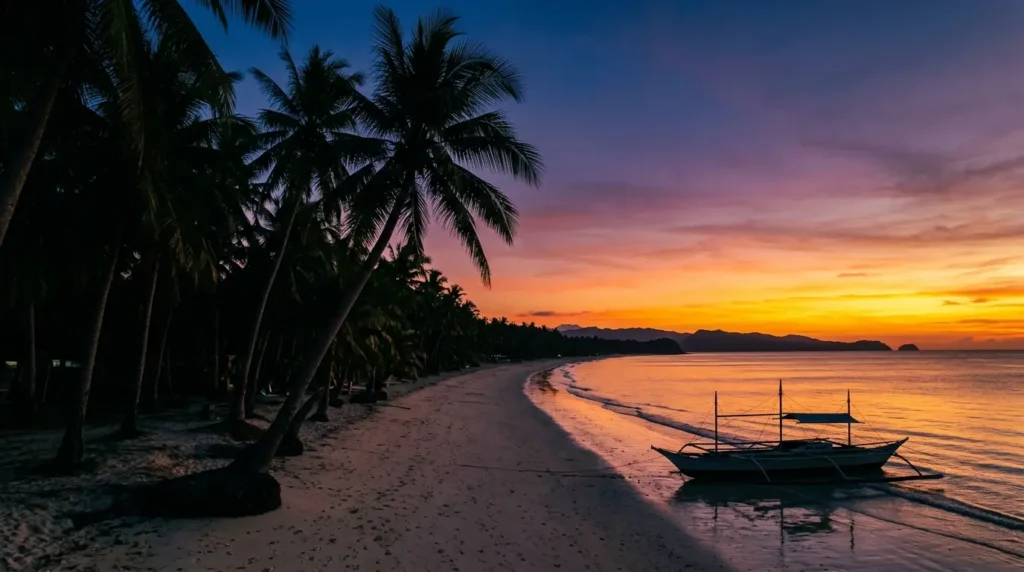
Boracay’s White Beach — four kilometres of powdery white sand on a calm protected bay — was closed in 2018 for six months of environmental rehabilitation after being declared an “environmental disaster zone” by the government. It reopened with new rules: no beach fires, no drinking or smoking outside designated bar areas, tighter wastewater regulations. The result, in 2026, is a beach that looks better than it did at its most crowded and functions more coherently as a destination.
White Beach is still the most popular beach in the Philippines and among the most visited in Southeast Asia. The water is calm, the sand stays light-coloured because the underlying geology is crushed coral, and the infrastructure — hotels, restaurants, water sports operators — is the most developed on any Philippine island. For families with small children, it remains the strongest Philippines choice: calm water, easy access, everything within walking distance.
Bulabog Beach on the eastern side of the island is the wind sports beach: consistent wind from November to April makes it one of the best kitesurfing and windsurfing locations in Asia. The atmosphere there is different from White Beach — quieter, more serious, with a smaller number of gear-focused visitors.
Peak pricing on Boracay (Christmas, New Year and Holy Week) runs 30–60% higher than shoulder season. The late November and early December window — after the typhoon season but before the holiday premium — is the best value entry point.
Siargao — the surf island that became something else
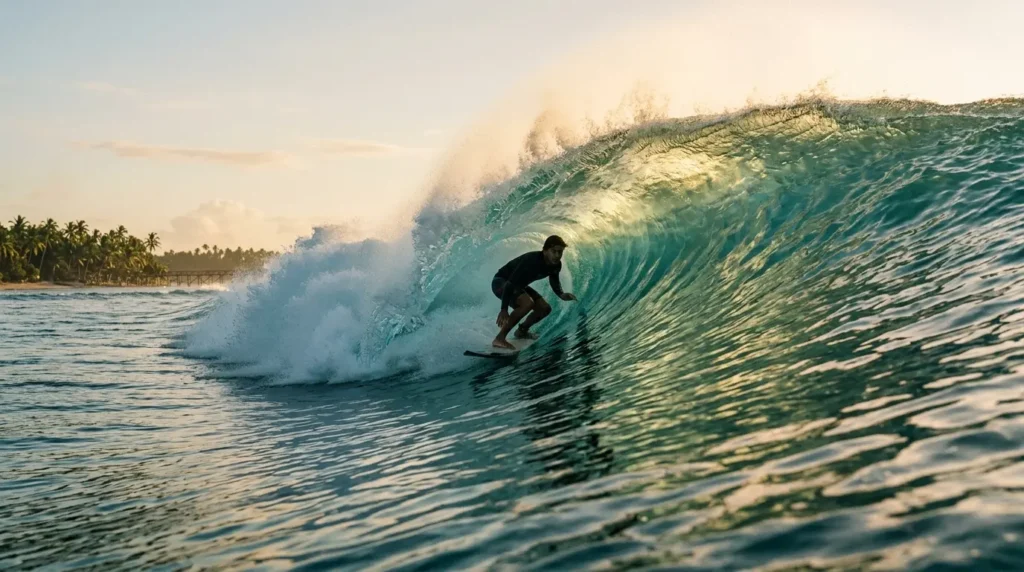
Siargao’s international profile was built on Cloud 9, the hollow right-hand reef break off the island’s eastern shore that hosts the annual Siargao Cloud 9 Surfing Cup and is one of the best surf waves in Southeast Asia. The island has developed beyond its surf foundation into a destination with a strong digital nomad presence, a functioning food scene, and a set of secondary activities — the lagoons and rock pools at Magpupungko, the island hopping circuit including Naked Island and Daku Island, the coconut road bike routes — that justify a visit regardless of surf ability.
The surf season runs September to November, which falls in the typhoon window. Most non-surfers visit between January and March: the swell is smaller, the weather is more reliably dry, and the island is quieter. Siargao is the cheapest of the three main Philippine island destinations — accommodation at $15–30 per night for a decent guesthouse, meals at $4–8 per dish — and functions as the right option for travellers who want a laid-back island stay without the resort pricing of Boracay or the logistical complexity of Palawan.
Cebu — the hub that is also a destination
Cebu City is the Philippines’ second city and the most convenient international entry point outside Manila, with direct flights from multiple Asian hubs. The surrounding province contains enough activities for a full week without moving to another island: the Kawasan Falls canyoneering (a half-day of cliff jumping, swimming through turquoise canyon water and rappelling behind waterfalls), the Moalboal sardine run (a million sardines moving in a bait ball off the reef wall, thirty seconds from the beach), and the Oslob whale shark interaction. The Oslob encounter — feeding whale sharks off a fishing village to allow snorkellers to swim with them — is ethically debated; the feeding conditions affect the sharks’ natural behaviour and migration patterns. It is also extraordinary. Visit with that tension acknowledged, support the newer non-feeding encounter operators if you can find them, and make your own assessment. Oslob whale shark snorkelling with canyoneering combo runs $45–65 from Cebu City as a day trip.
Bohol, accessible by fast ferry from Cebu in two hours, is the day trip or overnight extension: the Chocolate Hills (1,776 perfectly conical limestone hills turning chocolate brown in the dry season), the tarsiers (the world’s smallest primates, nocturnal, the size of a fist, with eyes proportionally larger than any other mammal), and the Loboc River boat lunch. Most visitors do it as a day trip; staying overnight allows for the Batad and Sagbayan viewpoints at dawn before the day-trip groups arrive.
What does the Philippines cost in 2026?
Daily budget (per person, USD)
| Category | Budget | Mid-range | Luxury |
|---|---|---|---|
| Accommodation | $7–16 | $22–55 | $70–180+ |
| Food (daily) | $6–11 | $18–30 | $44+ |
| Transport (inter-island) | Ferry $5–22 | Domestic flight $18–55 | Private transfers |
| Activities | Island hopping $22–35 | Diving $45–68 | Private tours |
| Daily total | $25–40 | $60–90 | $150–250+ |
Sources: jetsetteralerts.com Philippines budget guide; agbrief.com DOT arrival data, 2026
The Philippines is the best-value destination in Southeast Asia for beach quality to cost ratio, with the possible exception of Cambodia. A budget traveller eating street food and travelling by public ferry can genuinely manage $25–40 per day. The mid-range figure of $60–90 buys a comfortable room with air conditioning, restaurant meals and one or two activities daily. The significant cost is inter-island transport: domestic flights add up quickly when covering multiple islands, and the budget airlines (Cebu Pacific, AirAsia Philippines) require booking two to four weeks in advance to access the best prices.
International flights from the UK to Manila or Cebu run £700–1,100 return in the shoulder season (January–March excluding peak weeks), rising to £900–1,400 in December. Budget more time than you think: the Philippines is the destination in Southeast Asia where travellers most consistently wish they had longer.
Practical information for 2026
Visa: UK, US, EU, Australian and most other Western passport holders enter visa-free for 30 days, extendable to 59 days at Bureau of Immigration offices for approximately $55. No advance application required.
Getting around: Inter-island transport is by domestic flight (35–90 minutes between most island pairs; book Cebu Pacific or AirAsia Philippines 2–4 weeks ahead for best prices) or by ferry (overnight RoRo ferries connect Manila to the Visayas and Mindanao; fast ferries connect Cebu with Bohol, Siargao and smaller island groups). Within islands, tricycles and habal-habal (motorcycle taxis) are the standard short-distance transport. Renting a scooter is possible on most islands with an international driving permit.
Currency: Philippine peso (PHP). ATMs are reliable in cities and tourist centres; carry cash on smaller islands. Card payments work in hotels and larger restaurants; smaller guesthouses and boat tour operators typically prefer cash.
Health: Hepatitis A, typhoid and rabies vaccinations are recommended by most travel health clinics. Malaria risk exists in parts of Palawan (particularly inland areas) and some Mindanao provinces; the main tourist areas of El Nido, Boracay, Cebu and Siargao are considered negligible risk. Check the FCDO Philippines travel advice for current health and safety information before travel.
Frequently asked questions
Q: How many days do you need in the Philippines?
A: A minimum of ten days to cover two islands meaningfully; two weeks for three islands. The transit time between destinations — domestic flights, ferry connections, the El Nido minivan — eats into available island time more than most travellers expect. A standard two-week itinerary: Manila overnight → El Nido (four nights) → Coron by island ferry (two nights) → fly to Cebu (two nights with a Bohol day trip) → Siargao (three nights). If you can only do one island, make it El Nido in the dry season or Siargao if you are specifically there for surf.
Q: Is Manila worth visiting?
A: Worth one night, preferably in Intramuros (the Spanish colonial walled city) and at a BGC or Makati hotel for the convenience of the airport connection. Not worth more than that on a first trip. The city has real things in it — the National Museum, the food scene in BGC, the Binondo (Chinatown) food street, the Intramuros Fort Santiago — but none of them are the reason people fly to the Philippines, and the traffic can absorb a full day from a traveller who has not planned the logistics.
Q: Which is better for a first Philippines trip — El Nido or Boracay?
A: El Nido if the main interest is scenery, snorkelling, and boat tours. Boracay if the main interest is a beach you can walk to from your room, a reliable infrastructure, and ease of access. El Nido requires a longer journey and the town is a functional base rather than a resort. Boracay is the more polished product. For visitors who want one island that delivers everything, El Nido is more memorable; for visitors who want to decompress on a beach without logistical complexity, Boracay is more comfortable.
Q: Is the Philippines safe for independent travellers in 2026?
A: The main tourist destinations — El Nido, Boracay, Cebu, Siargao, Bohol, Coron — are all considered safe for independent travel. The FCDO advises against all but essential travel to certain western Mindanao provinces and the Sulu Archipelago, which are not on any standard tourist itinerary. Standard city precautions apply in Manila: keep phones in pockets, use ride-hailing apps rather than street-hailed taxis, and pre-arrange airport transfers. See our Vietnam travel guide for how the Philippines compares to the region’s other top Southeast Asia destination.
The Philippines in the dry season — November through April — delivers what most people come for: the lagoons of Palawan are genuinely extraordinary, Boracay’s White Beach earns its global reputation, Siargao is one of the most enjoyable islands in Southeast Asia for its price, and the diving and canyoneering infrastructure in the Visayas makes Cebu a destination rather than just a transit point. Plan for the dry season, give yourself more days than you think you need, and arrive at El Nido’s lagoons before eight in the morning. Everything else is negotiable. Start planning your Philippines itinerary on PlacesToday →