Prague in 2026 is still worth visiting, still 30–40% cheaper than Paris or Amsterdam for equivalent quality, and still one of the most beautiful medieval city centres in Europe. It is also, in the tourist triangle between Old Town Square, Charles Bridge and Wenceslas Square, running at prices that feel entirely Western European — a beer for €4 where 200 metres away the same beer costs €1.80. The city is genuinely two cities in one, and knowing which version you are in at any given moment is the skill that separates a good Prague trip from an expensive and crowded one (HelloPrague.net, local guide 2026).
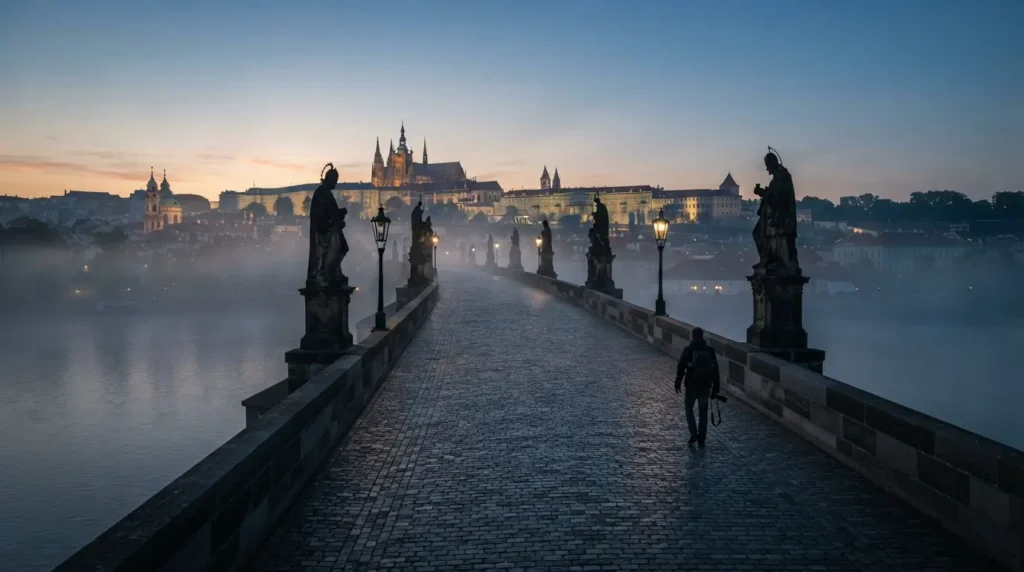
Before the tourist coaches arrive at Old Town Square — before ten in the morning, in the long June light of a Central European summer — Prague is one of the quietest beautiful things in Europe. The astronomical clock on the Old Town Hall. The Gothic spires above the rooftops in the direction of the river. A bakery on a side street already open, selling something warm, and a cat sitting in a window above it looking at the square with the particular indifference of a cat that has been watching this square for a long time.
By eleven, the square has filled. By noon on a July Saturday, Charles Bridge has 15,000 to 20,000 people crossing it per day, the tourist restaurants have opened their English menus, and Prague Castle is receiving 25,000 to 30,000 visitors (machupicchu.org, 2026 crowd data). None of this diminishes the quality of what Prague is. It does change what Prague requires from you: an early start, a neighbourhood away from the centre for dinner, and the knowledge that the two cities exist simultaneously and the choice between them is yours.
Is Prague still worth visiting in 2026?
Yes — with three conditions. Visit in May or September rather than July or August. Pre-book Prague Castle and the Jewish Quarter tickets before you travel. And eat in Vinohrady, Žižkov or Holešovice rather than within eyeshot of the Astronomical Clock.
Prague has one of the best-preserved historic centres in Europe — UNESCO-listed, and genuinely extraordinary in a way that the photographs communicate accurately for once. The castle is the largest castle complex in the world by area. The Gothic, Baroque and Art Nouveau architecture is intact in a way that the Second World War left undisturbed. The beer culture is the finest in Central Europe and does not become worse as visitor numbers rise. These are the reasons to go, and they remain entirely intact in 2026 despite the significant growth in visitor arrivals (Czech Republic flight interest up 149% year-on-year per KAYAK data reported in 2025). The conditions only tell you how to get the best of them.
When is the best time to visit Prague in 2026?
| Month | Temp | Crowds | Hotel prices | Verdict |
|---|---|---|---|---|
| January–February | -2 to 5°C | Very low | 50–60% below peak | Cold, cheap, atmospheric; Christmas markets cleared |
| March–April | 8–16°C | Building (Easter surge) | Moderate | Spring is lovely; Easter week pricier |
| May | 15–22°C | Moderate | Mid-range | Optimal — best weather-to-crowd ratio |
| June | 19–25°C | High | High | Still manageable early; evening light beautiful |
| July–August | 23–28°C | Maximum | Peak (+40–60%) | Genuine crowds; requires early starts; best avoided if possible |
| September | 15–22°C | Falling | 20–30% below July | Near-equal to May; autumn light excellent |
| October | 9–15°C | Low | Lower | Atmospheric; cooler; quieter |
| November–December | 1–8°C | Low (Dec high for markets) | Low; December moderate | Christmas markets from late November |
Sources: HelloPrague.net 2026 honest guide; machupicchu.org Prague 2026 crowd data; bestpragueguide.com local costs guide June 2026
May and September are the honest answer. May brings the city to full life before the summer density — the chestnut trees are in flower along the river, the light on the castle at golden hour is the light that the photographs are trying to capture, and the hotel prices have not reached the July spike. September brings the same conditions on the other side of summer, with the added quality of a city that is visibly relieved to be entering its quieter season.
What is the Prague tourist triangle — and how do you navigate it?
The tourist triangle — Old Town Square, Charles Bridge and the approaches to Prague Castle — contains Prague’s most extraordinary architecture and Prague’s most tourist-adapted restaurants. These two things exist in the same geography and require the same approach: visit the monuments, eat somewhere else.
The Astronomical Clock on Old Town Hall dates to 1410 and performs on the hour with a mechanical procession of apostles, a crowing cock and the figure of Death ringing a bell. It is more moving than it sounds when read as a description. The show lasts approximately two minutes. Every tourist in Prague is also at this moment looking at it. This is fine. Arrive early, watch the clock from one of the quieter corners of the square, and then walk — not into the nearest restaurant, but two streets in any direction.
The practical currency note: exchange offices around Old Town Square advertising “0% commission” offer exchange rates 15–20% below the bank rate. This is how they make money. Use ATMs instead, or exchange at a legitimate bank. Card payment is increasingly available across Prague, but cash remains preferable at local restaurants, markets and pubs. The Czech koruna (CZK) is the currency; the euro is not accepted except at tourist-facing establishments (bestpragueguide.com, 2026).
Which Prague neighbourhoods should you actually spend time in?
The best Prague happens in the residential neighbourhoods immediately adjacent to the centre — close enough that the Gothic spires are visible from dinner, far enough that the menu is in Czech and the beer costs what it should.
Malá Strana — the correct romantic district
Malá Strana (Lesser Town), on the western bank of the Vltava between Charles Bridge and the castle, is the district that most visitors pass through on the way up to the castle and do not stop in adequately. The Baroque palaces and gardens here — Wallenstein Garden, Vrtba Garden — are among the finest in Central Europe and are free or nearly free to enter. The lanes are cobblestoned, the restaurants here are quieter than the tourist centre, and the view of the river and Old Town from the Malá Strana side of Charles Bridge is the correct direction to look at dusk.
Vinohrady — where Prague eats
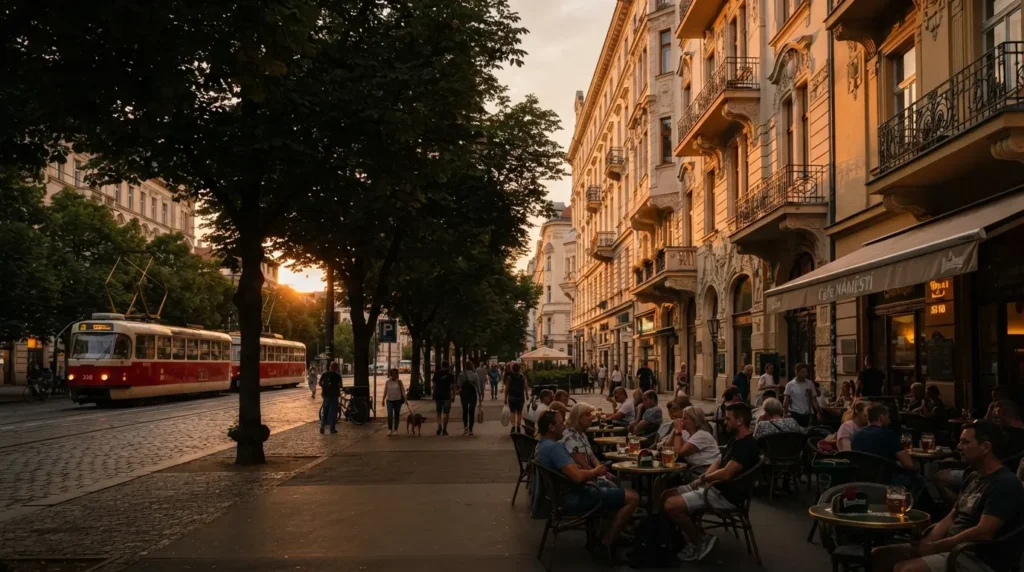
Vinohrady, the Art Nouveau residential district southeast of Wenceslas Square, is where Praguers who care about food and wine eat on a Friday evening. The wine bars are serious — Czech wine from Moravia, natural wine from across Central Europe, the kind of list that assumes knowledge. The restaurants here serve Central European food without the tourist premium. A svíčková (slow-braised sirloin with creamy vegetable sauce and bread dumplings) in Vinohrady costs half what the same dish costs near the Astronomical Clock and is made with more care.
A Prague craft beer and local pub tour in Vinohrady is the evening activity that most visitors leave Prague not having done and most wish they had built in.
Žižkov — the working pub
Žižkov, east of Vinohrady, is a hillside working-class district that has a pub on every corner and a television tower shaped like the least-likely-looking structure you can imagine covered in giant crawling babies (David Černý’s sculptural installation, permanently affixed to the tower since the 1990s). The pubs serve Pilsner Urquell or Kozel from the tank. A half-litre costs CZK 40–50 (€1.60–2). This is Prague operating at its own price level rather than the tourist zone’s.
What is Prague Castle actually like?
The largest castle complex in the world by area — approximately 70,000 square metres across multiple courtyards, palaces, gardens and the St Vitus Cathedral. It takes four to five hours to see properly, requires a ticket that covers multiple sections (the Long Visit covers everything significant), and should be approached via the stairs from Malá Strana rather than the tourist coach route for the view of the city during the ascent.
St Vitus Cathedral is the centrepiece — a Gothic cathedral begun in 1344 and completed in 1929, whose south tower is the highest point in Prague and whose stained glass includes a 1931 window by Alfons Mucha. Entry to the cathedral nave is free; entry to the tower and the historic circuits requires the castle ticket. Book through prague.eu or the official Prague Castle booking system ahead of visit — summer queues without pre-booking run forty-five minutes to an hour at peak times. A Prague Castle guided tour with skip-the-line access covers the cathedral, the Old Royal Palace and the Golden Lane.
The view from the castle gardens over Prague’s red rooftops to the Old Town towers and the river is the view that explains why this city has been continuously inhabited for 1,500 years. It is not diminished by the number of people looking at it simultaneously.
What is the Jewish Quarter (Josefov) and why does it matter?
Josefov, the former Jewish quarter between the Old Town and the river, contains six synagogues and the Old Jewish Cemetery — one of the most significant Jewish heritage sites in Europe, used from the 15th century to 1787 and containing 12,000 graves layered up to twelve deep. The specific quality of the Old Cemetery — the headstones accumulated in layers above each other, the weight of the number — is not reproduced anywhere and justifies the visit specifically.
The Spanish Synagogue is the most visually overwhelming of the six — an ornate Moorish interior from 1868 that is unlike anything else in Central Europe. The Pinkas Synagogue contains the names of 77,297 Bohemian and Moravian Jewish victims of the Holocaust inscribed on its interior walls. These are places that require time and quiet rather than efficiency.
A combined ticket covering all six synagogues and the cemetery should be booked well in advance through the Jewish Museum Prague’s official booking system; summer morning slots sell out within days of going on sale. A Prague Jewish Quarter and Old Town guided walking tour provides the historical context that the sites themselves do not always give adequately.
What does Prague cost in 2026?
Two answers depending on where you are in the city. Within the tourist triangle — Old Town Square, Charles Bridge, tourist restaurants — a beer costs €4–6 and a meal runs €15–30 per person. Two streets away in Vinohrady or Žižkov: beer €1.80, full lunch €6–8, dinner €12–20. This gap is not exaggerated; it reflects two genuinely different price environments existing in the same small city.
Mid-range travellers in a comfortable hotel and eating a mix of tourist and local restaurants should budget €100–150 per person per day. Budget travellers in hostels (€17–26 per person) and eating at local restaurants manage €50–70. Hotel prices have risen substantially — the average Prague hotel now runs approximately €117 per night (Real Prague Guides, December 2025 data) — so booking ahead matters more than it used to.
Prague remains 30–40% cheaper than Paris or Amsterdam for equivalent quality when you eat and drink where Praguers eat and drink. The arbitrage between the tourist zone and the residential districts is the practical skill the trip rewards.
What should you eat and drink in Prague?
The beer first. Czech lager — specifically the Pilsner style originating in the Bohemian city of Plzeň, 90 kilometres southwest of Prague — is the finest lager produced anywhere in the world by the consensus of people who have thought carefully about this. Pilsner Urquell from the tank, served at the correct temperature in a clean glass, costs CZK 40–50 (€1.80) at a local pub. Drink it there.
The food: svíčková na smetaně (slow-braised sirloin in a creamy root vegetable sauce, with bread dumplings and whipped cream — it sounds wrong and tastes right). Guláš (beef goulash with bread dumplings, the correct version available in a Žižkov pub rather than a tourist restaurant with an English-language photograph menu). Bramboráky (potato pancakes with garlic and marjoram). Trdelník — the rolled sugar pastry sold on every corner of Old Town Square as a “traditional Czech street food” — is not traditional or Czech; it is Slovak and was introduced to Prague’s tourist economy recently. This does not make it taste bad. It does make the claim worth noting.
You can plan your Prague itinerary on PlacesToday. For how Prague compares as one of the fastest-rising European alternatives to the crowded Western European hotspots, our guide to where to go instead of crowded Europe this summer covers the broader context.
Frequently asked questions
Q: Is Prague worth visiting in 2026 despite the crowds?
A: Yes — May and September, pre-booked tickets for the castle and Jewish Quarter, and dinner in Vinohrady. July and August are the genuine crowd problem; May and September have the same quality at lower intensity. Prague’s historic centre is among the finest in Europe and remains so regardless of the visitor numbers around it.
Q: How much does Prague cost per day in 2026?
A: Budget travellers: €50–70 per day (hostel, local restaurants, public transport). Mid-range: €100–150. The key variable is where you eat — the tourist triangle runs at Western European prices; two streets away in residential neighbourhoods, a full lunch costs €6 and a beer €1.80. Prague is still 30–40% cheaper than Paris or Amsterdam for equivalent quality (HelloPrague.net, 2026).
Q: Do you need to book Prague Castle in advance?
A: Yes, in summer. Peak season queues without pre-booking run forty-five minutes to an hour. Book through the official Prague Castle website or prague.eu ahead of travel. The Jewish Quarter requires similarly advanced booking for summer slots — both sell out days ahead of date in peak season.
Q: Is Prague better to visit than Budapest?
A: They are different cities for different reasons. Prague has the finer medieval architecture and the better beer culture. Budapest has the thermal bath culture, the Danube views, and a night scene that Prague does not match. For a first Central European trip, Prague is more compact and easier to navigate in three days. For a longer trip, both are worth including.
Q: What is the best neighbourhood to stay in Prague?
A: Malá Strana for the romantic version — castle views, cobblestones, Baroque gardens. Vinohrady for the most liveable version — Art Nouveau apartment buildings, excellent restaurants and wine bars, tram connections to the centre. Old Town is convenient but the most expensive and most tourist-facing. Žižkov for the budget option with the most local character.
Prague in 2026 rewards the visitor who treats the tourist triangle as a morning activity and the residential neighbourhoods as an evening destination. The castle is extraordinary. The bridge is worth crossing before eight in the morning. The beer in Žižkov is the best reason to stay an extra day. Go in May. Plan your Prague trip on PlacesToday →