Puglia is what Tuscany was twenty years ago — extraordinary food, genuinely beautiful landscape, a fraction of the visitor infrastructure, and prices that are 30–50% below the north (machupicchu.org, 2026 Puglia budget guide). The burrata was invented here and the version you eat in London or New York is a reasonable approximation of what a bad one tastes like in the region that makes it. The orecchiette made by the grandmothers in the lanes of Bari’s old city has the texture and thickness that the restaurant version in Rome does not replicate. You need a car. You need a week. September is the right month. Do not go to Alberobello at noon in August and expect anything except crowds.
Puglia is the heel of Italy’s boot — a region of flat limestone plains, ancient olive groves, a long Adriatic coastline, whitewashed hill towns, and the trulli, which are circular stone houses with conical roofs that were built without mortar so that their owners could quickly dismantle them to avoid taxation and that now constitute one of the most distinctive architectural landscapes in Europe. The region’s tourism was growing before the pandemic and has accelerated since. It remains, compared with Tuscany, Rome or the Amalfi Coast, genuinely accessible — Lecce hotels at €60–100 per night against Florence’s €150–220 for equivalent quality. Go before this gap closes entirely, because it is closing.
The food justifies the journey independently of everything else. A region that produces its own burrata, grows the oldest olive trees in Europe, invented orecchiette, makes excellent Primitivo wine, and provides Bari’s street food at prices that have not adjusted for inflation in a decade is the correct answer to the question of where in Italy to eat well without financial distress.
Does Puglia require a car?
Yes. This is a fact worth stating before everything else, in the same way as the Tuscany guide makes the same point. The trulli countryside of the Valle d’Itria, the masserie farmhouses in the olive groves, the smaller coastal towns, Lecce from Ostuni — none of these work on public transport at a practical level. Trains connect Bari, Brindisi and Lecce; buses exist on schedules that suit residents rather than itineraries. Rent the car at Bari or Brindisi airport. Budget for it before accommodation. The car is the trip.
The coast roads between towns — particularly the stretch from Monopoli south through Polignano a Mare and along the Salento coast — are among the better drives in southern Italy. This is not a disincentive.
Which part of Puglia should you visit?
| Area | Days | Best for | Key food/wine | Base town |
|---|---|---|---|---|
| Valle d’Itria | 2–3 | Trulli, whitewashed towns, countryside | Burrata, Primitivo, focaccia barese | Ostuni or Locorotondo |
| Lecce / Salento | 2 | Baroque architecture, beaches, slow pace | Orecchiette con cime di rapa, Negroamaro | Lecce |
| Bari | 1 | Gateway, street food, Bari Vecchia | Panzerotti, sgagliozze, orecchiette made by hand | Bari (day/night stop) |
| Gargano Peninsula | 1–2 | Dramatic coast, sea caves, pilgrim sites | Seafood, Caciocavallo cheese | Vieste or Peschici |
| Polignano a Mare | Half day | Cliff diving, dramatic coast, aperitivo | Gelato, fresh seafood | Day trip from Ostuni |
Sources: machupicchu.org Puglia 2026; theboujist.com Puglia travel guide 2026; travelandoo.com Puglia guide 2026
Most first trips to Puglia combine the Valle d’Itria (two nights in a masseria near Ostuni or Locorotondo) with Lecce (two nights) and a day in Bari at the start or end. Seven days is comfortable. Five is tight but workable with a car.
What is the Valle d’Itria and why is it the centre of the trip?
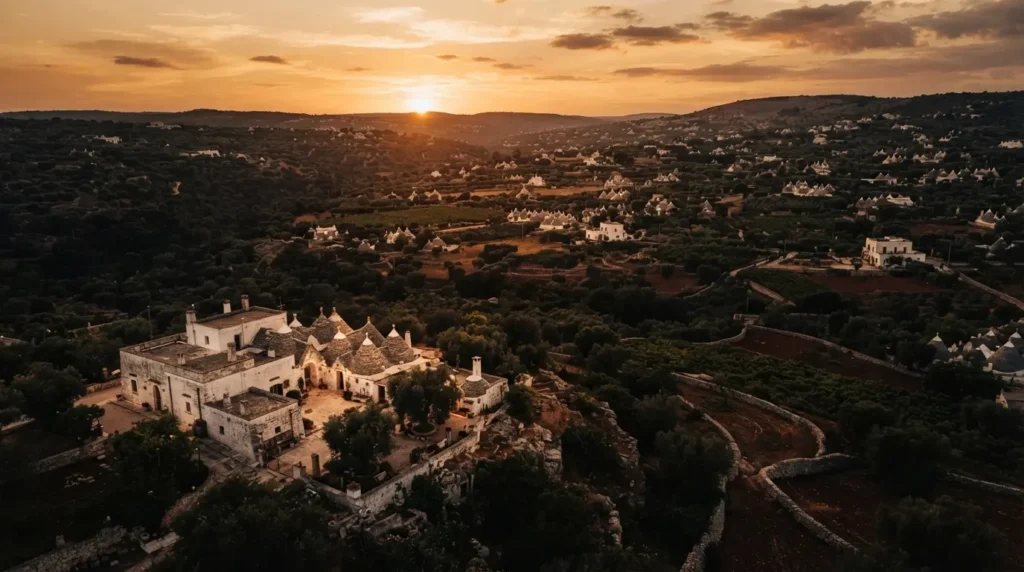
The Valle d’Itria is the area between Bari and Lecce — roughly the triangle between Alberobello, Ostuni and Martina Franca — where the trulli are concentrated and the town character is at its most distinctive. The landscape of olive groves and stone farmhouses broken by the conical rooftops of trulli villages is not available anywhere else in the world. UNESCO listed Alberobello’s trulli in 1996.
Alberobello — the honest version
Alberobello is the trulli town that appears on every poster and that receives the corresponding visitor volume. The trulli here are genuine and extraordinary. The tourist infrastructure that has grown around them — souvenir shops inside trulli, trulli restaurants, trulli hotels — is what it is. Go to Alberobello for the photograph and for the understanding of scale, go early in the morning before the tour coaches arrive from Bari, and then drive fifteen minutes into the surrounding countryside where the same trulli stand in olive groves with nobody else around them.
Ostuni — the white city
Ostuni, on a hill above the coastal plain, is the whitewashed town that the photographs of Puglia are mostly of when they are not of trulli. The historic centre is steep, entirely white and genuinely impressive in the evening light. It functions as a town as well as a landscape — restaurants and wine bars in the old city lanes are serious rather than tourist-adapted. Ostuni works as the base for the Valle d’Itria and the northern Salento coast simultaneously.
Locorotondo and Cisternino
Two kilometres apart in the valley, both have circular historic centres of whitewashed lanes that are less visited than Ostuni and equally beautiful. Locorotondo specifically has a perfectly preserved circular centre of flower-filled balconies and a panoramic terrace looking out over the trulli valley below. The evening aperitivo in Locorotondo’s main square, with the valley lights beginning to appear below, costs less than the same drink in Ostuni’s tourist streets and is better for the view.
Polignano a Mare
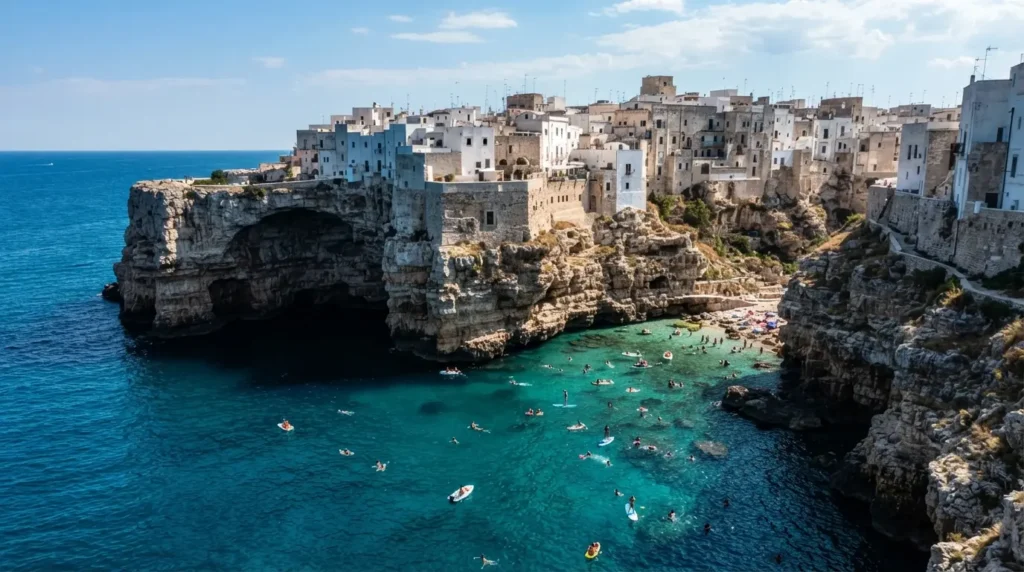
Polignano a Mare, on the Adriatic coast an hour north of Ostuni, is built on limestone cliffs above sea-level coves that are accessed by stairs cut into the rock. The famous photograph — a restaurant terrace cantilevered above the water, tables directly over the sea — is accurate. The gelato in the town’s main bar (Gelateria Mottola) is the best in the region by consistent local consensus. Go for a half-day, swim in the cove at Lama Monachile, eat the gelato, and continue.
What makes Lecce worth two nights?
The Baroque architecture, which is so concentrated and so elaborately executed that the city has been called the Florence of the south — a comparison that undersells it by being a comparison to somewhere else rather than simply describing what it is.
Lecce’s piazze (the Piazza del Duomo and Piazza Sant’Oronzo) and churches (the Basilica di Santa Croce, in particular) are built from lecce stone, a particularly workable local limestone that Baroque architects used for surface decoration of a density that stone usually does not allow. The facades of the churches here are covered in figures, foliage, animals and architectural ornamentation to a depth that makes them look more like ivory carving than building material. Walking through the historic centre in the early evening, when the stone turns gold and the piazze fill with locals, is the Lecce experience that the photographs do not adequately prepare you for.
Lecce also produces the most refined version of Puglia’s Baroque street food — the pasticciotto (a pastry filled with custard and amarena cherries, correct at breakfast), the caffè in ghiaccio (espresso poured over ice, absolutely correct in July), and a version of the orecchiette sauce with particular local variations. A Lecce Baroque walking tour of the historic centre covers the main churches and palazzi with enough architectural history to read what you are looking at.
What should you eat in Puglia?
The list is specific enough to plan meals around.
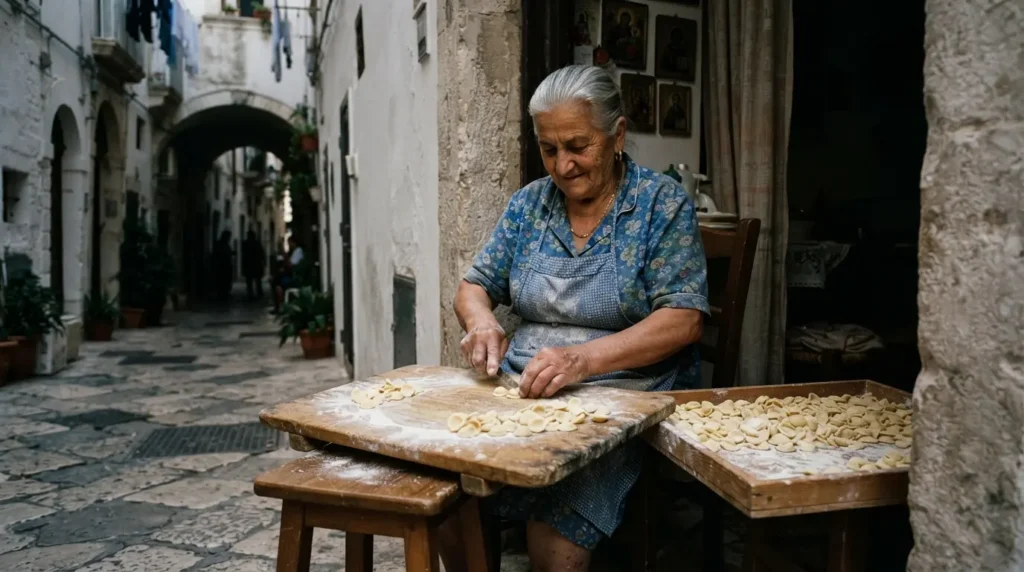
Orecchiette con cime di rapa. Orecchiette — the ear-shaped pasta specific to Puglia, made fresh by hand — served with cime di rapa (turnip greens), anchovies dissolved in olive oil, garlic and chilli. This is the region’s signature dish and is available at its most correct form in Bari’s old city, where women sit at doorways on Via dell’Arco Basso and hand-roll the pasta for restaurants behind them. A Bari street food tour through Bari Vecchia covers the orecchiette makers, the panzerotti and the other essential Bari street stops.
Burrata. The burrata was created in the Gioia del Colle area of Puglia in the early 20th century as a way to use leftover cream from mozzarella production. The correct version — a mozzarella shell filled with stracciatella cream and shreds of fresh curd — is made daily and sold that day. It does not travel well. The burrata available in London or New York is a version of something made to survive transport, not the original. In Puglia, you eat it at room temperature with bread and excellent olive oil, not dressed up with additional ingredients. This is correct.
Focaccia barese. Bari’s focaccia — thick, spongy, made with semolina, covered in cherry tomatoes and olives and olive oil — is available from bakeries throughout the old city for €1–2 per piece. It is the best bread available in the south of Italy and is eaten standing outside the bakery.
Panzerotti. Bari street food: a half-moon of fried dough filled with tomato and mozzarella, sealed and deep-fried to order at the stalls in the old city. €2. Eat two.
Primitivo di Manduria. The Primitivo grape, grown in the Manduria area of the Salento, produces wines of extraordinary body and warmth — full, dark, high-alcohol, suited to the food and the climate. Drink it with the lamb in a Lecce restaurant, not with the burrata.
What is a masseria and is it worth the cost?
A masseria is a fortified farmhouse — the working agricultural buildings of Puglia’s olive and grain farming tradition, built thick-walled and self-contained against the vulnerability of the open plateau. Many have been converted to accommodation, ranging from large resort-style properties (Borgo Egnazia near Fasano is the most celebrated) to intimate six-room family-run farmhouses where breakfast includes everything produced on the property.
Staying in a masseria is the correct Puglia accommodation experience. The large resort maserie cost €250–500 per night and include pools, spa facilities and multiple restaurants. The smaller family maserie run €80–150 per night and include breakfast, a swimming pool carved from the old cisterns, and conversation with the family who built the business from the farm. The smaller ones are better for the experience, though less consistent on the infrastructure. Book direct by email or phone for a 10–15% discount over platform rates; the families respond and negotiate.
What does Puglia cost in 2026?
Significantly less than northern Italy and noticeably less than the Amalfi Coast or Tuscany in peak season. Budget travellers in guesthouses and eating at street stalls and local trattorias manage €50–70 per day. Mid-range travellers in a comfortable hotel with restaurant meals and one or two activities should budget €90–130. A masseria stay pushes the accommodation cost up but keeps the food and activity costs consistent.
Car hire at Bari or Brindisi airport runs €30–60 per day for a standard model — budget for a week. Petrol in southern Italy runs approximately €1.85–2.00 per litre. The A14 toll between Bari and Lecce costs approximately €5.
You can plan your Puglia itinerary on PlacesToday and build the route around the Valle d’Itria, Lecce and the coast. For how Puglia fits into a broader Italian trip alongside Rome and Tuscany, our Rome guide and Tuscany guide cover the northern counterparts.
When is the best time to visit Puglia?
September and October. The sea is still warm enough to swim (24–26°C in September), the olive harvest begins in October and fills the countryside with activity, the summer crowds on the coastal towns have cleared, and hotel prices are 20–30% below the July–August peak. The light on the limestone towns in September and October is the light that the photographs of Puglia are trying to show.
May and June are the spring equivalent. The wildflowers are out across the limestone plateau, the sea is warming but not yet at summer temperature, and the tourist infrastructure is open without the summer density.
July and August are hot — Puglia regularly reaches 35–38°C inland in these months — and the coastal towns are at their busiest. Polignano a Mare and Ostuni operate at maximum capacity. Lecce, being more inland, is more bearable. The masserie benefit from the heat less obviously than the coast towns.
Frequently asked questions
Q: Is Puglia better than Tuscany?
A: For food and value, yes — Puglia’s food culture is deeper and more specific, the prices are 30–50% lower, and the region has not yet reached the tourist saturation of Tuscany. For art, wine heritage and landscape variety, Tuscany still leads. Most people who have been to both say Puglia is the more surprising and the more generous trip. Our Tuscany guide covers the choice in detail.
Q: How long do you need in Puglia?
A: Seven to ten days for a first trip covering the Valle d’Itria, Lecce and the Salento. Five days works if you are focused on the Valle d’Itria and Lecce only. Anything under four days reduces to a city visit without the countryside and coastline that define the region.
Q: Is Alberobello worth visiting in 2026?
A: Yes — the UNESCO-listed trulli are genuinely extraordinary. The tourism around them in the town centre is significant in peak season. Go early in the morning, spend two hours in the town, and then drive into the surrounding valley where the same trulli sit in olive groves without the souvenir infrastructure. The town is the entry point; the countryside is the experience.
Q: What is the best Puglian wine?
A: Primitivo di Manduria — full-bodied, dark, high in alcohol, specific to the Manduria zone of the Salento. Drunk with grilled lamb or aged cheeses. Negroamaro is the other important grape of the region — lighter than Primitivo, particularly good as a rosé (rosato) in summer. Both are significantly underpriced relative to Tuscan wines of equivalent quality.
Q: What makes Puglian burrata different from burrata sold elsewhere?
A: Freshness and the cream. Burrata made in Puglia — particularly in the Gioia del Colle area where it originated — is produced daily and sold the same day, because the cream filling (stracciatella) does not hold its quality for more than twenty-four hours. The versions exported to other countries are adapted to survive transport. In Puglia, you eat it the day it was made, at room temperature, with bread. This is a different experience.
Puglia rewards the traveller who arrives with a car, a week, and the correct expectations: this is not a city holiday, not a beach resort, and not a museum circuit. It is an agricultural region with extraordinary food, distinctive architecture and a pace that adjusts your idea of what a day in Italy should contain. September, a masseria, the orecchiette in Bari, the burrata somewhere in the Valle d’Itria, and the light on Ostuni at dusk. That is the trip. Plan your Puglia itinerary on PlacesToday →