Vienna in 2026 is one of Europe’s most culturally concentrated cities and, if you approach it correctly, considerably more affordable than its reputation suggests. The Vienna State Opera sells standing tickets (Stehplatz) for €4 to €10 per performance — the same programme, the same orchestra, the same acoustic, as the €200 seat forty rows back. The coffee houses are UNESCO Intangible Cultural Heritage and allow you to sit with a single Melange for as long as you require without being asked to leave. The Kunsthistorisches Museum contains one of the finest collections of Old Master painting in Europe and charges €21. September is the correct month: the opera season begins, the Prater turns autumn colours, and the young wine arrives at the Heuriger taverns on the city’s edge.
Vienna runs with a precision that other European capitals claim and do not achieve. The trams are on time. The museums open and close when they say they will. The coffee arrives at the correct temperature. The city was built, street by street, as a statement of Habsburg imperial ambition — the Ringstrasse, the ceremonial boulevard that replaced the old city walls in the 1860s under Emperor Franz Joseph I, is flanked by the Opera, the Parliament, the Kunsthistorisches Museum, the Rathaus and the Burgtheater, all constructed in different historical styles within the same decade as a deliberate demonstration of cultural comprehensiveness.
The result of this exercise in imperial architecture is a city centre that functions simultaneously as one of Europe’s great open-air museums and one of its most liveable cities. The Viennese use the Ringstrasse as a commuter route. The Opera is an institution they attend regularly rather than reverently. The coffee houses are offices as much as cultural monuments. Vienna does not perform its own significance in the way that some cities do. It simply expects you to understand it.
How much does Vienna cost in 2026?
More than Prague, less than Zurich, comparable to Copenhagen with slightly more affordable accommodation.
| Travel style | Daily cost | What it includes |
|---|---|---|
| Budget | €60–100 | Hostel or budget hotel, self-catering or Naschmarkt food, public transport, standing opera ticket |
| Mid-range | €150–250 | Three-star hotel (€90–140/night), restaurant meals, museum entries, concert or opera seat |
| Comfortable | €300–500+ | Four-star hotel, fine dining, seated opera, private tours |
The two decisions that most significantly reduce Vienna costs: standing at the State Opera instead of sitting (saves €150–190 per performance at equivalent productions), and eating at the Naschmarkt and the Würstelstand street sausage stalls rather than at restaurant tables. Both produce better experiences in their category than the expensive alternatives, which makes the financial case and the cultural case align unusually well.
The Vienna City Card (€17 for 24 hours, €25 for 48 hours, €29 for 72 hours) covers all public transport within the city and provides museum discounts. It breaks even on day one if you use the metro more than three times and visit a single museum. Most visitors do both.
What makes Vienna worth visiting in autumn specifically?
September marks the opening of the Vienna opera, ballet and concert season, which runs through June. The Vienna Philharmonic, the Vienna Symphony Orchestra, the Vienna State Ballet, the Burgtheater — all begin their new programmes in September, which means the standing ticket option applies immediately. The Prater, the large park that contains the 1897 Riesenrad (giant Ferris wheel), turns autumn colours in October and November in a way that the same park does not replicate in any other season.
The Heuriger wine taverns on the northern hills of the city — in Grinzing, Heiligenstadt, Nussdorf and Sievering — serve Sturm (young, slightly fermenting new wine, available only from September into November) alongside cold buffets of bread, cheese, pickled vegetables and schmalz. This is the Viennese autumn experience that the tourist circuit does not manufacture because it cannot: the new wine is available when it is available, and the Heuriger identified by a green Buschen (pine branch) above the door is the one that is currently serving it.
The Christmas market season, if that is the purpose, runs from approximately late November to December 24 across multiple squares in the city — the Rathausplatz market is the largest and most atmospheric, the Schönbrunn market is the most visited by international tourists, and the Spittelberg market in the seventh district is the most local and least crowded.
What should you do in Vienna?
Four things earn their place on any honest Vienna itinerary. The rest is supplementary.
The State Opera — standing tickets
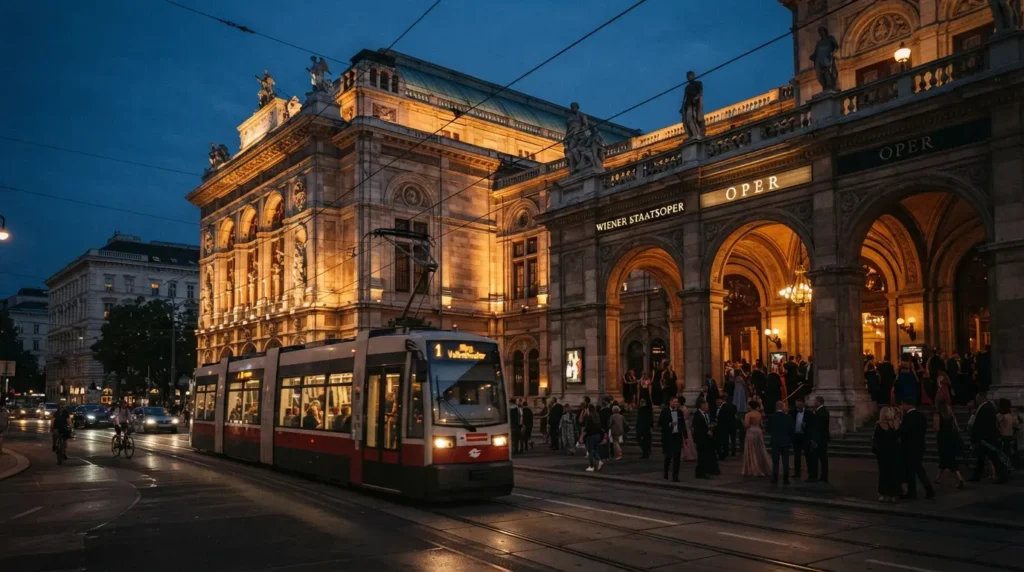
The Stehplatz (standing place) system at the Vienna State Opera is one of the genuine bargains of European cultural life. Standing tickets (€4–10 depending on the performance) go on sale online 80 days in advance and at the box office on the day of performance from 3pm. The standing areas — at the back of the stalls, the sides of the galleries — have handrails to lean against and, for a two-and-a-half-hour opera with one interval, are entirely manageable for most visitors. The acoustics of the building do not vary by ticket price. The experience of standing in the Vienna State Opera for a Wagner or a Strauss is the Vienna experience that the coffee house guides miss entirely.
Book through the official Vienna State Opera website (wiener-staatsoper.at). The full calendar is published in advance for the season. Dress code: evening wear is welcomed; ordinary clean clothes are perfectly acceptable. The Austrians do not turn anyone away for insufficient formality.
A Vienna highlights walking tour including the Opera and Ringstrasse covers the architectural context of the boulevard and its buildings in two hours — useful before attending a performance, since the 1860s building programme that produced the Opera is the same programme that produced the Parliament, the Kunsthistorisches and the Burgtheater within the same decade.
The Kunsthistorisches Museum
The Kunsthistorisches Museum — the museum of the history of art, built by Franz Joseph I to house the Habsburg imperial collections — contains Bruegel’s entire surviving body of work in one room; the world’s largest Cellini salt cellar; rooms of Rubens, Titian, Caravaggio, Raphael and Vermeer; and the Egyptian and Near Eastern collections in the wings. Entry is €21. Allow a full morning; attempting the whole museum in two hours produces a blur rather than an experience. The Bruegel room on the first floor is the reason to go specifically rather than as one room among many.
Schönbrunn Palace
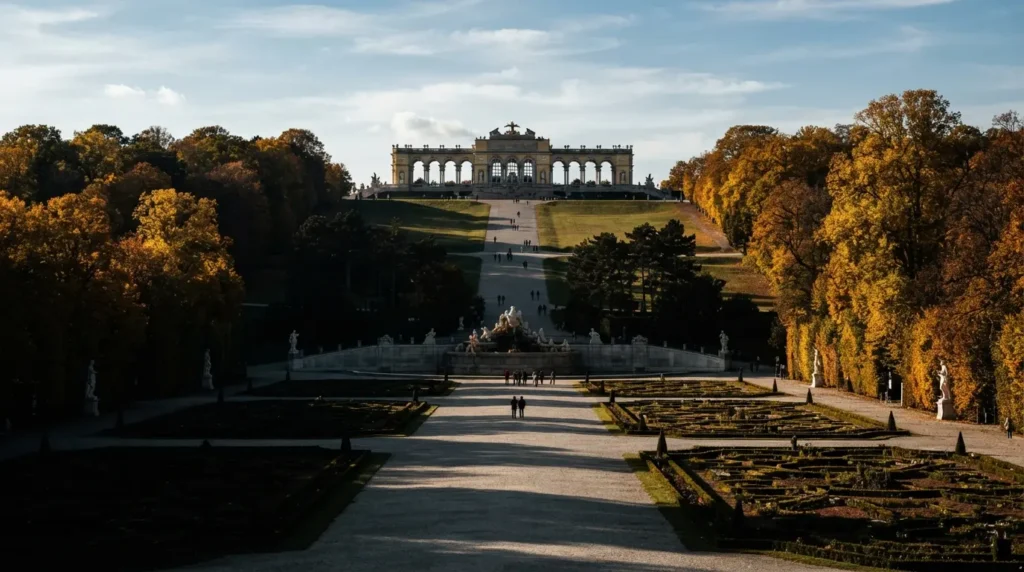
Schönbrunn, the Habsburg summer palace southwest of the centre, is accessible by metro (U4, Schönbrunn station) and is either a two-hour or a half-day visit depending on which ticket you choose. The Imperial Tour (€30, 40 rooms) covers the most significant state rooms. The Grand Tour (€38, 66 rooms) covers the complete interior. The Gloriette — the colonnade on the hill above the palace, reached by a fifteen-minute walk through the formal gardens — provides the panoramic Vienna view that the interior does not. The gardens are free. The palace interiors are not.
The Belvedere
The Upper Belvedere contains Klimt’s The Kiss — the painting that appears on postcards and tote bags throughout the city, and that in the original is larger and more luminous than any reproduction suggests. Entry is €18. It also contains the most coherent single-building survey of Viennese Secessionist art available anywhere. The Lower Belvedere has temporary exhibitions; the Baroque Museum within it is included in some ticket combinations. The formal gardens between the two palaces are free and worth an hour at any time of year.
The coffee house culture and why it matters
The Viennese coffee house is not primarily a café. It is an institution that for two centuries functioned as the sitting room, office, reading room, chess hall and social club of the Viennese middle class simultaneously — and that continues to do so, formally or informally, for residents who regard it as part of the ordinary week rather than a heritage experience. The tradition was inscribed on UNESCO’s Intangible Cultural Heritage list in 2011.
The correct coffee house order: a Melange (espresso with steamed and frothed milk, similar to a cappuccino but distinctively Viennese in its balance), served on a small silver tray with a glass of water and a biscuit, alongside a newspaper or a chess set if you ask for one. You are not expected to leave promptly. You are not expected to order more than the one coffee. The waiter will refill your water glass without charge. These are the operational parameters of an institution that is the correct opposite of a coffee chain.
Café Central (Herrengasse) is the most famous and the most tourist-facing; it has been restored to its original 1876 grandeur and is worth one visit to understand the scale of what these institutions were at their peak. Café Hawelka (Dorotheergasse, closed Tuesdays) is smaller, darker, still frequented by artists and writers, and has been run by the same family since 1939. Café Landtmann (Dr-Karl-Lueger-Ring, opposite the Burgtheater) is where the politicians, lawyers and academics go — it has been doing exactly this since 1873 and shows no signs of reconsidering.
What is the Naschmarkt?
The Naschmarkt, running along the Wienzeile from Karlsplatz for approximately one kilometre, is Vienna’s main outdoor market — open Tuesday through Saturday — and produces the best morning in the city for food. The market divides between fresh produce stalls (cheese, meat, fish, fruit, spices, olives from Turkish and Middle Eastern vendors who constitute a significant part of the stall-holder population) and the Heurigen-style wine bars and sit-down cafés at the far end. Saturday morning is the fullest version, when the antiques and flea market extends from the eastern end.
Eat at the market: a Würstel (Viennese sausage) from a stand costs €2–4; a serving of Graved lax from a fishmonger costs €5–8; a breakfast of bread, cheese and coffee at one of the market cafés costs €6–10. This is the budget version of Vienna’s food culture and it is genuinely excellent rather than merely adequate.
What should you eat in Vienna?
Five things that are specific to Vienna rather than generally Central European.
Wiener Schnitzel — veal escalope pounded thin, breaded and shallow-fried, served with a lemon wedge and typically a potato or cucumber salad. The correct version is veal; the cheaper version (often labelled Schnitzel Wiener Art) is pork. The difference is significant and the menu labelling is legally required to reflect it. Order it at a restaurant in the seventh or ninth district rather than on the Ringstrasse terrace, where it arrives at tourist-price with tourist-crowd.
Tafelspitz — boiled beef rump in a clear broth, served with chive sauce and apple horseradish, historically the favourite dish of Emperor Franz Joseph I. It is a lighter and more delicate dish than its description suggests and is the thing to order at a mid-range Viennese restaurant when the schnitzel already appears on three consecutive menus.
Sachertorte — the dense chocolate cake with apricot jam and chocolate glaze that was invented at the Hotel Sacher in 1832. Hotel Sacher and Café Demel fought a legal case over the right to call their version the “Original Sachertorte.” Both claim to have won. The Hotel Sacher version costs €8.90 per slice and is served with unsweetened whipped cream. It is correct that the cream is unsweetened; this is not an error.
Apfelstrudel — apple, raisin and cinnamon wrapped in stretched pastry dough and served warm with vanilla sauce or cream. Available everywhere and of variable quality; the better versions come from the bakeries in the market halls and the coffee houses.
Sturm — at the Heuriger in autumn, the partially fermented new wine that is cloudy, slightly sweet and considerably lower in alcohol than the finished product. Available only September to November when the grape harvest is in.
The Heuriger — Vienna’s wine taverns
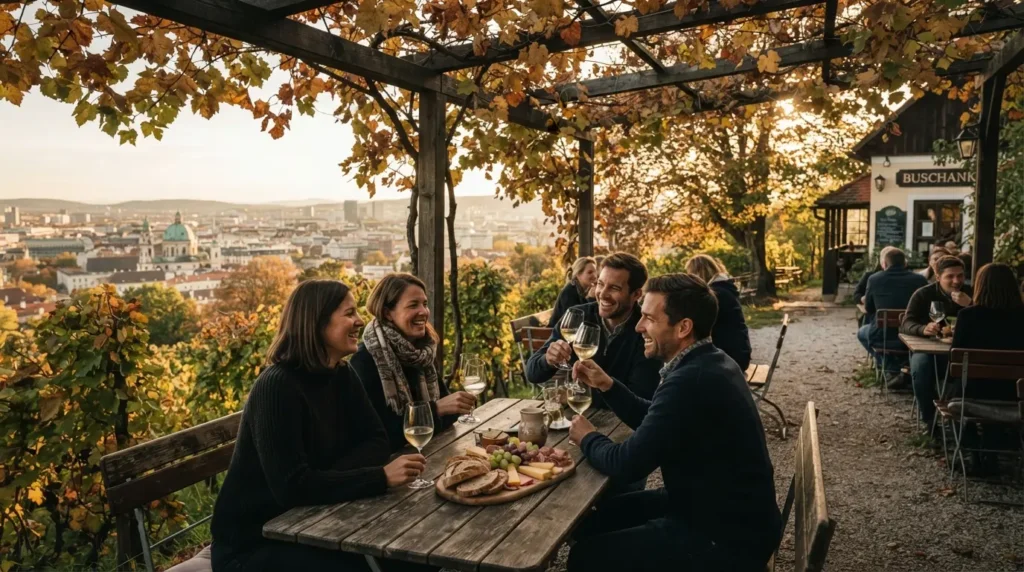
The Heuriger is a wine tavern on the outskirts of Vienna, in the wine-producing villages of Grinzing, Nussdorf, Heiligenstadt and Sievering on the northern hillsides above the city — accessible by tram and U-Bahn — where the wine producer serves their own new wine directly to the public alongside a cold buffet. The establishments are identifiable by a green pine branch (Buschen) above the door when they are currently serving; a tavern without the branch is closed. They are seasonal institutions, typically open spring through autumn, with reduced schedules in winter.
The experience: a table in a garden or courtyard, a litre of new wine (Sturm in autumn, white Grüner Veltliner or Riesling from the Wachau or the Vienna Hills the rest of the year), a plate from the cold buffet (bread, schmalz, pickles, lard-based spreads, various cheeses), and the particular relaxation of a city that takes its own leisure seriously. The wine costs €3–6 per quarter-litre. The buffet is pay-by-weight or by item. Two hours is the minimum to do it properly.
A Vienna wine evening and Heuriger experience includes transport to one of the hillside Heuriger, a guided tasting of Viennese wines and the cold buffet in the garden — the correct introduction before independent visits.
When is the best time to visit Vienna?
September to November for the opera season, autumn Prater colours, and Sturm at the Heuriger. December for the Christmas markets, which are among the best in Europe: the Rathausplatz market is the largest; the Schönbrunn market is the most photogenic; the Spittelberg market in the seventh district is the most local. January and February are quiet, cold and considerably cheaper than summer — the museums are uncrowded and the coffee houses are at their most characteristic with people sheltering from the cold outside.
July and August are the peak tourist months, with the highest hotel prices and the most visitors. The opera takes a summer break; the Wiener Philharmoniker concerts are reduced. Summer is not Vienna at its best by any cultural measure, though the outdoor programme (the Filmfestival on Rathausplatz shows opera and concert films for free in July and August) provides some compensation.
Vienna connects naturally to Prague — a four-hour bus or train ride east — as a Central European pair. Our Prague guide covers the other side of that combination. Plan your Vienna trip on PlacesToday →
Frequently asked questions
Q: How much does a standing ticket to the Vienna State Opera cost?
A: €4–10 depending on the performance. Stehplatz (standing tickets) go on sale at the box office from 3pm on the day of performance and online 80 days in advance. The standing areas — rear stalls and gallery sides — have handrails. The performance is the same as the performance seen from the €150–200 seats. This is one of the best cultural value propositions in Europe.
Q: Is Vienna expensive in 2026?
A: Mid-range, by Western European standards. A comfortable hotel runs €90–140 per night. Restaurant meals cost €15–30 per person. Museum entries run €16–21. The standing opera ticket and the coffee house sitting culture both provide exceptional cultural access at low cost, and the Naschmarkt and Würstelstand sausage stands keep food costs manageable. A realistic mid-range daily budget is €150–250.
Q: When is the best time to visit Vienna?
A: September to November — the opera and concert season begins in September, the Prater colours turn in October, and the Heuriger serve Sturm (new wine) from September through November. December for Christmas markets. January and February are the cheapest months and have uncrowded museums and very characteristic coffee house weather.
Q: What is the correct way to order in a Viennese coffee house?
A: A Melange — espresso with steamed and lightly frothed milk — on a small silver tray with a glass of water. Sit. Read the newspaper. Do not feel obligated to leave within a normal café timeframe. The waiter will refill your water glass. Order a second coffee if you want one; do not feel you must.
Q: What is a Heuriger and how do you find an open one?
A: A Heuriger is a wine tavern on the hillsides north and west of Vienna where the wine producer serves their own wine alongside a cold buffet. Open establishments are identified by a green pine branch (Buschen) above the door. They are primarily in Grinzing, Nussdorf, Heiligenstadt and Sievering — accessible by public transport on the U4 and various tram routes. Autumn (September to November) is when Sturm — the partially fermented new wine — is available.
Vienna is a city that rewards the visitor who takes it at its own pace — which is not slow, exactly, but deliberate. The coffee house requires an hour minimum. The Kunsthistorisches Museum requires a morning. The State Opera requires an evening, a standing ticket, and the willingness to stand in the world’s greatest opera house for €4 and consider it normal. Which it is. Plan your Vienna trip on PlacesToday →