Vietnam in 2026 is genuinely one of the best-value, most varied trips available in Southeast Asia — and it is getting busier every month. The country welcomed 12.3 million international visitors in the first six months of 2026 alone, up 14.9% on the same period last year (Vietnam National Authority of Tourism, VNAT). Hoi An is beautiful and crowded. Ha Long Bay is extraordinary and requires choosing the right operator carefully. Hanoi is excellent and slightly chaotic. Ha Giang, Phong Nha and Ninh Binh are genuinely magnificent and not yet crowded. Go now, choose carefully, and this is one of the better decisions you will make.
Vietnam has been “about to get too popular” for approximately fifteen years. It is now, in 2026, actually getting there — but not uniformly, and not irreversibly. The tourist infrastructure in the famous spots has kept pace with demand in ways that Thailand’s islands never quite managed at the equivalent moment. The food has not been diluted to accommodate international palates in the way that Bali’s has. And the parts of the country that sit outside the standard itinerary — the northern mountain loop, the cave systems in Quang Binh province, the quiet delta towns of the Mekong — are still running at a pace that makes the famous spots look frantic.
Vietnam overtook Thailand as the top destination for Chinese tourists in 2025, with 5.3 million Chinese arrivals versus Thailand’s 4.5 million (VNAT). European arrivals grew more than 50% year-on-year in the first four months of 2026. The French newspaper Le Parisien described Vietnam as “the star of Asian destinations,” citing Hanoi, Ha Long Bay and Hoi An specifically. All three remain worth visiting. All three require more planning than they did three years ago.
Is Vietnam worth visiting in 2026?
Yes — for the food, the landscape variety, the cost-to-quality ratio, and the sense that there is still a version of the country that exists beyond the landmarks. Go with honest expectations about the famous spots and a plan to spend at least three days somewhere that is not on the standard circuit, and Vietnam delivers on most of what people say about it.
The honest caveat: Hoi An in January, Ha Long Bay in the cheapest bracket of tour boats, and the most-photographed streets of Hanoi’s Old Quarter at noon on a Saturday — these are all still beautiful and all significantly more crowded than the photographs suggest. The solution is not to avoid them but to time them, choose the right operator, and arrive before nine in the morning.
Which Vietnamese city should you visit first?
| Hanoi | Ho Chi Minh City | Hoi An | Da Nang | |
|---|---|---|---|---|
| Best for | History, street food, north gateway | Energy, food, south gateway | Heritage, lanterns, tailors | Beach, transit hub, affordability |
| Pace | Busy, chaotic, manageable | Very fast, dense | Gentler, tourist-heavy | Relaxed, functional |
| Days needed | 2–3 | 2–3 | 2–3 | 1–2 |
| Crowds 2026 | High in Old Quarter | High in Bui Vien, markets | Very high in centre | Moderate |
| Food quality | Exceptional | Excellent, different style | Good, tourist-adapted | Good |
| Best season | Oct–April | Year-round | Feb–July | May–Sept |
Sources: vietnam.travel (VNAT); travelandtourworld.com 2026 arrival data; micetraveladvisor.com
Most first-time visitors fly into either Hanoi or Ho Chi Minh City, spend two to three days in the city, then travel the country between them. Hanoi for the north: Old Quarter, street food, day trip to Ninh Binh, gateway to Ha Long Bay and Ha Giang. Ho Chi Minh City for the south: Mekong Delta, Cu Chi Tunnels, the French colonial architecture and the food. Hoi An sits in the middle on the central coast and deserves two nights minimum if you are moving between north and south — it is not a day trip destination, despite being treated as one by roughly half the people who visit it.

What makes Hanoi worth two or three days?
The Old Quarter is the obvious starting point and worth every cliché written about it — thirty-six streets named for the goods historically sold there, a density of temples, pagodas and French colonial buildings in various states of elegant decay, and a street food scene that operates from six in the morning until considerably later than you should be awake. The crowds are real and worth planning around. The streets around Hoan Kiem Lake at weekend evenings when they are pedestrianised are genuinely atmospheric rather than simply crowded.
The food specifically
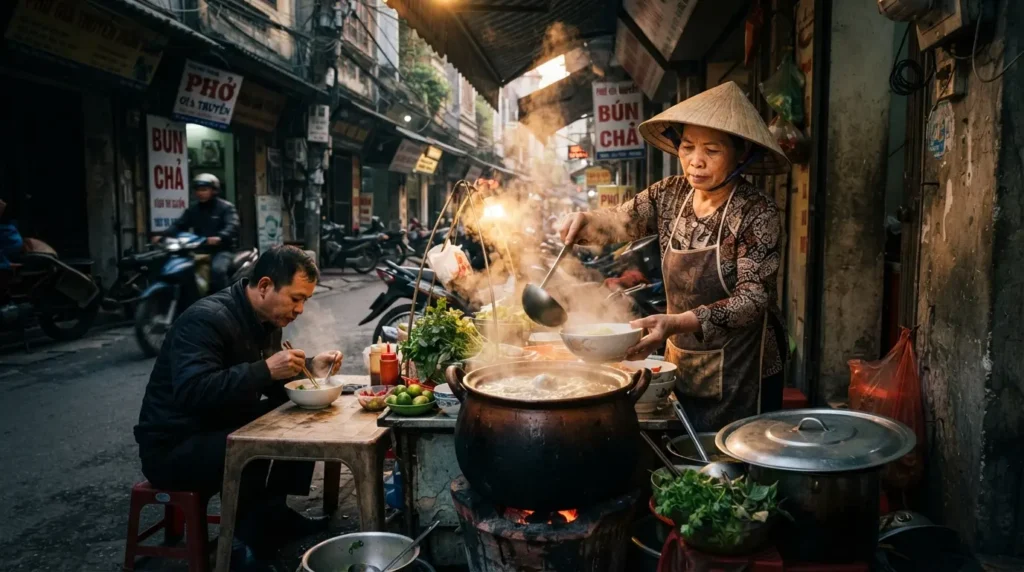
Hanoi’s food is different from southern Vietnamese food in ways that matter and reward paying attention. Pho here is the northern version — cleaner, more direct, less sweet than the southern style, served with fewer accompaniments because the broth is considered sufficient. Bun cha — grilled pork patties and belly with cold rice noodles and a sweet fish sauce broth — is specific to Hanoi. Cha ca La Vong, a turmeric-marinated fish dish cooked at your table on a small brazier, has been served in the same restaurant in the Old Quarter since the 19th century. Banh mi here is not quite the same as in the south. Egg coffee — Vietnamese coffee mixed with egg yolk beaten with condensed milk — is either extraordinary or perplexing depending on your position on sweet coffee, but it is specifically Hanoian and worth trying once.
A Hanoi street food walking tour through the Old Quarter connects the food geography in two or three hours and covers more ground than independent exploration on a first day. Do it early — morning is when the street kitchens are at their best.
What is actually happening in Hoi An in 2026?
Hoi An is beautiful. The lanterns are real, the tailors are genuinely skilled, and the yellow-plastered old town is one of the most complete examples of a Southeast Asian trading port anywhere in the region. It is also, on a warm evening in peak season, a walking queue for the same photograph.
The solution — because the solution exists — is the same one that works in any heritage town with this problem. The lanterns photograph best at dusk, before the tourist restaurants fill and the evening tour groups arrive. The old town is navigable at seven in the morning before most of it wakes up. The cooking classes in the surrounding countryside — away from the old town centre — are genuinely good and remove you from the congestion entirely. A Hoi An cooking class and market tour picks you up from the old town and takes you out of it — which is, honestly, the most useful thing it does.
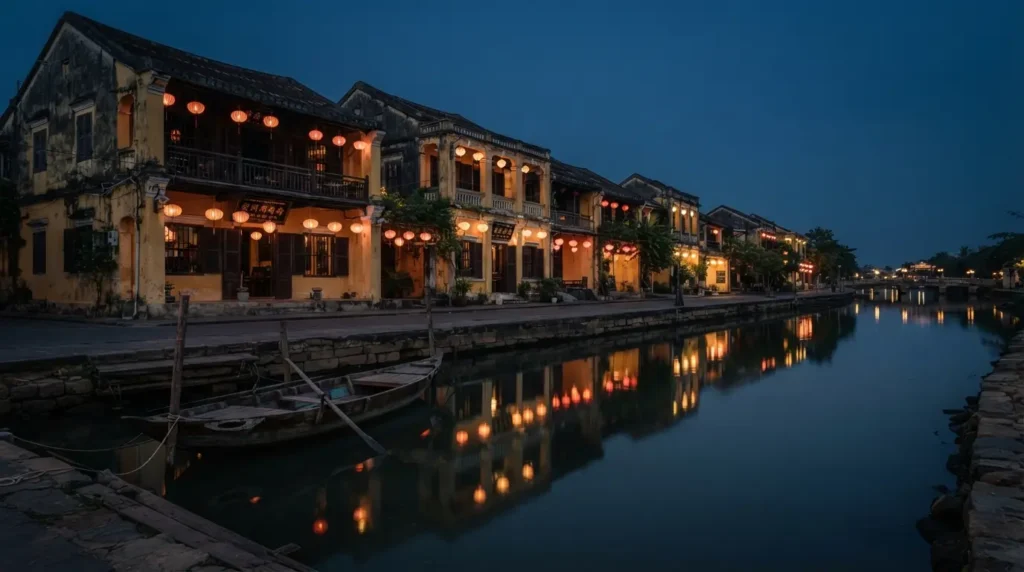
The beaches at An Bang and Cua Dai, a short bike ride from the old town, are the right place to spend the middle of the day. They are wide, mostly uncrowded outside the main season, and serve the grilled seafood and cold beer that the old town restaurants charge twice the price for.
Which parts of Vietnam are still genuinely undiscovered?
Three regions, all accessible, all still running at a pace that the central coast lost sometime around 2022.
Ha Giang Loop — the north’s most dramatic landscape
Ha Giang province in the far north, bordering China, is the Vietnam that most visitors do not reach. The loop road through the Dong Van Karst Plateau Geopark — a UNESCO-listed landscape of limestone mountains, terraced rice fields and minority village markets — takes three to four days by motorbike or on a rented semi-automatic scooter and covers some of the most dramatic mountain scenery in Southeast Asia. The minority communities here — Hmong, Dao, Tay — have a cultural authenticity that the more-visited hill tribe areas of northern Thailand have largely lost.
It is not a comfortable trip. The roads are steep, the accommodation is basic in places, and the elevation makes it cold at night even in summer. It is also one of those journeys that experienced Southeast Asia travellers consistently describe as a trip highlight they did not expect.
Phong Nha — caves on a scale that recalibrates your sense of what caves are
Phong Nha-Ke Bang National Park in Quang Binh province contains Son Doong, the largest cave in the world by volume — a passage so large it has its own weather system, including clouds and jungle. Son Doong tours are limited to 1,000 visitors per year and cost approximately $3,000 per person, which keeps them genuinely exclusive. The surrounding caves — Paradise Cave, Phong Nha Cave, Tu Lan — are accessible at a fraction of the cost and are extraordinary in their own right. The town of Phong Nha itself is small, inexpensive and genuinely pleasant.
Ninh Binh — Ha Long Bay on land
Two hours south of Hanoi, Ninh Binh’s karst landscape rises from flooded rice paddies rather than the sea. The boat trip through Tam Coc — limestone peaks, rice fields, river, cave passages — gives you a version of the Ha Long Bay aesthetic that is cheaper, less crowded, and navigable by bicycle between the main sights. Most visitors do it as a day trip from Hanoi. Staying overnight lets you see it at dawn and dusk rather than in the middle of the day when every tour group arrives simultaneously.
What is the best time to visit Vietnam in 2026?
Vietnam has different weather patterns in the north, centre and south, which means there is no single best month for the whole country.
The north (Hanoi, Ha Long Bay, Ha Giang) is best from October to April — cooler and mostly dry, with Ha Giang at its most spectacular in September and October when the rice terraces are golden before harvest. The central coast (Hoi An, Da Nang, Hue) is best from February to July — dry and warm, with the October to January period bringing heavy rain and the occasional typhoon. The south (Ho Chi Minh City, Mekong Delta, Phu Quoc) is best from December to April during the dry season.
This structure means a well-planned Vietnam itinerary from north to south works best from November through April, covering the country as the dry season moves with you. It also means that July — right now — is a reasonable time to visit the south and the beaches of Phu Quoc, while the central coast is at full summer heat and the north is entering its rainy period. Plan accordingly rather than against the season.
How much does Vietnam cost in 2026?
Less than Thailand in most categories and significantly less than Bali. A budget traveller staying in hostels and eating street food can manage $25–40 per day. A mid-range traveller in a comfortable hotel with restaurant meals and activities should budget $60–100. A day in Hanoi eating street food three times costs less than a single restaurant meal in Bangkok’s tourist district.
The significant cost items are the Ha Long Bay cruise (from $80 for a one-night boat tour on a decent operator to $200+ for a two-night premium cruise), the Ha Giang Loop if you hire a driver guide (around $120–150 for three days), and domestic flights if you are covering north to south (typically $30–80 on Vietnam Airlines or VietJet depending on timing). Everything else — transport, accommodation, food, local tours — is priced at a level that most Southeast Asia budgets handle comfortably.
A Ha Long Bay overnight cruise on a mid-range operator runs $90–150 per person for two days and one night including all meals. Book a reputable operator — the cheapest boat tours cut corners on food, safety equipment and guide quality in ways that become obvious once you are on the water.
Frequently asked questions
Q: Is Vietnam worth visiting in 2026? A: Yes — it remains one of the best-value, most varied trips available in Southeast Asia. Vietnam welcomed 12.3 million international visitors in the first half of 2026, up 14.9% year-on-year (VNAT), which tells you something about demand. The key is choosing the right parts and timing them correctly. The famous spots are getting busier; the less-visited north and the cave systems of Phong Nha are still genuinely underpressured.
Q: Is Vietnam cheaper than Thailand in 2026?
A: Yes, in most categories. Street food and local transport are cheaper in Vietnam’s cities than in Bangkok or Chiang Mai. Accommodation at the budget end is comparable; at the mid-range level Vietnam is slightly cheaper. The beach islands of Phu Quoc have risen in price and now approach Thai island resort pricing, but the mainland cities and rural areas remain excellent value. Budget travellers can manage $25–40 per day; mid-range travellers should expect $60–100.
Q: What is the best itinerary for two weeks in Vietnam in 2026?
A: Hanoi (three nights) — Ninh Binh day trip — Ha Long Bay overnight cruise — fly to Da Nang — Hoi An (two nights) — Hue day trip — fly to Ho Chi Minh City (two nights) — Mekong Delta day trip. That is twelve days covering the main corridor. Add Ha Giang at the start or Phu Quoc at the end for longer trips. Skip Sapa in the peak summer months; Ha Giang is the stronger northern mountain option in 2026.
Q: Is Ha Long Bay worth visiting in 2026?
A: Yes, but choose your operator carefully. The bay itself is extraordinary — 1,969 limestone islands, the UNESCO listing is deserved. The cheapest overnight boat tours cut corners on food and guide quality in ways you notice immediately. A mid-range two-day cruise from a reputable operator costs $90–150 per person and delivers a significantly better experience. Book through a registered tour operator or a reliable platform rather than from the street in Hanoi.
Q: Which is better — Hanoi or Ho Chi Minh City?
A: Different cities, genuinely. Hanoi is older, calmer, more northern in character — cooler weather, stronger French-era architecture, the best pho. Ho Chi Minh City is faster, more southern, with a different food register, the Vietnamese-French hybrid buildings, and an energy that does not slow down. See both if you have the time; start with Hanoi if you are entering from the north, Ho Chi Minh City if flying from Australia or SE Asia. See our Thailand travel guide for how to combine both countries on a longer Southeast Asia trip.
Vietnam in 2026 is better than the growing crowds suggest, and the parts of it that remain genuinely quiet are some of the best travel experiences available in Asia right now. The standard circuit — Hanoi, Ha Long Bay, Hoi An, Ho Chi Minh City — is crowded and still worth doing. The parts that sit outside it — Ha Giang, Phong Nha, Ninh Binh, the Mekong Delta properly — are not yet on the postcard but are on the trajectory to get there. Go before the trajectory completes. Build your Vietnam itinerary on PlacesToday →