Dubai is worth visiting in 2026 — but not quite for the reasons most visitors go. The Burj Khalifa is genuinely impressive. The indoor ski slope is exactly what it sounds like. The city’s real character, the one that makes a week there worthwhile, exists in Al Fahidi’s wind-tower buildings and the basement restaurants of Deira, where 90% of the population is South Asian and the biryani is better than most of what you will find in London. November to March is the right window: temperatures between 20 and 30°C, functional outdoor life, and everything open. Avoid July and August unless the 43°C heat is a feature rather than a problem.
Dubai is not one city. The version on Instagram — artificial islands, record-breaking skyline, brunch at altitude — is real and accessible and tells you something true about what the city has chosen to build. The version that exists in the old districts, in the Deira souks, in the Indian, Pakistani, Bangladeshi and Sri Lankan restaurants that have shaped the city’s food culture since the 1970s — this is the city that the photographs do not reach. Both versions are available to anyone who visits. Most visitors only find one of them.
Dubai welcomed over 17 million international visitors in 2025, with growth continuing into 2026 across every key month (Dubai Department of Economy and Tourism, December 2025 data). It is one of the world’s most visited cities by choice rather than necessity — people come specifically to be here, which is a meaningfully different statement than it was twenty years ago. The infrastructure has kept pace with demand in ways that most cities at this visitor volume cannot claim. What has not kept pace, for many first-time visitors, is the understanding of what the city actually contains.
When is the best time to visit Dubai in 2026?
The honest answer is more specific than most guides state. November to March is broadly correct but disguises significant variation within those months.
| Month | Temperature | Price vs peak | Crowds | Notes |
|---|---|---|---|---|
| November | 25–30°C | Moderate, rising | Building | Good outdoor conditions, less crowded than December |
| December | 20–26°C | Peak (+80–150%) | Maximum | Shopping Festival; NYE is the most expensive night of the year |
| January | 19–24°C | Peak | High | Shopping Festival ends late Jan; DSF discounts deepen mid-month |
| February | 20–25°C | Moderate | Lower | Best balance of weather, price, crowds; Ramadan 2026 from Feb 18 |
| March | 22–28°C | 20–30% below Dec | Moderate | Sea still warm (28–29°C); Ramadan continues to March 19 |
| April | 26–33°C | 20–40% below peak | Low–moderate | Last comfortable beach month; prices reasonable |
| May–September | 37–45°C | 40–60% below peak | Low | Genuinely very hot; indoor-focused trip only |
| October | 30–36°C | 20–40% below peak | Low | Shoulder value; still hot but cooling toward month end |
Sources: simbye.com 2026 weather data; dubaispots.com seasonal price analysis; mychoicetourism.com
March is the answer that most guides understate. The sea temperature in March is still 28–29°C from the summer warming, the air is warm without being oppressive, and prices have eased from the December and January peak. Ramadan in 2026 runs approximately February 18 to March 19 — which affects daytime restaurant hours and outdoor eating but comes with a 20–40% hotel discount and evening Iftar buffets that are among the most genuinely interesting cultural experiences available in the city. Experienced Middle East travellers specifically time Dubai visits to coincide with Ramadan evenings.
Is Dubai actually worth visiting in 2026?
Yes — if you approach it as what it is rather than as a parody of excess. The critique of Dubai as a city built purely for spectacle and consumption is accurate as far as it goes and misses most of what the city contains.
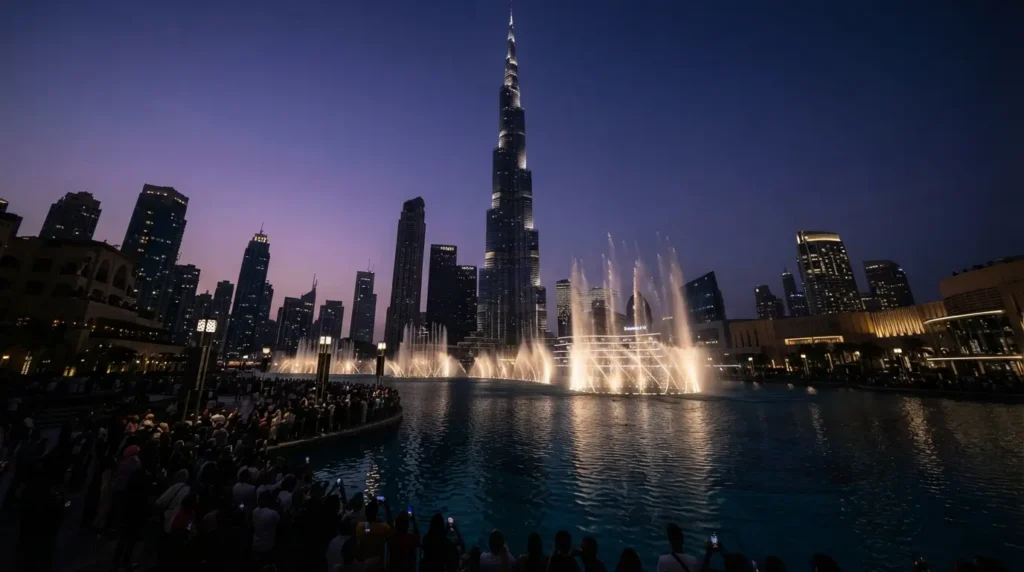
The scale of what has been built is genuinely worth experiencing directly. The Burj Khalifa at 828 metres is not a number that means anything until you are standing at its base. The Palm Jumeirah — an artificial island shaped like a palm tree, visible from space, constructed in under five years — is either an extraordinary feat of engineering or a symptom of poor ecological judgement or both, depending on your position, but it is emphatically real and emphatically unlike anything else. These things were built, exist, and reward direct encounter over the photographs that preceded them.
What is worth correcting is the idea that Dubai is only this. The city has a working population of over three million people, most of them not from the UAE, and the culture, food and daily life that has developed around that demographic reality is the more interesting version of the place. See the spectacle. Then find the other half of the city.
What does Dubai actually cost in 2026?
Less than the reputation suggests, if you make the right choices. The same city contains a shawarma for AED 15 and a hotel brunch for AED 800 per person. Both are available to the same visitor on the same day.
Accommodation is the largest variable. Budget properties in Deira and Bur Dubai — within easy metro distance of everything — run AED 80–200 per night (simpledubaiguide.com, 2026). The Rove Hotels chain (Rove Downtown, Rove Healthcare City) is the best mid-range option in the city: modern, well-located, with rooftop pools and reliable wifi, at AED 300–500 per night. Downtown Dubai and the Marina run AED 1,000+ per night for properties in the view locations, which is a significant premium for proximity to the Burj Khalifa fountain.
Daily costs for a mid-range traveller — comfortable hotel, mix of local restaurants and occasional tourist venues, metro and taxis, paid attractions — run $150–250 per day in peak season and $90–150 in the summer months, excluding international flights (simbye.com, 2026).
The practical lever: food. Eating at local Indian, Pakistani and Filipino restaurants in Deira cuts the food budget by 70% compared to eating at tourist venues near the Burj Khalifa. The food is also better. AED 15–30 for a full meal that is genuinely excellent is the operating reality of the Deira restaurant scene, not a budget compromise.
What is the difference between Old Dubai and New Dubai?
This is the question that most Dubai guides fail to frame clearly enough. They are separated by a few kilometres of waterway and two or three decades of construction and feel like different cities.
Al Fahidi and the Creek — the city that existed before
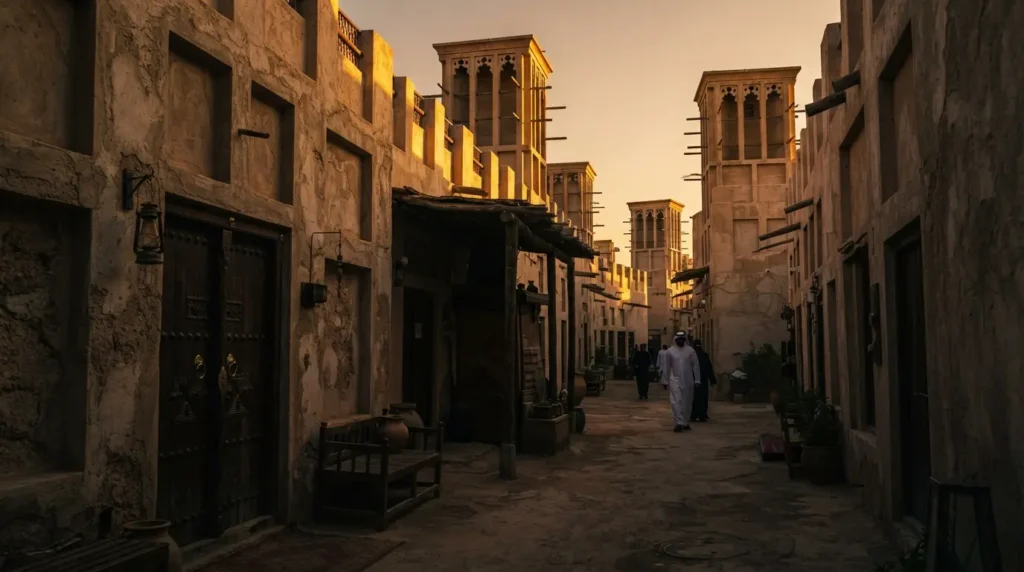
Al Fahidi Historical District, along the southern bank of Dubai Creek, is what Dubai looked like before the oil money arrived and the skyline was built. Restored wind-tower houses — traditional Arab architecture using wind-catchers to cool interior rooms — cluster around narrow lanes and courtyard buildings that are now home to small galleries, cafes and museums. The XVA Art Hotel here occupies twelve rooms in a restored building and has a courtyard restaurant that is one of the more pleasant lunch spots in the city (packzup.com). The Dubai Museum in the old fort explains the transition from pearl-diving settlement to the city visible on the opposite bank. It takes less than two hours. It makes the rest of the trip make more sense.
The Deira Souks — where Dubai’s food culture is
Cross Dubai Creek by abra — the traditional wooden water taxi, AED 1 per crossing — to Deira, and the city changes register completely. The Gold Souk and Spice Souk are the headline attractions and worth visiting in the morning before the heat builds. The food that surrounds them is the real reason to spend time here. The concentration of Indian, Pakistani, Bangladeshi and Sri Lankan restaurants in Deira, most of them operating without a website or a social media presence, represents a food culture that exists nowhere else quite like this (packzup.com, 2026). Mutton biryani from a restaurant with thirty seats and no English menu, eaten at noon on a Wednesday, is the meal that Dubai first-time visitors most consistently say they wish they had found earlier.
Downtown, the Marina and the spectacle
Downtown Dubai — the Burj Khalifa, the Dubai Mall, the Dubai Fountain — is where the photographs come from and where the largest concentration of international visitors spends most of their time. The Dubai Fountain show runs nightly (free to watch from the waterfront) and the Burj Khalifa observation deck is worth booking in advance. The Marina is the beach and leisure district, with JBR Walk and the beach clubs that define Dubai’s weekend social life for residents. Both areas function well for visitors and are expensive by the standards of the rest of the city.
What should you actually do in Dubai?
Five things earn their place on any honest Dubai itinerary.
The Burj Khalifa observation deck — At the Top, levels 124 and 125 — is worth the advance booking and the ticket price (currently approximately AED 169 for the standard level). The view from 452 metres is not the same as looking at the photographs. Book the sunset slot rather than sunrise; the evening light on the desert and the city lights beginning to come on is the better spectacle. A skip-the-line Burj Khalifa observation deck ticket removes the queue, which in peak season is meaningful.
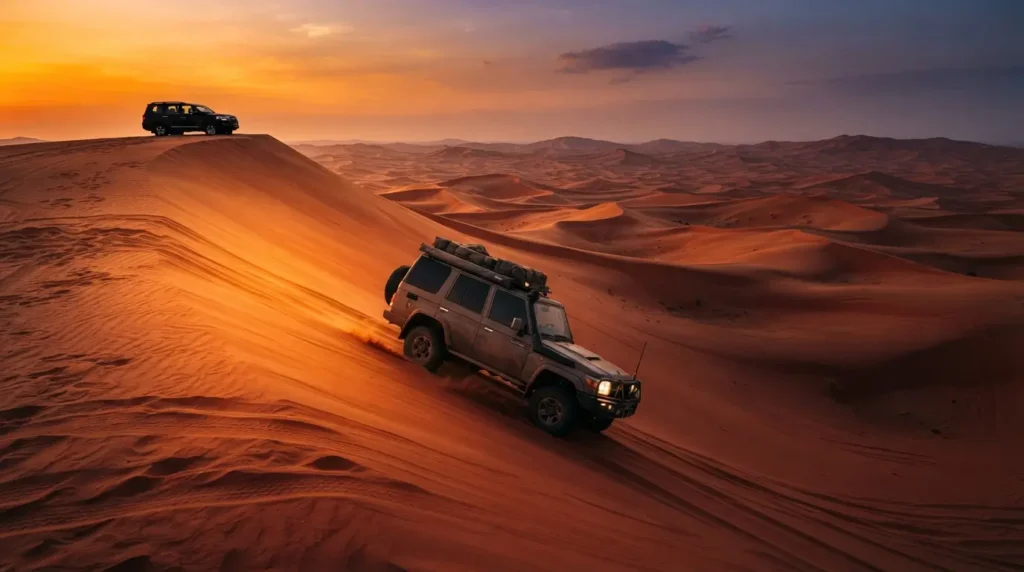
The desert safari, at least one night: dune bashing in 4WD vehicles followed by a Bedouin camp dinner. This is a tourist experience constructed specifically for tourists and is worth having specifically on those terms — the desert at sunset and the stars afterwards are real regardless of the surrounding choreography. A Dubai desert safari with BBQ dinner from a reputable operator covers the essential experience well.
The Al Fahidi walking tour and the Creek abra crossing, covered above. The Deira food circuit — Gold Souk in the morning, lunch in one of the Pakistani or Indian restaurants in the surrounding streets, Gold and Spice Souk in the afternoon. A Dubai Creek and Al Fahidi historical walking tour covers this neighbourhood properly. The Dubai Frame — a 150-metre picture frame building that literally frames the old city through one glass wall and the new city through the other — is the most useful single viewpoint in the city for understanding what you are looking at.
What should you know about visiting Dubai during Ramadan 2026?
Ramadan 2026 runs approximately February 18 to March 19, confirmed by moon sighting a few days before it begins. If your Dubai trip falls within this window, several things change and several things become available that are not available at other times.
Eating, drinking and smoking in public during daylight hours is not permitted and is a legal restriction rather than a social convention. Most restaurants close during the day or operate in screened-off sections for tourists; hotels provide designated dining areas. After sunset — at Iftar — the city transforms. The hotel Iftar buffets are elaborate and worth attending specifically as a cultural experience. The night markets, the communal prayer atmosphere, and the hospitality extended to guests during Ramadan give the city a character that is entirely different from the December peak season. Hotel prices during Ramadan are 20–40% lower than in the surrounding months (dubaispots.com, 2026). The combination of cultural access and lower costs makes Ramadan one of the more interesting windows for experienced Middle East travellers, with the caveat that the daytime restrictions limit a standard sightseeing schedule considerably.
Frequently asked questions
Q: Is Dubai safe to visit in 2026?
A: Yes. Dubai has consistently low rates of violent crime against tourists and a high-visibility police presence across tourist areas. The legal restrictions to be aware of are the public conduct rules (no public intoxication, no public display of affection beyond what is culturally acceptable, no disrespectful behaviour near mosques or during Ramadan) and the strict drug laws. Standard traveller awareness applies, but personal safety is not a meaningful concern for the vast majority of visitors.
Q: Is Dubai expensive in 2026?
A: It depends entirely on how you travel. The same city contains a shawarma for AED 15 and a hotel brunch for AED 800. Mid-range travellers in a Rove Hotel, eating a mix of local and tourist restaurants, using the metro and occasional taxis, can manage $150–250 per day in peak season. Budget travellers in Deira accommodation eating local food can do considerably less. The expensive version of Dubai is a choice, not a requirement (simpledubaiguide.com, 2026).
Q: What is the best time to visit Dubai in 2026?
A: March, honestly. Temperatures are warm rather than extreme (22–28°C), the sea is still 28–29°C from the summer warming, prices have eased from the December–January peak, and the city is less crowded than at Christmas and New Year. October is the runner-up — cooling from summer, lower prices, transitional weather that is comfortable toward the month’s end. November and December are beautiful but expensive, particularly around New Year’s Eve.
Q: Do you need a visa to visit Dubai as a British or American citizen?
A: British, American, Australian, EU and most Western passport holders receive a visa on arrival in Dubai for stays of up to 30 days, at no cost. This is renewed automatically for another 30 days if you exit and re-enter the UAE. Always confirm current entry requirements on the UAE government official immigration portal before travel, as rules update periodically.
Q: How many days do you need in Dubai?
A: Three to five days covers the main attractions — Al Fahidi, the souks, the Burj Khalifa, the desert safari, and the Marina district. Seven days adds room for a day trip to Abu Dhabi (Louvre Abu Dhabi and the Sheikh Zayed Grand Mosque are both genuinely world-class) and a more thorough exploration of the Deira food scene. Two days is the minimum for highlights only; anything under three feels rushed.
Dubai is one of those places where the version in the visitor’s head and the version that actually exists are further apart than almost anywhere. The spectacle is real. The scale is real. The biryani in Deira is real and is probably not in your head at all, which is precisely the point. Go with curiosity about both versions and you will find a city that is stranger, more interesting and more human than the photographs suggest. Plan your Dubai trip on PlacesToday →