Jordan in 2026 is worth visiting, the regional security question has a clear answer, and Petra is one of the genuine wonders of the ancient world. Jordan recorded 1,305,454 visits to tourist sites in the first half of 2026, led by Petra with 235,157 visits (Jordan Ministry of Tourism and Antiquities). The UK updated its Jordan travel advisory in June 2026 following regional de-escalation. The Jordan Pass — a unified ticket covering the visa fee and entry to more than 40 attractions including Petra — is worth buying before you travel. None of this is complicated. What is worth explaining is what the country is actually like, which is considerably more than the sum of its postcard images.
Jordan occupies a particular position in the Middle East that the Jordan Tourism Board describes with accuracy as “the calm house between noisy neighbours.” The characterisation is not marketing. Jordan has maintained its stability and its tourism infrastructure through a period when several surrounding countries have not, and that stability has made it the region’s most accessible and most reliably functioning destination for Western visitors. It shares land borders with Israel, Saudi Arabia, Iraq, Syria and the Palestinian territories. It has stayed open.
The version of Jordan most visitors arrive expecting — ancient ruins in a rose-red desert setting — is real and worth the journey specifically for that. The version that makes a week there worthwhile includes Wadi Rum at night, when the Milky Way over the red desert is something that urban travellers genuinely have not seen, and Amman’s Rainbow Street at ten in the evening, when the city operates the way a capital city should. Both versions are available. This guide covers both.
Is Jordan safe to visit in 2026?
Yes, in the areas that international visitors travel. The UK Foreign, Commonwealth & Development Office updated its Jordan travel advisory in June 2026 following regional de-escalation, reflecting renewed confidence in the country’s stability. The FCDO Jordan travel advice should be checked before departure, as guidance is updated in response to regional developments and the Middle East requires more monitoring than European or East Asian destinations.
Jordan itself — the tourist sites, the capital Amman, the route between Petra, Wadi Rum and the Dead Sea — has not experienced the instability affecting some of its neighbours. The Jordan Tourism Board’s own summary is that the country has invested heavily in reassuring visitors it remains “open, peaceful, and safe.” That investment reflects a real track record, not a marketing position. Seventy-five percent of all tourist site visits in Jordan in early 2026 were made by foreign visitors — a figure that would not hold if the security situation was materially problematic (Jordan Ministry of Tourism and Antiquities, 2026).
What is the Jordan Pass and is it worth buying?
Yes, almost always. The Jordan Pass is a unified ticket covering the visa fee on arrival (equivalent to JD 40) plus entry to more than 40 tourist sites, including Petra (which normally costs JD 50 per day). Buy it before arrival at jordanpass.jo. A three-day Petra access Jordan Pass costs approximately JD 75 — which covers the visa entirely and gives you three days at Petra, making the attractions themselves essentially free.
The Jordan Pass is worth buying if you plan to stay in Jordan for at least two nights and visit Petra at least once. It does not cover accommodation, food or transport. It does mean that the majority of Jordan’s most significant sites cost nothing additional once you have it in hand, which changes the budget calculation considerably.
What is Petra actually like in 2026?
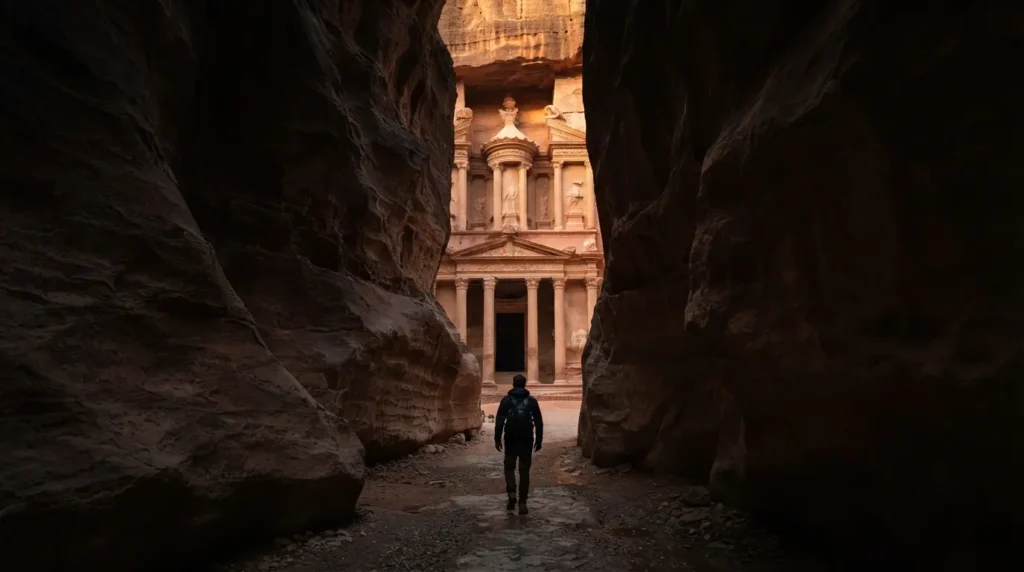
The Treasury — the image on the Jordan tourist board, the one on the poster — is a rock-cut tomb facade 40 metres high at the end of a kilometre-long canyon called the Siq. Walking the Siq toward the Treasury, watching the canyon walls narrow and the light shift and the first glimpse of rose-red stone appear in the gap ahead, is one of those travel experiences that does exactly what the anticipation promises. This happens very rarely. At Petra, it happens.
When to arrive and why it matters
The correct arrival time is before 6am, when the site opens. The Treasury in the first hour of the morning — before the tour groups arrive, with the light coming in at an angle across the stone — is a different experience from the Treasury at noon, when a crowd fills the square in front of it and the vendors around it call out simultaneously. Both exist at Petra. One of them is the reason to go. A Petra guided tour starting at opening time covers the Treasury and the inner city with enough context that the site’s three phases of Nabataean, Roman and Byzantine occupation become legible.
Petra by Night
Three times a week — Monday, Wednesday and Thursday — Petra after dark runs a candlelit walk through the Siq to the Treasury, which is lit by 1,500 candles placed along the path and in front of the facade. It is the version of the Treasury that the midday crowd cannot provide: quiet, atmospheric, the stone changing colour in the candlelight. Separate ticket; book through the Petra Visitor Center or a local operator.
Beyond the Treasury
Most visitors spend two to three hours at Petra and turn back at the Treasury. The site continues for several kilometres beyond it. The Street of Facades, the Theatre (carved from rock by the Nabataeans), the Royal Tombs, the Colonnaded Street, the Temple of the Winged Lions, the Monastery — a structure roughly equivalent in scale to the Treasury, reached by 800 rock-cut steps — are all accessible, all extraordinary, and collectively visited by a fraction of the people who photograph the Treasury. Two full days at Petra, using the multi-day Jordan Pass access, is the correct allocation for anyone who wants to understand what the site actually contains.
| Day | Location | Recommended focus |
|---|---|---|
| 1 | Amman arrival | Rainbow Street, Roman Citadel, overnight |
| 2 | Jerash day trip | Roman city, return to Amman evening |
| 3 | Amman → Petra (3–4 hr drive) | Petra by Night (Mon/Wed/Thu) |
| 4 | Petra full day | Early start, Treasury + inner city + Monastery |
| 5 | Petra → Wadi Rum (2 hr drive) | Afternoon jeep tour, overnight camp |
| 6 | Wadi Rum → Dead Sea (2.5 hr) | Floating, mud, spa |
| 7 | Dead Sea → Amman → depart | Half-day buffer |
Sources: visitjordan.com; Jordan Ministry of Tourism and Antiquities H1 2026 data; jordanpass.jo
Why does Wadi Rum justify a separate day?
Because it is not like anywhere else. Wadi Rum is a desert of red and orange sandstone formations rising from a flat sandy valley floor, a landscape that has been used as the setting for Mars in several films precisely because it does not look like a version of something else — it looks like the surface of another planet, in the way that very few places on earth do.
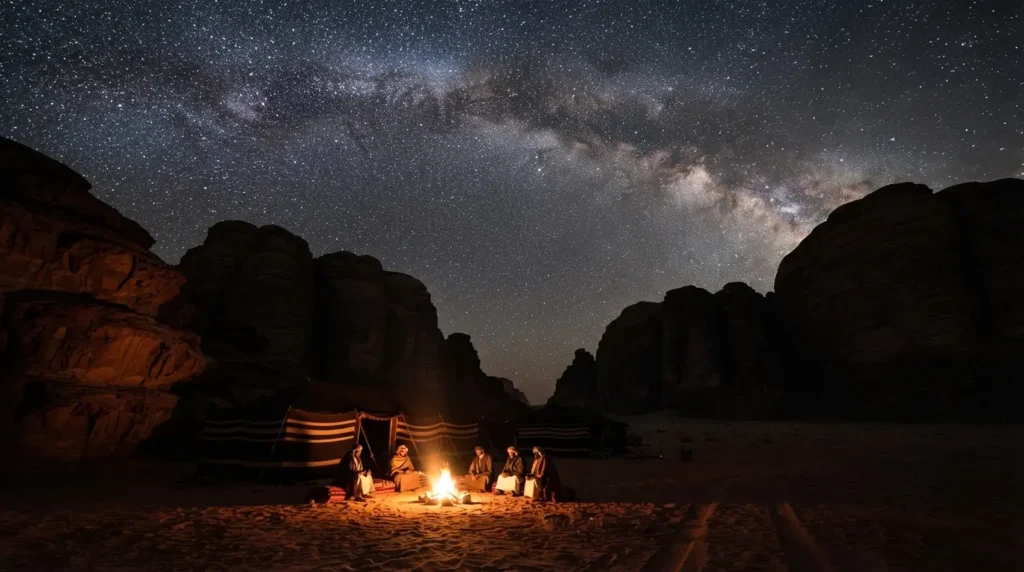
The practical reality: Wadi Rum is two hours by car south of Petra and accessible only by 4WD jeep tour or camel into the desert interior. Staying overnight in a Bedouin camp — a structure of desert tents with a fire, dinner cooked in the sand, and the sky above a desert with no light pollution — is the experience that most visitors say was the trip’s best night. A Wadi Rum jeep tour and overnight desert camp covers the main rock formations — Khazali Canyon, Um Fruth rock bridge, the Lawrence Spring — and ends with the camp and the night sky.
The Milky Way over Wadi Rum on a clear night is the specific thing that travellers who have been there describe to people who have not. It is not possible to adequately describe it. Go in the absence of a full moon for the best conditions.
What else is Jordan worth visiting for?
Amman — better than most guides suggest
Amman is a functioning capital city with a food scene that has improved significantly in the past decade and a morning coffee culture in the Rainbow Street and Jabal Al-Weibdeh neighbourhoods that is entirely its own. The Roman Citadel (Jabal al-Qal’a) gives you the best elevated view of the city’s white stone spread across its seven hills, alongside the remains of a Temple of Hercules whose enormous hand is one of the more arresting fragments of antiquity available without a ticket queue. The Jordan Museum near the Third Circle has the Dead Sea Scrolls fragments and a chronologically organised Jordanian history that is worth two hours of anyone’s time.
A night or two in Amman at the start of the trip, before the archaeological sites, resets the context. Jordan is not a collection of ruins in a desert. It is a country with a contemporary culture and a capital city that reflects it.
Jerash — the best Roman city outside Italy
Jerash, 50 kilometres north of Amman and easily visited as a day trip, is one of the most complete Roman provincial cities surviving anywhere. The South Theatre seats 5,000 and still hosts performances. The Oval Plaza colonnade, the Cardo Maximus, the nymphaeum and the Temple of Artemis are all in a state of preservation that makes the Forum in Rome look fragmented by comparison. A Jerash guided tour from Amman covers the key structures in four hours with enough historical context that the site reads as a city rather than a collection of columns.
The Dead Sea
The Dead Sea sits at 430 metres below sea level — the lowest point on Earth’s surface — and contains water with a salt concentration of approximately 34%, roughly nine times the average ocean. You float in it without effort, which is a peculiar and slightly absurd experience that is precisely as strange as it sounds. The black mud extracted from the sea floor is the basis of the spa and wellness industry that has developed along the Jordanian shore. Stay at one of the resort hotels for the full experience, or visit for a half-day from Amman.
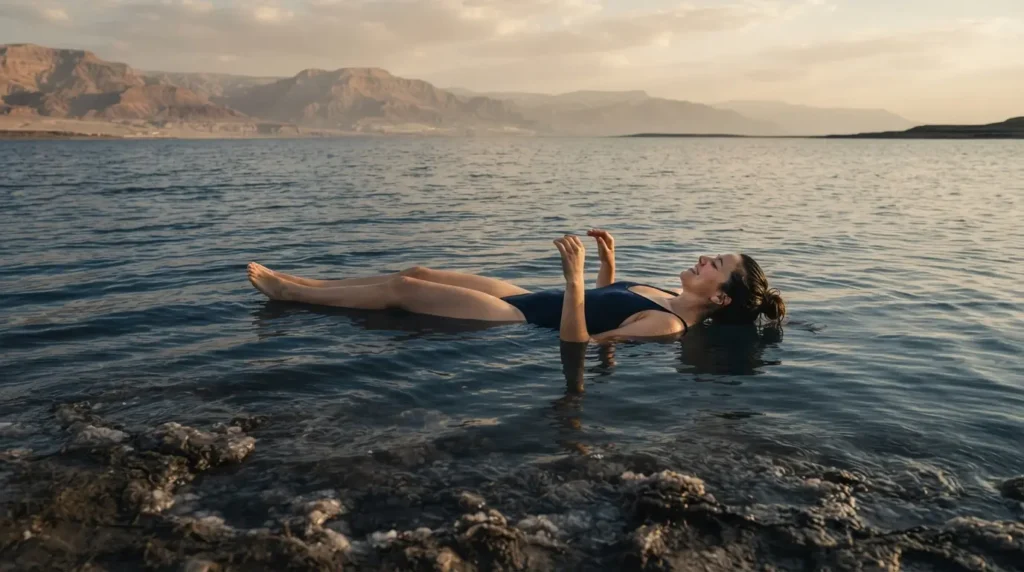
The Dead Sea is receding at approximately one metre per year due to water extraction from the Jordan River. It will look meaningfully different in 20 years than it does now.
How much does Jordan cost in 2026?
Less than visitors from Europe typically expect. A mid-range day in Jordan — comfortable hotel, restaurant meals, paid activities — runs approximately JD 60–100 (£65–110) per person, excluding the Jordan Pass which amortises across the trip. Budget travellers in hostels and eating at local restaurants can manage JD 30–40 per day.
The Jordan Dinar is pegged to the US dollar at a fixed rate of approximately 1 USD = 0.71 JD, which makes the currency calculation straightforward. Petra entry without the Jordan Pass costs JD 50 per day — the Jordan Pass is therefore worth buying for any visit of two nights or more.
Transport is the main variable. Hiring a car from Amman gives the most flexibility for reaching Petra, Wadi Rum, Jerash and the Dead Sea independently. Organised tours from Amman are cheaper per day but provide less control over timing — which matters specifically at Petra, where early arrival and time management are the variables that most determine the quality of the experience.
When is the best time to visit Jordan?
March to May and September to November. Spring brings wildflowers across the northern highlands and temperatures of 15–25°C in Petra and Amman. Autumn is the equivalent, with harvest season adding to the food culture of the capital. Both windows avoid the two conditions that challenge a Jordan visit: the summer heat (July–August regularly exceeds 38°C in Petra and 40°C+ in Wadi Rum) and the winter cold (December–February sees occasional snowfall on the Jordanian highlands, including at Petra).
The Desert Highway between Petra and Wadi Rum is operational year-round. Aqaba on the Red Sea is worth adding if you are a diver — the Gulf of Aqaba has some of the most accessible coral reefs in the world and is warm enough to dive year-round. See visitjordan.com for the current Jordan Tourism Board programme.
You can plan your Jordan itinerary on PlacesToday. For how Jordan compares as a Middle East destination alongside Dubai, our Dubai travel guide covers the UAE side of the region in detail.
Frequently asked questions
Q: Is Jordan safe to visit in 2026?
A: Yes, in the areas visited by international tourists. The UK eased its Jordan travel advisory in June 2026 following regional de-escalation. Jordan has maintained stable security conditions through a period of broader regional instability, earning its description as “the calm house between noisy neighbours” (Jordan Tourism Board). Always check the current FCDO or your government’s travel advisory before departure.
Q: What is the Jordan Pass and do I need it?
A: The Jordan Pass covers the visa fee on arrival and entry to 40+ sites including Petra. It is worth buying for any stay of two nights or more. The three-day Petra access pass costs approximately JD 75 total — which covers the visa (JD 40 equivalent) and multiple days at Petra. Buy it before travel at jordanpass.jo. Without it, Petra entry alone costs JD 50 per day.
Q: How long do you need at Petra?
A: Two full days to see the site properly — the Treasury and inner city on day one, the Monastery (800 rock-cut steps above the main valley) and the outer areas on day two. Most visitors who allocate only one day consistently say it was not enough. The Jordan Pass covers multiple days; use them.
Q: Is Wadi Rum worth an overnight stay?
A: Yes — the overnight camp specifically for the night sky. Wadi Rum by day is extraordinary landscape. Wadi Rum at night, under full Milky Way conditions with no light pollution, is the experience that separates an overnight stay from a day trip in terms of what it delivers. One night is sufficient; two is better if the budget allows.
Q: What do you eat in Jordan?
A: Mansaf — lamb slow-cooked in fermented dried yoghurt (jameed) and served over rice — is the national dish and worth eating once at a proper restaurant in Amman. Hummus of a quality and freshness different from anything available outside the Levant. Falafel from a street stall. Knafeh (the cheese-and-pastry dessert doused in sugar syrup) from a Nablus-style shop in the old city. Jordanian cuisine is part of the Levantine tradition and shares the same depth as Lebanese and Syrian cooking at its best.
Jordan is a country that most visitors leave having been surprised by more than they expected to be. The sites deliver exactly what the photographs show — Petra is real, Wadi Rum is real — and then the country delivers Amman’s evenings and Jerash’s colonnades and the particular silence of the Dead Sea at dawn, which the photographs did not prepare anyone for. That is the version of the trip worth planning for. Plan your Jordan itinerary on PlacesToday →