Sardinia in September: 24°C sea, 28°C air, crowds 70% lower than August, hotel prices 30–40% lower than peak, and the suckling pig at a Barbagia mountain restaurant still being cooked the way it has been cooked for four thousand years (inside-sardinia.com, updated July 2026). This is the month. The car is not optional. The Costa Smeralda is extraordinarily beautiful and extremely expensive and is not what makes Sardinia worth the flight. The Golfo di Orosei’s east coast cliffs, the nuraghi, and the food are what make Sardinia worth the flight. This guide covers all of them in the correct order.
Sardinia has two identities and they coexist on the same island without resolving into a single experience. The first: the Costa Smeralda, the La Maddalena Archipelago, Porto Cervo — some of the most beautiful and most expensive coastal real estate in the Mediterranean, where a sun-lounger rental runs €50 and the superyachts are the correct scale reference for understanding the prices. The second: the Barbagia mountain interior, where the villages celebrate festivals that have not changed since before the Roman conquest, the Cannonau wine comes from vines that are among the oldest cultivated in Europe, and the men live to 100 in disproportionate numbers compared to anywhere else in the world (Sardinia’s Barbagia is one of five certified Blue Zones, where longevity is clustered).
Most visitors go for the first. The second is why the island deserves the superlatives it is occasionally given. The correct Sardinia trip contains a meaningful proportion of both.
Do you need a car in Sardinia?
Yes. The same answer as Tuscany and Puglia — and for the same reason, amplified by the fact that Sardinia is an island with no rail network worth using and buses that serve residents rather than itineraries. The beaches that justify the journey — Cala Goloritzé, Cala Luna, Cala Mariolu on the Golfo di Orosei — are accessible by boat from Cala Gonone or by trails that require a car to reach the trailhead. The Barbagia mountain interior is inaccessible without a car. Alghero, Bosa and the western coast require a car or a tour.
Rent the car at Olbia airport (northeast, most direct flights) or Cagliari airport (south, longer transfer to north but closer to the Barbagia). Allow for Sardinia’s road quality outside the main SS131 highway — the SS125 Orientale Sarda, which follows the east coast through the gorge country of the Golfo di Orosei, is narrow, scenic and occasionally one-lane where you least expect it. The correct driving speed on these roads is considerably lower than the road surface suggests.
When is the best time to visit Sardinia in 2026?
| Month | Sea | Air temp | Crowds | Price vs Aug | Verdict |
|---|---|---|---|---|---|
| May | 19°C | 22°C | Low | -40% | Spring: wildflowers, hiking, quieter beaches |
| June | 22°C | 26°C | Building | -25% | Excellent: sea swimmable, crowds manageable |
| July | 26°C | 32°C | Maximum | Peak | Hot, crowded, most expensive |
| August | 27°C | 33°C | Maximum | Peak (+200-300%) | Ferragosto: avoid unless you enjoy crowds |
| September | 24°C | 28°C | 70% lower | -30-40% | Best month. Full stop. |
| October | 22°C | 22°C | Low | -50% | Sea cooling; wine harvest; landscape colours |
| November–March | Cold | 14–18°C | Minimal | -60% | Many coastal businesses closed; for hikers |
Sources: inside-sardinia.com July 2026; rental12.com Sardinia timing guide; machupicchu.org Sardinia costs 2026
September is the correct answer. The sea is warmer in September than it was in June. The beaches are occupiable rather than crowded. The restaurants are open and not at full capacity. Hotel rates have dropped by a third. The light on the limestone cliffs of the east coast in September is the light that the photographs are trying to capture.
October is the wine harvest — Cannonau grapes come in, the interior smells of fermentation, and the landscape colour shifts. It is the second-best month and is significantly more affordable.
Which Sardinia beaches are actually worth the trip?
This depends on what you came for. If you came for the superyacht scene and the €50 sun-loungers, the Costa Smeralda is the answer and it delivers exactly what it promises. If you came for water so clear that the seabed is visible at fifteen metres and beaches accessible only to people willing to either hike or take a boat, the east coast is the answer and it is better.
Cala Goloritzé and the Golfo di Orosei
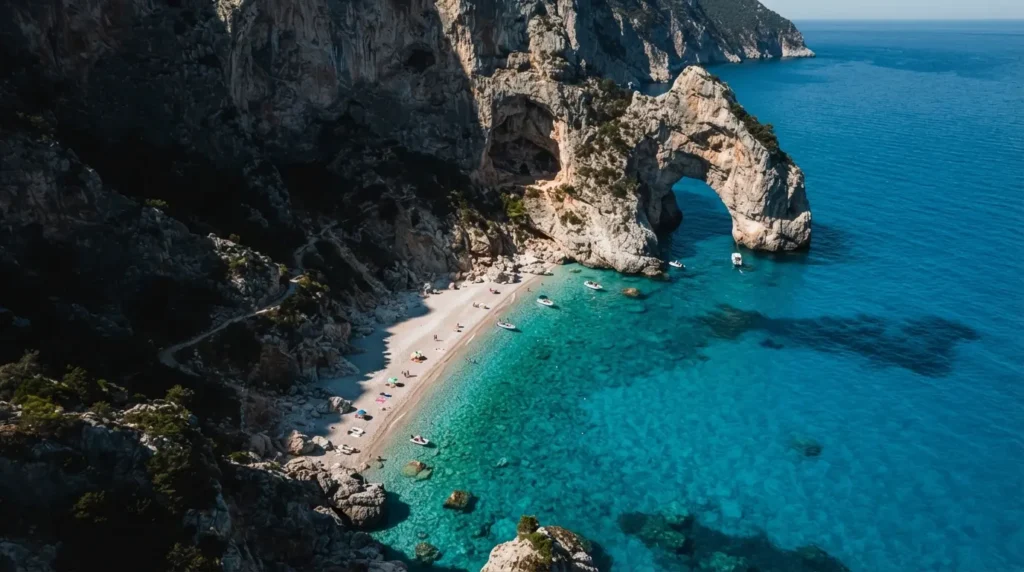
Cala Goloritzé is the beach that appears on every ranked list of Italy’s best and that receives a fraction of the visitors of the Amalfi Coast or Cinque Terre. It is accessible by a two-hour hike down from the plateau above (trailhead at Baunei, requires a car and a €3 entry permit — book online in advance as daily access is capped) or by boat from Cala Gonone, the small resort town at the base of the east coast gorge. The natural limestone arch at one end of the beach is the specific image. The water at the base of the cliffs is the reason to stay.
The Golfo di Orosei, stretching north from Cala Gonone, is a sequence of coves — Cala Biriola, Cala Mariolu, Cala Luna — all inaccessible by road and all reached by the same boat that serves Cala Goloritzé. A full-day boat tour from Cala Gonone covers three or four of them with swimming stops at each. A Cala Goloritzé boat trip from Cala Gonone is the correct way to cover the coast if your time in eastern Sardinia is limited to one day.
La Maddalena Archipelago
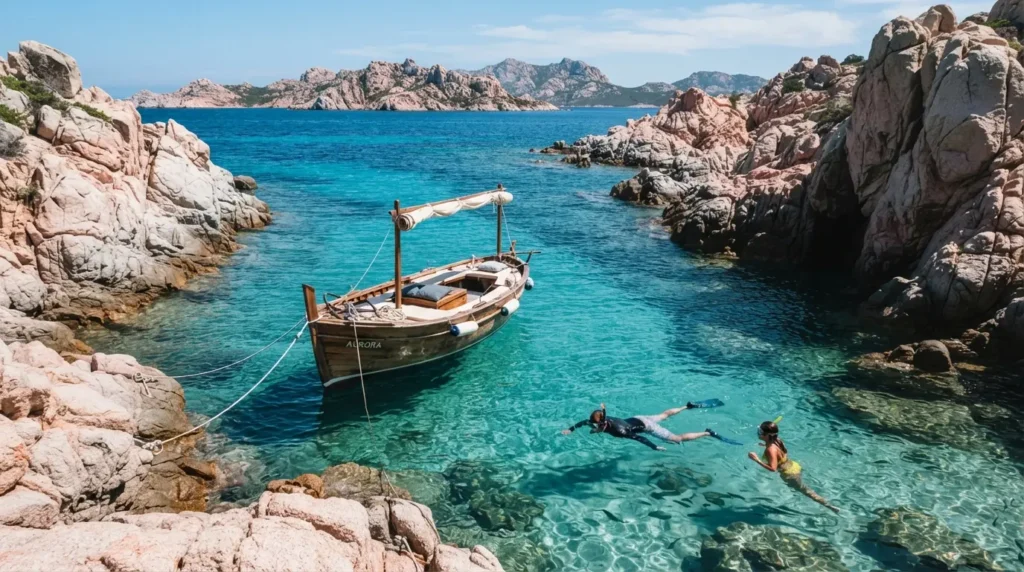
The La Maddalena Archipelago, off the northeastern coast near Palau, is the marine national park version of Sardinian beaches — an island chain of granite islands with sheltered coves, each with water in a slightly different shade of turquoise depending on depth and bottom. A boat tour covers four or five islands in a day, with snorkelling stops, and costs €35–55 per person (machupicchu.org, 2026). This is the correct version of northern Sardinia if the Costa Smeralda hotels are not the budget’s primary concern. A La Maddalena Archipelago boat tour from Palau covers the main islands in a full day.
The Costa Smeralda — the honest version
The Costa Smeralda, designed by the Aga Khan IV in the 1960s as a luxury resort development, is the most expensive stretch of coast in Italy and has the beaches to justify the claim. Porto Cervo and Cala di Volpe have the combination of clear water, pale granite rock and tourist infrastructure that the reputation describes. A mid-range hotel room here in July or August costs €300–600 per night. The same room in September is €150–250. The beach clubs charge what beach clubs charge.
It is genuinely beautiful. It is also the version of Sardinia that most resembles a product designed for visitors rather than a place that developed organically. Both things are true.
What should you eat in Sardinia?
More than anywhere else in Italy, the food in Sardinia is specific to the island. It does not resemble Italian food in any straightforward way.
Porceddu — roast suckling pig cooked over myrtle and juniper wood — is the definitive Sardinian dish and is best eaten in the Barbagia mountain interior at a restaurant or agriturismo where it arrives whole and carved at the table. It is not available on the coast in any form that makes sense. Drive to Orgosolo, Mamoiada, Tonara or any of the mountain villages on a Saturday lunch and the restaurant serving it will be busy with Sardinian families. The correct table is one of those.
Culurgiones are pasta parcels filled with potato, pecorino and mint — a shape and filling specific to the Ogliastra region of the east coast, with the ridged fold closure that no other pasta uses. They are available in Cagliari and in the coastal towns, but the correct version is in the Ogliastra villages where they are made by the method that the specific family learned from the method before them.
Bottarga — cured grey mullet roe from the lagoons around Cabras on the west coast — is grated over pasta or sliced and dressed with olive oil and lemon. The Cabras production is a specific local tradition. A small packet of good Sardinian bottarga costs €8–15 and is one of the more concentrated food experiences available in the country.
Cannonau wine is the Sardinian name for the Grenache grape, and the Barbagia Cannonau — dark, high in alcohol, tasting of dried fruit and Mediterranean scrubland — is one of Italy’s most undervalued wines. It is drunk from large round glasses at the table and paired with the porceddu and the aged pecorino. It costs €12–25 per bottle in a Cagliari wine shop and €6–9 per glass in the mountain trattorias.
What is in Sardinia beyond the beaches?
The nuraghi
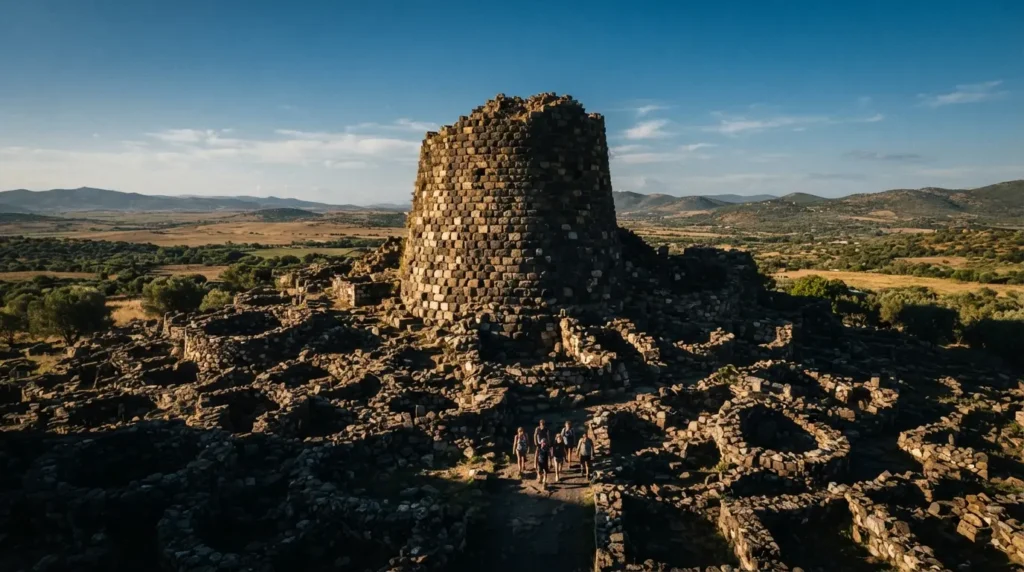
Sardinia has more than 7,000 nuraghi — Bronze Age circular stone towers built between 1800 and 500 BC by the Nuragic civilisation, a culture that developed in complete isolation on the island and produced an architectural tradition found nowhere else on earth. Su Nuraxi di Barumini, near the town of Barumini in the south, is the best preserved and is UNESCO World Heritage listed. A guided tour takes approximately ninety minutes and covers the main tower and the surrounding village complex. Book in advance; entry is limited.
The nuraghi are the specific reason that Sardinia is not simply a beach destination. Standing at Su Nuraxi, with the stone tower above you and the evidence of a two-thousand-year-old street plan below, is a different experience from the ruins at Pompeii or the Forum in Rome — not because it is better, but because the Nuragic civilisation left behind nothing in writing and the buildings are everything we have. Silence fills the gaps differently.
Orgosolo’s murals
Orgosolo, a mountain village in the Barbagia, has covered its walls in political murals since the 1970s — originally statements against the Italian state and the military use of Sardinian land, now a tradition that has expanded to cover local history, global events and the particular concerns of a mountain community that has survived foreign domination by a succession of powers since the Bronze Age. The murals are not a gallery; they are on the external walls of houses and shops and the back of a petrol station. Walk the village for an hour. Most of the work is still politically direct.
Bosa
Bosa, a medieval river town on the western coast, is the most beautiful town in Sardinia that most visitors never reach. The painted houses climb the hill from the Temo River — Italy’s only navigable river in Sardinia — to the Malaspina Castle above. The town produces Malvasia di Bosa, one of the most distinctive dessert wines in Italy. The journey from Alghero involves a coastal road of genuine drama. Stay one night.
What does Sardinia cost in 2026?
The honest answer is: it depends on whether you are there in August or September. The same hotel room that costs €250 in August costs €100–120 in September (machupicchu.org, 2026). The same beach club that charges €50 for a sun-lounger in August is either charging €30 or has closed until next year.
Budget travellers eating at local trattorias, sharing accommodation and managing beach costs without the club infrastructure: approximately €87 per day (gotripzi.com, 2026 cost data). Mid-range travellers in a comfortable hotel with restaurant meals and one or two boat tours: €200–250. A week in Sardinia mid-range, including flights from the UK: €1,500–2,000 per person. Flights from the UK run €80–200 return in September; July–August fares are €200–400 (machupicchu.org).
The ferry from Civitavecchia (Rome’s port) to Olbia takes twelve to fourteen hours overnight and costs €40–80 per person for a cabin; Cagliari ferries from Genoa or Palermo also operate. For anyone combining Sardinia with a Rome or mainland Italy trip, the overnight ferry is a legitimate and romantic way to arrive — and removes a night of accommodation cost.
You can plan your Sardinia itinerary on PlacesToday. For how Sardinia fits into a longer Italy trip alongside Rome, Tuscany, Sicily and Puglia, our Rome guide, Tuscany guide, Sicily guide and Puglia guide cover the mainland and Sicily alternatives.
Frequently asked questions
Q: When is the best time to visit Sardinia in 2026?
A: September — without meaningful competition. The sea temperature peaks in September at 24°C (warmer than June’s 22°C), crowds are 70% lower than August, and hotel prices drop 30–40% from peak. October is the second choice: sea cooling to 22°C, wine harvest beginning, fewer tourists and prices 40–50% below August.
Q: Which Sardinia beach is the best?
A: Cala Goloritzé on the Golfo di Orosei east coast, for the limestone arch, the cliff setting and the water colour. Accessible by boat from Cala Gonone or a two-hour hike. Daily access is capped; book the hiking entry permit in advance. The La Maddalena Archipelago is the correct northern Sardinia answer: a boat tour covers multiple granite island coves in a day.
Q: Is the Costa Smeralda worth visiting?
A: Yes, if the price point is acceptable. It has some of the most beautiful water and coastline in the Mediterranean and resort infrastructure that is genuinely high quality. A mid-range hotel there in July or August costs €300–600 per night; September brings that to €150–250. If the budget allows it, go in September. If it does not, the La Maddalena Archipelago day trip from Palau covers comparable beach quality without the resort pricing.
Q: What is the most important food to eat in Sardinia?
A: Porceddu — roast suckling pig over myrtle wood — at a mountain restaurant in the Barbagia, on a Saturday, with Cannonau wine. This is the correct sequence and the specific experience that justifies the journey into the interior. The coastal towns do not do it correctly; the mountain trattorias do. Drive to Orgosolo, Mamoiada or Oliena and find the restaurant with the outdoor grill.
Q: Is a car required in Sardinia?
A: Yes. The island’s best beaches — Cala Goloritzé, the Golfo di Orosei coves, the nuraghi — are inaccessible by public transport at any useful frequency. The Barbagia interior requires a car. Even the boat tours to the best beaches require driving to the embarkation point. Rent the car at Olbia or Cagliari airport. Budget for the fuel costs, which are the main additional expense.
Sardinia rewards the visitor who arrives with a car, goes in September, drives to the mountain interior at least once, and takes the boat to Cala Goloritzé before swimming in water so clear it gives you a small shock. The Costa Smeralda is extraordinary. The Barbagia is better. The porceddu at a mountain trattoria on a Saturday is the reason to come back. Plan your Sardinia trip on PlacesToday →