Croatia in September: the Adriatic sea at 24–25°C, Dubrovnik’s city walls walkable without a queue forming at every viewpoint, accommodation prices 40–50% below August (amigosim.com, 2026), and the taverna at the end of a Korčula alley still serving grilled sea bass for what it costs in Split in July. Croatia in July and August is 30% more expensive and considerably more crowded. September is the honest answer. October extends it further — the Istria truffle season begins and the islands quiet to their most authentic register.
The Adriatic light on the old stones of Dubrovnik in the early evening — the way it falls across the limestone pavement of the Stradun and turns it the colour of old parchment — is the light that most people come to Croatia for. It is also the light that most people experience alongside several thousand other people. On a Tuesday in September, with the cruise ships still anchored but the walking tour groups reduced to a fraction of their August volume, the Old Town breathes again in a way that makes the visit feel like something other than a logistics exercise. This is not a secret; it is simply the information that July bookings erase from consideration.
Croatia joined the Schengen Area in January 2023 and switched its currency to the euro simultaneously — two changes that simplified the trip considerably for European visitors and removed the currency conversion anxiety that previously punctuated every konoba meal and ferry ticket purchase (europeantourism.org, 2026 travel guide). EES biometric checks are live at Croatian border crossings since April 2026; ETIAS (approximately €20) is expected later in 2026 but had not yet been required as of the most recent guidance. Check the current entry requirements for your passport before travel.
When is the best time to visit Croatia in 2026?
| Month | Sea temp | Crowds | Price vs August | Verdict |
|---|---|---|---|---|
| May–June | 18–22°C | Low–moderate | -30% | Spring: wildflowers on islands, hiking conditions, sea warming |
| July–August | 26–28°C | Maximum | Peak | Hot, expensive, crowded; Dubrovnik and Hvar at highest intensity |
| September | 24–25°C | Falling fast | -40-50% | Best month: warm sea, manageable crowds, lower prices |
| October | 20–22°C | Low | -50-60% | Istria truffle season, island quiet, sea cooling but swimmable |
| November–April | Cold | Minimal | Lowest | Many coastal businesses close; winter is for Istria and Zagreb |
Sources: europeantourism.org Croatia 2026; amigosim.com Croatia costs 2026; top7.hr expensive destinations Croatia 2026
September is the clearest recommendation in Croatian travel and the one most consistently made by people who have been more than once. May and June offer equivalent conditions for those who cannot travel in September. July and August exist on their own terms — expensive, hot, and busy — and are best avoided unless the budget is flexible and the crowds are a tolerable part of the experience.
Split or Dubrovnik — which should you base yourself in?
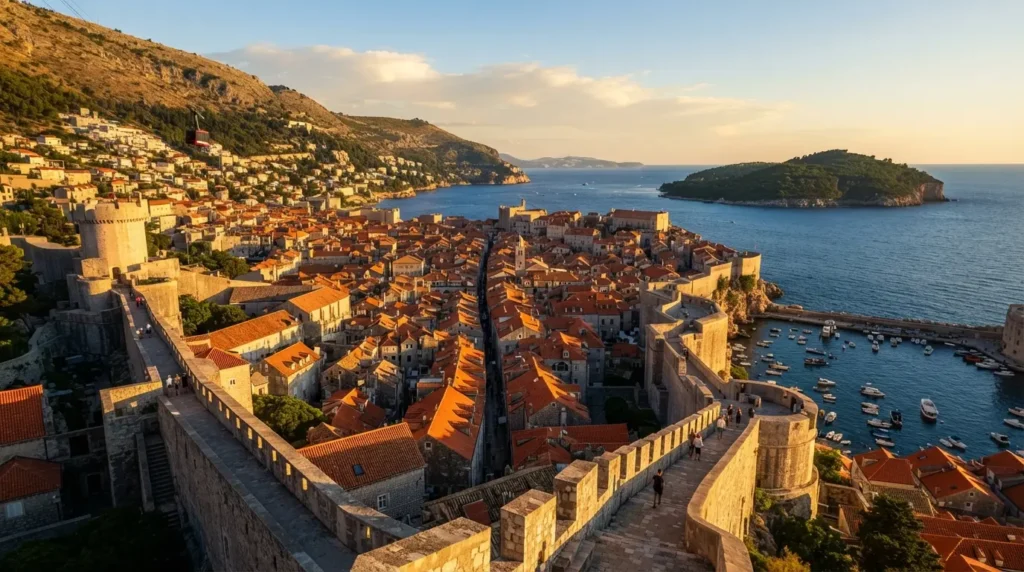
The honest answer separates the two cities clearly. Dubrovnik has the more dramatic setting and the more immediately cinematic old town — the limestone walls enclosing the Stradun, the view from the city walls across the rooftops and the Adriatic, the specific quality of the evening light on UNESCO-listed stone. It is also consistently more expensive (coffee €6 vs Split’s €2.50; a basic meal €20 vs Split’s €15; accommodation running £800–1,000 for a week in a three-star hotel compared to Split’s £580–800 for the same period — ellamckendrick.com, 2026).
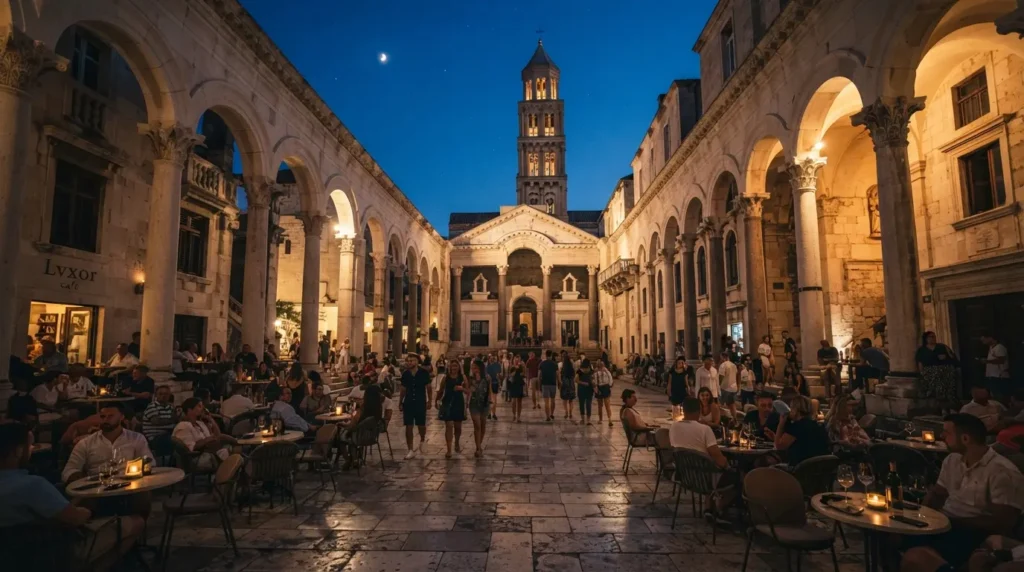
Split is a functioning city of 200,000 people whose medieval old town is built literally inside Diocletian’s Palace — the Roman emperor’s retirement complex, constructed in 305 AD, whose walls and cellars are now the walls and cellars of restaurants, apartments and shops where Spalatini (Split residents) live, eat and argue. It is messier and more alive than Dubrovnik and costs significantly less. It is also the transport hub for all Dalmatian island ferries, which makes it the logical base for an island-hopping trip.
Use Split as the primary base for a week-long trip. Add two to three nights in Dubrovnik at the end or beginning, when you want the cinematic set-piece and can afford it for a shorter stay.
What makes Dubrovnik worth the crowds?
The city walls. Walking the 2-kilometre circuit of Dubrovnik’s medieval fortifications — one of the most complete examples of defensive architecture in Europe — is the single experience that justifies the trip even at July prices. From the wall walk, the old town below is a perfectly preserved 14th-century city, the Adriatic is on the other side, and the logic of the fortification becomes legible in a way it doesn’t from street level. The walls open at 8am; arrive at opening time to have the first hour largely to yourself.
The wall walk ticket costs approximately €40. Book online to avoid the ticket queue. A Dubrovnik Old Town and city walls walking tour covers the walls and the key old town streets with enough historical context that the specific Gothic, Renaissance and Baroque buildings read as a sequence rather than a general impression of old-ness.
Lokrum Island — a short ferry from the old town harbour, €10 return — is Dubrovnik’s correct afternoon escape. A nature reserve with peacocks that wander freely among the 11th-century Benedictine monastery ruins, a salt lake, and the rocky coves on the southern shore where most visitors do not walk. Two hours here restores the perspective that the Stradun crowds briefly remove.
The food problem in Dubrovnik is real. Restaurants in the old town charge for the postcode rather than the cooking. Eat in Lapad (a twenty-minute bus ride, the locals’ neighbourhood) or in the Gruz harbour area, where the fish market and the konobas around it serve Dalmatian food at Split prices.
What is Split and why is it the better base?
Split is the city where the old town and the Roman imperial palace have been the same thing for 1,700 years. Diocletian’s Palace was built in 305 AD as the emperor’s retirement complex and has been continuously inhabited since the 5th century, when the Roman population of nearby Salona moved into it for protection. The streets inside the palace walls are medieval streets; the cellars beneath them are Roman cellars now used for exhibitions and wine bars; the peristyle courtyard at its centre hosts summer concerts and year-round pedestrians who mostly do not know they are standing in a 1,700-year-old throne room.
Walking the palace is free. It is also extraordinarily easy — there are no tickets, no gates, no hours. You walk in through one of the four original Roman gates and out through another and the city continues around you without break. The UNESCO designation and the tourist photographs notwithstanding, Diocletian’s Palace remains a living city centre. People live in apartments inside the palace walls and hang laundry from the windows above the Roman columns.
The riva — Split’s seafront promenade, outside the southern palace wall — is where the city’s social life operates: morning coffee, evening aperitivo, the particular hour at dusk when the Adriatic is pink and the lights come on along the promenade. A konoba meal nearby costs €15–20 per person for grilled fish with bread and salad. This is the correct comparison with Dubrovnik’s €30 equivalent for the same quality.
Which Croatian islands are worth visiting in 2026?
Hvar — honest about what it is
Hvar is a beautiful island and an expensive party destination. The two coexist without resolving. The lavender fields in the interior, the fortress above Hvar Town, the transparent water at the Pakleni Islands — all are real and all are extraordinary. The €50 beach club sun-lounger and the €15 cocktail are also real and dominate the coastal strip in July and August. In June or September, Hvar is accessible without those prices, which is when it becomes the island it is supposed to be.
Catamaran from Split to Hvar Town takes approximately one hour and costs €20–25 each way. The island is worth a night or two; three nights is the maximum before the limited size becomes a constraint.
Korčula — the one to choose instead
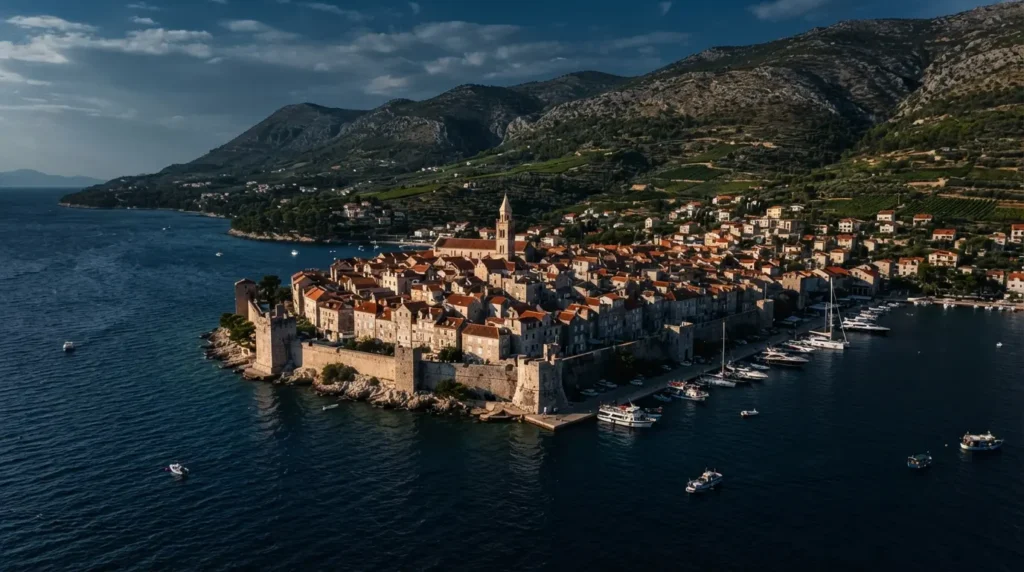
Korčula Town — a medieval walled town on a small peninsula of the island of the same name — is often described as “little Dubrovnik.” The comparison is apt and the name undersells it. The Venetian Gothic architecture of the old town, the vineyards of Pošip (one of Croatia’s finest white wines) on the island’s interior, and the water around the island’s southern coves are all exceptional. Korčula is 25–30% cheaper than Hvar and receives a fraction of its visitors. A Split and Korčula island day trip by catamaran includes the ferry crossing and a guided tour of either Hvar or Korčula.
Vis — the genuinely quiet one
Vis is the furthest inhabited island from the mainland and, as a result, the most preserved and the least crowded. The island was a Yugoslav military base until 1989, which kept it closed to foreign visitors for decades and left its character unusually intact. Two small towns (Vis Town and Komiža), a handful of excellent restaurants, the Blue Cave at Biševo accessible by boat tour, and the kind of quiet that other Dalmatian islands once had and have mostly traded. More expensive in absolute terms than you would expect (supply constraints); incomparably more peaceful than anything you can reach in under two hours from Split.
What else is Croatia for?
Plitvice Lakes National Park — 120 kilometres northeast of Split, a system of sixteen interconnected lakes connected by travertine waterfalls and walkways — is one of the most beautiful national parks in Europe and is UNESCO World Heritage listed. Entry costs €12–40 depending on the season. A Plitvice Lakes National Park guided day tour from Split or Zagreb is the practical way to visit from either city without a rental car.
Istria — the peninsula in Croatia’s northwest, with Rovinj as its most beautiful town — is the part of Croatia that rewards autumn specifically. The truffle season runs from late September through November in the forests around Livade and Buzet; the restaurants in these towns serve truffle dishes at prices that Italian truffle restaurants do not approach. Rovinj’s fishing village old town, built on a peninsula above the sea, is among the loveliest towns on the Adriatic at any time of year and almost entirely visitor-free in October.
What does Croatia cost in 2026?
Croatia uses the euro (since January 2023). Mid-range travel — comfortable accommodation, restaurant meals, ferry tickets and national park entries — runs €115–150 per person per day (europeantourism.org, 2026). Budget travellers in hostels and konoba lunches manage €60–80. Dubrovnik and Hvar run at the higher end; Split, Korčula and Vis are more affordable; Istria in autumn is the best value of any Croatian destination in the shoulder period.
Ferry tickets (catamaran, Split to Hvar or Korčula): €10–25 per person each way. Dubrovnik city walls: approximately €40. Plitvice Lakes entry: €12–40 depending on season. Meals in a good Split konoba: €15–20 per person with wine.
See the official Croatia Tourism site for current ferry schedules and national park entry pricing. You can plan your Croatia itinerary on PlacesToday — tell us how many days, which islands interest you and whether you want the Old Towns, the national parks or a combination of both.
Frequently asked questions
Q: When is the best time to visit Croatia in 2026?
A: September — sea at 24–25°C, accommodation 40–50% cheaper than August, manageable crowds and most businesses still open. May and June offer comparable conditions at 30% below August prices. October extends the season further with the Istria truffle period and even lower prices, though some island businesses begin closing. July and August are expensive and crowded.
Q: Split or Dubrovnik — which should you choose?
A: Use Split as the primary base (cheaper, better food, transport hub for island ferries) and add two to three nights in Dubrovnik for the city walls and the cinematic old town. Split is 25–35% cheaper than Dubrovnik across accommodation, food and drinks. Diocletian’s Palace in Split is one of the finest Roman sites in Europe and is free to walk through.
Q: Which Croatian island should you visit?
A: Korčula for the best combination of medieval character, wine, manageable crowds and value. Hvar for the lavender, the party scene and the beach clubs, in June or September rather than August. Vis for genuine quiet and the Blue Cave. Brač for the best single beach (Zlatni Rat, the famous curved sandbar).
Q: How do you get around Croatia?
A: Bus between mainland cities (Zagreb, Split, Dubrovnik — €18–28); catamaran for islands from Split (€10–25 per person); rental car for Plitvice Lakes and Istria. Trains are minimal along the coast and not the correct transport mode for Dalmatia. Jadrolinija is the main ferry operator (jadrolinija.hr); private catamarans also run popular routes.
Q: Does Croatia require an ETIAS travel authorisation in 2026?
A: Not yet, as of the September 2026 guidance available. ETIAS (approximately €20) is expected but had not been required as of the most recent update. EES (Entry/Exit System) biometric checks have been operating at Croatian border crossings since April 2026. Check current FCDO or government travel advice before travel.
Croatia’s Dalmatian coast is at its most itself in September — when the light is the same golden light that fell on Diocletian’s limestone walls and on the Korčula cathedral stone and on the vineyards above Vis in every September before this one, and the crowd level allows you to notice it. The island ferry takes an hour. The grilled sea bass costs what it should. The city walls are worth the €40 and the early start. September is the month. Plan your Croatia trip on PlacesToday →