Fes el-Bali — the old city, the medina — is the largest car-free urban area in the world: a 9th-century Islamic city of more than 9,000 alleys, 14 gates, the oldest continuously operating university on earth, and the most concentrated medieval architecture in North Africa. It is genuinely overwhelming on the first day. It is also genuinely extraordinary in a way that Marrakech, having accommodated tourism for longer, no longer consistently is. October and November are the correct months: 15–22°C, the summer heat lifted, the light on the carved stucco of the madrasas warm and direct. A licensed guide for the first day is not optional; without one, Fes el-Bali is a maze with a compass that points in seventeen directions simultaneously.
The sound of Fes arrives before the sight of it. The call to prayer from the Bou Inania Madrasa travels through the alleys at angles that the straight-line geography of other cities does not produce — bouncing off the tile and plaster walls, arriving from three directions at once, filling the medina in a way that street music in Marrakech fills a square. This is the first thing. Then the smell: cedar shavings from the carpenter’s souk, roasting meat from somewhere ahead, the particular mineral sharpness of the tanneries from the southwest when the wind is right. Then the sound of hammers on brass from the metalworking district, rhythmic and dense, the sound that the medina has made in this neighbourhood since the 13th century.
Fes is what Marrakech is often described as: ancient, disorienting, overwhelming. The difference is that Fes has not been substantially rebuilt to accommodate visitors in the way that Marrakech’s tourist core has. The riads here are converted homes rather than purpose-built guesthouses. The craftsmen in the leather and woodworking souks are making things for domestic markets as much as for tourists. The Kairaouine Mosque and University — 859 AD, the oldest continuously operating university in the world — is still a working religious institution rather than a heritage site with timed entry.
October is the month when Fes makes the most sense for international visitors. The heat that turns the narrow alleys into a furnace from June through August has lifted; the light on the carved plasterwork of the madrasas is the light that the architects intended.
Is Fes safe and functional for visitors in 2026?
Yes — Fes is one of Morocco’s most-visited cities and has well-established tourist infrastructure, including a significant riad accommodation sector, licensed guides and a functional petit taxi network. The standard Morocco cautions apply: agree taxi prices before getting in (negotiate rather than assume the meter), be aware of unofficial guides who attach themselves to visitors at medina gates, and carry small-denomination dirham for souks and street food.
The FCDO Morocco travel advice maintains a low advisory level for Fes and the main tourist cities. Check current guidance before departure.
What are the essential sites in Fes?
| Site | Access | Entry | Best time |
|---|---|---|---|
| Chouara Tanneries | Via rooftop leather shops (view from above) | Free | Morning when workers are active |
| Bou Inania Madrasa | Open to non-Muslims | ~30 MAD | Before 9am |
| Al-Attarine Madrasa | Open to non-Muslims | ~30 MAD | Combined with Kairaouine quarter |
| Mellah (Jewish Quarter) | Free to walk | Free | Market hours |
| Dar Batha Museum | Andalusian garden palace | ~70 MAD | Afternoon for garden light |
| Borj Nord Weapons Museum | Above the medina | ~20 MAD | Morning; views over the whole medina |
Sources: visitmorocco.com; morocco.com Fes guide 2026
The Kairaouine Mosque and University itself is not accessible to non-Muslims — the prayer hall and courtyard may be glimpsed through open doorways at certain times, but entry is not permitted. This is not a restriction specific to 2026; it is the mosque’s standing policy.
What is the Chouara Tanneries experience actually like?
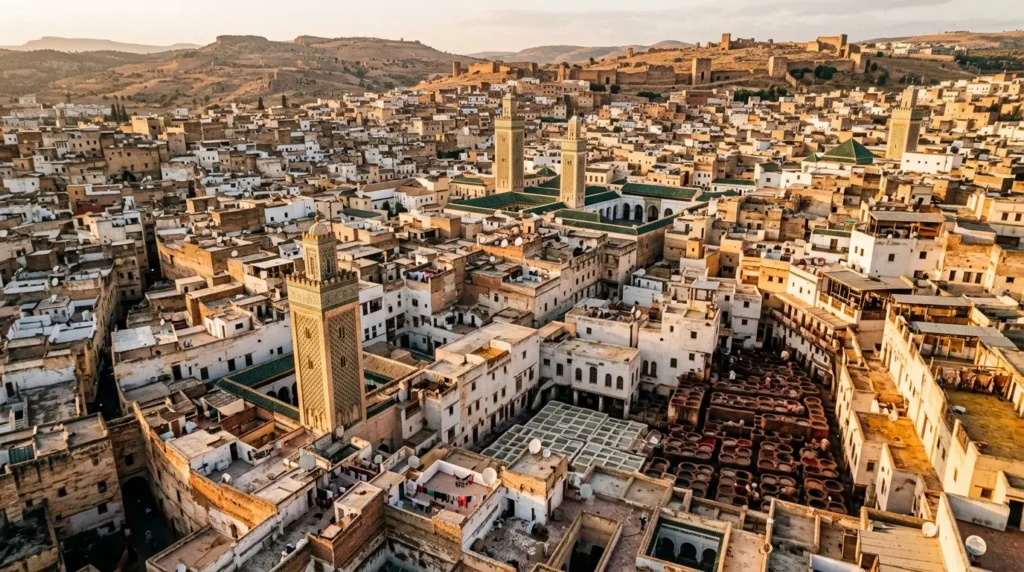
The Chouara Tanneries are the image most associated with Fes and are more spectacular than their equivalent in Marrakech: a compact district of circular stone vats cut into the earth, filled with dye — saffron yellow, poppy red, indigo, pigeon-dropping white (the traditional softening agent) — and surrounded by the working infrastructure of a tannery that has functioned continuously in the same location since the 11th century.
The view is from the rooftop terraces of the leather shops that ring the tannery district on three sides. Enter through one of the shops; the owner will show you to the terrace. A sprig of mint may be handed to you at the entrance — hold it near your nose as required. The smell of the tanneries is the smell of the processing agents used in leather curing, which include pigeon guano and other traditional chemicals. It is powerful and specific and nothing that photographs convey.
Go in the morning when the tanning work is most active: workers in the vats, the colours at their brightest, the full scene operational. A Fes medina and Chouara Tanneries guided walking tour covers the tanneries, the main madrasas and the souk districts in four to five hours — the correct introduction to the medina before independent exploration.
What is the Bou Inania Madrasa and why does it matter?
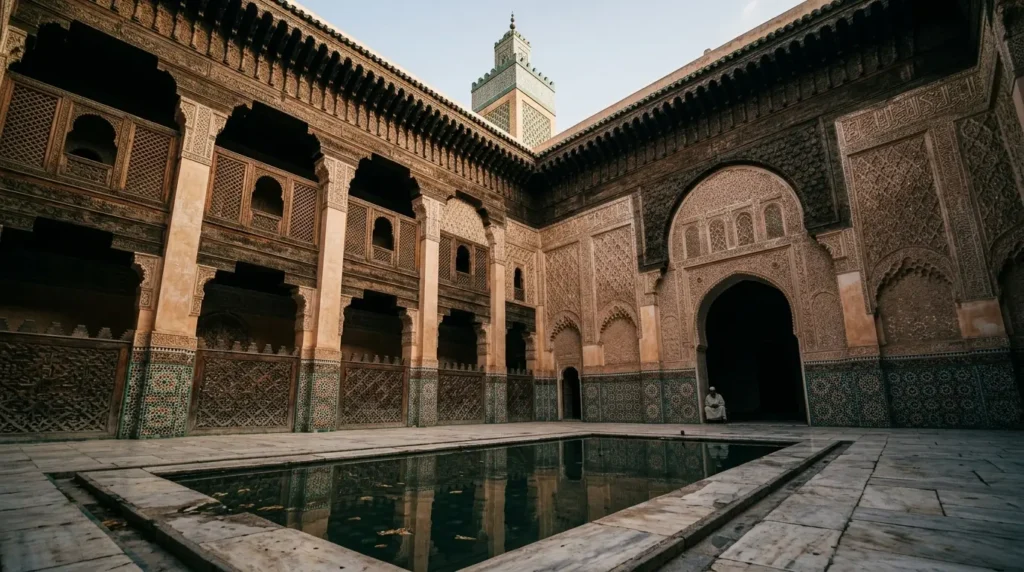
The Bou Inania Madrasa, built between 1350 and 1355 by the Marinid sultan Bou Inan, is a theological college and a masterwork of Moroccan Islamic architecture: the courtyard’s lower walls covered in intricate carved stucco above a dado of geometric tile, the upper walls of carved cedarwood lattice, a green-tiled minaret above, and a marble-paved central courtyard with a long narrow pool. The Bou Inania is one of the few Moroccan madrasas open to non-Muslim visitors and is the building that most clearly explains what the rest of the medina’s carved and tiled facades are working toward.
Go before 9am. The medina’s main souks run along the same street and the foot traffic from ten onwards makes the madrasa entrance more crowded than its size accommodates.
The Al-Attarine Madrasa — five minutes’ walk into the heart of the medina near the Kairaouine — is the second essential madrasa: slightly smaller, slightly later (1325 AD), equally elaborate, and approached through the spice and attar (perfume oil) souk that gives it the name Al-Attarine (the perfumers).
Do you need a guide in Fes?
Yes, for the first day at minimum — and not a reluctant yes but a practical one. Fes el-Bali has no grid structure, no street names that appear on any map with any consistency, and approximately 9,000 alleys, many of which dead-end into private houses or courtyards. Getting disoriented in the Fes medina is not a metaphor; it is a navigational reality that most first-time visitors experience within thirty minutes of entering.
A licensed guide (available through your riad or through the official guide bureau near Bab Bou Jeloud, the main medina gate) costs approximately 350–500 MAD ($35–50) for a half-day. The guide provides the navigational thread that allows the medina to be experienced as a sequence of extraordinary things rather than a sequence of identical-looking alleys. After the guided first day, the medina becomes navigable on a relative basis — you will still get lost, but you will get lost in neighbourhoods you recognise.
What should you eat in Fes?
Fes has a more conservative food culture than Marrakech — fewer restaurants performing for tourists, more restaurants making the food they make for the city’s residents.
Harira — the tomato, lentil and chickpea soup thickened with flour and brightened with lemon and fresh coriander — costs 10–15 MAD from a street stall at any hour and is the correct way to start or end any medina walk. Bastilla (also pastilla) — the sweet-savoury pigeon or chicken pie in layered warqa pastry, dusted with powdered sugar and cinnamon — is the city’s signature preparation. Order it at a restaurant that makes it from pastry rather than pre-bought shells; the texture difference is significant. Mechoui — whole lamb slow-roasted in a traditional underground oven, sold by the portion from hole-in-the-wall restaurants near the main souks — is the Fes lunch that requires nothing else.
The food in the Riad-Batha neighbourhood, between Dar Batha museum and the bus station, is consistently better value and more local-facing than the restaurants on the main tourist routes.
Fes or Marrakech — which should you visit?
Both, in sequence if possible; Fes first if only one. Fes is what Marrakech was thirty years ago — architecturally intact, genuinely functioning as a city rather than as a tourism infrastructure project, and requiring more from the visitor in terms of orientation and patience. Marrakech is easier, more international in its accommodation and food, and more comfortable for visitors who prefer not to get lost.
The 9th-century medina, the Kairaouine University, the tanneries in their original operating context — these are not available in Marrakech’s equivalent heritage. The trade-off is that Fes asks more of you. The trade-off is worth making.
Our Marrakech travel guide covers the Djemaa el-Fna and the southern Morocco context. Fes and Marrakech are a three-and-a-half-hour train ride apart and are best understood as a pair. Plan your Morocco itinerary on PlacesToday →
What does Fes cost in 2026?
Fes is slightly cheaper than Marrakech across most categories. A riad room costs 400–800 MAD ($40–80) per night. A mid-range restaurant meal costs 80–150 MAD ($8–15) per person. A licensed guide for the day: 350–500 MAD. A petit taxi across town: 10–20 MAD (negotiate before getting in).
The currency is the Moroccan dirham. ATMs are available in the Ville Nouvelle (the French Protectorate-era new city, a twenty-minute taxi ride from the medina) and at the main medina entrances. The medina itself is cash-only in most establishments.
October and November are the optimal months: daytime temperatures of 15–22°C, comfortable for extended medina walking. The summer months (June–August) reach 35–38°C in Fes, which is a landlocked city without the Atlantic breeze that moderates Marrakech’s worst days.
Frequently asked questions
Q: Do you need a guide in the Fes medina?
A: Yes, for at least the first day. The Fes el-Bali medina has no grid structure and approximately 9,000 alleys, many of which dead-end. Navigating independently without prior knowledge produces extended disorientation rather than exploration. A licensed guide costs 350–500 MAD ($35–50) for a half-day and is the most practical investment available in Fes. Hire through your riad or the guide bureau at Bab Bou Jeloud.
Q: Is Fes or Marrakech better for a first Morocco visit?
A: Both cities reward visiting but serve different travellers. Fes is more architecturally intact, more conservative and more demanding to navigate — it requires patience and a guide. Marrakech is more accessible and more prepared for first-time visitors. For those with time for only one city, the experienced view is that Fes is the more significant. If time allows, visit both — three and a half hours apart by train.
Q: When is the best time to visit Fes?
A: October to November and March to May. The medina’s narrow alleys reach 35–38°C in summer (June–August), making extended walking genuinely unpleasant. Spring and autumn bring comfortable 15–22°C daytime temperatures, lower tourist density and the correct light on the carved stucco of the madrasas. Check the Ramadan calendar before travel — it significantly changes the daytime food and drink situation in the medina.
Q: What is the Chouara Tanneries experience like?
A: The view is from rooftop terraces of leather shops above the tannery district — you do not enter the tannery itself. The circular stone vats are visible below, workers visible in them. The smell is significant (traditional processing agents including pigeon guano); a sprig of mint is typically offered at the entrance. Go in the morning when the work is most active and the colours are at their most vivid. The experience is unlike anything available in Marrakech.
Q: How much does Fes cost per day in 2026?
A: Budget travellers in modest riads eating at street stalls and local restaurants: 400–600 MAD per day ($40–60). Mid-range travellers in a comfortable riad with restaurant meals and a guide: 800–1,500 MAD ($80–150). The guide fee (350–500 MAD) is a one-off cost on the first day rather than a recurring daily expense.
Fes does not make itself easy. The medina gives you no grid to navigate by, no view of the sky from which to orient yourself, and no street names that match any map you carry. What it gives you instead is 1,200 years of Islamic architecture in its original location, a tannery that has operated continuously since the 11th century, the sound of a working city that has never entirely stopped working, and the specific quality of the light on carved plaster at ten in the morning in October. The guide is the key to the first day. The medina is the reason for the second. Plan your Morocco trip on PlacesToday →