Porto Torres is a working port town of approximately 22,000 people on the northern coast of Sardinia — Sardinia’s second-largest seaport after Olbia — and the main ferry gateway for the northwest of the island. Most visitors pass through without stopping, which is their loss. Beneath the industrial port infrastructure sits one of the most significant Roman archaeological sites in Sardinia, an 11th-century Romanesque basilica that rivals anything in mainland Italy, and a ten-minute ferry ride away, Asinara National Park: a former maximum-security penal colony turned protected island whose albino donkeys, wild coastline and extraordinarily clear water make it one of the most unusual and compelling day excursions in the entire Mediterranean. The nearest beach worthy of serious attention — La Pelosa at Stintino, routinely listed among the best in Europe — is 30 minutes north by road. Porto Torres does not market itself aggressively. It does not need to.
Is Porto Torres worth visiting in 2026?
Yes, on two conditions: you have to know what you are looking for, and you have to accept that it is not a resort. Porto Torres is not Alghero, which is beautiful and knows it, nor is it the Costa Smeralda, which is polished to a high sheen for people who fly private. Porto Torres is a real Sardinian town — fishing boats in the harbour, older men playing cards outside the bar, a daily market near the port — with archaeological layering that most Italian cities with ten times its profile cannot match. The Roman town of Turris Libisonis, founded in the 1st century BC, is buried in parts and exposed in others across the entire modern town centre; the Basilica di San Gavino is one of the finest examples of Sardinian Romanesque architecture in existence; and Asinara, visible on the horizon from the northern beaches, is an experience with no equivalent elsewhere in the Mediterranean.
The right frame for Porto Torres is a base — two to four nights, enough time to cover the archaeological sites, take the full-day Asinara excursion, and use the afternoon to reach La Pelosa beach before making the short drive into Alghero for dinner. Treated that way, it is one of the most rewarding stops in northern Sardinia.
When is the best time to visit Porto Torres?
| Month | Weather | Sea temp | Crowds | Price tier | Verdict |
|---|---|---|---|---|---|
| January–March | Cool, 10–15°C, some rain | 14–16°C | Very low | Low | Off-season; archaeological sites uncrowded |
| April | Warming, 16–20°C | 16–18°C | Low | Low–shoulder | Good for ruins and hiking; sea still cool |
| May–June | Warm, 22–27°C | 19–22°C | Low–moderate | Shoulder | Best overall window |
| July–August | Hot, 28–34°C | 24–26°C | High | Peak | Asinara and La Pelosa get crowded; book ahead |
| September | Warm, 24–28°C | 24–25°C | Moderate, falling | Shoulder | Sea warmest of year; post-peak prices |
| October | Mild, 20–24°C | 21–23°C | Low | Shoulder | Good walking weather; some sites close early |
| November–December | Cool, 14–18°C | 18–20°C | Very low | Low | Quietest period; accommodation from ~£47/night |
May, June and September are the optimal months. The sea is warm enough to swim, Asinara runs its full programme of boat tours, La Pelosa has not yet reached its July–August capacity cap (the beach introduced a daily visitor limit to protect its famous white sand), and accommodation prices are 30–40% below the summer peak. September is particularly good: the water is at its annual warmest, the summer crowds have departed, and the Sardinian countryside is still green from late-season rainfall.
July and August work but require advance booking for the Asinara ferry and La Pelosa entry reservation (the daily cap fills quickly in peak summer). The heat in July and August reaches 33–35°C on the hottest days; the Roman ruins are exposed and shadeless, so archaeological visits are best done before 11am.
Asinara — the island that earns a full day
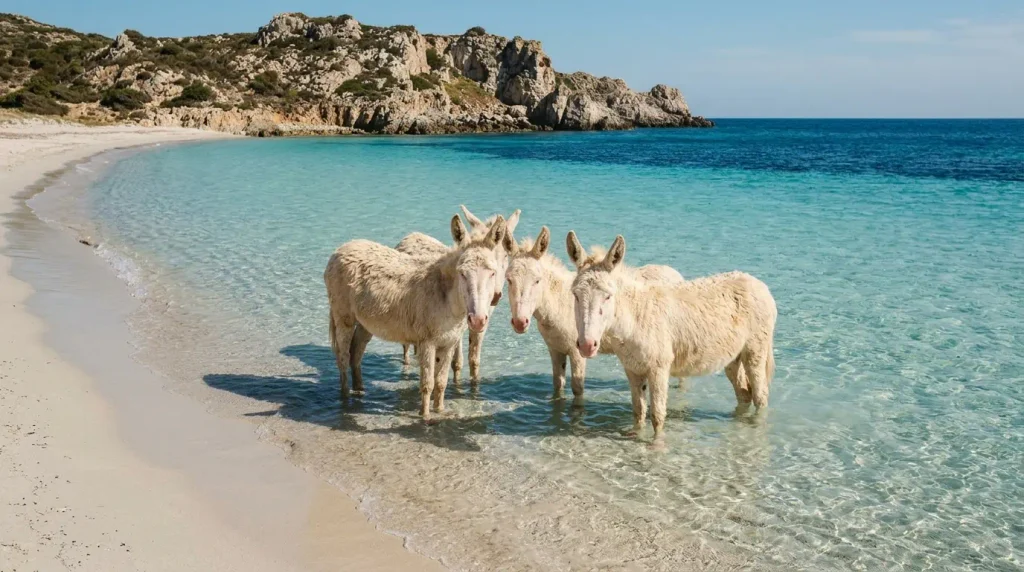
Asinara is one of those places that seems impossible until you arrive: an island of 51 square kilometres, 12km off the northwestern tip of Sardinia, that for most of the 20th century served as one of Italy’s most isolated maximum-security prisons. The prison closed in 1997. The island became a national park in the same year. Today it is accessible only by ferry or organised boat tour from Porto Torres or Stintino, private motor vehicles are prohibited, and the human population is limited to park rangers and visiting researchers. What this creates is a landscape of complete ecological recovery: wild boar, mouflon, griffon vultures, loggerhead turtles and the island’s most famous inhabitants — a small herd of genetic albino donkeys whose white coats and pale pink eyes make them look as though they have been invented for a children’s book.
The boat tour from Porto Torres covers the island’s perimeter, stopping at three or four coves for swimming and at the ruins of the prison complex at Cala Reale — the only human infrastructure on the island, now overgrown and weathered into something that looks more like an archaeological site than a 20th-century institution. The water visibility in the coves around Asinara regularly exceeds 30 metres; the seabed is sand and posidonia meadow and shows every detail from the boat. The snorkelling is extraordinary. Book an Asinara island boat tour with snorkelling and guided visit from Porto Torres on GetYourGuide from €55 per adult. <!– GYG Partner Link –>
Full-day tours depart Porto Torres port at approximately 09:00 and return by 18:00. In peak season (July–August), places fill well ahead; book at least one week in advance. The park authority also permits visits by electric vehicle on the island’s internal tracks, arranged on arrival at the park entrance at Cala Reale — an option that allows exploration of the interior, including the villages of Tumbarino and Fornelli that the prison workers inhabited.
The Roman town beneath the streets
Porto Torres was, in its Roman incarnation, Turris Libisonis — a municipium of the 1st century BC that functioned as the principal port of Roman Sardinia and one of the most important Roman settlements on the island. The evidence is everywhere, and most visitors to the port miss it entirely.
The Antiquarium Turritano on Via Ponte Romano (Tuesday–Sunday, 09:00–20:00) is the place to start. The museum holds the most significant collection of Roman finds from the site — mosaics, statuary, everyday objects, a detailed reconstruction of the Roman urban layout — and contains in situ the excavated remains of the Palazzo del Re Barbaro, a large Roman public bath complex of the 2nd and 3rd centuries AD whose heated floor system (hypocaust), wall sections and mosaic fragments are preserved at street level beneath a protective roof. Entry is €2, or €3 combined with the Atrium Metropolis archaeological area outside. It is one of the most under-visited Roman sites in Italy relative to its significance.
The Ponte Romano is a five-minute walk from the museum: the largest surviving Roman bridge remains in Sardinia, spanning approximately 165 metres across the Rio Mannu on 16 arches, still largely intact after two thousand years. There is no entry fee and no queue.
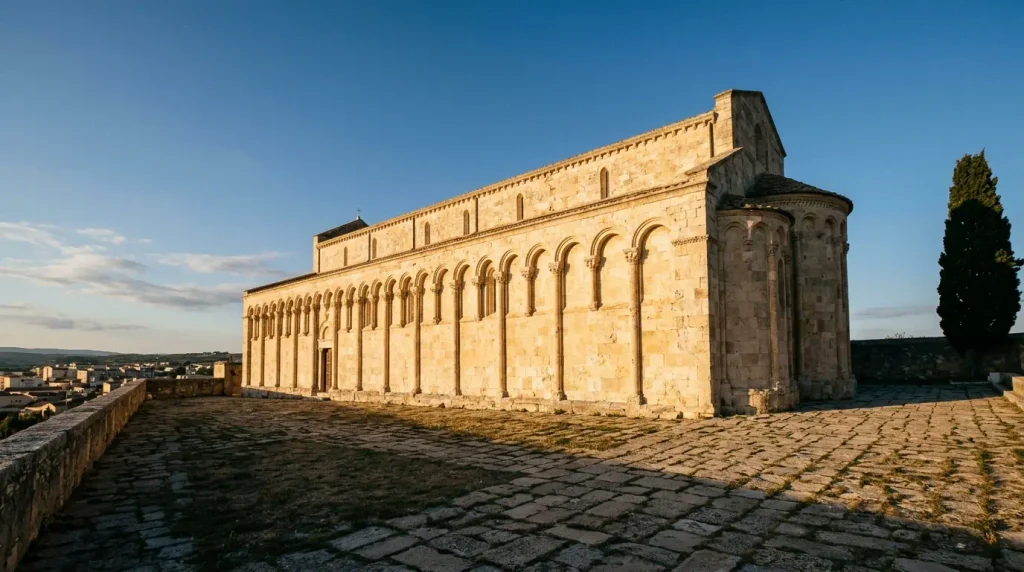
The Basilica di San Gavino stands on a low hill at the eastern edge of the historic centre, built between 1065 and 1110 AD over the site of an early Christian martyrium. Its architectural distinction is immediately visible: unlike virtually every other Western Christian church, it has no west facade — both ends of the building are apses, creating a double-apsed plan that is rare anywhere in Romanesque Europe. The crypt beneath the church holds Roman sarcophagi repurposed as reliquaries and a series of early medieval stone carvings of significant quality. Entry is €3 including crypt. The Atrium Metropolis behind the basilica — a pagan and then early Christian necropolis spanning several centuries of religious transition — costs €1.50 independently or €4.50 combined with the basilica and crypt.
What are the beaches near Porto Torres?
Porto Torres itself has two urban beaches within walking distance of the town centre. Spiaggia di Balai is a small cove defined by dramatic red porphyry rocks, calm water, and a beach bar open in summer — not a long beach, but striking and easily reached on foot from the port. Scogliolungo is a longer stretch of mixed sand and rock directly accessible from the Lungomare coastal road. Both are free, both are usable by July, and both are local beaches in the sense that Sardinian families use them rather than tourists.
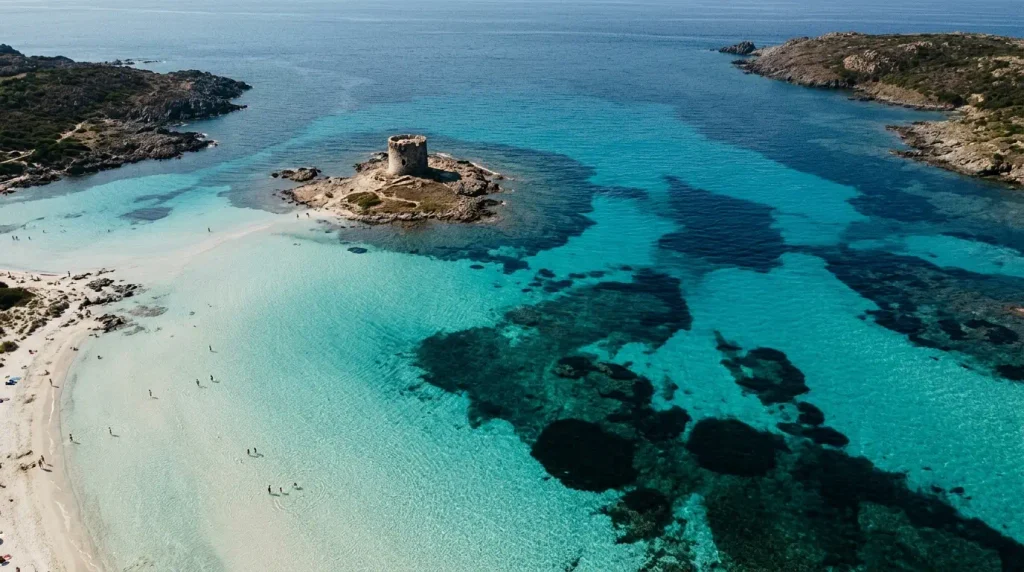
For the beach that earns the journey to this corner of Sardinia, the destination is La Pelosa at Stintino, 30 kilometres north of Porto Torres on the SP34 coastal road. La Pelosa is a shallow, south-facing lagoon of water so pale and clear that it reads as Caribbean rather than Mediterranean; the sand is white and powder-fine; and at the edge of the bay, a small 16th-century Aragonese tower stands on a rocky outcrop in the water, which is the image that defines northern Sardinia’s visual identity. The beach introduced a daily visitor cap of 1,500 people in summer to protect the fragile seagrass meadow beneath the water — booking a time slot online (through the Comune di Stintino website) is required from June through September, and slots fill weeks ahead in July and August. Arrive outside the booking window in May or late September and the process is straightforward. Book a La Pelosa and Stintino guided boat tour from Porto Torres on GetYourGuide from €40 per person. <!– GYG Partner Link –>
How do you get to Porto Torres?
By air: The closest airport is Alghero-Fertilia (AHO), approximately 35–40 minutes by road or a direct bus connection. Ryanair, easyJet and Volotea serve Alghero from multiple UK and European airports; the route is busiest from May through October with reduced winter schedules. Olbia Costa Smeralda (OLB), 140km east, is a larger airport served by more airlines including Ryanair, easyJet, British Airways and Vueling — the better choice if flying mid-range. A rental car from Olbia with a drive west along the SS131 to Porto Torres takes approximately 1h45.
By ferry: Porto Torres is a major Mediterranean ferry hub. The main routes:
| Route | Operator | Crossing time | Frequency |
|---|---|---|---|
| Genoa → Porto Torres | GNV, Tirrenia, Grimaldi Lines | 11–13 hours (overnight) | Daily in summer |
| Civitavecchia (Rome) → Porto Torres | Tirrenia | 10–11 hours (overnight) | Several per week |
| Barcelona → Porto Torres | GNV, Grimaldi Lines | 12 hours (overnight) | Several per week |
| Toulon → Porto Torres | Corsica Sardinia Ferries | 17 hours | Several per week |
The overnight ferry from Genoa is the classic approach for travellers combining Sardinia with mainland Italy — depart in the evening, wake up docked in Porto Torres. Cabins on the GNV and Tirrenia services are comfortable and represent genuinely good value when booked ahead. Vehicle rates on the Genoa–Porto Torres crossing in peak season run approximately €80–120 for a standard car including driver.
By train and bus: Porto Torres Marittima station connects to Sassari in approximately 15 minutes (Sassari is the northern Sardinian hub for onward connections). Bus services run to Alghero, Castelsardo, Stintino and Olbia, though timetables thin considerably outside summer months. Buy train tickets online, on board, or at the tabacchi on Via Monte Angellu — the station has no ticket office.
What does Porto Torres cost in 2026?
| Budget | Mid-range | Comfortable | |
|---|---|---|---|
| Accommodation (per night) | €45–70 guesthouse/B&B | €80–130 3-star hotel | €150–250 4-star or Alghero boutique |
| Meals (per person per day) | €20–30 (market, local bars, one restaurant) | €35–55 (restaurants, local trattorias) | €60–90 (good restaurants + wine) |
| Activities | €15–30 (archaeological sites, free beaches) | €40–70 (Asinara boat tour + sites) | €80–120 (private boat, guided tours) |
| Transport | €5–10 (bus/train) | €25–40 (car hire per day) | €40–70 (car hire + fuel) |
| Total per day (two adults) | €80–130 | €140–220 | €250–400 |
Sardinia is meaningfully cheaper than the Italian mainland at the accommodation and food level outside the Costa Smeralda luxury strip. A meal for two at a local trattoria in Porto Torres or Stintino — antipasto, pasta, a main course of grilled fish, house wine, water — costs €40–60. A pasticcio of culurgiones (Sardinian filled pasta with pecorino and potato) from a market stall costs €4. The car hire average in Porto Torres is approximately £9 per day, and petrol runs around £1.67 per litre — a full tank for a small car costs £20–25.
Frequently asked questions
Q: Is Porto Torres a good base for exploring northern Sardinia?
A: Yes — probably the best-value base in the region. It sits 20 minutes from Sassari (the northern cultural capital), 35 minutes from Alghero (old town, beaches, seafood), 30 minutes from La Pelosa at Stintino (one of Europe’s finest beaches), and is the departure point for Asinara. The accommodation is significantly cheaper than Alghero for equivalent quality, and the road connections are straightforward.
Q: How long does the Asinara day trip take?
A: Allow a full day. Boat tours from Porto Torres depart around 09:00 and return by 17:30–18:00. The island is large — 17km from north to south — and the tour typically covers the perimeter by boat with three or four stops for swimming and one stop at the former prison complex of Cala Reale. There is no way to visit Asinara meaningfully in half a day.
Q: Can you drive your own car onto Asinara?
A: No. Private motor vehicles are not permitted on the island. Access is by ferry or organised boat tour only; once on the island, visitors travel by electric vehicle (available to hire from the park authority at Cala Reale), bicycle, or on foot. The park’s internal tracks are well-maintained and clearly signed.
Q: What is the best way to combine Porto Torres with Alghero?
A: The most natural itinerary is two nights in Porto Torres (covering Asinara and the Roman sites) followed by two nights in Alghero (old town, the Riviera del Corallo coast, Neptune’s Grotto by boat). Alghero is 40 minutes by road or a direct bus from Porto Torres, and the two towns complement each other — Porto Torres for depth and archaeology, Alghero for atmosphere and coastal beauty.
Q: Is northern Sardinia safe for tourists?
A: Yes. Sardinia has one of the lowest crime rates of any Italian region, and northern Sardinia specifically is very safe for tourists. The standard precautions that apply anywhere in Italy — keep valuables out of sight in a parked car, be aware in busy market areas — apply here, but violent crime is extremely rare and the general atmosphere toward visitors is hospitable.
Porto Torres rewards the traveller who arrives without expecting it to perform. The Roman town beneath the streets, the Romanesque basilica on the hill, the wild island on the horizon, the best beach in northern Sardinia thirty minutes up the road — none of these require crowds, queues or premium prices to access. They require only the decision to stop, rather than treating the ferry port as a transit point and driving south. Start planning your Sardinia itinerary on PlacesToday →