Thailand in the rainy season is not a bad idea — it is a bad idea on the wrong coast. The country has two separate monsoon seasons running on opposite sides of the peninsula at opposite times of year. From May to October, the Andaman Coast (Phuket, Krabi, Phi Phi) is wet and the seas are rough. During those exact same months, the Gulf Coast (Koh Samui, Koh Phangan, Koh Tao) is dry, warm and significantly cheaper than it was in December. Pick the right coast for your month and Thailand in the low season is one of the best value trips in Southeast Asia.
Most people planning a Thailand trip in June, July or August look at a weather map, see the word “monsoon” stamped across the entire country, and either cancel or arrive at the wrong island expecting sunshine. Both outcomes are avoidable. The two-coast rule is the single most useful piece of information about travelling to Thailand in summer 2026, and it is barely mentioned in the standard travel guides.
Here is everything you actually need to know.
Does Thailand have one rainy season or two?
Two — and they affect opposite coasts at opposite times. This is the thing that changes everything about summer trip planning.
| Andaman Coast (Phuket, Krabi, Phi Phi, Koh Lanta) | Gulf Coast (Koh Samui, Koh Phangan, Koh Tao) | |
|---|---|---|
| Rainy months | May – October | October – December |
| Dry months | November – March | January – September |
| Best time to visit | November – March | July – September |
| July conditions | Rough seas, rain, some tour cancellations | Largely sunny, calm seas, low prices |
| Similan Islands | CLOSED May–October (National Park) | — |
| July hotel prices | Lowest of the year | Low season — 30–50% below peak |
Source: roafly.com, koh.tours 2026 seasonal data, Tourism Authority of Thailand
The practical upshot: if you are travelling in July, August or September and want a Thai beach holiday, book the Gulf Coast. Koh Samui, Koh Phangan and Koh Tao are at their driest and least crowded during these months. If you want the Andaman Coast — Phuket, Krabi, the Phi Phi islands — wait until November.

Which Thai islands are worth visiting in the rainy season 2026?
The Gulf Coast islands are the answer for summer travel. Here is the honest breakdown of each one.
Koh Samui — the practical choice
Koh Samui is the easiest Gulf island to get to — direct flights from Bangkok take under an hour, and the island has the most developed infrastructure outside of Phuket. From May to September the weather is largely dry, accommodation rates are 30–50% lower than peak season (roafly.com), and the main beaches are calm enough for swimming on most days. The island is not quiet in July — it never truly empties — but it is manageable in a way that January is not.
Koh Phangan — for the pace, not the party
Koh Phangan has a reputation built around the Full Moon Party. In July the party still happens monthly, but the surrounding island is noticeably calmer and cheaper than in peak season. The northern and eastern beaches — Bottle Beach and Thong Nai Pan — stay beautiful and largely uncrowded through the low season. The hiking trails around the interior, and the waterfalls that are at their fullest in the wet months, give the island a second dimension beyond beach life. A kayaking and snorkelling day trip from Koh Phangan is entirely viable in July on the Gulf side.
Koh Tao — for divers
Koh Tao is one of the cheapest places in the world to get a PADI open water diving certification, and the Gulf’s summer dry spell makes July to September one of its better months for underwater visibility. The island is small, functional and unpretentious. It suits travellers who came specifically to dive and do not need a great deal else.
Where to be careful
Koh Lanta on the Andaman side gets genuinely quiet in August and September — so quiet that many hotels, restaurants and tour operators close entirely (indietraveller.co). The Similan Islands National Park closes from May to October, which means liveaboard diving trips are not possible. Phi Phi Island boat tours run weather-dependent cancellations through the Andaman rainy months. If any of these are on your list, save them for November onwards.
Is Bangkok worth visiting in Thailand’s rainy season?
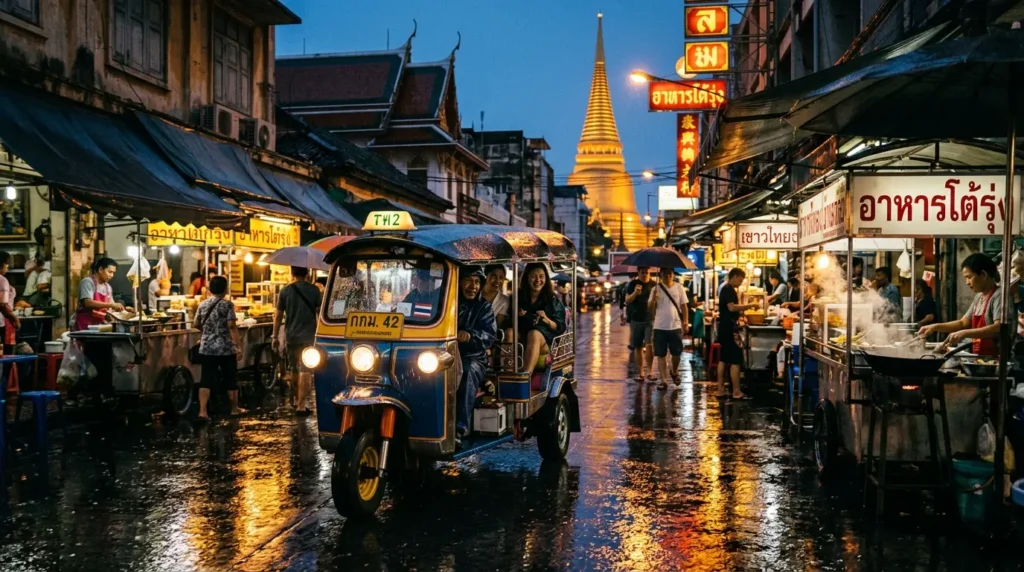
Yes, unreservedly. Rain in Bangkok means a heavy downpour for an hour or two in the afternoon, not a grey day from start to finish.
The temples, markets, street food lanes and rooftop bars that make Bangkok worth visiting are available in any month. Low season brings lower hotel prices without any meaningful reduction in what the city offers. A Bangkok temples and street food tour in July is the same experience as in December, minus the crowds and with notably better hotel rates. The one genuine low-season concern is flooding in certain low-lying areas of the city during the heaviest September and October rain — check local conditions if travelling in those months, and avoid booking accommodation in flood-prone neighbourhoods.
What is Thailand’s rainy season actually like — is it raining all day?
No. Rain in Thailand during the low season is typically a short, heavy downpour — most often in the afternoon — followed by clear skies. It is not the grey all-day drizzle of a northern European winter.
On the Gulf Coast in July, a typical day involves a hot, sunny morning, possible cloud build-up in the afternoon, a heavy shower lasting one to two hours, and a warm evening that clears in time for dinner outdoors. The landscape after rain in Thailand is extraordinary — rice fields turn an almost luminous green, waterfalls in places like Khao Yai and Kanchanaburi run at full force, and the air, temporarily freed from the dust that builds through the dry months, is the cleanest it gets all year. September and October are the exception on the Andaman Coast specifically, where storms can be more sustained and seas rougher — but those same months are still largely pleasant on the Gulf.
How much cheaper is Thailand in the rainy season?
Significantly. Hotel prices drop 30–50% from peak-season rates across most of Thailand in the low season (roafly.com). Flight prices follow the same pattern — routes from Europe and the UK to Bangkok in July and August are consistently cheaper than equivalent December and January fares.
A mid-range traveller on the Gulf Coast in July — decent hotel, meals at local restaurants, a boat trip or two — can comfortably manage on £60–80 per day. In December on Koh Samui, that same budget buys less and the beach is shared with considerably more people. The value case for the low season is real, as long as you have the right coast.
What can you do in Thailand when it rains?
More than most people expect. Thailand does not shut down when it rains — it just reorganises around the weather.
A Thai cooking class in Chiang Mai is one of the best half-days available anywhere in the country, and the northern city is largely shielded from the worst of the monsoon. A ChiangMai cooking class and market tour works in any month and gives you a half-day of indoor and market activity followed by the meal you cooked. Temple circuits in Bangkok, the ancient ruins of Ayutthaya, the night markets across the north — none of these are meaningfully affected by afternoon rain. Plan outdoor and water-based activities for the morning, when conditions are at their best, and leave the afternoons flexible. It is the correct approach for any tropical destination.

Frequently asked questions
Q: Is Thailand worth visiting in July 2026? A: Yes, if you choose the right coast. July sits firmly in the Gulf Coast’s dry season — Koh Samui, Koh Phangan and Koh Tao all see their best weather in July with calm seas and significantly lower prices than peak season. Avoid the Andaman Coast (Phuket, Krabi, Phi Phi) in July, as those islands are in their wet season with rough seas and frequent tour cancellations.
Q: Which Thai islands are open in the rainy season? A: The Gulf Coast islands — Koh Samui, Koh Phangan and Koh Tao — are open and operating normally in the rainy season, as their dry period runs May to September. The Andaman Coast islands (Phuket, Krabi, Koh Lanta, Phi Phi) remain physically open but with reduced services, some closed businesses and weather-dependent boat trips. The Similan Islands National Park closes entirely from May to October.
Q: How much does Thailand cost in the low season? A: Hotel prices across most of Thailand drop 30–50% from peak-season rates in the low season (roafly.com). A mid-range traveller on the Gulf Coast in July — decent hotel, local restaurant meals, day trips — can manage comfortably on £60–80 per day per person. That same trip in December costs noticeably more and comes with significantly more crowds.
Q: Does it rain all day in Thailand’s rainy season? A: No. Rain in Thailand is typically a heavy afternoon downpour lasting one to two hours, followed by clearing skies and a warm evening. All-day rain is unusual outside of the peak of the storm season in September and October on the Andaman Coast. Morning activities are rarely affected, and evenings are almost always clear enough for outdoor dining.
Q: Is Chiang Mai good in the rainy season? A: Yes. Chiang Mai in the rainy months is lush, cool relative to the rest of Thailand, and considerably less crowded than in November or December. The city’s temples, cooking classes, elephant sanctuaries and night markets all operate normally. The main caveat is the air quality in February to April — the smoke from agricultural burning in the north is a genuine concern during those months, not the rainy season.
Thailand in July is not a compromise. On the Gulf Coast it is one of the better times to visit — warm, manageable, genuinely cheaper, and free of the December and January crowds that turn Koh Samui’s beaches into a slow shuffle. The rain arrives in the afternoon, does its business and leaves. Plan your days around it and you barely notice. Want to build a day-by-day Thailand itinerary around the low season? Plan your trip on PlacesToday →