Thailand welcomed 20.81 million international visitors in the first eight months of 2026, generating over THB 1 trillion in tourism revenue, according to Khaosod English (September 2026). On 15 September 2026, Thailand cut its visa-free allowance from 60 days to 30 days for UK, US and EU citizens — a change most existing travel guides have not yet updated for. A mandatory digital pre-registration called the Thailand Digital Arrival Card (TDAC) is required before flying. Budget travellers can cover daily costs at $25–50 per person; mid-range comfort runs $60–100. The single most important thing to understand before choosing dates is that the Andaman coast and the Gulf coast have opposite monsoon seasons — there is always a dry coast somewhere in Thailand, but it depends entirely on which one you go to.
Thailand is a country of regions that function almost as separate destinations, and the shape of a good Thailand trip depends on understanding what each one offers. Bangkok is the universal entry point and worth two to three days in its own right — not just a transit hub. The north, anchored by Chiang Mai, is a mountain culture with temples, elephant sanctuaries and the most spectacular festival in Southeast Asia. The south divides into two coastlines with different weather patterns: the Andaman coast (Phuket, Krabi, Railay, Koh Lanta) with its limestone karst scenery and the Gulf coast (Koh Samui, Koh Phangan, Koh Tao) with its diving and party infrastructure. A typical first trip combines Bangkok, one northern destination and one coast. Ten days is the minimum to do that combination justice; two weeks is the format most visitors wish they had planned.
Is Thailand still worth visiting in 2026?
Yes — and the modest year-on-year dip in arrivals (down 2.97% through August 2026) has done the destination a favour in certain respects. The pressure on the most popular islands is slightly reduced from the peaks of 2023 and 2024. The Grand Palace still justifies every photograph that has ever been taken of it. The food — from street-cart pad kra pao at 60 baht to the multi-course tasting menus in Bangkok’s ranked restaurants — remains one of the strongest arguments for Southeast Asia travel. Chiang Mai in November, with its cool mountain air and Yi Peng lantern festival, is among the best travel experiences in Asia at any price point.
The honest briefing: Thailand’s infrastructure is so well-developed for tourism that it can feel, in the most visited spots, like a delivery mechanism for other people’s expectations of Thailand. Patong Beach in Phuket high season is not a discovery; Khao San Road in Bangkok is a theme park for backpackers. The reward comes from choosing the right spots at the right time — arriving at Railay Beach before the day-tripper speedboats, being in Chiang Mai for Yi Peng, eating in Yaowarat (Bangkok’s Chinatown) after dark rather than from a tourist menu. Thailand at its best is still one of the best destinations in the world. The work is in the timing.
When is the best time to visit Thailand?
The most important variable in planning a Thailand trip is not the month but the coast. The Andaman and Gulf of Thailand coastlines sit on opposite sides of the Malay Peninsula and are governed by different monsoon systems — when one is dry, the other may be wet, which means there is always somewhere viable in the south. What changes by season is where that somewhere is.
| Month | Andaman Coast (Phuket, Krabi, Koh Lanta) | Gulf Coast (Koh Samui, Koh Phangan, Koh Tao) | North and Bangkok | Notes |
|---|---|---|---|---|
| November | Excellent — dry season beginning | Wet — Gulf monsoon ending | Excellent — cool and dry | Best month for a multi-region trip; Yi Peng festival in Chiang Mai |
| December | Excellent | Poor — wettest Gulf month | Excellent | Christmas peak pricing on Andaman coast |
| January | Excellent | Excellent | Excellent | Best overall month; all regions viable |
| February | Excellent | Excellent | Excellent | Strong weather, fewer crowds than January |
| March | Excellent — final reliable month | Excellent | Hot (28–35°C) | Last month to catch Andaman coast at its best |
| April | Drying but patchy | Excellent | Very hot (35–40°C); Songkran festival | Avoid Bangkok in April heat unless for Songkran |
| May | Wet — Andaman monsoon arriving | Excellent | Hot, rains building | Gulf coast comes into its own |
| June–September | Poor — monsoon | Excellent | Rainy (Chiang Mai), hot (Bangkok) | Gulf coast and Koh Tao diving season peak |
| October | Improving | Poor — Gulf monsoon peaking | North clearing | Awkward shoulder: check specific coast |
Sources: directferries.com regional weather guide
November through February is when everything aligns: the Andaman coast is dry and clear, the north is cool and green, Bangkok is comfortable, and the Gulf islands have emerged from their own brief monsoon. This four-month window is when Thailand receives the majority of its international visitors, which means peak pricing in December and January on the Andaman coast in particular. The less-obvious insight is that May through September, when Phuket is wet, is when Koh Samui and Koh Tao are at their sunniest and least crowded — a productive direction for travellers who have flexibility.
What changed about Thailand’s visa rules in September 2026?
This is the most important practical update for 2026 travel to Thailand, and most existing guides have not yet caught up with it. On 15 September 2026, Thailand ended its 60-day visa exemption and replaced it with a standard 30-day tourist entry for UK, US and EU citizens. The previous 60-day allowance, which had been in place since 2024, no longer applies to new arrivals.
Under the current rules, UK, US and all 27 EU member state passport holders receive 30 days visa-free on arrival, for tourism purposes only. An extension of a further 30 days is available inside Thailand from any immigration office, at a fee of around 1,900 THB (approximately $53); the extension is not automatic and must be applied for before the original 30 days expire. Overstaying carries fines of 500 THB per day and repeat offences result in entry bans. For anyone planning a longer trip — a month-long slow travel circuit, or a combination of Bangkok, the north and two island groups — the smarter move is to apply for a TR tourist e-Visa before departure, which grants 60 days from arrival. Check the Royal Thai Embassy website in your country for current e-Visa processing times.
A second pre-travel requirement applies to everyone, regardless of visa type: the Thailand Digital Arrival Card, known as the TDAC, is mandatory for all non-Thai nationals entering the country by air, land or sea. It is completed online at tdac.immigration.go.th, it is free (any third-party site charging for this service is unofficial), and it must be submitted within 72 hours before arrival — not earlier. The information required includes passport details, flight number, first accommodation address and basic health questions. After submission you receive a QR code by email; show it at immigration or use the facial recognition automated gates at Suvarnabhumi and Don Mueang airports. Parents or guardians can include children under 12 in a group submission; children aged 12 and over require their own TDAC. Thai immigration may ask for proof of funds on arrival — 20,000 THB per person (approximately $550) or 40,000 THB per family, with cash being the most reliable form of evidence. See the FCDO Thailand travel advice for current entry requirements.
Bangkok — the gateway that earns its own time
Most travellers who shortchange Bangkok come to regret the decision. Two to three nights is the right allocation for a first visit; one night is enough only for the airport connection. The city’s scale is enormous and its traffic is legendary, but the BTS Skytrain and MRT metro have made the central areas navigable in a way that the city’s reputation does not always suggest.
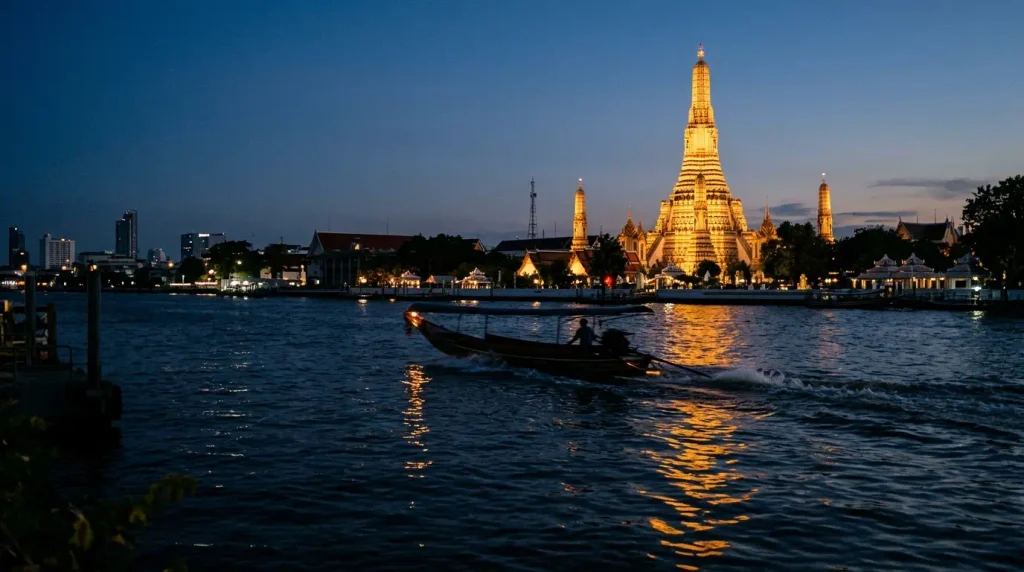
The Grand Palace and Wat Phra Kaew, the complex that houses the Emerald Buddha, open at 8:30am and build quickly in crowd through the morning; entry is 500 THB (approximately $14), dress code strictly enforced (covered shoulders and ankles — free wraparounds available at the entrance). Wat Pho, immediately adjacent, holds the 46-metre reclining Buddha and runs one of the country’s oldest traditional massage schools; entry is 200 THB and a 30-minute foot massage runs approximately 260 THB. Wat Arun, the Temple of Dawn, sits across the river and is best photographed from the opposite bank at blue hour: the longtail ferry from Tha Tien pier costs 5 THB and takes three minutes. The combination of these three sites — the Grand Palace in the morning, Wat Pho before lunch, a short ferry to Wat Arun for the late afternoon — is a full and worthwhile day. Book the Grand Palace, Wat Pho and Wat Arun guided tour on GetYourGuide from $35 per person. <!– GYG Partner Link –>
After dark, Bangkok’s two essential experiences are Yaowarat (Chinatown) for street food and the Chatuchak Weekend Market (Saturday and Sunday, 9am to 6pm, 15,000 stalls across 27 acres — arrive before 11am). Accommodation zones divide by preference: Silom and Sathorn for mid-range and business hotels, Sukhumvit Sois 1–21 for expats and upscale options, Banglamphu near Khao San Road for budget travellers wanting the backpacker infrastructure. Khao San Road itself — the famous backpacker strip — is worth one evening drink and no more.
Chiang Mai — the north that stands on its own
Chiang Mai is the reason the north exists as a travel destination in its own right rather than just a route to somewhere else. The city sits at 300 metres in a valley of the northern highlands, noticeably cooler than Bangkok and, between November and February, genuinely cold in the mornings at 15–20°C. The old city — a moated square of ancient walls and temple lanes — functions as the base, and the things worth doing radiate outwards from it on foot, by songthaew and, for the national park, by car.
Wat Phra That Doi Suthep is the temple above the city: the gold-spired mountaintop shrine visible from the valley below, reached by cable car or 300-step naga staircase, and best visited at sunrise before the day-trip coaches arrive. The three major Old City temples — Wat Chedi Luang (a partially ruined 15th-century chedi originally 82 metres high), Wat Phra Singh (Lanna-style architecture housing the revered Phra Singh Buddha), and Wat Chiang Man (the oldest temple in Chiang Mai, built in 1296) — are all within comfortable walking distance of each other and can be covered in a single morning for entry fees of 20–40 THB each.
The elephant sanctuary question has a clearer answer in Chiang Mai than anywhere else in Thailand: the ethical operations here — those without riding, chains or performance — are genuinely good experiences, and there are enough of them that you can select based on reviews and operating philosophy rather than proximity. Elephant Jungle Sanctuary and Secret Elephant Sanctuary are among the most visited. Half-day programmes including transport run approximately $70–90 per person. Book a half-day ethical elephant sanctuary from GetYourGuide from $70 per person. <!– GYG Partner Link –> Doi Inthanon National Park — Thailand’s highest peak at 2,565 metres, with twin royal chedis, a cloud forest trail and multiple waterfalls — is the best full-day excursion from the city, accessible with a driver for $30–50.
Day trips from Chiang Mai extend to Chiang Rai, three hours northeast, for the White Temple (Wat Rong Khun — a contemporary Buddhist temple in brilliant white with mirrored glass embedded throughout, unlike anything else in Thailand) and the Blue Temple (Wat Rong Suea Ten, cobalt and gold, far fewer visitors). The mountain town of Pai, three hours northwest, is popular for its hot springs, canyon, and the slow pace of a town that has chosen not to grow beyond its valley.
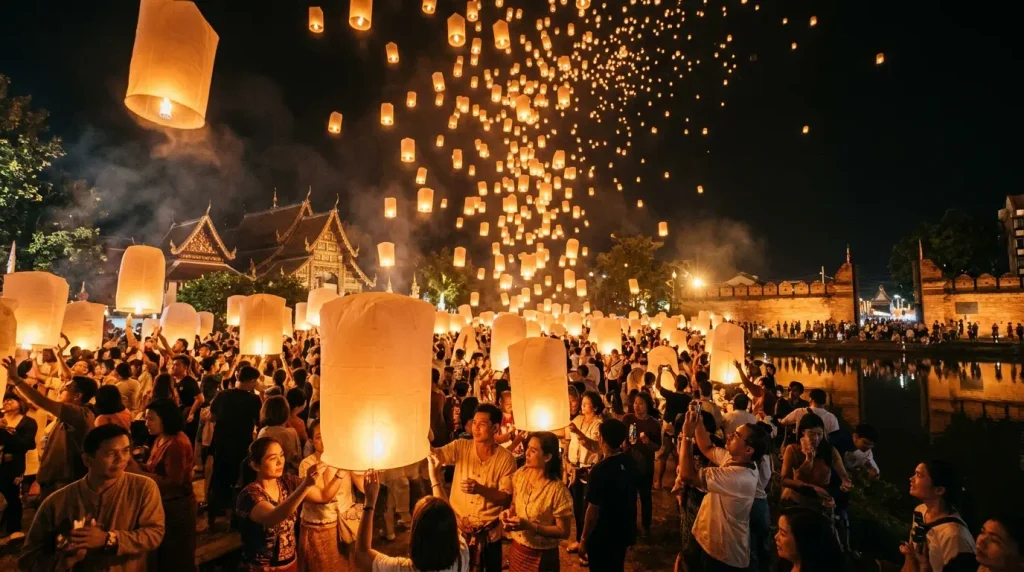
If dates allow, November is when Chiang Mai holds Yi Peng: thousands of paper sky lanterns (khom loi) released simultaneously over the old city moat, the lanterns rising through the darkness in a spectacle that is reproduced in photographs everywhere and still manages to exceed expectations in person. The exact date shifts with the lunar calendar and falls in mid-to-late November most years. Book accommodation in Chiang Mai for Yi Peng at least three months ahead — it is the most-booked event in northern Thailand and the city fills completely.
Which Thai island should you choose?
The island question is the one Thailand travellers search for most, and the answer depends on two variables: which coast and what kind of traveller you are. The Andaman coast islands (Phuket, Krabi, Koh Lanta, Railay) are dry from November to April and among the most beautiful beach environments in Asia. The Gulf coast islands (Koh Samui, Koh Phangan, Koh Tao) have a different monsoon season and are dry from January to August. A traveller arriving in June has one poor choice and one excellent one; a traveller arriving in January has both.
| Phuket | Krabi / Railay | Koh Samui | Koh Phangan | Koh Tao | Koh Lanta | |
|---|---|---|---|---|---|---|
| Best for | First-timers, nightlife, direct flights | Rock climbing, kayaking, budget Andaman | Couples, families, Gulf-season escape | Full Moon Party, backpackers | Diving certification | Off the beaten track, quiet |
| Daily cost | $30–100+ | $22–80 | $22–120+ | $18–50 | $25–70 | $20–80 |
| Best season | November–April | November–April | January–August | January–August | January–August | November–April |
| Avoid | May–October | May–October | October–December | October–December | October–December | May–October |
Source: pixidia.com Thailand island comparison, 2026
Phuket is the most accessible island in the country: direct flights from Europe (including seasonal routes from London, Paris and Frankfurt), the widest range of accommodation from budget guesthouses to ultra-luxury resorts, and an infrastructure that functions efficiently at scale. Patong is the party beach and should be treated accordingly — useful to know it exists, not the best reason to go. Kata and Karon are calmer alternatives a short drive south. Phuket Town’s Sino-Portuguese Old Town quarter is worth a morning for its street art, 19th-century shophouses and the best local restaurant scene on the island.
Krabi and Railay are the Andaman alternatives for travellers who find Phuket overbuilt. Railay Beach — one of the most photographed beaches in Thailand — is reachable only by longtail boat from Ao Nang (20 minutes, approximately 100 THB per person), as the sheer limestone karst cliffs that make it beautiful also make a road connection impossible. No vehicles, no through traffic, and near-empty mornings before the day-trip longtails arrive. Rock climbing on the Railay walls is excellent; the four-island boat tours leaving from Ao Nang run approximately $25–45 per person and take in Phra Nang Cave Beach, Chicken Island and Tup Island. Book the Krabi four-island longtail boat tour on GetYourGuide from $25 per person. <!– GYG Partner Link –>
Koh Samui is the Gulf coast’s main island and the strongest choice for families and couples who want calm, clear water from May through September when the Andaman is wet. Ang Thong Marine National Park, a protected archipelago of 42 islands reached by speedboat day trip from Samui pier, is consistently described by visitors as the most beautiful thing they saw in Thailand. Koh Tao has earned its reputation for one specific reason: PADI Open Water dive certification runs approximately $350–420 here, which is among the lowest prices for a globally recognised qualification anywhere in the world.

What does Thailand cost in 2026?
| Budget | Mid-range | Luxury | |
|---|---|---|---|
| Accommodation per night | $8–15 hostel dorm | $30–60 private hotel | $100–300 resort |
| Food daily | $5–10 street food and local restaurants | $15–30 mixed | $50–100+ |
| Domestic flight (one-way) | — | $30–50 | — |
| Inter-island ferry | $15–25 | $15–25 | Private transfer |
| Activities | Island hopping $25–45 | Dive day trip $50–80 | Private tours |
| Daily total | $25–50 | $60–100 | $200–400+ |
Source: nomadasaurus.com Thailand trip cost guide, 2026
Thailand remains exceptional value for quality at every tier. A backpacker eating well from street carts and local restaurants — pad see ew at 60 THB, mango sticky rice at 50 THB, fresh coconut at 30 THB — can manage $25–35 per day outside peak season on the islands. The mid-range figure of $60–100 per day buys a comfortable air-conditioned room, restaurant meals and one activity daily. The luxury tier is where Thailand’s value proposition becomes most striking: a five-star resort on Koh Samui or a boutique pool villa in Chiang Mai at $150–250 per night represents a fraction of the equivalent pricing in the Maldives or Bali.
The Thai Baht runs at approximately 43–45 THB to the pound and 34–36 THB to the dollar. ATMs charge a flat fee of around 220 THB per withdrawal regardless of amount; withdraw larger amounts less frequently. Cash is essential for markets, street food and most island transport; cards are accepted at hotels, shopping malls and tourist restaurants.
Getting around Thailand
Thailand’s domestic transport network is extensive and well-priced, and the choice between options is usually a function of time versus cost. By air, the Bangkok-to-Chiang Mai route takes one hour by flight and twelve to thirteen hours by overnight train — the difference in price is smaller than expected ($30–50 for a budget flight against $20–40 for a first-class overnight train berth), and the overnight train is a genuine travel experience worth choosing once. Book State Railway of Thailand tickets through their official website; the overnight northern express fills up in peak season.
The overnight train or bus from Bangkok to the south (Surat Thani for Koh Samui, or further to Hat Yai) takes ten to twelve hours and connects to ferry services. An island-to-island route such as Koh Samui to Koh Phangan costs $8–15 by high-speed ferry and takes forty-five minutes; Koh Phangan to Koh Tao is another thirty minutes. Long-distance coaches between Bangkok and the major destinations run reliably for $20–40 and depart from Mo Chit (Northern Terminal) for Chiang Mai or Sai Tai Mai (Southern Terminal) for Phuket.
Within cities, Grab (Thailand’s ride-hailing app, functioning identically to Uber) works reliably in Bangkok, Chiang Mai, Phuket and Pattaya and is both fairer in price and less stressful than negotiating tuk-tuk fares. Bangkok’s BTS Skytrain and MRT metro cover the main tourist and business districts and are essential for navigating the city in any kind of reasonable time.
Frequently asked questions
Q: How many days do you need in Thailand?
A: Ten days covers Bangkok (two to three nights), Chiang Mai (two to three nights) and one island group (three to four nights) — the standard first-timer circuit. Two weeks opens up a second island or a longer northern loop including Chiang Rai and Pai. The mistake most visitors make is underestimating the travel time between regions: the Bangkok-to-Chiang Mai flight takes one hour, but domestic airport transit, check-in and transfers absorb half a day. Build in rest days.
Q: Is the Full Moon Party worth going to?
A: For one night, yes — 20,000 to 30,000 people on Hat Rin beach, fire shows, multiple sound systems, and a scale of outdoor party that does not exist elsewhere. The Half Moon and Black Moon parties on the same island (different venues, running monthly) are smaller and more relaxed alternatives if the main event sounds overwhelming. The night before the Full Moon is when most experienced visitors actually go: the energy is identical and the crowd is a third of the size.
Q: What happens if 30 days is not enough?
A: Two options. First, apply for a 30-day extension at any Thai immigration office before your original 30 days expire — cost is 1,900 THB (approximately $53) and is approved in most cases. Second, apply for a TR tourist e-Visa before you leave home, which gives 60 days from arrival. The e-Visa is the better option for anyone planning a long trip; the in-country extension is the fix if plans change. Do not overstay — fines apply from day one after expiry.
Q: Is Thailand safe for solo female travellers?
A: Generally yes — Thailand is one of the more solo-female-friendly destinations in Southeast Asia, with an established backpacker infrastructure, easy navigation in most tourist areas, and English widely understood. The standard precautions apply: use Grab rather than street-hailed transport at night, be aware of your drink in party areas on Koh Phangan, and research local scams (tuk-tuk temple tour diversions in Bangkok are a decades-old con). For how Thailand compares to the region, see our Philippines travel guide — a similar ease of travel with different geography.
Q: What vaccinations are recommended for Thailand?
A: The NHS recommends ensuring routine vaccinations are current (MMR, diphtheria, tetanus, polio) and adding typhoid and hepatitis A for most travellers. Hepatitis B and rabies are recommended depending on activities and length of stay. Malaria risk is very low in the main tourist areas — Bangkok, Chiang Mai, the southern islands — but exists in some rural border regions. Consult a travel health clinic at least six weeks before departure. Check the FCDO Thailand travel advice for current health and entry guidance before you fly.
Thailand in the November-to-April window — when the Andaman coast is dry, the north is cool, and Bangkok is comfortable — delivers what most people travel for: the temples are as extraordinary as the photographs suggest, the islands have beaches that justify the journey, and the food makes every other destination feel slightly undercatered. The single decision that changes everything is understanding the two coasts and picking the one that is actually dry when you land. Get that right, arrive in Chiang Mai if November dates work for you, and give Bangkok more than a night. Everything else is negotiable. Start planning your Thailand itinerary on PlacesToday →