Ten days is the right length for a first Japan trip. The standard route — Tokyo, Kyoto, Osaka — remains the correct answer for most first-time visitors in 2026, with Hakone between Tokyo and Kyoto for those who want hot springs and a Fuji view. What most guides get wrong is not the route but the details: when to be where, which sights reward the effort and which reward the photograph, and whether the JR Pass is actually worth the ¥50,000. This guide addresses all three.
Japan’s overtourism numbers are real — 42.7 million international visitors in 2025, concentrated in five prefectures — but the standard ten-day itinerary covers those five prefectures specifically because they contain most of what a first trip to Japan is for. The crowds exist. They are manageable with timing. The crowds at Fushimi Inari thin completely past the second plateau. The crowds in Gion are minimal before eight in the morning. Arriving at the right hour at the right sight is the single most effective tool available on this trip.
The yen is historically weak against sterling, the euro and the dollar, delivering approximately 20–30% more purchasing power than 2019 levels (machupicchu.org, 2026 data). Japan is, at current exchange rates, noticeably better value than it was before the pandemic.
What is the best 10-day Japan itinerary in 2026
The route that works for most first-time visitors, with realistic day counts.
| Day | Location | Priority |
|---|---|---|
| 1 | Tokyo — arrive, Shinjuku or Shibuya base | Settle in, one neighbourhood walk |
| 2 | Tokyo — Meiji Shrine, Harajuku, Shibuya Crossing | Modern Tokyo |
| 3 | Tokyo — Asakusa, Senso-ji, Ueno | Old Tokyo |
| 4 | Hakone (optional) or Mt Fuji area | Onsen, Fuji views, reset |
| 5 | Shinkansen to Kyoto — light evening walk | Transit day |
| 6 | Kyoto — Fushimi Inari (early), Tofuku-ji | South Kyoto temples |
| 7 | Kyoto — Kinkaku-ji, Arashiyama, Gion evening | North and west Kyoto |
| 8 | Nara day trip, move to Osaka evening | Deer, Todai-ji, Dotonbori |
| 9 | Osaka — Kuromon market, Osaka Castle, Shinsekai | Food and city |
| 10 | Depart from Osaka (KIX) | Open-jaw routing recommended |
Two practical decisions shape the whole trip. First: fly into Tokyo (Haneda or Narita) and out of Osaka (Kansai International, KIX) if your airline allows it. Most carriers treat this as a multi-city booking at roughly the same price as a return. Saving the three-hour Shinkansen back to Tokyo on the last day is worth the minor booking complexity. Second: the JR Pass. The case for buying it automatically is weaker in 2026 than it used to be, and is covered in detail below.
What should you actually do in Tokyo in three or four days?
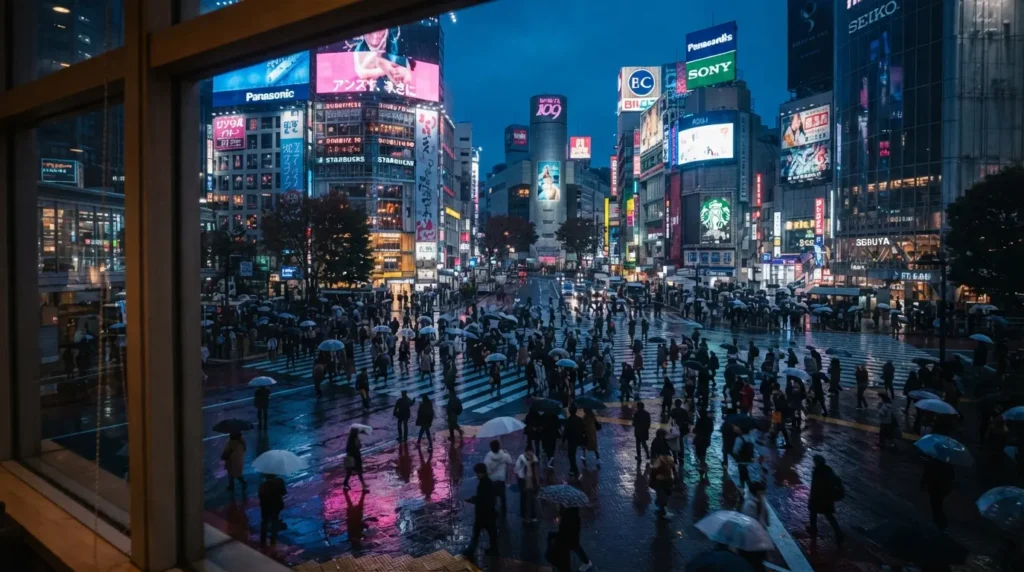
Tokyo does not need to be explained through landmarks. Meiji Shrine in the morning, before the tour groups, is a genuinely quiet hour in a forest in the middle of the world’s largest city. Senso-ji in Asakusa is worth visiting at seven in the morning when the market stalls are setting up and the incense at the main hall is the only smell in the street. Shibuya Crossing is worth watching from the second-floor Starbucks window rather than crossing repeatedly as a pedestrian; the spectacle reads better from above.
Which Tokyo neighbourhood to base in
Shinjuku has the best transport connections — direct trains to both airports, most metro lines, proximity to everything. It is also the busiest and noisiest neighbourhood in the city, which is either a feature or a problem depending on your preferences. Shibuya is slightly more central for sightseeing and marginally less intense. Asakusa is atmospheric but sits further from the sightseeing spine and adds commute time to most days. For a first trip, Shinjuku or Shibuya. Do not stay east of the station.
What is genuinely worth doing
The Tsukiji Outer Market in the morning for breakfast sushi and tamagoyaki. The Yanaka neighbourhood for old Tokyo street life without crowds — small temples, specialist food shops, cats on walls. Akihabara if electronics or anime culture is relevant to you; Nakameguro canal walk for the Instagram edit. A Tsukiji outer market food tour is worth doing on the first full day — it orients you to Japanese food vocabulary before you start ordering from menus.
Should you visit Hakone between Tokyo and Kyoto?
Hakone adds one hotel move and one day. What it gives you in return: an onsen (hot spring) experience, a view of Mt Fuji when conditions allow, and the Hakone Open Air Museum, which is one of the better sculpture parks in Japan. Whether the exchange is worth making depends on what you prioritise.
The Fuji view from Hakone is dependent on weather and is obscured by cloud on approximately half the days in summer and autumn. This is not a reason to skip Hakone but is a reason not to build the trip’s emotional peak around it. The mountain is also visible from the Shinkansen between Tokyo and Kyoto, from the right-hand side of the train, around Shin-Fuji station approximately forty minutes from Tokyo. Book the right-hand seats if the day is clear. The view lasts about five minutes and requires no hotel move.
If the Fuji view is the priority, a direct day trip from Tokyo to Lake Kawaguchiko by highway bus (approximately two hours from Shinjuku, ¥1,750 one way) is a more reliable option than committing a night in Hakone to an uncertain forecast.
What should you do in Kyoto in three days?
The correct approach to Kyoto is to ignore the queue and go early. Almost every major site in the city has a version that exists before nine in the morning and a version that exists after ten. These are different experiences.
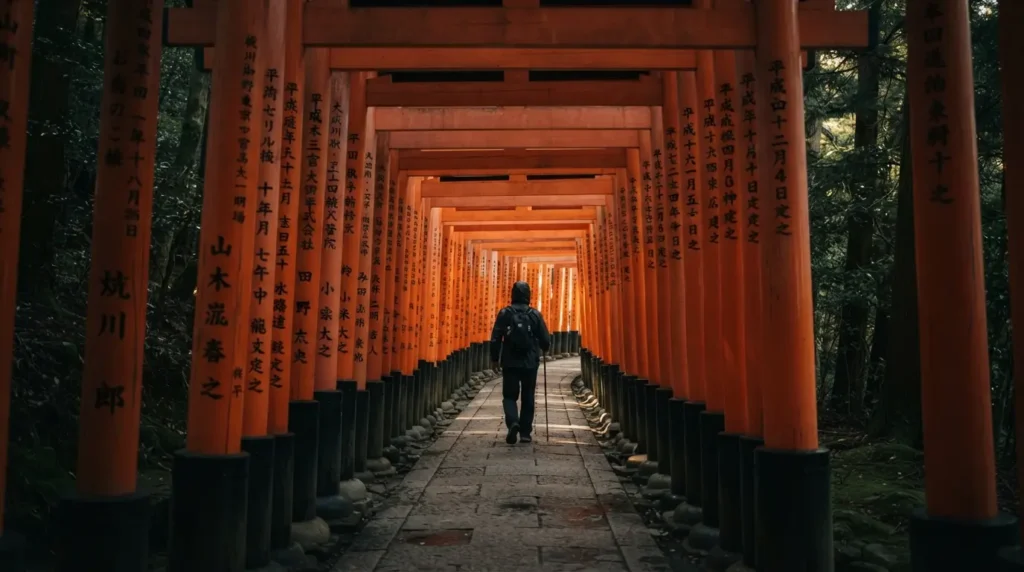
Fushimi Inari Shrine — the thousands of orange torii gates that appear in most photographs of Japan — is the most affected by this. The lower section of the gates, visible from the entrance, is shoulder-to-shoulder from nine until late afternoon. The route past the first two plateaus, however, thins rapidly and above the Yotsutsuji intersection, about forty-five minutes from the entrance, the path becomes quiet. The full hike to the summit takes about ninety minutes each way. Most of the crowd does not know it continues past the first set of photographs. A Fushimi Inari early morning guided walk starts before the crowds arrive and reaches the upper sections before the day has properly begun.
Tofuku-ji, a Zen temple ten minutes by train from Kyoto Station, is the correct answer to Kinkaku-ji (the Golden Pavilion, which will be crowded whenever you arrive). The garden at Tofuku-ji is more architecturally sophisticated than the pavilion and receives a fraction of the visitors. Kinkaku-ji is still worth visiting; go before eight in the morning when the gate opens.
Gion and the right time to be there
Gion, Kyoto’s preserved machiya district, is best at two specific times: early morning, when the wooden townhouses are quiet and occasionally a maiko moves between appointments, and the early evening, around six, when the lanterns light and the street temperature drops. Midday in summer, Gion is a photograph-blocking crowd. It does not stop being beautiful; it stops being an experience.
Arashiyama — the bamboo grove, the Tenryu-ji garden, the river boat option — is best in the early morning. The bamboo grove itself, without crowd management, takes about seven minutes to walk through. With the crowds of a standard Tuesday in July, it takes fifteen and involves significant photography of other visitors’ backs. The Tenryu-ji garden, adjacent to the grove, is considerably less crowded and considerably more interesting.
Is the JR Pass worth buying for 10 days in Japan in 2026?
Not automatically. Run the numbers for your specific route before committing.
The 7-day ordinary JR Pass cost ¥50,000 as of May 2026, rising to ¥53,000 from October 1, 2026 (Japan National Tourism Organization, JNTO). For the standard Tokyo → Kyoto → Nara → Osaka route, the main JR-covered legs are: Tokyo to Kyoto Shinkansen (approximately ¥13,320 on the Hikari; the faster Nozomi is not JR Pass-eligible), and the Kyoto to Osaka local JR train (approximately ¥570). A Nara day trip from Kyoto adds the JR Nara line (approximately ¥720 return). Hakone on the standard route uses the Odakyu Railway, which is not covered by the JR Pass.
For this route, individual tickets total approximately ¥30,000–35,000 — significantly less than the ¥50,000 pass. The JR Pass begins to earn its value when the itinerary includes Hiroshima, Kanazawa, or other distant cities. For the ten-day Golden Route as described above, an IC card (Suica or Pasmo, reloadable, available from airport machines) plus individual Shinkansen bookings is usually the better financial decision.
The one practical tip most guides miss: luggage forwarding (takkyubin). For ¥2,000–3,000 per bag, Yamato Transport will collect your suitcase from your Tokyo hotel and deliver it to your Kyoto hotel by the following day. Moving between cities by Shinkansen with a handheld day bag instead of a full suitcase is a materially different experience. Most hotels arrange this; ask at check-in.
What should you do in Osaka and Nara?
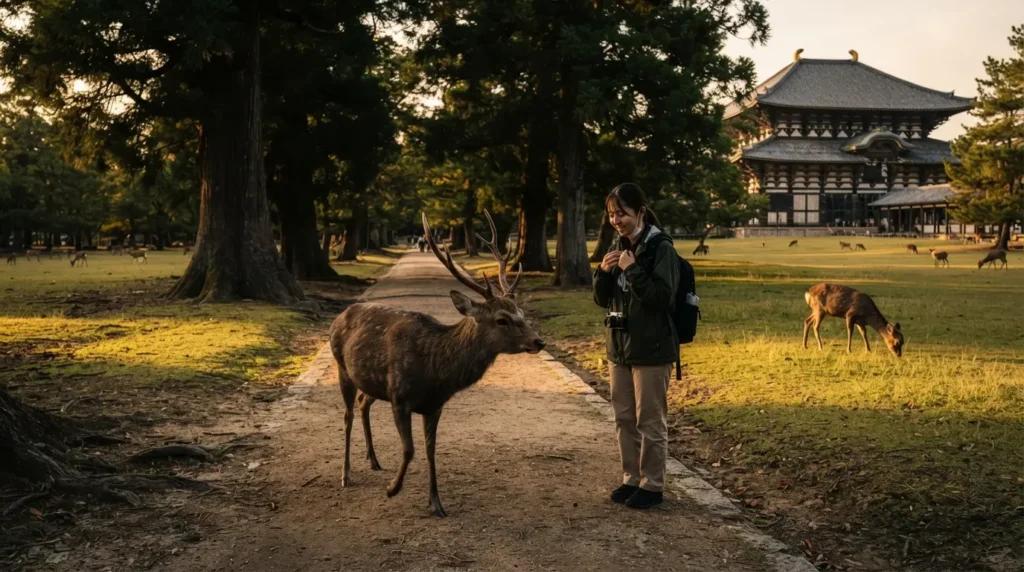
Nara is a day trip from Kyoto or Osaka, worth the thirty minutes it takes by train in either direction. The deer are genuinely unconfined and genuinely indifferent to people — they will take crackers from your hand and eat maps if left unattended. Todai-ji, the temple that houses Japan’s largest bronze Buddha, is a genuine feat of scale. The walk through Nara Park between the two is pleasant. A Nara deer park walking tour covers both efficiently with context.
Osaka has a reputation for being the friendlier, more direct version of Japanese city culture, and that reputation is accurate. The food culture here is serious and specific: takoyaki (octopus balls) from a standing stall on Dotonbori, eaten immediately and not while walking; Kuromon Ichiba market rather than the more tourist-adapted Nishiki in Kyoto. Osaka Castle is worth the morning. The Shinsekai neighbourhood, built in the early twentieth century to replicate both Paris and New York and succeeding at neither, is worth an hour in the evening for the atmosphere of a city genuinely not performing for visitors.
What is the best time of year for a Japan trip in 2026?
October and November for autumn foliage. Late March to mid-April for cherry blossom. Both are beautiful and both are expensive and crowded.
The foliage in 2026 is worth specific note: Japan’s autumn colour has been shifting earlier due to temperature changes, and the peak period in Tokyo now typically falls in late November rather than early December. Kyoto’s maples peak approximately one week later. Both are predictable enough to plan around with three to four months’ lead time and a flexible check-out.
If the specific events are not the reason for going, June through early July and September are the more practical windows — lower accommodation prices, manageable crowds, and full access to all sites. The cherry blossom timing is variable year to year and extremely difficult to book against accurately more than six weeks in advance. Do not build an international itinerary around a specific cherry blossom date. Our Japan beyond Tokyo and Kyoto guide covers the regional alternatives and seasonal timing in more detail.
What does 10 days in Japan cost in 2026?
Budget travellers in hostels and convenience stores: $80–100 per person per day. Mid-range in good hotels, one or two restaurant meals daily, paid activities: $200–300. The JR Pass or individual Shinkansen tickets are the largest transport cost at ¥30,000–50,000 depending on route. A private guided tour runs US$350–500 per person per day all-inclusive of guide, transport and tickets (japanhighlights.com, 2026). International flights from Europe typically run £600–1,200 return; from the US east coast $900–1,400.
The yen’s current weakness means Japan is meaningfully more affordable in 2026 than it was in 2019, and more affordable than most comparable long-haul destinations. The country is worth the flight cost and the planning effort. It is one of the places that consistently exceeds expectations.
You can plan your Japan itinerary around your occasion and travel style on PlacesToday — including how many days to allocate to each city and whether to extend the trip to Kanazawa or Hiroshima.
Frequently asked questions
Q: Is 10 days enough for Japan?
A: Yes, for a first trip. Ten days covers Tokyo, a day in the Fuji or Hakone area, Kyoto properly, Nara, and Osaka with room for one flex day in each city. Trying to add Hiroshima, Kanazawa or Hokkaido to a ten-day trip stretches it. Those cities are worth returning for.
Q: Is the JR Pass worth it for 10 days in Japan in 2026?
A: Not automatically. The 7-day ordinary JR Pass costs ¥50,000, rising to ¥53,000 from October 1, 2026 (JNTO). For a standard Tokyo–Kyoto–Osaka route, individual Shinkansen tickets total approximately ¥30,000–35,000, making the pass cost more than buying tickets separately. The pass earns its value when your route includes multiple long-distance journeys — add Hiroshima or Kanazawa and the calculation changes. Run your specific route through the JNTO fare calculator before buying.
Q: What is the best time to visit Japan in 2026?
A: October and November for autumn foliage — typically the most visually spectacular season. Late March to mid-April for cherry blossom — beautiful but expensive and crowded. June and September offer lower prices and manageable crowds without a specific seasonal spectacle. Summer (July–August) is hot and humid; early starts are essential for outdoor sights.
Q: Which Tokyo airport should you use?
A: Haneda (HND) for arrivals if your airline offers it — it is 20–30 minutes from central Tokyo by train, significantly closer than Narita. Narita (NRT) has more international routes and is 60–90 minutes from the city. Kansai International (KIX) near Osaka is the recommended departure airport if you plan an open-jaw itinerary ending in the Kansai region.
Q: How do you move luggage between cities in Japan?
A: Luggage forwarding (takkyubin). Yamato Transport or Sagawa Express collect your bags from your current hotel and deliver them to your next hotel overnight for ¥2,000–3,000 per bag. Most hotels arrange this at the reception desk. Travelling the Shinkansen with a small day bag rather than a full suitcase is a significantly better experience and one of the practical Japan tips that makes a real difference on the ground.
Ten days in Japan rewards the traveller who plans the details correctly rather than just the sequence of cities. The route is well-established because it works. What separates a good Japan trip from a great one is the hour at which you arrive at Fushimi Inari, which seat you sit in on the Shinkansen, and whether you take your luggage or send it ahead. None of this is complicated. It is just information. Ready to build the itinerary? Plan your Japan trip on PlacesToday →