Barcelona received approximately 24 million visitors in 2024, in a city of under 2 million residents — and the numbers are up again in 2026, with Amadeus projecting 9% year-on-year growth for the winter season alone. The hotel tourist tax rose to €6–15 per person per night in April 2026 depending on accommodation category. A mid-range day in Barcelona costs €150–180 all in. The best months to visit are May and September: warm enough, not ruinously crowded, and cheaper than July and August. The city is worth it. It requires more planning than it did five years ago.
Barcelona has a problem it created by being excellent. The architecture is genuinely extraordinary — there is nowhere else in the world with this concentration of Modernista buildings, and Gaudí alone would be enough to justify a city. The food is serious in a way that rewards paying attention rather than defaulting to La Rambla. The beach is real and walkable from the centre. And the weather, for northern European visitors in particular, feels like a different planet from October through June. These are not invented selling points. They are why 24 million people visited in a single year.
The honest reckoning: Barcelona’s local government is not quietly accepting this. In 2026, the city appointed what was widely described as an “overtourism czar” to manage visitor impact. Hotel construction in the city centre has been under a moratorium since 2017. More than 10,000 short-term rental permits are being revoked by 2028. Cruise terminals are being cut from seven to five, with the mayor stating his aim to eliminate stopover cruise visits entirely. The tourist tax — already among the highest in Europe — rose again in April 2026. The official position, as one city deputy put it: “We don’t want more tourists, not even one more, but we need to manage those we have.”
None of this makes Barcelona worse to visit. It makes visiting Barcelona in 2026 a different exercise from showing up without a plan and joining the queue for everything.
Is Barcelona worth visiting in 2026?
Yes — but with an itinerary built around timing and neighbourhood choice rather than landmark ticking. The visitors who leave disappointed are overwhelmingly those who spent three days in the Gothic Quarter eating overpriced paella and standing in unbooked queues. The visitors who leave committed to returning are those who booked Sagrada Família in advance, stayed in Eixample or Gràcia, ate lunch at the menu del día price, and spent an evening in Poble Sec eating pintxos on Carrer de Blai at €1.50 a piece. The city rewards the ten minutes of planning it takes to do it this way.
When is the best time to visit Barcelona?
| Month | Temperature | Crowds | Price | Best for |
|---|---|---|---|---|
| January–March | 13–16°C | Very low | Lowest | Budget, sightseeing without queues |
| April | 18°C | Moderate | Moderate | Sant Jordi festival (23 April), roses and books |
| May | 21°C | Moderate | Moderate | Best overall month — warm, manageable |
| June | 24°C | High | High | Beach, Sónar and Primavera Sound festivals |
| July–August | 28°C | Very high | Very high | Beach; everything else is unpleasant |
| September | 26°C | Moderate–high | Moderate | Best beach month; La Mercè festival |
| October | 22°C | Moderate | Moderate | Sightseeing, hiking, cooler coast |
| November | 17°C | Low | Low | Quiet, good for food and museums |
| December | 14°C | Moderate | Moderate | Christmas market (Fira de Santa Llúcia) |
Sources: Jetpac Global seasonal data; radicalstorage.com Barcelona travel guide, 2026
May and September are the practical sweet spots. May brings 21°C average highs, manageable crowds, and accommodation prices 30–40% below peak summer. September has the best beach conditions of any month — the sea is at its warmest, crowds drop after the first week, and La Mercè festival (Barcelona’s biggest street celebration, free, city-wide) runs in the third week of September and is one of the best reasons to visit at any time of year.
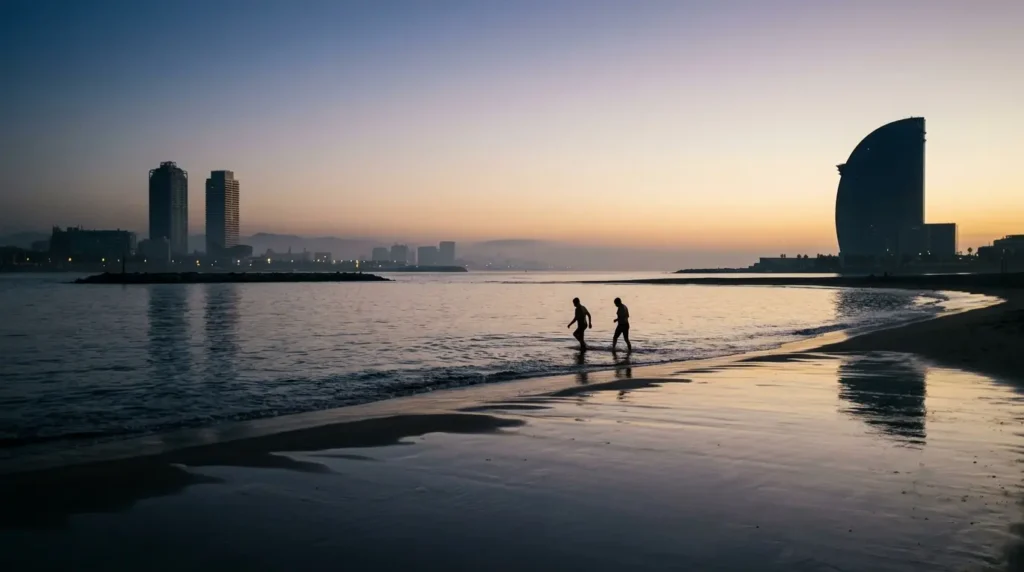
July and August are hot, very expensive, and very crowded. The landmarks operate at maximum density. The beach at La Barceloneta is standing room on weekends. If summer is the only option, stay in the city for no more than three days and build in day trips: Montserrat, the Costa Brava, Tarragona.
Which neighbourhood should you stay in?
| Gothic Quarter / El Born | Eixample | Gràcia | Poblenou | Poble Sec | |
|---|---|---|---|---|---|
| Best for | Being near monuments | Architecture, restaurants | Local atmosphere, plazas | Creative, beach access | Budget, pintxos bars |
| Typical hotel | €120–280/night | €100–220/night | €80–160/night | €80–150/night | €65–120/night |
| Crowd level | Very high | Moderate | Low–moderate | Low | Low |
| Metro access | Excellent | Excellent | Good | Good | Good |
| Noise at night | Very high | Moderate | Low | Low | Moderate |
| Feel | Tourist-dense | Residential + visitors | Neighbourhood | Neighbourhood | Neighbourhood |
Eixample is the strongest default for first-time visitors: central, well connected, home to the Modernista buildings (including Sagrada Família, Casa Batlló and Casa Milà), and a long stretch of genuinely good restaurants at non-Gothic Quarter prices. The left side of Eixample (Esquerra) is more residential and cheaper than the right; both work.
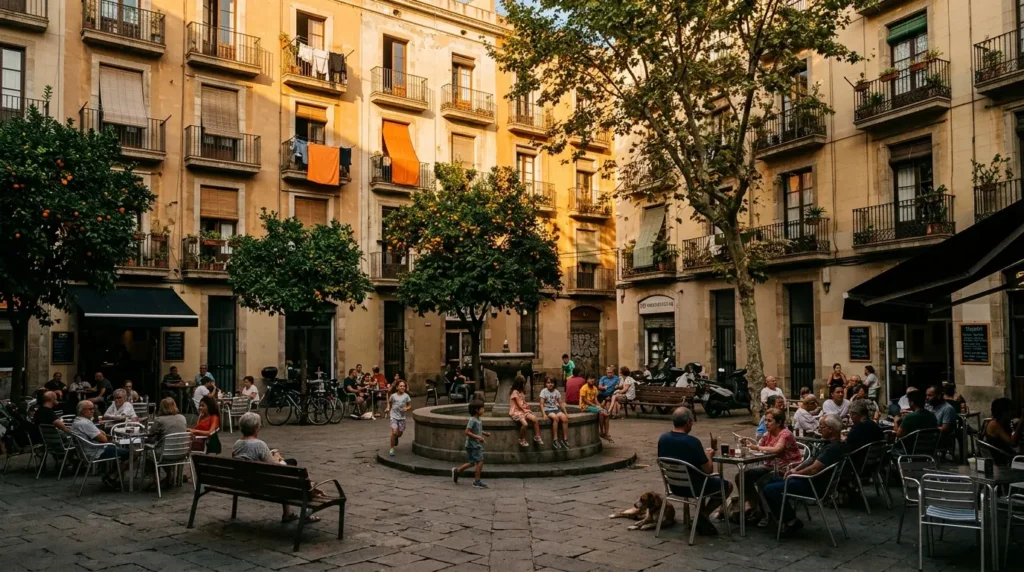
Gràcia — a neighbourhood that functioned as an independent municipality until 1897 and still feels like one — is the choice for travellers who have already done the monuments and want a version of the city where people actually live. Active squares, a proper neighbourhood market, independent coffee shops, and the August Festa Major de Gràcia (when residents decorate entire streets in elaborate handmade decorations) make it the most genuinely pleasant place to spend time in Barcelona that is not also the most photographed.
Poble Sec sits below Montjuïc and offers the city’s best pintxos street (Carrer de Blai) at prices that are roughly a quarter of what the Gothic Quarter charges for worse food. It is fifteen minutes from the city centre by metro and significantly cheaper for accommodation.
What is actually worth seeing in Barcelona?
Sagrada Família — book in advance, arrive when it opens
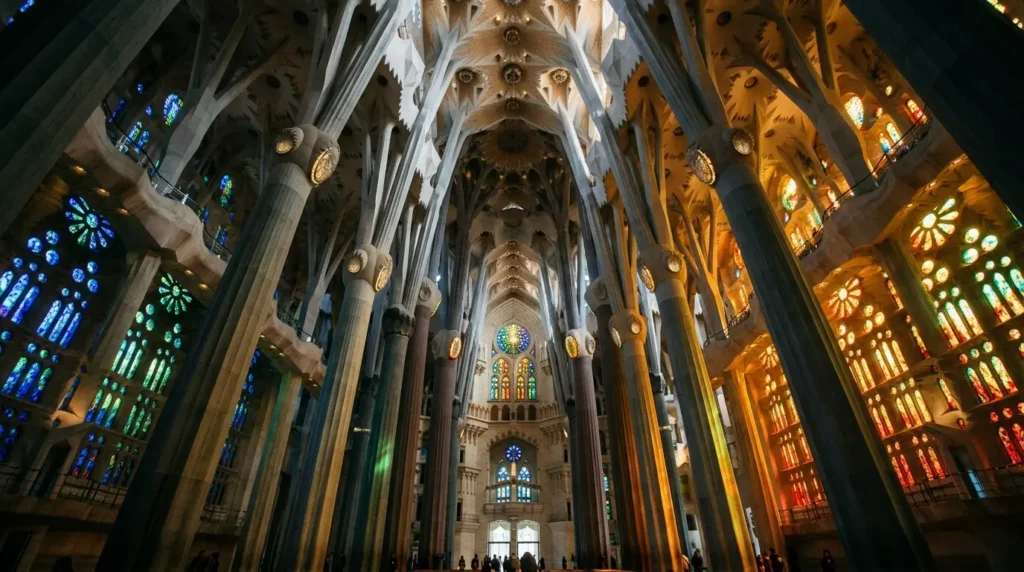
The Sagrada Família is the best argument against low expectations. The interior, completed in stages as funding has allowed since Gaudí’s death in 1926, is genuinely unlike any other building: columns that branch like stone trees, stained glass that shifts from cool blue-green in the western nave to warm amber and red in the eastern nave, a structural logic that makes Gothic cathedrals look straightforward by comparison. It does not photograph well from the outside in peak season because the construction scaffolding and the queues make it look like a building site with tourists. Book online in advance (€26 basic entry; €36 with tower access, which is worth the addition for the views and the Gaudí perspective on the façade details). Go at opening time — 9am — and the interior is navigable before the guided groups arrive.
A Sagrada Família skip-the-line guided tour covers the nave, the crypt and tower access with a licensed guide in two hours. It costs more than the standard ticket and is worth it specifically for the explanation of the façade symbolism, which is impenetrable without context.
Park Güell — the ticketed zone only
Park Güell is two parks. The free sections — the wooded paths, the viaducts, the terraces around the edges — can be accessed without a ticket and are pleasant. The ticketed Monumental Zone, which contains the mosaic terrace, the Dragon Staircase and the Hypostyle Hall, requires a timed-entry ticket (€10 online, €13 at the gate; book online — the gate often sells out). The terrace is the photograph everyone has seen and is worth seeing in person, preferably in the morning slot before the midday heat and full crowd density. The rest of the park on a warm day is a perfectly reasonable place to spend an hour.
Casa Batlló and Casa Milà — choose one
Both are architectural tours of Gaudí’s Eixample residential buildings; both are excellent; both are priced at €35–45. If time and budget allow only one, choose based on priority: Casa Batlló (the marine-themed façade, the bone staircase, the rooftop) is the more visually dramatic interior. Casa Milà (La Pedrera) has the better rooftop terrace and a more complete museum of Gaudí’s working process. The evening audio-visual experience at Casa Batlló is genuinely impressive but priced at around €50–65 and is an add-on, not a replacement for the daytime visit.
El Born — the neighbourhood behind the Gothic Quarter
The Gothic Quarter gets the visitors; El Born gets the neighbourhood. The streets around the Basílica de Santa Maria del Mar — the 14th-century Catalan Gothic church built by the neighbourhood’s merchants without royal or ecclesiastical patronage — contain the best independent restaurants, wine bars and cheese shops in the central city. The Born Cultural Centre, built around the excavated ruins of an 18th-century market, is free to visit and one of the better historical museum experiences in the city. The neighbourhood is tourist-adjacent but maintains enough independent business to remain enjoyable.
La Boqueria — and where to eat instead
La Boqueria, the covered market on La Rambla, is worth a look as an architectural and social space. It is not worth eating in. The market underwent what the city describes as a “touristification” process over the past decade: the vendors who served the neighbourhood have been gradually displaced by stalls selling overpriced jamón, pre-cut fruit cups and €10 smoothies. The Mercat de l’Abaceria in Gràcia and the Mercat de Sant Antoni in the neighbourhood of the same name serve local customers, have operating fish and meat counters, and are half the price for everything.
For proper Barcelona food, the formula is: breakfast at a local café (café amb llet and a croissant, €3–4 outside the tourist areas), lunch at the menu del día — a three-course meal with wine included at €13–20, available Monday through Friday at nearly every neighbourhood restaurant, and the way working Barcelona eats lunch — and dinner at whatever you can find by walking into Poble Sec, El Born or Gràcia and reading menus. The menu del día is the single best value proposition in the city.
What does Barcelona cost in 2026?
Daily budget (per person, excluding accommodation)
| Category | Budget | Mid-range | Splurge |
|---|---|---|---|
| Breakfast | €3–5 | €8–12 | €15–20 |
| Lunch (menu del día) | €13–15 | €18–25 | €35–60 |
| Dinner | €12–18 | €25–40 | €60–120+ |
| Transport (T-Casual card) | €2.90/ride | €2.90/ride | Taxi ~€12/trip |
| One attraction | €10–14 | €28–36 | €45–65 |
| Drinks and snacks | €8–12 | €15–25 | €30–50 |
| Daily total | ~€80 | €150–180 | €350+ |
Note: Tourist tax (from April 2026) adds €6–15 per person per night to accommodation costs, depending on hotel category. Not included in daily totals above.
Sources: radicalstorage.com Barcelona cost guide, 2026; barcelonaurbana.com neighbourhood pricing data
Accommodation adds €55–95/night at the budget end and €95–190 for a comfortable mid-range hotel. The tourist tax applies to all accommodation categories including apartments; factor it in when comparing prices. Short-term rental supply is contracting as the city revokes permits — book further in advance than you think you need to, particularly for stays over five nights.
Transport within the city is straightforward: the T-Casual card (€13 for 10 journeys) covers metro, bus and some tram lines and is the practical choice for stays of three to five days. The Hola Barcelona Card (€18.70 for two days to €43.60 for five days) includes unlimited rides and airport transfer and suits visitors who plan to move frequently between neighbourhoods. The airport metro runs €5.90 each way; Aerobus is €7.25 but drops you on La Rambla. Either is fine.
Do I need to book Barcelona attractions in advance in 2026?
For Sagrada Família: yes, always. The queue for on-the-day tickets in peak season is 90 minutes minimum; the booked queue is under five minutes. For Park Güell’s Monumental Zone: yes, especially for morning slots. For Casa Batlló and Casa Milà: advisable in peak season. For Barcelona Cathedral, MACBA and the Picasso Museum: advance booking is helpful but not essential outside July and August.
The general rule: anything Gaudí, book it. Everything else, aim for opening time on weekdays and it is generally navigable.
Frequently asked questions
Q: Is Barcelona too crowded in 2026?
A: In July and August, yes — the Gothic Quarter and La Boqueria are at densities that compromise the experience. In May, September, October and the winter months, the city is very manageable. The overtourism headlines are real, but they describe a specific version of Barcelona: high summer, central landmarks, no advance planning. A visitor who books in advance, arrives in shoulder season and spends time in Gràcia, Poblenou and Poble Sec alongside the monuments will not recognise the experience the headlines describe.
Q: How many days do you need in Barcelona?
A: Three days covers the Gaudí monuments, one or two neighbourhood evenings, and the beach. Four to five days allows for day trips (Montserrat is two hours by rack railway; the Costa Brava coast is reachable by train and worth a full day; Tarragona has Roman ruins that most Barcelona visitors never reach). A week is not excessive if the food, architecture and coast appeal equally. Two days is not enough unless you have been before and are returning for something specific.
Q: Is Barcelona more expensive than Madrid?
A: Yes, in most categories — accommodation and tourist attractions particularly. Madrid is generally 15–25% cheaper for hotels and restaurants. The cost premium for Barcelona reflects the beach access, the Gaudí architecture and the Catalan food culture, which is considered distinct from Castilian cooking and broadly regarded as the stronger culinary tradition. For a Spain trip covering both cities, Madrid is the better-value choice for days when the agenda is museums; Barcelona is where the beach, the architecture and the restaurant density justify the extra cost.
Q: Is the tourist tax worth knowing about?
A: It is worth factoring into your accommodation budget. From April 2026, the Barcelona tourist tax runs €6 per person per night for budget accommodation and up to €15 per person per night for the highest hotel category. A couple staying five nights in a mid-range hotel (tax around €10/night each) will pay an additional €100 on top of the room rate. It is charged at check-in or check-out and is not optional. Spain’s national government also levies its own tourist tax in Catalonia, which is charged separately — the combined nightly tourist tax can be €8–20 per person depending on accommodation category. FCDO travel advice for Spain has current entry requirements.
Q: What is the best day trip from Barcelona?
A: Montserrat — the serrated mountain monastery 90 minutes by train and rack railway from the city — is the standard recommendation and deserves its reputation. The rack railway from Monistrol de Montserrat takes eight minutes through increasingly dramatic mountain scenery to the monastery at 720 metres; the hike from there to the Sant Joan summit (another 250 metres) gives views that extend to the Pyrenees on clear days. Go on a weekday to avoid the weekend day-tripper volume. The Costa Brava — specifically Cadaqués, the white-washed fishing village at the end of a winding mountain road — is a full-day commitment that rewards the journey with one of the most distinctive coastal landscapes in the western Mediterranean.
Barcelona in 2026 is one of the most thoroughly planned travel experiences in Europe, in the sense that arriving without preparation delivers a significantly worse trip than the city is capable of. The Gaudí architecture alone justifies the visit. The food, timed correctly and located correctly, is among the best in Spain. The beach access from a city with this density of cultural infrastructure is a genuine rarity in Europe. Get the timing right, book the monuments, eat where the fixed-price lunch menu exists, and stay somewhere that is not the Gothic Quarter — and the overtourism headlines will read like they are describing a different city. Start planning your Barcelona trip on PlacesToday →